
Robinhood Q2 2026: Prediction Markets Revenue Surpasses Crypto for the First Time
Robinhood posted record Q2 2026 revenue of $1.31 billion. For the first time, prediction markets generated more revenue than crypto — $156 million vs. $100 million — driven by Rothera, its own CFTC-licensed exchange.
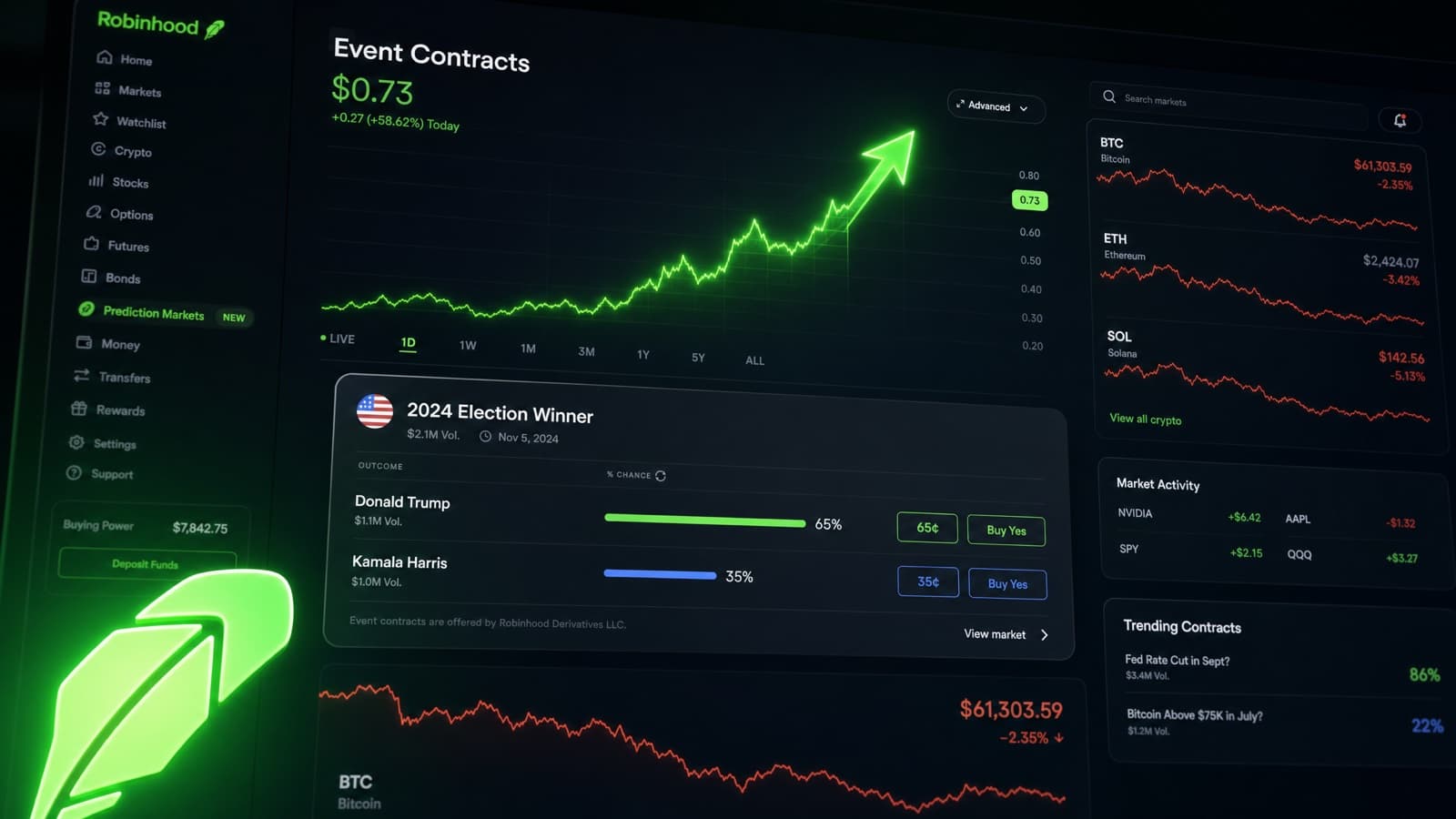
For the first time in Robinhood's history, its prediction markets business outearned its cryptocurrency trading operation in a single quarter — a milestone that underscores how decisively the retail brokerage has repositioned itself since entering event contracts two years ago.
Robinhood reported record total net revenue of $1.31 billion for Q2 2026, up 32% year-over-year, with diluted earnings per share of $0.62. Both figures beat analyst consensus: Wall Street had projected revenue of approximately $1.25 billion to $1.28 billion and earnings of roughly $0.41 per share. The headline result, however, was buried in the transaction-revenue breakdown: prediction markets and event contracts generated $156 million in Q2, while cryptocurrency trading brought in $100 million — a 38% decline from the same period a year earlier.
The crossover was not a coincidence of market conditions. It was the direct result of a structural decision Robinhood made six months earlier.
Why Prediction Markets Surpassed Crypto
Robinhood launched Rothera in June 2026 — a Designated Contract Market (DCM) and Designated Clearing Organization (DCO) built as a joint venture with market-making firm Susquehanna International Group. The exchange was assembled through the acquisition of MIAXdx, a CFTC-licensed DCM, DCO, and swap execution facility, completed in January 2026.
Before Rothera existed, Robinhood distributed event contracts sourced from Kalshi and passed a share of transaction revenue to that platform. Once Rothera launched, Robinhood began directing more trades to its own venue — keeping both the execution economics and the clearing margin rather than splitting them with a third party.
Robinhood CFO Shiv Verma explained the logic on the earnings call with reporters: when you own both the execution and clearing layers, you control the full product and capture better unit economics per contract. The result is visible in the numbers. Even as Rothera offered users lower fees — particularly on less liquid contracts — the per-contract revenue Robinhood retained grew because it no longer shared the exchange take.
Total event contracts traded in Q2 reached 13 billion, up from 9 billion in Q1 2026, representing more than tenfold growth compared to Q2 2025. Prediction market revenue jumped from approximately $104 million in Q1 to $156 million in Q2, a 50% sequential increase.
Live market view — HOOD earnings beat/miss as priced before the report:
The Institutional Infrastructure Behind the Numbers
To understand what Rothera represents, it helps to know what the two CFTC licenses actually do.
A Designated Contract Market is the exchange layer: the regulated venue where event contracts are listed, matched, and executed. A Designated Clearing Organization is the clearinghouse layer: the entity that guarantees trades, nets positions, holds margin, and manages counterparty risk. Most prediction market operators hold one license or the other. Kalshi holds both as an independent exchange. Rothera also holds both — controlled jointly by Robinhood and Susquehanna, giving the partnership end-to-end infrastructure comparable to a standalone exchange, embedded inside a retail brokerage with more than 28 million funded customers.
Susquehanna's role as market maker on Rothera is particularly significant. The firm is one of the largest options market makers in the world. Its involvement means Rothera can provide tighter spreads on event contracts than a smaller exchange operating with less liquidity support — a structural advantage for retail traders placing smaller orders.
The Kalshi CEO has publicly cited Robinhood as the company's leading competitor, according to Fortune, even while Kalshi continues supplying some event contracts to the brokerage. The competitive dynamic is now explicit: Robinhood distributes contracts from multiple sources, including its own exchange. The share routed to Rothera will increase as its contract catalog expands.
Crypto Revenue: A Structural Step Back
Cryptocurrency trading revenue came in at $100 million for Q2, down 38% year-over-year. Robinhood's crypto trading volumes totaled $40 billion in the quarter — $18 billion through the Robinhood app, down 35% year-over-year, and $22 billion through Bitstamp, the European crypto exchange Robinhood acquired in 2024.
The divergence between prediction markets and crypto in Q2 tells a broader story about where speculative appetite is migrating. Event contracts — tied to sports outcomes, economic indicators, elections, and other real-world events — offer a structured, CFTC-regulated alternative to spot cryptocurrency positions. For a retail trader who wants to put capital to work on a specific outcome, a binary event contract at $0.01 per trade is a different product than a crypto position: defined payoffs, defined settlement, a regulated counterparty, and — on many contracts — fees capped below anything a sportsbook charges.
Beyond Prediction Markets: Robinhood's Diversification
The earnings call provided context that prediction markets alone don't capture. CEO Vlad Tenev noted Robinhood now operates across 13 distinct business lines each generating more than $100 million in annualized revenue, up from three in 2022.
Transaction-based revenue for the quarter reached $776 million, up 44% year-over-year, with equities trading revenue up 95% and options growing 29%. Net deposits were a record $21.7 billion, representing 28% annualized growth. Total Platform Assets grew 32% year-over-year to $369 billion.
Gold subscribers reached a record 4.8 million — up 39% year-over-year — with the Gold Card surpassing 1 million customers and more than $17 billion in annualized purchase volume. The retirement book grew 82% year-over-year to a record $34.5 billion in assets under custody. Adjusted EBITDA increased 35% year-over-year to $741 million.
Bernstein analyst Gautam Chhugani, who had already forecast that prediction markets would cross crypto as a revenue line starting this quarter, raised his price target on Robinhood shares to $160 from $130, citing the new market opportunities opened by Rothera, according to Bloomberg.
The Regulatory Cloud That Follows All of This
The $156 million Q2 result and the 13 billion contracts traded both occurred while one fundamental legal question remained unresolved: whether CFTC-regulated event contracts are preempted from state gambling enforcement.
On July 7, 2026, a New York federal judge denied a bid to block the state from enforcing its gambling laws against prediction market operators, finding that the federal Commodity Exchange Act does not preempt state authority. Robinhood is a named party in the parallel Ninth Circuit case, where a three-judge panel heard consolidated arguments earlier this year and expressed skepticism toward the federal preemption argument. If appellate courts ultimately side with states, Robinhood could face user restrictions and enforcement actions in major markets — directly threatening the business line that just posted its strongest quarterly result.
The CFTC published a proposed rule in June 2026 defining permissible event contract categories, with public comments closing July 27. The NFL season — historically the largest prediction market vertical by trading volume — begins in the fall. Management expressed confidence on the earnings call that the regulatory framework will continue clarifying in the company's favor, but the Ninth Circuit ruling, expected later in 2026, will be the first definitive appellate signal.
What the Q2 Numbers Mean for the Prediction Markets Industry
Robinhood's Q2 result provides the clearest data point yet for how large US prediction market trading has grown as an industry segment. PredictionMarkets.US tracks live market data across Kalshi, Polymarket, and PredictIt — the three platforms with the deepest publicly accessible order books.
The crossover of prediction market revenue above crypto at Robinhood — a platform with 28.4 million funded customers — confirms that event contracts have moved from niche to mainstream within retail financial services. The World Cup driven surge in Q2 demonstrated that major sporting events now generate prediction market volume at a scale that influences broker quarterly results. The structural buildout of Rothera shows that established financial intermediaries are willing to invest in purpose-built CFTC-licensed infrastructure to compete in this market.
For traders using PredictionMarkets.US to compare prices across platforms, the practical implication is that Rothera's lower-fee structure on many contracts creates a new pricing reference point alongside Kalshi's and Polymarket's order books.
Frequently Asked Questions
Why did Robinhood's prediction markets revenue surpass crypto for the first time in Q2 2026? Two forces converged. Robinhood launched Rothera in June 2026 — its own CFTC-licensed exchange built with Susquehanna — which eliminated revenue sharing with Kalshi and let Robinhood keep more economics per contract. Simultaneously, major sporting events including the FIFA World Cup drove record contract volume. Together, the improved margin structure and high trading volumes produced $156 million in Q2 prediction market revenue against $100 million from cryptocurrency trading.
What is Rothera and how is it different from Kalshi? Rothera is a CFTC-licensed DCM and DCO operated as a joint venture between Robinhood and Susquehanna International Group, assembled through the January 2026 acquisition of MIAXdx. Kalshi is an independent prediction market exchange that Robinhood previously relied on to source event contracts. The difference matters economically: when Robinhood distributed Kalshi contracts, Kalshi retained exchange and clearing revenue. Rothera eliminates that split. Both are CFTC-regulated; the competition between them is primarily a distribution and economics story, not a regulatory one.
What is the regulatory risk to Robinhood's prediction market business? More than a dozen states are contesting whether CFTC-regulated event contracts are preempted from state gambling enforcement. A New York federal judge ruled on July 7, 2026 that the Commodity Exchange Act does not block New York from applying its gambling laws to prediction market operators. Robinhood is a party in the parallel Ninth Circuit case. If courts ultimately side with states, Robinhood could face user restrictions and enforcement actions that directly limit its ability to offer event contracts in major markets.
How does prediction market revenue appear in Robinhood's financials? Robinhood reports prediction market and event contract revenue within its "other transaction revenue" line item, which also includes futures and similar products. In Q2 2026, that line totaled approximately $156 million, primarily driven by event contracts. It is distinct from options revenue ($359 million), equities revenue ($129 million), and cryptocurrency revenue ($100 million).
Sources & Verification
- Robinhood Q2 2026 revenue ($1.31B), EPS ($0.62), PM revenue ($156M), crypto revenue ($100M, -38%), transaction-based revenue ($776M), Gold subscribers (4.8M), net deposits ($21.7B), total platform assets ($369B), funded customers (28.4M), adjusted EBITDA ($741M): Robinhood Q2 2026 Earnings Press Release — verified July 30, 2026
- Q1 2026 PM revenue (~$104M), Kalshi CEO naming Robinhood chief rival, CFO Verma quote on Rothera economics, contracts (13B): Fortune, July 29, 2026
- MIAXdx acquisition confirmed, Rothera DCM/DCO structure: Robinhood Q2 2026 Earnings Press Release
- Bernstein analyst Gautam Chhugani raised PT to $160 from $130: Bloomberg, July 21, 2026
- New York federal court ruling July 7, 2026: predictionmarkets.us/articles/44-state-ags-cftc-prediction-markets-rule-2026