
How Prediction Markets Called Spain's 2026 World Cup Win: A Complete Calibration Retrospective
Spain won the 2026 FIFA World Cup 1-0 over Argentina. Kalshi and Polymarket saw it coming. Here's how the markets tracked La Roja's run — and what $5.69 billion in bets reveals about collective intelligence.
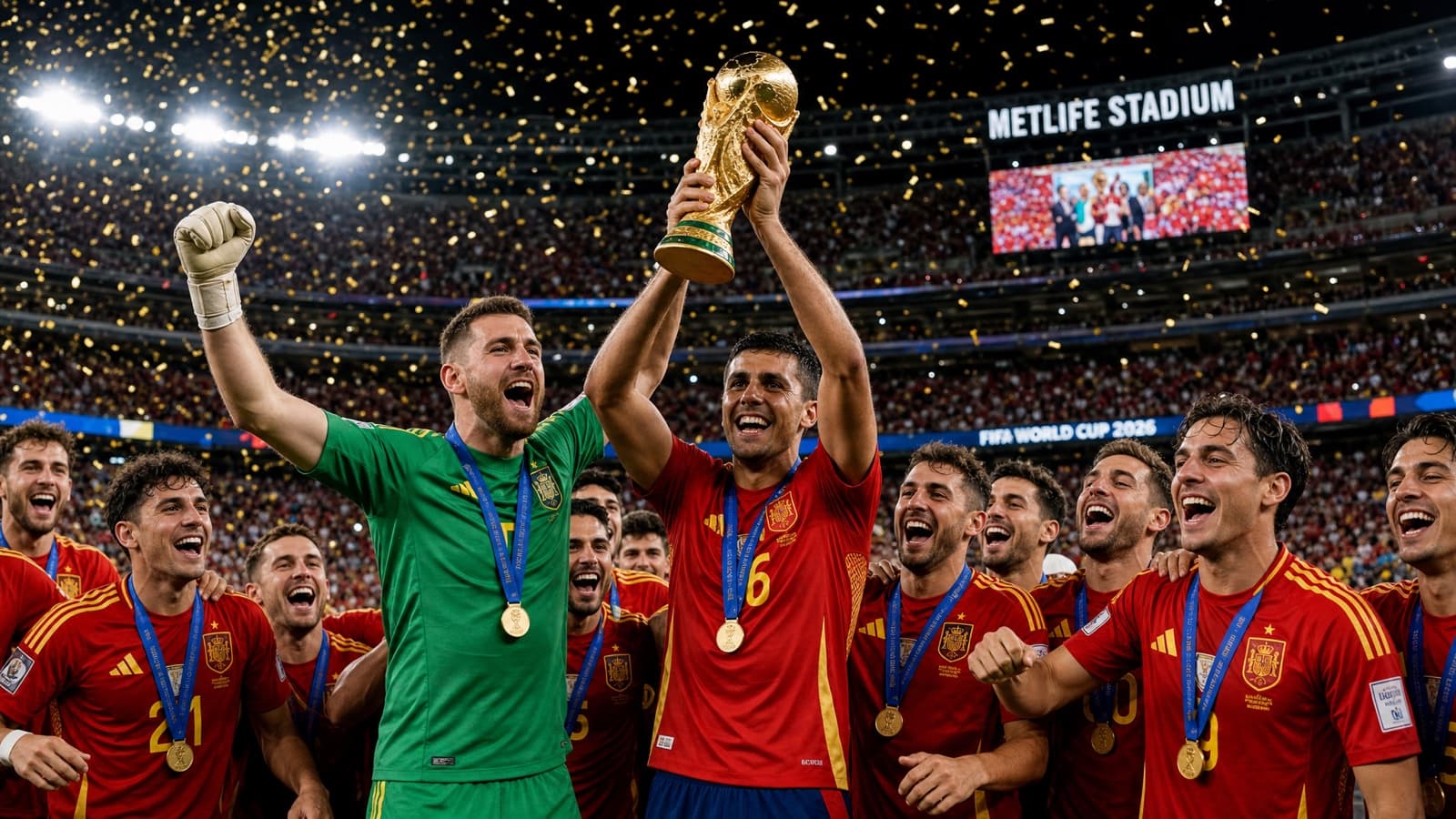
Spain was always the market's pick. That's the story the numbers tell.
When Ferran Torres buried his left-footed shot in the 106th minute at MetLife Stadium on July 19, giving Spain a 1-0 extra-time victory over defending champion Argentina, the prediction markets had already priced in the outcome. Not perfectly — no market is — but with a consistency and cross-platform accuracy that stands as a testament to collective intelligence when $5.69 billion in real capital is at stake.
This is a calibration story. Not a celebration of easy money, but an honest accounting of what Kalshi and Polymarket got right, where they wavered, and why the 2026 World Cup may have permanently altered how America thinks about event-driven prediction markets.
Spain's Run Was Built for Markets to Love
The numbers that made Spain attractive to prediction-market traders throughout the tournament were not subtle. Luis de la Fuente's squad conceded a single goal across eight matches — a World Cup record for any champion — against one of the strongest 48-team fields in the tournament's history.
La Roja's knockout road: Austria 3-0, Portugal 1-0, Belgium 2-1, France 2-0, Argentina 1-0 after extra time. They beat four top-ten nations without a single defeat, and goalkeeper Unai Simón was beaten only once in regulation across the entire competition.
Spain entered the final unbeaten in their last 37 matches, a streak that extended to 38 after the final whistle to become the longest unbeaten run by any European national team ever, eclipsing Italy's record, according to CBS News.
These are the kinds of structural signals prediction markets absorb quickly. When a team consistently controls games, limits opponents to minimal shots, and grinds out wins, rational actors in deep and liquid markets take notice — before analysts write it up. That's the point.
The Odds Journey: From Contender to 59-Cent Favorite
Spain's probability arc across the tournament reflects a market processing new information in real time and updating accordingly.
The quarterfinal against Belgium was the first major test of Spain's market standing. According to data shared by Kalshi and reported by Fortune, Kalshi priced Spain at 73% to win that individual match, with Polymarket at 59%. Spain won 2-1. Mikel Merino, coming off the bench, scored a late winner. The market's directional read was correct on both platforms.
The semifinal against France on July 14 — Bastille Day — was the true inflection point for the tournament-winner market. Spain's 2-0 win, with Mikel Oyarzabal's first-half penalty and Pedro Porro's 58th-minute finish off a give-and-go with Dani Olmo, sent the tournament-winner market into rapid repricing. Within hours, Spain sat at approximately 58% to win the tournament on both Kalshi and Polymarket, a level it would hold through the final.
By the eve of the final, both platforms had converged to an almost identical read: Spain at 58-59%, Argentina at 41-42%. Kalshi's final implied probability on Spain was 59%; Polymarket's was also 59%.
That's cross-platform consensus at the moment that mattered most.
Live market view — track these prices yourself:
The Final: $5.69 Billion and a 59-Cent Favorite
The Argentina-Spain final wasn't just the biggest soccer match in recent memory. It became the largest single event in prediction-market history.
According to data shared by Kalshi and reported by Fortune, Kalshi's Argentina-Spain final contract — launched after Argentina eliminated England in the semifinal — surpassed $1.27 billion in trading volume, making it the largest single market in Kalshi's history at that point. Polymarket's World Cup Winner market reached $4.28 billion in cumulative volume since the contract launched in July 2025, surpassing the 2024 U.S. presidential election as the platform's largest-ever market, Fortune reported.
Combined across both platforms, more than $5.69 billion was wagered on the World Cup final before kickoff. Fortune reported that total trading across all World Cup-related contracts on Kalshi alone exceeded $25 billion — dwarfing other major sports markets, including approximately $2 billion for the NBA Finals and $1 billion for the Super Bowl.
As of mid-day Friday, July 17, Kalshi showed Spain at 61% to win the tournament, according to Fortune. That number settled at 59% by Sunday morning.
Ferran Torres scored in the 106th minute. Spain won 1-0.
The market was right.
When Two Independent Markets Say the Same Thing
One of the most underappreciated aspects of the 2026 World Cup's prediction-market story is the convergence between Kalshi and Polymarket despite their fundamental differences.
Kalshi is a CFTC-regulated designated contract market (DCM) operating under U.S. financial law, with a U.S.-based trader base. Polymarket, in the United States, operates through QCX LLC, a separate CFTC-regulated entity that offers sports markets to U.S. users through its App Store app. Globally, Polymarket runs through its platform on the Polygon blockchain, drawing a crypto-native international trading base with entirely independent liquidity.
Different regulatory frameworks. Different user demographics. Different technical infrastructure. Independent order books.
Yet across the 2026 World Cup, they priced Spain within one percentage point of each other at the most critical market checkpoint: the final. Spain at 59% on both platforms. Identical reads despite different crowds.
When two structurally independent prediction markets land on the same number with billions of dollars at stake, the consensus is the signal. It doesn't mean a 59% outcome is guaranteed on any given day — probability doesn't guarantee single outcomes. But a well-calibrated prediction market should reflect the true probability distribution across many such events, and the 2026 World Cup provided one of the largest, most liquid, most scrutinized tests of that proposition ever conducted.
What the Markets Got Right — and Where They Hesitated
The calibration story is not frictionless. During the semifinals, prediction markets showed some volatility in individual-match pricing. Kalshi and Polymarket initially gave the eventual losing sides a narrow advantage heading into both semifinal matches before odds shifted as play unfolded, according to the Livemint, citing Fortune reporting.
In the France-Spain semifinal, market odds began shifting roughly 20 minutes into the match — shortly before Spain converted its opening penalty. In the England-Argentina semifinal, odds moved sharply in line with game momentum, which produced several significant swings.
That's not a failure mode. That's a market functioning correctly — updating on new information in real time as it arrives, which is exactly what liquid markets are designed to do. The more meaningful calibration question is whether the markets identified the right eventual champion well in advance.
They did. Spain at 58-59% after the semifinal, holding through the final, proves the market's pre-game read was coherent and directionally accurate.
The Scale of What This Tournament Meant for Prediction Markets
The 2026 World Cup was not just a soccer tournament. For the prediction-market industry, it was a defining inflection that reshaped the competitive landscape.
Kalshi gained 3 million new users during the tournament, according to the company. H2 Gambling Capital, cited by Fortune and subsequently Bloomberg, estimated that prediction markets accounted for an estimated 27% of all legal U.S. sports betting activity during the World Cup — up from roughly 9% at the start of 2026.
Kalshi CEO Tarek Mansour attributed the growth to keeping the platform closely tied to real-world events: "Our volumes are where the news is at." Kalshi ran at nearly 10 times its pre-tournament daily trading levels during peak World Cup activity, Fortune reported, repeatedly breaking its own records throughout the competition.
Apptopia, a mobile analytics firm, reported that Kalshi's app attracted more daily users during the World Cup than both DraftKings and FanDuel — the two largest online sportsbooks in the United States.
The $1.2 billion-plus on Kalshi's World Cup Winner contract alone was the largest single market in the company's history. For Polymarket, the $4.28 billion World Cup Winner contract surpassed the 2024 U.S. presidential election — an event that itself broke every prior record.
Frequently Asked Questions
How much money was wagered on the 2026 World Cup on prediction markets? Total trading across all World Cup-related contracts on Kalshi alone exceeded $25 billion, according to Fortune reporting Kalshi data. Polymarket's World Cup Winner market reached $4.28 billion in cumulative volume. The Spain-Argentina final generated over $5.69 billion combined across both platforms before kickoff.
Did prediction markets correctly pick Spain to win the 2026 World Cup? Yes. After Spain's 2-0 semifinal win over France on July 14, both Kalshi and Polymarket priced Spain at approximately 58-59% to win the tournament — making La Roja the clear favorite heading into the final against Argentina. Spain won 1-0 in extra time, with Ferran Torres scoring the decisive goal in the 106th minute.
Did Kalshi and Polymarket agree on Spain's odds? Yes, within one percentage point. Despite operating as structurally independent markets with different user bases, different regulatory frameworks, and separate order books, both platforms converged on Spain at 59% heading into the final against Argentina, who was priced at 41%.
How do prediction market odds compare to traditional sports betting? Prediction markets use a contract-based system where prices represent probability — 59¢ = 59% implied probability of that outcome. Traditional sportsbooks use moneyline and spread formats. During the 2026 World Cup, H2 Gambling Capital estimated prediction markets captured 27% of all legal U.S. sports betting volume, up from roughly 9% at the start of 2026, according to Fortune and Bloomberg.
What records did the 2026 World Cup set for prediction markets? The Spain-Argentina final became the single largest market by volume in Kalshi's history. Polymarket's World Cup Winner contract surpassed the 2024 U.S. presidential election as the platform's largest-ever market. Kalshi added 3 million new users during the tournament and ran at approximately 10 times its pre-tournament daily trading levels.
Conclusion
Spain lifted the trophy. The prediction markets had been saying so for weeks.
The 2026 FIFA World Cup final was a landmark moment for prediction markets as a category: $5.69 billion in bets, two independent markets that agreed within one percentage point, and a 59% favorite who delivered in extra time. It's the kind of calibration story that the industry will cite for years — not as proof that markets can predict the future, but as evidence that, when enough informed actors put real money on the line, collective intelligence tends to converge on something close to truth.
Spain was always the market's pick. Now they're world champions.
Sources & Verification
- Spain 1-0 Argentina (AET), Ferran Torres 106', Rodri Golden Ball, Spain road to title: FIFA.com official match report — verified July 20, 2026
- Spain conceded 1 goal in 8 matches (record); Emiliano Martinez 12 saves (most ever in a WC final); 38-match unbeaten streak; Luis de la Fuente oldest WC winning coach at 65: CBS News / AP — verified July 20, 2026
- Spain first nation to hold both men's and women's World Cup simultaneously: NPR — verified July 19, 2026
- Spain vs Belgium QF (73% Kalshi / 59% Polymarket); Kalshi $1.27B+ final contract volume; Spain 61% as of July 17; $25B total WC Kalshi volume; Polymarket WC Winner $4B+ cumulative; NBA Finals ~$2B; Super Bowl ~$1B: Fortune — verified July 17-20, 2026
- Prediction markets at 27% of US legal sports betting during WC (H2 Gambling Capital); Kalshi running at ~10x pre-tournament levels; Apptopia ranking Kalshi above DraftKings/FanDuel in daily users: Fortune — verified July 19, 2026
- Kalshi 3 million new users during WC; $1.2B+ on WC winner market = Kalshi's largest single market: Mashable — verified July 20, 2026
- $5.69B combined on Spain-Argentina final; Polymarket $4.28B WC Winner surpassing 2024 US election: Fortune — verified July 20, 2026
- Semifinal odds dynamics and market behavior: Livemint citing Fortune — verified July 20, 2026