
Washington's Sweeping Kalshi Order Collides With Federal Mention Markets Probe
Washington bans Kalshi from sports, elections, and mention markets. The CFTC opens its own probe of mention markets — state and federal authority collide.
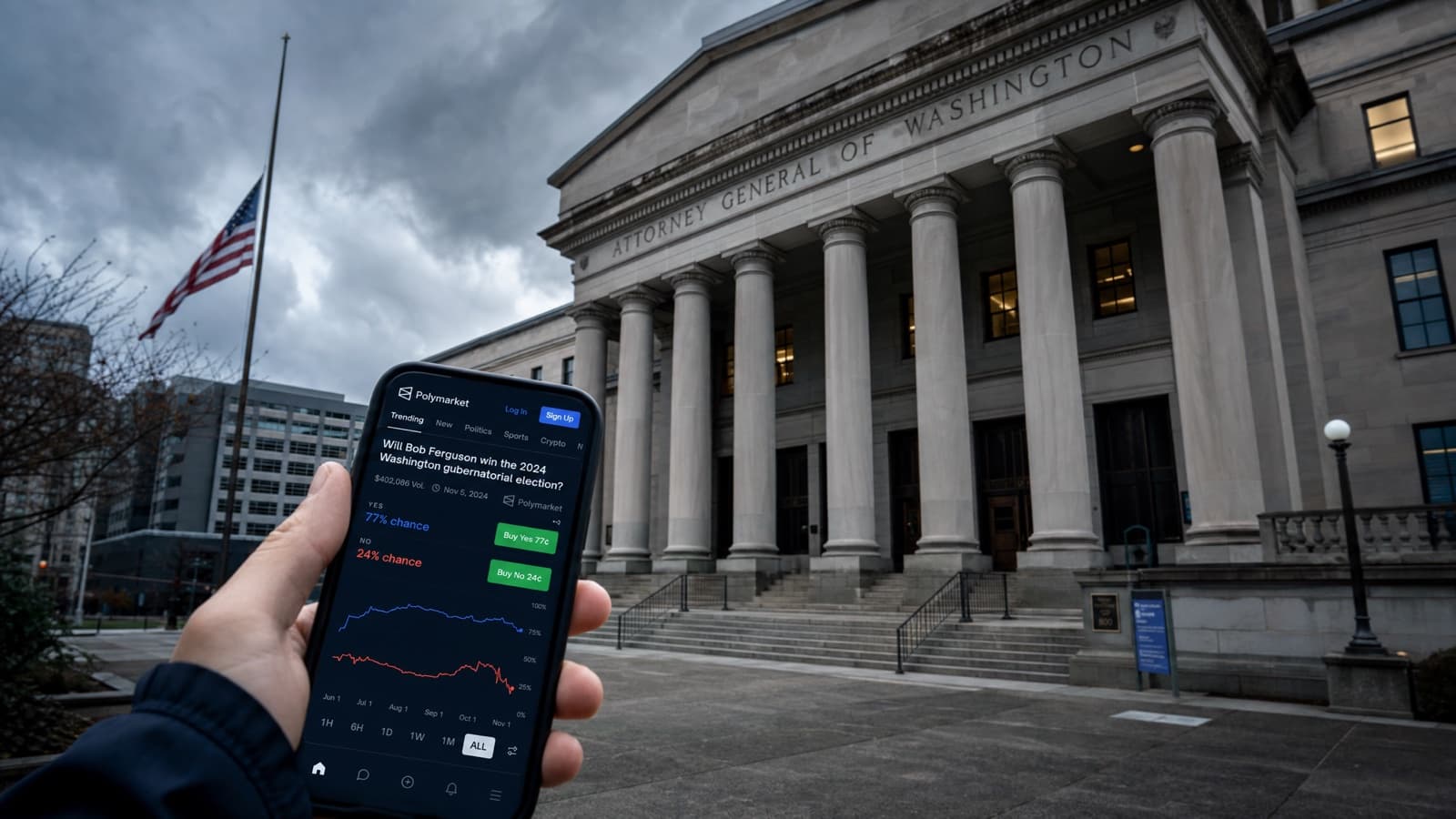
Two separate regulatory storms struck Kalshi this week — and the result is one of the most legally complex weeks in the prediction market industry's brief history as a federally regulated category.
On August 13, a King County Superior Court judge issued a final order requiring Kalshi to stop offering the vast majority of its event contracts in Washington state. One day later, CNBC and NPR confirmed that the CFTC has opened a separate internal review of Kalshi's "mention markets" — contracts that let traders speculate on specific words spoken by athletes, executives, or politicians. In response, Kalshi quietly removed all sports-related mention markets several weeks ago.
The collision of a state court restricting what Kalshi can offer and a federal regulator simultaneously scrutinizing what Kalshi should offer has created an unprecedented legal environment — one that will define how prediction markets operate in the United States for years.
What Judge McHale Ordered
King County Superior Court Judge John McHale signed the final order on August 13, implementing a preliminary injunction that he had first granted in July after finding Kalshi "likely violated" Washington state's Gambling Act and Consumer Protection Act.
The order is sweeping. Kalshi must stop offering, accepting, or facilitating contracts in seven categories for Washington state users:
- Sports — the bulk of the platform's weekly trading volume
- Elections and politics
- Entertainment and culture
- Technology and science
- Mentions — contracts on whether a specific word or phrase will be spoken
Four categories are expressly excluded and may continue operating for Washington users: commodities, climate, economics, and finance.
"Kalshi has gotten rich promoting wagers on sports, elections, natural disasters, events related to the Iran War, and more," said Washington Attorney General Nick Brown in a statement released by his office. "Under this order, Kalshi is banned from offering wagers on most of those topics in Washington."
The order also bans Kalshi from advertising the restricted contracts to Washington consumers — and requires "good faith efforts" to exclude Washington from national advertising campaigns where technologically feasible. Kalshi's own pitch to Washington consumers, citing the ability to "bet on the NFL even though you live in Washington," was cited by the court as evidence of deceptive marketing under the state's Consumer Protection Act.
Two Geofencing Deadlines, One Hard Penalty
The order sets a two-stage compliance timeline with real teeth:
- By August 19: Kalshi must implement an IP address and residency-based geofence to block Washington users from restricted markets.
- By September 2: Kalshi must deploy a multi-source geofencing solution — specifically the GeoComply platform — that layers multiple location-verification signals beyond a single IP address.
Missing the September 2 deadline carries a penalty of $120,000 per day, unless Kalshi files a sworn affidavit explaining any technical delay for the court to assess.
Washington users who already hold positions in the restricted categories can close or exit those positions. However, Kalshi must preserve all records relating to Washington consumers — including logs, geolocation determinations, and marketing data — until the court directs otherwise. The state reserved the right to seek recovery of fees and losses incurred by Washington consumers on or after September 2.
The Washington Court of Appeals has already denied Kalshi's request to stay the injunction pending its appeal.
The Market View on a Federal Sports Ban
Live price — will a law banning sports prediction markets be enacted in 2026?:
The CFTC's Contradictory Week
While Washington state was restricting Kalshi's operations, the federal government was simultaneously ordering the platform to keep running.
On August 11, the Commodity Futures Trading Commission invoked emergency authority after Kalshi notified the agency of a "market emergency" linked to a New York lawsuit seeking more than $36 billion in damages and a court order halting Kalshi's event contracts statewide. The CFTC's emergency order directed Kalshi to continue operating under the Commodity Exchange Act's core principles regardless of what state courts had ordered.
"A state cannot force a DCM to violate its obligations, and federal law does not permit a DCM to discriminate against a state's residents," said CFTC Chairman Michael Selig.
The CFTC also filed the emergency order as "supplemental authority" in its own Southern District of New York lawsuit against New York, effectively asking a federal court to override what state courts were doing.
The result is a genuine conflict: one arm of the federal government is telling Kalshi to ignore state orders, while a separate state court is telling Kalshi that ignoring those orders will cost $120,000 a day.
Washington is now the third state — joining Michigan and Nevada — where Kalshi faces active court-ordered restrictions. Kalshi pulled out of Nevada entirely after similar geofencing requirements were imposed there.
What Are Mention Markets — and Why Are Regulators Watching?
Mention markets are contracts that pay out based on whether a specific word or phrase is spoken during a defined event. Sports mention markets have included contracts on whether a broadcaster says "MVP," "ankle," or "redshirt" during a game. Political mention markets include contracts on whether President Trump mentions a specific topic or company during a speech or press conference.
NPR, citing two people with direct knowledge of the probe, reported August 13 that the CFTC had opened a review of mention markets as a category, examining whether their structure makes them "readily susceptible to manipulation" — which would run afoul of the Commodity Exchange Act's core principles for designated contract markets.
CNBC independently confirmed the review, noting that the CFTC first alerted Kalshi of its concerns several weeks ago. Kalshi removed its sports mention markets on approximately August 3, according to reporting from Awful Announcing, with no announced return date.
The CFTC investigation follows a high-profile incident involving Gabriel Perez, a teleprompter operator for President Trump, who allegedly placed trades on mention markets tied to specific words in prepared presidential remarks — and generated more than $90,000 in potential profits before Kalshi's surveillance team flagged the activity and referred it to regulators. Kalshi froze the funds. Perez is no longer employed by the federal government.
Both Kalshi and the CFTC declined to comment to NPR. No formal enforcement action or public announcement has been issued.
As of this week's reports, political and earnings-call mention markets remain active on Kalshi. Sports mention markets are gone "until further notice." Whether the CFTC review will extend beyond sports — or result in formal action — is not yet known.
What Washington Users Can Still Trade
Despite the sweeping order, Kalshi's financial markets remain available to Washington state residents. The four permitted categories reflect the platform's original financial-market identity:
- Commodities — crude oil, natural gas, agricultural contracts
- Climate — temperature, weather event outcomes
- Economics — CPI, GDP, unemployment rate markets
- Finance — Federal Reserve decisions, interest rate contracts, S&P 500 level markets
Users who had open positions in restricted categories can continue to close or exit those positions during the transition window. After September 2, any new positions in sports, elections, politics, entertainment, culture, technology, science, or mention categories must be blocked entirely.
The Constitutional Question Ahead
The core legal issue — whether the CFTC's authority over federally regulated contracts preempts state gambling laws — remains unresolved in Washington's courts, just as it does in Michigan, New York, Utah, and several other states where Kalshi faces legal challenges.
Kalshi has consistently argued that as a CFTC-registered Designated Contract Market, it operates under exclusive federal oversight. States have consistently argued that federal registration does not transform a product into something other than what state law already governs.
The Ninth Circuit — which covers Washington, Oregon, and California — has not yet weighed in. Depending on how Kalshi's appeal proceeds in Washington, this jurisdiction's ruling could eventually create a circuit split that accelerates the case toward Supreme Court review.
Meanwhile, the mention markets question adds a new dimension: the CFTC is now examining whether certain product types it has permitted might nonetheless fail its own anti-manipulation standards — creating a scenario where the agency that has been defending Kalshi in state court may simultaneously require Kalshi to remove some of its own products.
FAQ: Washington State and Kalshi
Can I still use Kalshi in Washington state after August 19? Yes, but with significant restrictions. Contracts on commodities, climate, economics, and finance remain available. Sports, elections, politics, entertainment, culture, technology, science, and mention contracts are banned under the order.
What happens if Kalshi misses the September 2 geofencing deadline? Kalshi faces $120,000 in daily fines unless it files a sworn affidavit explaining any technical delay. The court will then assess the appropriate penalty amount.
Is Polymarket affected by the Washington order? The court order applies to Kalshi specifically. Polymarket's U.S. platform (operated by QCX LLC) does not currently offer mention markets, elections, or politics contracts on its CFTC-regulated U.S. exchange — those categories are only available on Polymarket's global platform, which is not accessible to U.S. users.
What are mention markets, and are they gone permanently? Mention markets are contracts on whether a specific word will be spoken during an event. Kalshi has removed sports mention markets "until further notice" while a federal review is ongoing. Political, earnings-call, and Trump-related mention markets remain active on the platform for now. The CFTC review's outcome and timeline are not yet public.
Are other states expected to follow Washington's approach? Michigan, Nevada, Utah, and New York have all taken legal action against Kalshi or issued restrictions. The Washington order is notable for being among the broadest — covering seven contract categories including mentions — and for being issued as a final order rather than a preliminary step.
The Bottom Line
Washington's final order is the most comprehensive state restriction Kalshi has faced, covering nearly every non-financial contract category on the platform. It arrives the same week the CFTC — Kalshi's federal regulator and legal defender — opened its own review of the very product type that Washington is banning: mention markets.
The industry is watching to see whether Kalshi complies with Washington's order, contests it through appeals, or finds itself caught between conflicting state and federal directives. Every state court that rules against Kalshi, and every federal order directing Kalshi to ignore those rulings, moves this conflict one step closer to a definitive federal resolution — most likely in the appellate courts, and potentially beyond.
Sources & Verification
- Washington AG Nick Brown statement on Kalshi order, August 13, 2026
- NYT: Kalshi Ordered to Cease Most Operations in Washington State
- Ars Technica: State judge orders Kalshi to stop offering sports bets and other wagers
- NPR: Feds probe mention markets amid White House Kalshi controversy
- CNBC: Regulators and banks step up scrutiny of prediction markets
- Washington State Standard: Kalshi ordered to sharply curtail operations in WA