
Utah Attorney General Sues Kalshi for Illegal Gambling, Seeks Up to $61 Million
Utah AG Derek Brown sued Kalshi on Oct. 20, 2026 using the public nuisance doctrine, seeking up to $61.2 million. What it means for users and the industry.
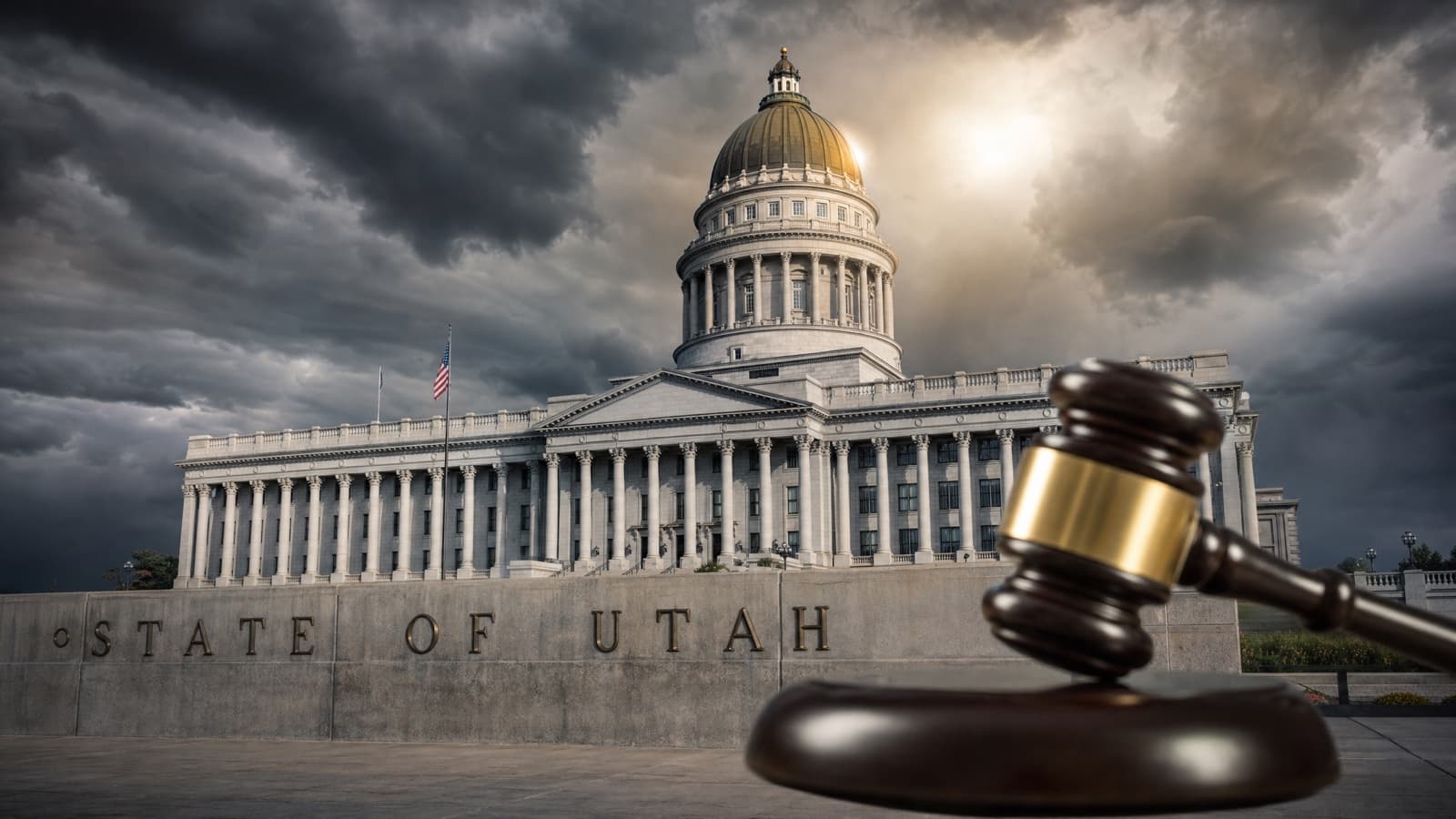
Utah Attorney General Derek Brown filed a landmark lawsuit against prediction market platform Kalshi on October 20, 2026, in a case that introduces a novel legal weapon into the growing state-versus-federal battle over event contracts: the public nuisance doctrine.
The 63-page complaint, filed in Utah's 3rd District Court in Salt Lake City, names Kalshi, its affiliates, and two Susquehanna trading firms as defendants. It seeks to permanently shut down Kalshi's operations in Utah and recover between $30.6 million and $61.2 million in fees and profits the state estimates the platform has collected from Utah residents since 2024.
"Kalshi runs an online casino in Utah and calls it a prediction market. That violates Utah law," Brown said at a press conference Tuesday morning. "Effectively, Kalshi bet today that Utah would not enforce its gambling laws. Well, we are enforcing it, and so on that point, Kalshi's now lost their bet."
What Makes the Utah Case Different
Most state legal actions against prediction markets have centered on cease-and-desist orders, licensing demands, or constitutional preemption arguments. Utah is the first state attorney general to pursue Kalshi under a public nuisance theory — arguing that the platform's operations create a legally cognizable harm to Utah residents and the state's sovereign interests.
By declaring Kalshi's gambling activities a public nuisance, Brown is invoking a legal framework that has historically been used against pollution sources, opioid manufacturers, and lead paint companies. The doctrine allows a state to seek broad injunctive relief and monetary damages without needing to prove a specific statutory violation — making it a potentially powerful and difficult-to-preempt tool.
The lawsuit also takes an unusual step by naming two Susquehanna trading firms as co-defendants. The complaint alleges that these firms hold the other side of Utah bettors' trades and profit when users lose. By reaching upstream to the institutional market makers, Utah's legal strategy aims to disrupt Kalshi's entire market infrastructure in the state — not just the user-facing app.
The Numbers Behind the Complaint
The lawsuit provides detailed data on Kalshi's Utah footprint:
- 55,800 accounts registered with Utah addresses as of February 2026
- More than 5 million wagers placed by Utah-based accounts
- $30.6 million to $61.2 million in platform fees collected from Utah accounts (estimated)
- $5.5 million in additional gambling profits from Utah residents as of May 2026, based on proportional loss rates
- 80–90% of Kalshi wagers on the platform are tied to sporting events, according to the complaint
"The illegal wagers that Kalshi enterprises offer to Utah residents under the guise of 'event contracts' are indistinguishable from traditional forms of gambling, including bets offered through sportsbooks," the complaint states.
Utah is asking the court to require Kalshi to deploy a court-approved geolocation provider to enforce any block, disgorge all profits from Utah accounts, and pay restitution to affected Utahns.
Live market view — track these prices yourself:
Utah's Constitutional Gambling Ban: One of Only Two
The Utah case carries particular legal weight because of where it was filed. Utah is one of only two states whose constitutions explicitly prohibit gambling — the other being Hawaii. That constitutional prohibition, in place since statehood in 1896, means the state has a stronger legal foundation than most. It cannot waive gambling restrictions through ordinary legislation; a constitutional amendment would be required.
"For 130 years, Utah has been clear: gambling has no place here, and we didn't change that when betting moved onto cell phones," AG Brown said in a separate statement.
In 2026, the Utah legislature reinforced this position by passing HB 243, a law that explicitly classifies proposition-style bets — the format Kalshi uses — as illegal gambling under state law. That statute gives the attorney general's office an additional statutory hook beyond the constitutional ban.
Adding cultural context, at the Church of Jesus Christ of Latter-day Saints' General Conference on October 3, 2026, President D. Todd Christofferson specifically named prediction market apps in an address asking members not to gamble — an unusual direct reference to specific technology platforms that signaled Utah's growing concern about app-based wagering.
The Prior Federal Case: Kalshi Already Lost Here
The state court filing follows a significant loss Kalshi suffered in Utah's federal courts. In February 2026, Kalshi preemptively sued Utah officials in U.S. District Court, arguing that the federal Commodity Exchange Act (CEA) preempted the state from applying its gambling restrictions to Kalshi's sports event contracts.
On August 4, 2026, U.S. District Judge Robert Shelby rejected that argument and granted summary judgment to Utah. The court's written order found that federal commodities law did not preempt enforcement of Utah's gambling statutes — mirroring similar rulings in Nevada and the Sixth Circuit.
With that federal preemption door closed, Utah is now pursuing Kalshi through the state court system, where the question is no longer about federal law: it is squarely about whether Kalshi's products constitute illegal gambling under Utah's constitution and statutes.
Where This Fits in the National Legal Battle
Utah's lawsuit lands at an inflection point in the nationwide prediction markets legal fight. Here is the current appellate scoreboard:
| Court | States | Result |
|---|---|---|
| 3rd Circuit | New Jersey (KalshiEX v. Flaherty) | For Kalshi — 2-1, April 6, 2026 |
| 6th Circuit | Ohio + Tennessee (consolidated) | Against Kalshi — 3-0, September 25, 2026 |
| 9th Circuit | Nevada (KalshiEX v. Assad) | Against Kalshi — 3-0, August 28, 2026 |
| 4th Circuit | Maryland | Argued May 7, 2026; decision pending |
| 2nd Circuit | New York + Connecticut | Briefing stage |
The Sixth Circuit ruling, authored by Senior Circuit Judge Julia Smith Gibbons, held that even if Kalshi's sports-event contracts qualify as swaps under federal law, the Commodity Exchange Act does not preempt states from enforcing their gambling statutes. That circuit split — one circuit for Kalshi, two against — is widely expected to push this question to the U.S. Supreme Court.
Courts have currently blocked prediction market access in three states: Michigan, Nevada, and Washington. In Utah, Ohio, Tennessee, Connecticut, Iowa, Maryland, and New York, courts have cleared states to enforce their own gambling laws even while federal litigation continues.
Kalshi's Response
Kalshi issued a statement Tuesday afternoon through spokesperson Jacki McGavick: "Our customers trade with each other and set the prices. This latest state court action does not affect our ongoing federal litigation."
The statement reflects Kalshi's consistent legal position: that it operates as a CFTC-regulated financial exchange — similar to the Chicago Mercantile Exchange — and that federal oversight under the Commodity Exchange Act takes precedence over state gambling laws. The CFTC has sided with Kalshi in several cases, filing amicus briefs and preemption arguments in multiple states.
But Utah's approach may complicate that defense. By invoking the public nuisance doctrine rather than challenging Kalshi's CFTC status directly, the state is arguing that the harm Kalshi causes in Utah is actionable regardless of federal regulatory status — the same way nuisance law can reach federally regulated industries in other contexts.
What This Means for Kalshi Users in Utah
Kalshi currently continues to operate in Utah while the state court action proceeds. The federal courts have not issued a preliminary injunction at the state court level, and Utah's TRO motion status was not confirmed in initial reports.
Users with Utah-registered accounts should monitor developments closely. The Utah AG's office is seeking both prospective relief (shutting down operations) and retrospective relief (recovering fees already paid). It is not yet clear whether any restitution, if awarded, would be distributed to affected Utah bettors.
For prediction market users elsewhere, Utah's public nuisance filing represents a legal template that other state attorneys general could adopt — particularly the nine-plus states already engaged in active enforcement. If the public nuisance theory succeeds in state court, it could open a second legal front that operates independently of the CEA preemption debate dominating the federal appeals courts.
FAQ
Why can't the CFTC just override Utah? Kalshi has argued the Commodity Exchange Act (CEA) preempts state gambling laws. But two federal circuit courts — the Sixth and Ninth Circuits — have now ruled that the CEA does not preempt state gambling law enforcement. The CFTC has supported Kalshi's position in amicus briefs, but courts have not accepted that view uniformly.
What is the public nuisance doctrine, and why does it matter here? Public nuisance is a legal theory that allows states and localities to sue entities causing widespread community harm. It was famously used against opioid manufacturers and lead paint companies. Utah is the first state to apply it to a prediction market, which could make it harder to dismiss on preemption grounds.
Why is Susquehanna named in the lawsuit? The complaint names Susquehanna trading entities because they allegedly operate as market makers on Kalshi — holding the other side of trades when Utah residents place bets. By naming the market makers, Utah broadens its legal reach beyond the platform itself.
What would it take for Kalshi to stay in Utah? Kalshi would need to either win a court order blocking Utah's enforcement, reach a settlement, or exit the Utah market voluntarily. The state is asking for both a permanent injunction and geolocation enforcement tools to prevent circumvention.
Is this case headed to the Supreme Court? The broader federal preemption question — whether states or the CFTC controls prediction markets — is increasingly likely to reach the Supreme Court given the existing circuit split. Utah's state court case is a separate track but will contribute to the broader legal and political pressure on the industry.
Sources & Verification
- Utah Attorney General files Kalshi lawsuit in 3rd District Court, Oct. 20, 2026: KSL.com — Oct. 20, 2026
- Public nuisance declaration, $61.2M demand, Susquehanna defendants: Deseret News — Oct. 20, 2026
- "Back-alley gambling den" quote, 55,800 accounts, geolocation demand: Salt Lake Tribune — Oct. 20, 2026
- Kalshi spokesperson Jacki McGavick statement: Deseret News — Oct. 20, 2026
- Sixth Circuit ruling (Ohio/Tennessee, 3-0): CNBC — Sep. 25, 2026
- Judge Julia Smith Gibbons opinion excerpt: Courthouse News — Sep. 25, 2026
- Sixth Circuit ruling analysis: The Hill — Sep. 25, 2026
- KUTV: Brown statement "Utah has said no to gambling since statehood in 1896": KUTV — Oct. 20, 2026
- Kalshi CFTC DCM designation: CFTC.gov