Underdog Sues Tennessee Over Prediction Market Ban — With Kalshi's Loss as a Warning
Underdog filed a federal lawsuit against Tennessee after a C&D threatened its prediction markets and fantasy sports license. Can it succeed where Kalshi failed?
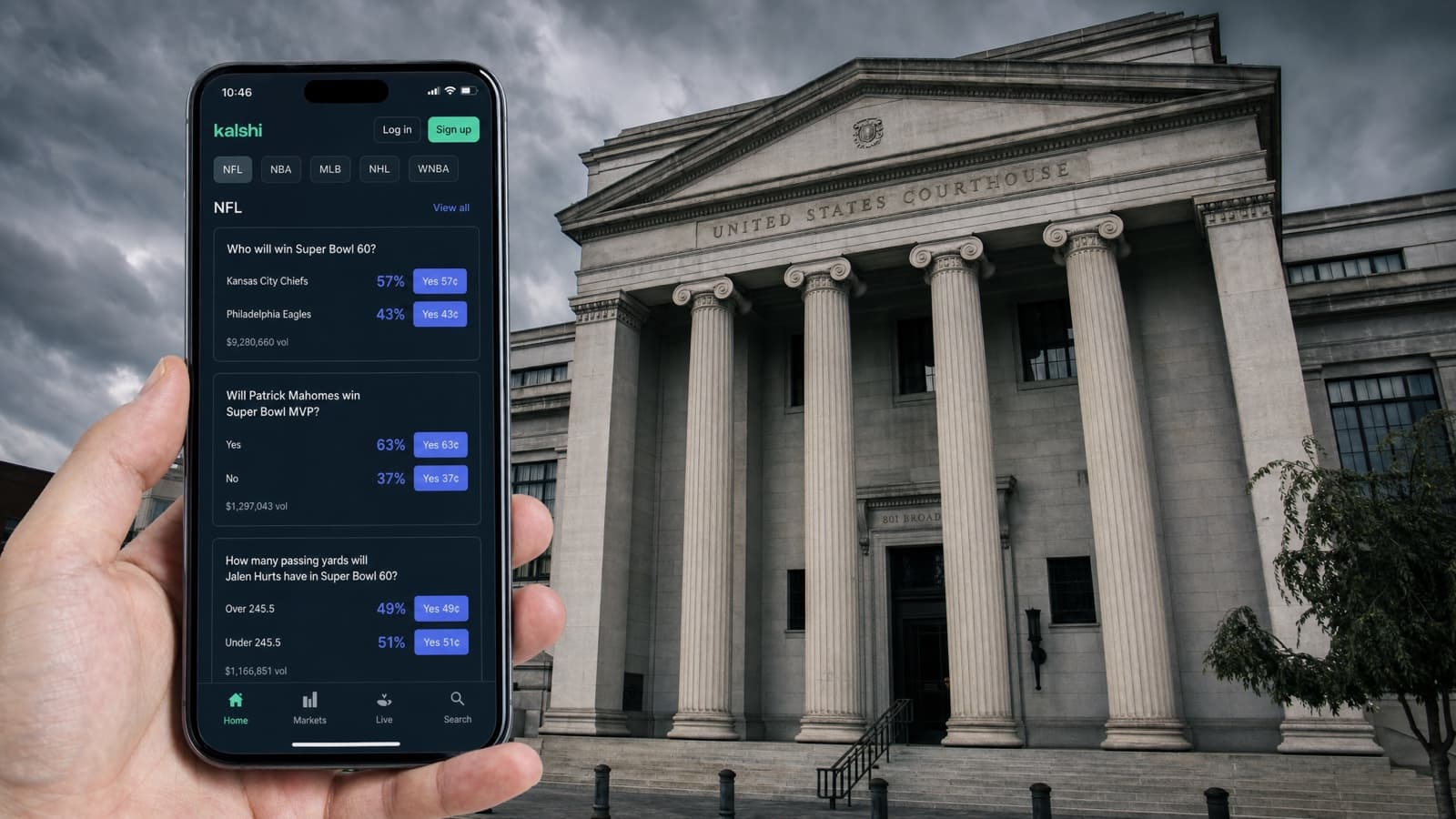
When Tennessee's sports wagering regulators sent Underdog a cease-and-desist order on October 9, 2026, they weren't making an empty threat. The letter gave Underdog four days to explain why the state shouldn't treat its sports event contracts as illegal gambling — and then warned that non-compliance could trigger fines, civil penalties, criminal investigations, and the revocation of an affiliated company's fantasy sports license.
Four days later, on October 13, Underdog's lawyers were in federal court.
The company — operating as Underdog Exchange DCM, Inc. and UDM, LLC d/b/a Underdog Predict — filed suit in the U.S. District Court for the Middle District of Tennessee, Nashville Division, naming Tennessee Attorney General Jonathan Skrmetti and members of the Tennessee Sports Wagering Council (TSWC) as defendants. The argument is the same one that has powered every prediction market lawsuit from coast to coast: federal law, not state gambling statutes, governs sports event contracts.
What makes this case worth watching isn't just the legal theory. It's the stakes — and the bad precedent sitting right in front of Underdog's lawyers.
Tennessee Has Already Beat This Argument Once
Less than three weeks before Underdog's lawsuit was filed, a unanimous three-judge panel of the U.S. Court of Appeals for the Sixth Circuit ruled against Kalshi in two states simultaneously.
On September 25, 2026, Judges Julia Smith Gibbons, Eric Clay, and Rachel Bloomekatz affirmed a lower court's denial of a preliminary injunction in Ohio and — more significantly for Underdog — vacated a preliminary injunction that Kalshi had previously won in Tennessee. The ruling was Kalshi's second appellate loss in roughly a month and deepened an already widening circuit split on whether the Commodity Exchange Act preempts state gambling laws over event contracts.
The Sixth Circuit's Tennessee ruling is the most direct legal precedent for what Underdog is now asking the same district to reconsider. Underdog's lawyers will need to argue either that the district court should reach a different conclusion despite the appellate ruling — difficult — or that Underdog's situation is legally distinguishable from Kalshi's in ways that matter.
They may have a real argument.
The Fantasy Sports License Threat Changes the Calculus
Kalshi's Tennessee fight was purely about prediction markets. Underdog's is about something more.
According to the complaint, Tennessee's regulators didn't just threaten Underdog's sports event contract operations. They threatened the company's affiliated fantasy sports license — a separate, established business line that Underdog has operated for years in the state.
This matters legally. A cease-and-desist that bundles prediction market enforcement with the revocation of an unrelated license raises different questions than a straightforward market shutdown order. Underdog can argue that using the fantasy license as leverage creates a constitutional issue independent of CFTC preemption — a due process or unconstitutional conditions claim that Kalshi never had the opportunity to raise.
Whether that's enough to distinguish the case from the Sixth Circuit's September ruling remains to be seen. But it gives Underdog's lawyers a lane that Kalshi didn't have.
Underdog's CFTC-Regulated Exchange
Underdog is not operating on borrowed infrastructure. In March 2026, the company acquired Aristotle Exchange — the CFTC-designated contract market (DCM) that had previously served as the backbone of PredictIt — and spent the next several months rebuilding it as its own platform.
On July 18, 2026, Underdog launched prediction markets through its own federally licensed exchange, operating under the entity name Underdog Exchange DCM, Inc. The company had previously offered event contracts through Crypto.com's CDNA (Crypto.com Derivatives North America) exchange as a brokerage.
The transition to a fully owned, CFTC-regulated DCM strengthens Underdog's preemption argument. The Commodity Exchange Act gives the CFTC exclusive jurisdiction over designated contract markets. Underdog can point to its own CFTC designation as direct evidence that it is operating a federally regulated product, not a gambling operation.
This is roughly the same argument Kalshi has made — and courts have pushed back on it, noting that federal DCM designation doesn't automatically shield a platform from state gambling laws for every contract type. But Underdog's ownership of the full exchange stack, rather than routing through a third party, may lend additional weight to the argument.
The Seventh Lawsuit in Two Months
Tennessee is not an isolated fight for Underdog. According to reporting from Sportsbetting Dime, Tennessee is the seventh state in which Underdog has filed a lawsuit in roughly two months as part of a coordinated legal strategy to defend its prediction market operations nationwide.
That pattern matters for a few reasons.
First, it signals that Underdog — which is currently in the process of being acquired by IG Group (LON: IGG), the London-listed financial services company — has the legal resources and corporate backing to fight on multiple fronts simultaneously. IG Group's acquisition of Underdog adds a significant balance sheet behind these lawsuits.
Second, a multi-state litigation campaign increases the odds of a circuit split, which is exactly what the prediction market industry needs. A SCOTUS petition becomes much more compelling when two or three circuits have reached conflicting conclusions. By suing in multiple districts, Underdog — along with Kalshi, Polymarket, Novig, and Crypto.com — is helping build the factual record and circuit-level disagreements that could ultimately force the Supreme Court to take up the question of federal preemption.
Third, it means Tennessee is just one front. Even if Underdog loses in the Sixth Circuit's backyard, a win in another circuit (the Ninth Circuit is currently considering Kalshi's Nevada case) could change the overall legal landscape.
What Tennessee Is Arguing
The Tennessee Sports Wagering Council's position is that sports event contracts — contracts on the outcome of sporting events that pay out in cash — are gambling under state law, and that Underdog needs to comply with Tennessee's licensing and regulatory requirements for sports wagering operators.
Those requirements include obtaining a sportsbook license, paying a 10% privilege tax on adjusted gross income, and implementing 21+ age verification — all requirements that prediction market platforms have argued are incompatible with their federally regulated, CFTC-licensed operations.
From the state's perspective, the Sixth Circuit has already blessed this reading of the law. Tennessee's AG Jonathan Skrmetti has been one of the most aggressive state regulators in the prediction market space, filing actions against multiple platforms and pursuing the Kalshi case through the appellate courts.
Platform-by-Platform: Who's Still Fighting in Tennessee
Tennessee's crackdown has affected different platforms differently:
Kalshi: Lost its preliminary injunction at the Sixth Circuit (September 25, 2026). The case returned to the district court following the appellate ruling. Kalshi's situation in Tennessee is listed as an active litigation state in its regulatory filings.
Underdog: Filed suit October 13, 2026 in the Middle District of Tennessee. Seeking preliminary and permanent injunctions against enforcement of state gambling laws against its event contracts.
Polymarket (QCX LLC): QCX, the Polymarket US entity (CFTC DCM), operates sports-only markets for US users. Its status in Tennessee is listed under active litigation states, though the specific procedural posture is not publicly confirmed.
Robinhood: Routes prediction market contracts through Kalshi. Its exposure in Tennessee tracks Kalshi's litigation posture.
What Prediction Market Users in Tennessee Should Know
If you're currently using Underdog Predict in Tennessee, the lawsuit means the company is actively seeking to preserve your ability to continue trading. An injunction, if granted, would temporarily block the state from enforcing its cease-and-desist. If no injunction issues, Underdog may need to suspend operations in the state pending the lawsuit's outcome.
Given that the Sixth Circuit has already ruled against Kalshi in Tennessee, the odds of an immediate preliminary injunction are lower than they would be in a circuit where no appellate precedent exists. Federal courts in the Sixth Circuit will have to grapple with the September ruling before granting the same relief they previously reversed.
For Tennessee users on other platforms: Kalshi continues to serve users in litigation states unless forced to suspend by court order. Check each platform's state availability page, which updates as the legal situation evolves.
The Bigger Picture: CFTC Preemption Heads Toward SCOTUS
Every one of these state-level lawsuits is building toward the same destination: a Supreme Court ruling on whether the Commodity Exchange Act's grant of CFTC authority over event contracts displaces state gambling laws.
The Sixth Circuit's September ruling was the second appellate loss for the industry, joining earlier rulings from the Third Circuit (New Jersey). But the Ninth Circuit (Nevada, Kalshi) has not yet ruled — and the Ninth's reading of federal preemption law tends to be broader. If the Ninth rules in Kalshi's favor, there's a circuit split. If SCOTUS denies cert, the industry has to live with a patchwork where platforms are legal in some states and banned in others.
Underdog's Tennessee lawsuit, along with the seven others it's fighting simultaneously, is both a defensive play and a long-game bet on SCOTUS resolution.
FAQ
Why is Underdog suing Tennessee if Kalshi already lost there? Underdog is making several arguments Kalshi couldn't, including the threat to its separate fantasy sports license and the strength of its own CFTC DCM designation. The lawsuit also keeps the legal issue alive for potential Supreme Court review.
What is the Tennessee Sports Wagering Council? The Tennessee Sports Wagering Council is the state regulatory body that oversees sports betting in Tennessee. It issued the October 9, 2026 cease-and-desist to Underdog directing it to stop offering sports event contracts.
Is Underdog still operating in Tennessee while the lawsuit is pending? As of filing date, the lawsuit seeks injunctive relief to block enforcement. If a court grants a temporary restraining order or preliminary injunction, Underdog can continue operating. Without an injunction, it may need to suspend Tennessee operations.
Who is Underdog's parent company? Underdog is in the process of being acquired by IG Group (LON: IGG), a London-listed financial services and trading company with significant balance sheet resources to support the litigation campaign.
What does Underdog Exchange DCM, Inc. mean? DCM stands for Designated Contract Market — the CFTC license category that allows an exchange to list regulated commodity contracts. Underdog obtained its own DCM designation through its March 2026 acquisition of Aristotle Exchange.
Sources & Verification
- Underdog lawsuit filing, Middle District of Tennessee: Underdog v. Tennessee complaint, Middle District of Tennessee — verified October 2026
- Cease-and-desist issued October 9, 2026: Underdog Sues Tennessee as State Threatens Fantasy Sports License — Sportsbookreview
- Lawsuit filed October 13, Middle District of Tennessee, Nashville Division: Sportsbookreview
- Tennessee is Underdog's 7th state lawsuit in ~2 months: SportsbettingDime
- Sixth Circuit September 25, 2026 ruling against Kalshi in Ohio and Tennessee: SportsbettingDime
- Underdog Exchange DCM launched July 18, 2026: Business Wire — Underdog official press release
- Aristotle Exchange acquired March 9, 2026: PredictionScout Underdog Review
- IG Group acquiring Underdog: Casino.org