
tastytrade Launches Prediction Markets: A Complete Guide for Active Traders
tastytrade launched CFTC-regulated prediction markets on July 27, 2026, powered by Apex Fintech Solutions. Here's what active traders need to know about event contracts on Fed decisions, CPI, crypto, and commodities.
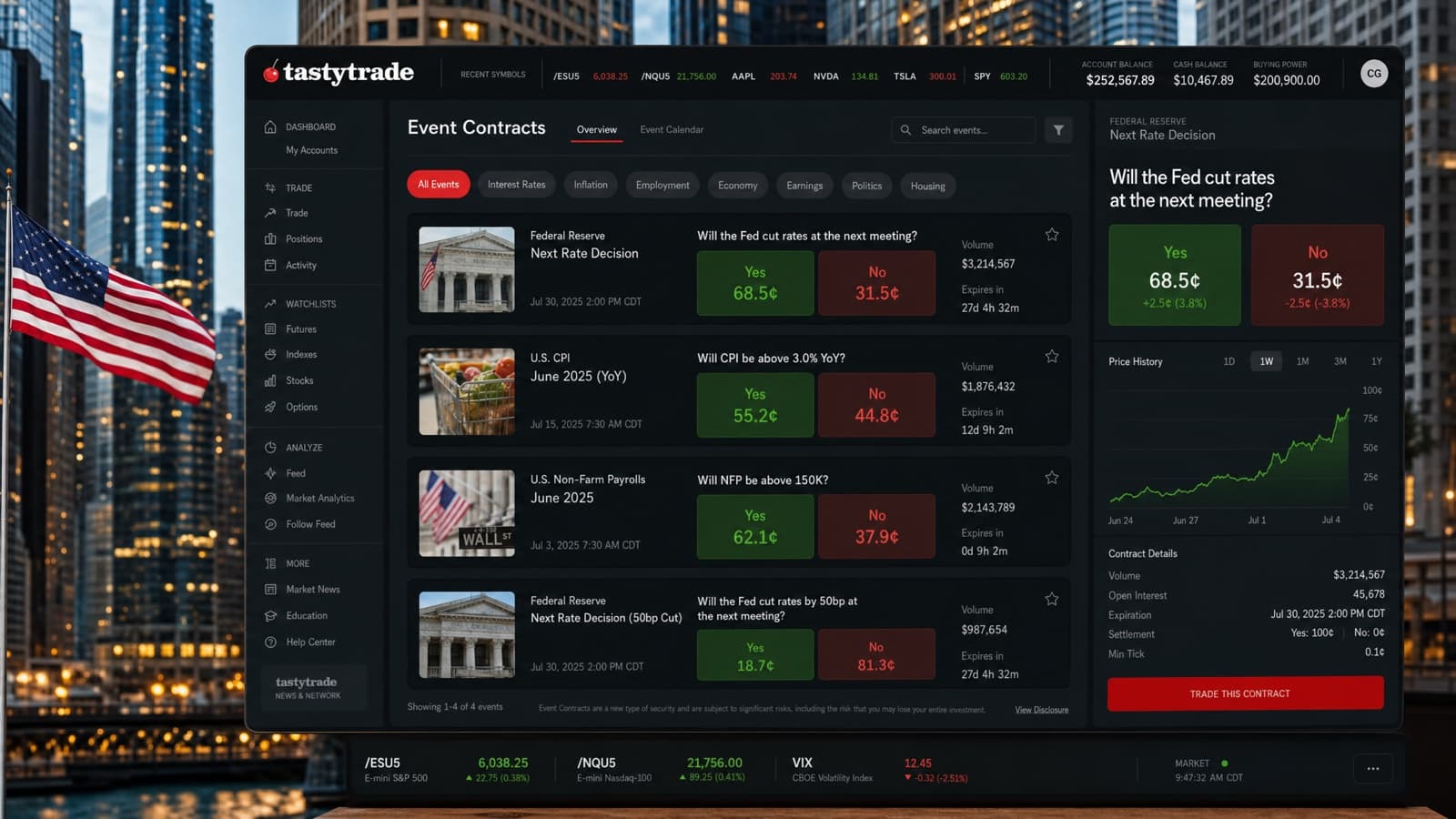
When one of the country's most popular options brokerages quietly rolled out a prediction markets tab on July 27, 2026, the announcement barely made headlines outside trading circles. It should have. tastytrade — the Chicago-based brokerage with an estimated 500,000 customers — became the first brokerage to launch on Apex Fintech Solutions' turnkey futures commission merchant (FCM) infrastructure, and in doing so, opened a door that dozens of other brokerage firms are now eyeing.
This isn't a sportsbook. It isn't a crypto exchange. It's an established regulated brokerage with traders who already know the difference between a VIX spike and a jobs number — and it just gave them a new way to trade the event itself, not just the market reaction.
Here's everything you need to know about tastytrade Prediction Markets, how event contracts work, and what it means for the broader prediction market landscape.
What Is tastytrade Prediction Markets?
tastytrade Prediction Markets is a CFTC-regulated event contracts offering fully integrated into the tastytrade brokerage platform. Powered by Apex Fintech Solutions and available 24 hours a day, seven days a week, the service allows traders to take binary yes-or-no positions on real-world market events — the same catalysts they already trade around — without leaving the platform where they manage their stocks, options, and futures.
The contracts are held in a segregated account alongside existing brokerage positions, which means your event contracts and your equity portfolio share a single unified view but are held separately under CFTC rules. Each contract settles to a straightforward yes-or-no outcome, with pricing that reflects real-time market probabilities — essentially the same binary structure used by Kalshi and other CFTC-licensed exchanges.
tastytrade is a subsidiary of IG Group (London: IGG), the global brokerage firm that acquired the Chicago-based platform in 2021 for approximately $1 billion. The prediction markets launch is part of a broader IG Group push into the event contracts space — the company separately agreed to acquire Underdog, a CFTC-licensed exchange and clearing operator, for up to approximately $1.3 billion in late July 2026.
How Event Contracts Work on tastytrade
The mechanics are simpler than most traditional derivatives. You take a position on whether a specific event outcome will happen, expressed as a yes-or-no question with a price between $0 and $1 per contract.
The tastytrade help page gives a clear illustration: suppose you believe the June Core CPI reading will come in at exactly 0.2% month-over-month. You buy 100 YES contracts at $0.44 each — a total outlay of $44. There are only two outcomes:
- If you're right: Each YES contract pays $1.00, returning $100 total — a $56 profit on your $44 investment.
- If you're wrong: You lose the $44 you paid. Your maximum loss is fixed at entry.
That defined-risk structure is a significant departure from futures trading, where losses can exceed your initial position. For the active traders who make up tastytrade's core customer base, the appeal is transparent: you're expressing a directional view on a known catalyst with a predefined payoff and no need to manage delta or manage margin calls.
Contracts are available across timeframes ranging from hourly to yearly, giving traders the flexibility to structure around a specific data release, a Fed meeting, or longer-duration macro outcomes.
What You Can Trade
tastytrade has deliberately built its catalog around market-moving events that its existing customer base already monitors. No sports. No celebrity outcomes. No political races.
The launch catalog covers:
Macro data releases:
- Consumer Price Index (CPI) and core CPI
- Personal Consumption Expenditures (PCE)
- Nonfarm payrolls
- GDP
- ISM manufacturing and services
Central bank decisions:
- Federal Reserve rate decisions
- European Central Bank (ECB) decisions
- Bank of England (BoE) decisions
- Bank of Japan (BoJ) decisions
Market indicators:
- Major equity indices (S&P 500, Nasdaq, Dow)
- Treasury yields
- VIX volatility index
- U.S. dollar
Cryptocurrencies:
- Bitcoin (BTC)
- Ethereum (ETH)
- Solana (SOL)
- XRP
Commodities:
- Crude oil
- Natural gas
- Gold
- Silver
- Copper
For context, this catalog covers virtually every major catalyst that drives short-term volatility in traditional markets. A trader who already has a view on whether the Fed holds rates, whether CPI comes in above consensus, or whether Bitcoin breaks a key level now has a defined-risk instrument to express that view directly — rather than interpreting price action in futures or options.
Why No Sports?
The deliberate omission of sports contracts is one of the most strategically significant features of the tastytrade launch — and it's not an oversight.
Sports event contracts are the primary flashpoint in the ongoing federal-state legal battle over prediction markets. More than 17 states have filed lawsuits, issued cease-and-desist orders, or passed laws specifically targeting sports contracts on Kalshi and Polymarket, arguing they constitute unlicensed gambling. New York's Attorney General sued Kalshi in July 2026 for a combined $36 billion in penalties and restitution. Four states — Massachusetts, Michigan, Nevada, and Washington — have already won court orders restricting Kalshi's sports trading activities.
By launching without sports, tastytrade sidesteps the litigation risk entirely. The company stays squarely in territory where the CFTC's jurisdiction over financial event contracts is substantially less contested. Interactive Brokers has operated on the same model through ForecastEx for several years and has largely avoided the legal crossfire that has followed Kalshi into every state capital.
"Customer demand for simple, directional trades is accelerating, and we built Prediction Markets for the way active traders already think. We focused it on the catalysts our customers already trade: the Fed, the inflation print, the VIX, crude, crypto," said Pete Mulmat, Head of Brokerage at tastytrade, in the July 27 announcement. "Most markets make you trade around the outcome and wait for the news to get interpreted. This flips it."
That framing — trading the event, not the reaction — is the key positioning distinction. tastytrade is not pitching this as a prediction market for sports fans. It's pitching it as a new instrument class for the same traders who already use options to hedge around CPI prints.
The Apex Fintech Infrastructure Play
tastytrade is the first brokerage to go live on Apex Fintech Solutions' new turnkey FCM infrastructure — a detail that matters far beyond the tastytrade launch itself.
An FCM (futures commission merchant) is the regulated intermediary that stands between a retail trader and a CFTC-licensed exchange. FCMs custody customer funds, manage collateral, handle margin requirements, and serve compliance functions that smaller brokerages simply cannot build from scratch. For a brokerage that wants to offer CFTC-regulated event contracts without building its own exchange or clearinghouse, an FCM relationship is the critical missing piece.
Apex's turnkey model solves that problem. "Apex's turnkey FCM infrastructure helps firms like tastytrade offer prediction markets and get to market faster without building FCM technology or connecting to exchanges from scratch," said Travis McGhee, Global Head of Digital Markets at Apex Fintech Solutions, in the joint announcement.
The implication for the broader market is significant. Apex already provides clearing and operational infrastructure to hundreds of retail brokerages. If the FCM infrastructure is productized and available as a turnkey offering, the barrier to entry for other brokerages to add CFTC-regulated event contracts drops substantially. tastytrade is the proof of concept; if the model works, it becomes a blueprint.
How tastytrade Fits the Broader Prediction Market Landscape
The prediction market space now has three distinct distribution models competing for retail traders:
1. Native prediction market exchanges (Kalshi, Polymarket US): Stand-alone platforms built specifically for event contracts, with the deepest liquidity and widest contract variety. Kalshi processed approximately $37.7 billion in trading volume in July 2026 alone, according to The Block's data dashboard — roughly 74.5% of combined July volume across the three major platforms.
2. Brokerage distribution (tastytrade, Robinhood via Kalshi, Coinbase via Kalshi, moomoo via Kalshi): Existing brokerages that add event contracts as a feature inside their existing platforms. The advantage is distribution — tastytrade's ~500,000 existing customers don't need to create a new account or fund a new platform.
3. Infrastructure-as-a-service (Apex Fintech FCM, CME Group for FanDuel and DraftKings): Third-party infrastructure providers that power multiple brokerage entrants simultaneously.
The key difference between tastytrade and Robinhood/Coinbase is the infrastructure layer. Robinhood and Coinbase route event contracts through Kalshi — meaning their customers are trading on Kalshi's exchange and Kalshi's order books, branded inside the Robinhood or Coinbase interface. tastytrade, through Apex's FCM infrastructure, operates under a different structure where the clearing function runs through Apex rather than Kalshi directly.
This also means tastytrade's catalog is independent from Kalshi's — which is why the contract categories differ. Robinhood's prediction markets include sports contracts (sourced from Kalshi). tastytrade's do not.
Getting Started on tastytrade
tastytrade Prediction Markets is available to existing tastytrade account holders. To access event contracts:
- Log into your tastytrade account
- Navigate to the Prediction Markets section (available under the trading interface)
- Event contracts are held in a segregated account — you'll trade them alongside but separate from your existing stock, options, and futures positions
- Contracts settle to $0 (NO wins) or $1.00 (YES wins) at expiration
New to tastytrade? The brokerage was established in 2017 and is known for its options-focused platform, commission-free stock trading, and an educational content library built for self-directed active traders. Opening an account is free. tastytrade's prediction markets page at tastytrade.com/prediction-markets/ includes risk disclosures and basic contract mechanics.
Important: Trading prediction markets is highly speculative and not suitable for all investors. You may lose 100% of your invested capital. These markets are offered through Apex and carry significant risk. Read the risk disclosures at tastytrade.com/disclosures/ before trading.
Frequently Asked Questions
What is tastytrade Prediction Markets? tastytrade Prediction Markets is a CFTC-regulated event contracts offering launched July 27, 2026. Powered by Apex Fintech Solutions, it lets traders take yes/no positions on macro events — Fed decisions, inflation data, crypto prices, commodities — directly inside the tastytrade brokerage platform, 24/7, in a segregated account.
Does tastytrade offer sports prediction markets? No. tastytrade's launch catalog is limited to financial and economic events: equity indices, Treasury yields, VIX, Fed and central bank decisions, CPI/PCE/NFP/GDP, major cryptocurrencies, and commodities. There are no sports event contracts at launch.
Is tastytrade Prediction Markets CFTC-regulated? Yes. The offering is CFTC-regulated, powered through Apex Fintech Solutions' FCM (futures commission merchant) infrastructure. Apex is CFTC-registered.
How is tastytrade different from Kalshi or Polymarket US? tastytrade is a brokerage that distributes event contracts as a feature alongside stocks, options, and futures — it's not a standalone prediction market exchange. Kalshi and Polymarket US are dedicated exchanges. tastytrade's contracts are focused exclusively on financial and macro events (no sports); Kalshi offers both financial and sports contracts.
Who is behind tastytrade Prediction Markets? tastytrade is owned by IG Group (London: IGG), which acquired the platform in 2021. The prediction markets infrastructure is provided by Apex Fintech Solutions, making tastytrade the first brokerage to go live on Apex's turnkey FCM platform. Pete Mulmat (Head of Brokerage, tastytrade/IGNA) and Travis McGhee (Global Head of Digital Markets, Apex Fintech Solutions) led the launch.
Where do the prices come from? Prices reflect real-time market probabilities based on trading activity. Each contract's YES price represents the market's implied probability of the event occurring. A contract priced at $0.44 means the market assigns roughly a 44% probability to the YES outcome.
The Bottom Line
tastytrade's launch is less about prediction markets getting a new competitor and more about the distribution model for regulated event contracts expanding rapidly. The platform's 500,000 traders don't need to be converted into prediction-market enthusiasts — many already have opinions about the next CPI print or Fed decision. tastytrade just gave them a cleaner way to act on those views.
The Apex FCM infrastructure story is arguably the bigger long-term signal. If turnkey FCM infrastructure becomes a commodity, dozens more brokerages can add event contracts without the multi-year regulatory buildout that Kalshi or Polymarket required. That is either a feature or a threat for the existing exchanges, depending on which side of the order book you're on.
For PredictionMarkets.US coverage of the full prediction market landscape — including live odds on economic data, Fed decisions, and macro events — visit predictionmarkets.us.
Sources & Verification
- tastytrade Prediction Markets launch (July 27, 2026): BusinessWire press release
- Apex Fintech Solutions confirmation, FCM infrastructure details: Apex Fintech Solutions press release
- tastytrade platform details, risk disclosures, contract mechanics example: tastytrade.com/prediction-markets/
- Pete Mulmat and Travis McGhee quotes: Finance Magnates, July 27, 2026
- IG Group ownership and Underdog acquisition: Finance Magnates, July 30, 2026
- tastytrade customer count (~500,000) and no-sports strategy context: CFO Tech News, July 28, 2026
- July volume data ($50.59B, Kalshi 74.5% share): The Block data dashboard, reported August 3, 2026