
Stanford-Led Research Catches $8.2 Million in Systematic Bitcoin Settlement Manipulation on Polymarket
Peer-reviewed research by Stanford and Singapore Management University researchers documents 821 traders extracting $8.2M from retail Polymarket Bitcoin contract holders — by pushing Binance prices in the final seconds before settlement.
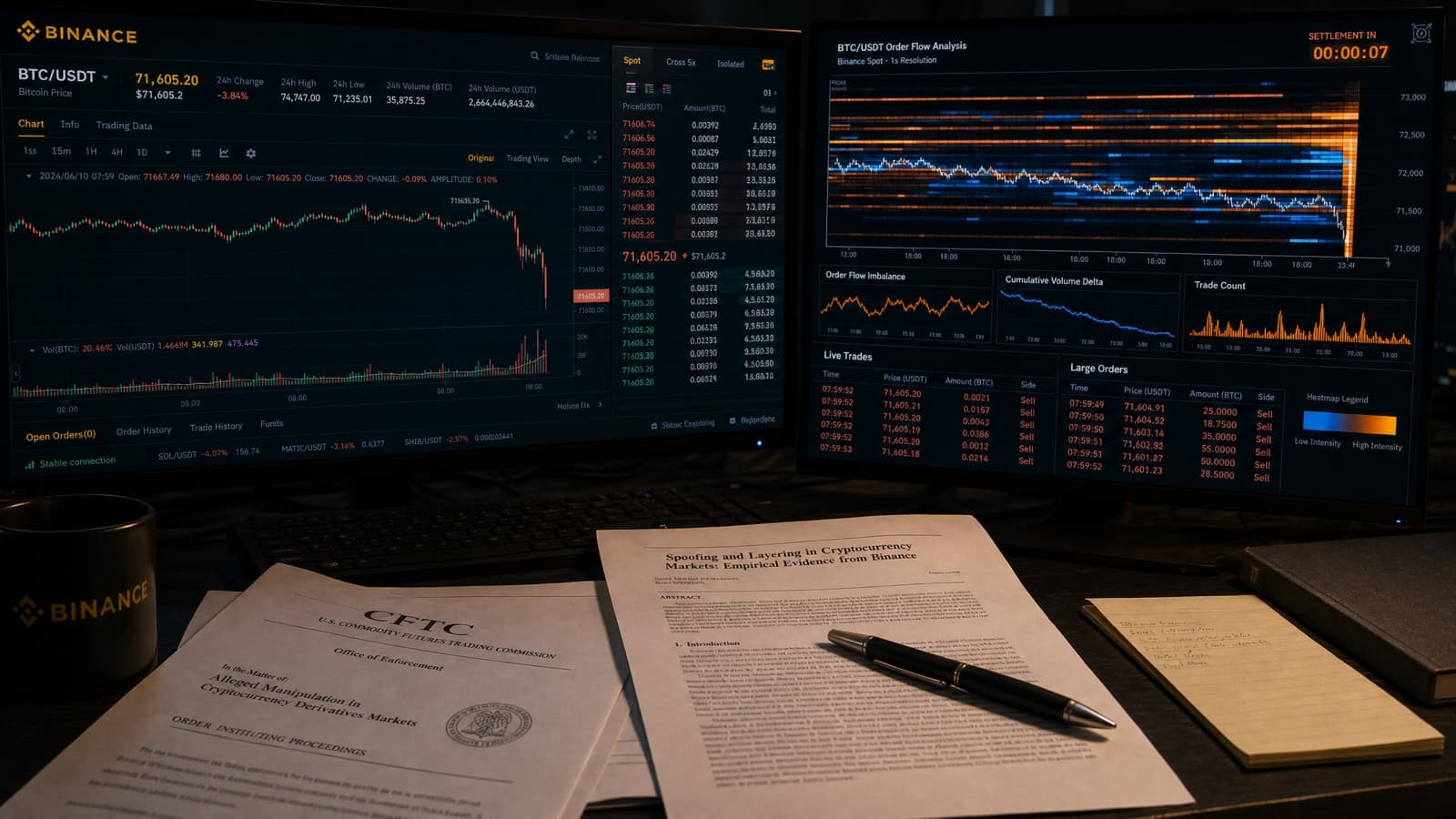
Stanford-led researchers have documented systematic manipulation of Polymarket's five-minute Bitcoin prediction contracts, finding that 821 traders extracted $8.2 million from approximately 243,000 retail participants in just two months — by pushing around Bitcoin's price on Binance in the final seconds before contract settlement.
The working paper, "Settlement Manipulation in Prediction Markets" (arXiv:2606.31675), was submitted June 30, 2026, by co-authors at Stanford University's Department of Management Science and Engineering and Singapore Management University. It is the first peer-reviewed academic study to document settlement manipulation in oracle-settled prediction market contracts, and it arrives as regulators are debating how to govern a $24 billion monthly industry.
How Polymarket's 5-Minute Bitcoin Contract Works
Polymarket launched its five-minute Bitcoin up/down contract on February 12, 2026. The structure is simple: a contract pays $1 if Bitcoin's price is higher at the close of a five-minute window than at its open, and $0 otherwise.
What makes these contracts structurally vulnerable is their settlement mechanism. Resolution doesn't happen inside Polymarket's own system. Instead, the contract pays based on a Chainlink price oracle that aggregates Bitcoin's price across major spot exchanges. Binance — the world's largest cryptocurrency exchange by volume — is a decisive input to that oracle: Binance's mid-price sits about two-and-a-half basis points from the oracle reading and moves essentially one-for-one with it within each five-minute window, finishing on the same side of the strike as the contract resolution approximately 85% of the time.
That's the structural opening. Move the Binance price a few basis points in the final seconds of a window, and you can reliably flip the Chainlink oracle reading — and change who gets paid.
The Manipulation Playbook: Final Seconds, Predictable Reversals
The mechanism the researchers document is precise. A manipulator first takes a position in a Polymarket contract — betting, say, that Bitcoin will be higher at the close than at the open. Then, in the final ten seconds before settlement, they flood Binance with buy orders. The burst of order flow pushes Binance's mid-price above the strike level, dragging the Chainlink oracle with it. The Polymarket contract resolves in their favor. They close the spot position immediately after.
The empirical fingerprint is unmistakable. After the five-minute contract launched, Binance spot order flow in the final ten seconds before each close spiked approximately 50% above pre-launch baseline levels. Within ten seconds of the close, the price reverted. Real information-driven trading persists; a manipulative push reverts. The reversal is the tell.
The manipulation was surgically targeted. The researchers classified the top decile of final-ten-second order flow magnitude — approximately 1,600 cycles — as likely manipulated. Of those, 56% occurred during overnight trading hours and 44% on weekends: thin-liquidity windows where a given dollar of order flow moves prices the most. Away from the settlement window, these manipulated cycles were quieter than average. The flow was not a general market signal. It was a late, concentrated push.
The effectiveness was striking. In near-even cycles — where neither outcome was strongly favored — a push against the leading side flipped the winner 65% of the time, versus 41% in ordinary trading. More dramatic: even in cycles where one side held a 90-to-100% implied probability just before close, a last-second push reversed the outcome 34% of the time. An event the market was treating as near-certain was overturned one time in three.
Who Won, Who Lost: 821 Traders vs. 243,000
The scale of the extraction is visible only because Polymarket settles on a public blockchain. Every wallet's trade history and profit-and-loss is traceable to pseudonymous addresses.
The researchers identified 821 likely manipulators out of roughly 243,000 traders who held the five-minute Bitcoin contract — fewer than one in 300 participants. Those 821 traders collected $8.2 million in the manipulated cycles while breaking essentially even in non-manipulated cycles. The edge existed only where the manipulation did.
The loss was not evenly distributed across counterparties. Market makers, who quote passively and finish each cycle roughly flat, absorbed almost none of it. Instead, 93% of the losses fell on retail traders — ordinary participants who bought the contract with no intent or ability to move the Binance market. The paper describes them as the "liquidity traders" of the model: on the losing side in 65% of manipulated cycles, versus 48% in normal ones. All of it came from one contract, on one platform, over two months.
Why This Isn't Hedging
The paper directly addresses the most obvious innocent explanation: that the near-settlement order flow could represent prediction-market makers hedging their binary contract exposure in the underlying spot market.
Two facts rule that out. First, a binary contract's sensitivity to spot price is economically meaningful only when the contract is priced near the strike. Once one side holds a 90-to-100% implied probability, the contract barely responds to spot moves — there's nothing meaningful left to hedge. Yet those nearly-decided cycles are precisely where the researchers find the pushes most frequently, and where they flip outcomes one time in three. A trade placed when there's nothing to hedge is not a hedge.
Second, a genuine hedger accumulates spot exposure gradually as the directional exposure builds over the five-minute window. Instead, the researchers found the order flow arrives in a single burst in the final fifty seconds, with essentially no signed trading before that window. A position assembled only in the closing seconds is not an accumulating hedge. It is a settlement-price push.
The Regulatory Dimension
The findings arrive against a specific regulatory backdrop. The Commodity Exchange Act requires every Designated Contract Market to list only contracts that are "not readily susceptible to manipulation" — a standard codified in DCM Core Principle 3 and reaffirmed for event contracts in CFTC Staff Advisory 26-08, issued in 2026.
Polymarket's US operations run through QCX LLC, the CFTC-licensed Designated Contract Market and Derivatives Clearing Organization that Polymarket acquired in July 2025. The company previously reached a $1.4 million settlement with the CFTC in January 2022 related to unregistered binary options offered to US persons.
The paper stops short of making a legal judgment about whether Polymarket has violated DCM Core Principle 3. But it frames the issue clearly: asset-price contracts with ultra-short settlement windows raise "exactly the concern that standard is meant to prevent." The CFTC's own investor advisory describes the public benefits of prediction markets; the paper shows what happens at the five-minute settlement window when those safeguards aren't structurally enforced.
The stakes extend beyond crypto. Nasdaq and Cboe have both filed with the SEC to list binary options on equity indices. The manipulation mechanism documented here — take a binary derivative position, then trade the settlement reference near the close — could apply to any short-horizon, oracle-settled contract regardless of the underlying asset.
The Fix: Lengthen the Horizon
The researchers also identify what works. Polymarket's fifteen-minute Bitcoin contract — which runs alongside the five-minute version — showed the manipulation signature "largely absent." The theoretical model explains why: a longer settlement window aggregates more genuine spot-market price discovery before the close, reducing the fraction of outcomes that a single last-second burst can flip.
The paper's prescriptive conclusion is direct: lengthen the contract horizon. For an industry that has been racing toward ever-shorter contracts — from a day to an hour to fifteen minutes to five — the finding inverts the competitive logic. Shorter windows are not automatically better for market integrity or user outcomes.
The fix requires no regulatory action to test. If Polymarket were to retire or restrict the five-minute contract while retaining the fifteen-minute version, the empirical prediction is that the manipulation signature would largely disappear — as it already has in the longer-duration contracts.
What This Means for the Broader Industry
The scale of the prediction market industry makes this research consequential beyond a single platform or contract type. Combined monthly volume on Kalshi and Polymarket rose nearly fivefold in seven months, from under $5 billion in September 2025 to approximately $24 billion by April 2026, according to Pew Research Center data. Kalshi's crypto contract volume alone surpassed $1 billion per month for the first time in March 2026.
As binary contracts expand from crypto into mainstream equity markets, the design vulnerabilities documented here become systemic rather than niche concerns. A market that can be reliably flipped by a concentrated order flow burst in its final ten seconds is not a market that supports the price-discovery and hedging functions regulators have publicly attributed to prediction markets.
The prediction market industry has spent two years building the case that it serves genuine public functions. That case now has an academic counterweight: 821 wallets, $8.2 million, 93% falling on retail, over sixty days. Regulators evaluating whether the manipulation standard has been met will have this paper to cite.
You can track prediction market regulatory developments and live market prices at PredictionMarkets.US, which aggregates live data from Kalshi, Polymarket, and PredictIt alongside regulatory news across the industry.
FAQ
What is settlement manipulation in a prediction market? Settlement manipulation occurs when a trader with a position in a prediction market also trades the underlying asset near settlement time to push the settlement price in their favor. In Polymarket's five-minute Bitcoin contracts, researchers found traders buying Bitcoin on Binance in the final ten seconds before each contract close, moving the price enough to flip which side wins — then immediately reversing the spot trade.
Which Polymarket contract was studied? The five-minute Bitcoin up/down contract, launched February 12, 2026. Polymarket's fifteen-minute Bitcoin contract showed significantly less manipulation, suggesting the vulnerability is specific to ultra-short settlement windows rather than prediction markets in general.
How much money did manipulators extract? A peer-reviewed working paper by researchers at Stanford University and Singapore Management University identified 821 traders extracting $8.2 million from approximately 243,000 other participants over the study period. 93% of the losses fell on retail traders.
Is Polymarket regulated in the US? Polymarket's US operations run through QCX LLC, a CFTC-licensed Designated Contract Market and Derivatives Clearing Organization, acquired by Polymarket in July 2025 for $112 million. The company previously settled with the CFTC for $1.4 million in January 2022.
What is the proposed fix? The paper recommends lengthening the contract's settlement window. The fifteen-minute Bitcoin contract shows dramatically less manipulation than the five-minute version. The longer the horizon, the more genuine price discovery accumulates before settlement, reducing the leverage any single last-second trade can have on the outcome.
Does this affect other prediction markets? The manipulation mechanism — taking a binary derivative position and trading the settlement reference near close — could apply to any oracle-settled, short-horizon contract, including proposed binary options on equity indices that Nasdaq and Cboe are seeking SEC approval to list.
Sources & Verification
- Settlement Manipulation in Prediction Markets — arXiv:2606.31675 — Dai, Jia, Yu; submitted June 30, 2026 — verified July 19, 2026
- Pew Research Center: Trading Volume on Prediction Markets Has Soared in Recent Months (2026) — monthly volume data cited in paper
- CF Benchmarks: Kalshi Leads Surging Crypto Event Contract Market (2026) — Kalshi crypto volume cited in paper
- CFTC Staff Advisory 26-08 (2026) — manipulation standard reaffirmation for event contracts
- Commodity Exchange Act, DCM Core Principle 3 — "not readily susceptible to manipulation" standard
- Polymarket US Amended CFTC Order, November 25, 2025 — QCX LLC DCM/DCO regulatory status
- Polymarket Acquires QCX for $112 Million — PR Newswire, July 2025 — acquisition facts