
South Korea Blocks Polymarket as Global Prediction Market Regulation Diverges From the U.S.
South Korea joined 30+ nations blocking Polymarket on Aug. 18, 2026. The U.S. is taking the opposite approach. Here is what the global split means for traders.
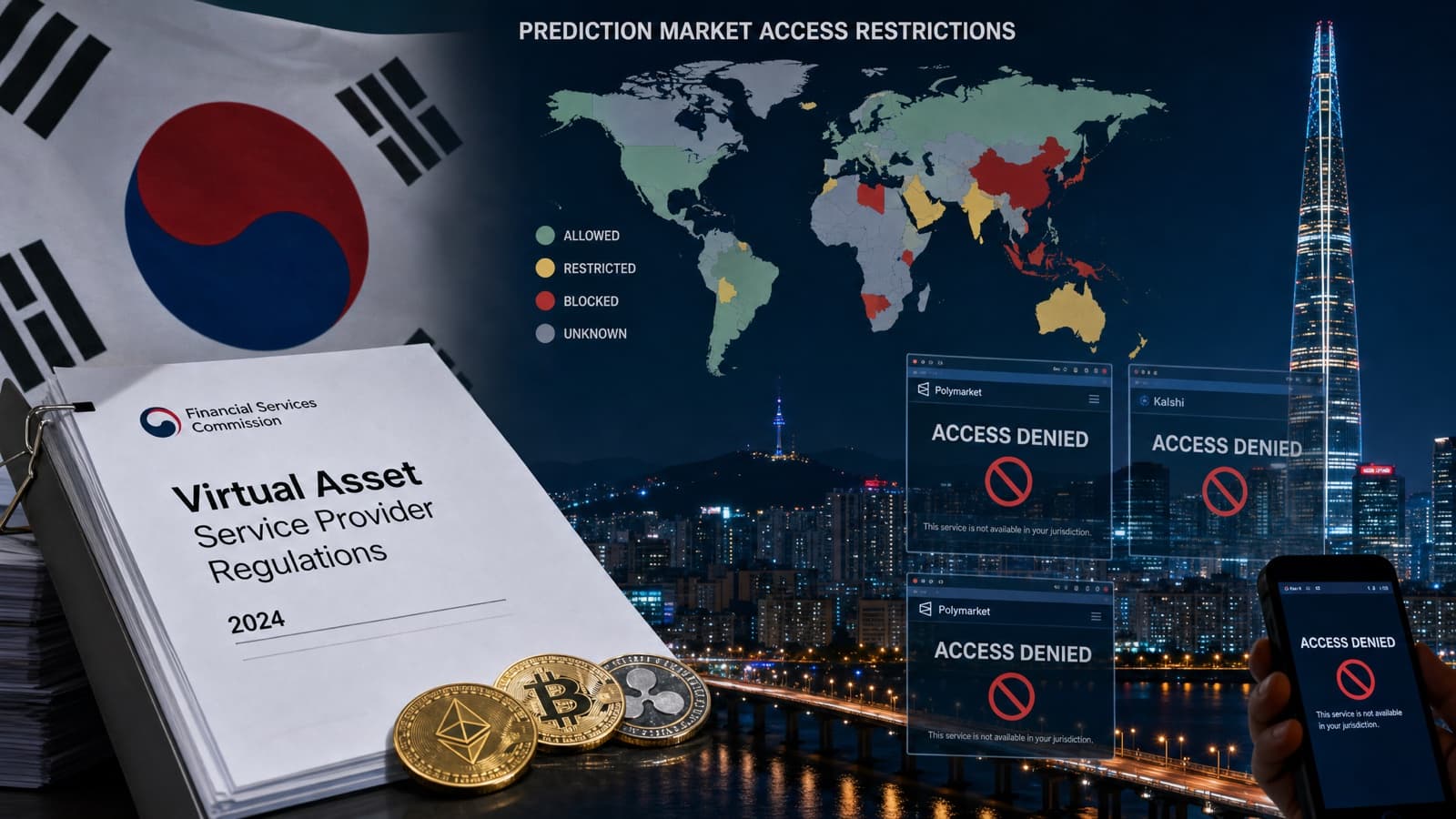
South Korea's media regulator ordered internet service providers to block access to Polymarket on August 18, 2026 — making the country the latest in a string of more than 30 nations to restrict the world's largest crypto-native prediction market. The decision, issued by the Korea Media and Communications Standards Commission (KMCSC), rules that Polymarket's winner-takes-all event contracts constitute illegal gambling under the country's Criminal Act and National Sports Promotion Act.
The timing matters. While South Korea, France, Australia, Germany, and dozens of other major economies have moved to block or restrict prediction market access, the United States is building the most expansive legal framework for event-contract trading in the world — issuing CFTC licenses to more than a dozen platforms and advancing legislation that would further codify their status. The divergence is widening, and it is reshaping where prediction market capital flows and how platforms design their global compliance strategies.
How South Korea's Regulator Reached Its Decision
The KMCSC's path to the August 18 block began on May 21, 2026, when the commission opened a formal review into whether Polymarket qualified as an illegal gambling site under Korean law. The trigger: a surge of South Korean user activity around the country's June 3, 2026 presidential election, which reportedly generated tens of millions of dollars in trading volume on the platform. Gangwon Provincial Police had already opened the country's first criminal probe into Korean users trading on the platform.
After consulting with the Korean National Police Agency, the National Gambling Control Commission, and the Korea Sports Promotion Foundation, the KMCSC issued its ruling.
The commission's legal reasoning centered on four features of Polymarket's product:
- Winner-takes-all structure — Users stake funds on binary event outcomes and lose their entire position if their prediction is wrong. The KMCSC said this structure "incites gambling tendencies" under the Criminal Act.
- Operator-controlled markets — Polymarket creates the markets, sets the trading rules, and collects transaction fees — making it, in the regulator's framing, a gambling operator rather than a neutral protocol.
- Korea-specific market targeting — The commission pointed to a market asking users to predict August rainfall totals in Seoul as evidence the platform was actively courting Korean audiences.
- Cryptocurrency settlement — Users trade using USDC on Polygon, a structure regulators compared directly to speculative betting with real monetary stakes.
The Korea JoongAng Daily, one of South Korea's largest newspapers, published the commission's formal statement: "Under the Criminal Act, Polymarket constitutes information that facilitates gambling or is intended to provide a venue for gambling, as well as information intended for activities similar to sports betting that fall under the National Sports Promotion Act."
Why Polymarket's Defense Failed
Polymarket offered two primary arguments to the commission before the ruling. Both were rejected.
Argument 1: Decentralization. Polymarket argued that its non-custodial, smart-contract-based structure means it does not directly collect or manage user funds — that transactions run peer-to-peer with no central operator controlling the money. The commission dismissed this outright. "Technical characteristics or service delivery methods cannot be used to evade Korean law," the KMCSC ruled, per SBC News's reporting on the decision.
Argument 2: Localization removal. Polymarket had proactively removed its Korean-language interface and hidden Korea-specific markets in July 2026, before the commission's final ruling. The argument: without Korean-language support or KRW payment rails, the platform was no longer targeting Korean residents. The commission was not persuaded — it cited the Seoul rainfall market and the platform's general accessibility as sufficient evidence of domestic reach.
The result: all South Korean internet service providers are now required to block access to Polymarket's domains. Users who attempt to access the platform via VPN could face fines of up to KRW 10 million (approximately $7,080) under Article 246 of the Criminal Act.
Not everyone agreed with the ruling. Kim Yu-gyeom, a researcher at Four Pillars, a South Korean crypto analysis firm, told News1 that regulators failed to assess prediction markets' legitimate economic functions before classifying them as gambling. "The government needs to examine whether the regulator adequately reviewed the economic functions of prediction markets before classifying them as gambling industry operators," Kim said, according to CasinoBeats. Industry experts quoted in the same report predicted the ruling would deter South Korean crypto exchanges and fintech companies from entering the prediction market space.
The Global Picture: A Growing Blocked-Country Map
South Korea's action aligns it with a diverse group of economies that have moved against Polymarket on gambling-related grounds. The list includes France, Australia, Germany, Japan, the United Kingdom, Spain, Brazil, Indonesia, and Argentina, among others. Polymarket itself lists 39 countries where it is "completely restricted" in its user documentation, citing international sanctions, local financial regulations, gambling and prediction market laws, and anti-money laundering requirements.
The regulatory pattern is remarkably consistent across jurisdictions, even when the specific legal mechanisms differ:
- France (July 2026): France's gambling authority restricted access, citing unlicensed gambling operations — the same month the country hosted prediction market traders for the Paris Olympics follow-up cycle.
- Brazil: Federal regulators moved to block Polymarket in early 2026, joining a broader LatAm regulatory crackdown on crypto-based betting products.
- Germany and Australia: Both countries restricted access on financial services licensing grounds, treating event-contract trading as a regulated financial product requiring local authorization rather than a gambling product under criminal law.
The common thread across all these decisions is a refusal to treat blockchain architecture as a regulatory exemption. Whether regulators frame prediction markets as gambling (Korea, France) or unlicensed financial products (Germany, Australia), the technical structure of the platform — smart contracts, USDC settlement, non-custodial design — has not provided legal cover in any of these jurisdictions.
This has significant implications for how prediction market platforms design their global compliance postures. Geofencing, localization removal, and non-custodial infrastructure have not proven sufficient to satisfy regulators outside the United States. Platforms operating globally are increasingly facing a binary choice: obtain a local license or accept being blocked.
The U.S. Takes the Opposite Path
Against this global backdrop, the U.S. regulatory environment stands in sharp contrast. Rather than restricting or banning prediction market platforms, American regulators have moved to actively license and integrate them into the established financial regulatory framework.
The Commodity Futures Trading Commission has granted designated contract market (DCM) and derivatives clearing organization (DCO) status to more than a dozen prediction market entities in the past two years. Kalshi, which operates as both a DCM and DCO, pioneered this framework. QCX LLC — which operates Polymarket's U.S. venue and is a separately regulated entity from the global Polymarket platform blocked in South Korea — holds its own CFTC DCM and DCO designations. ProphetX received CFTC DCM and DCO approval in June 2026. Novig (operated by Ludlow Exchange LLC) received DCM approval the same month.
Crypto.com's Derivatives North America (CDNA) exchange, a CFTC-regulated DCM and DCO, powers OG Predictions, Fanatics Markets, Underdog, and several other consumer-facing platforms. Interactive Brokers operates ForecastEx, its own CFTC-regulated prediction market exchange. CME Group, one of the world's largest derivatives exchanges, powers FanDuel Predicts and DraftKings Predictions.
In Congress, the CLARITY Act would formalize the CFTC's authority over event contracts, clarifying federal preemption and establishing a durable legal framework for the industry. The bill is scheduled for a Senate cloture vote on September 15, 2026, with prediction markets on Polymarket's global platform currently pricing passage at 13 to 14 percent and Senate cloture at approximately 26 percent — reflecting ongoing resistance from Democratic members over scope and consumer protection provisions.
The CFTC's own notice of proposed rulemaking on event contracts, published in June 2026, proposes formal rules governing how prediction market platforms list, price, and settle contracts — further institutionalizing the regulatory framework. Public comment periods are open through September.
The contrast is stark: in South Korea, operating a prediction market is a potential criminal matter. In the United States, prediction market operators are increasingly listed companies, exchange partners with major financial institutions, and sponsors of major sports leagues. Kalshi is the exclusive prediction market partner of the U.S. Open tennis tournament. DraftKings operates a CFTC-licensed futures exchange. Robinhood routes prediction market order flow through Kalshi's infrastructure.
What This Means for Traders and Platform Operators
For U.S.-based traders, the South Korea ruling has no direct impact — access to U.S.-regulated platforms like Kalshi, Polymarket US (QCX LLC), OG Predictions, and others continues without restriction. But the global regulatory divergence has meaningful implications for the broader industry:
Platform design. Global prediction market operators are being forced to architect their products around geofencing compliance from day one. The South Korea ruling reinforces that removing language support and hiding local markets is insufficient — platforms need ISP-level geofencing protocols and clear documentation of their jurisdiction restrictions. Kalshi, for example, is currently implementing GeoComply-based geofencing solutions in Washington state, Nevada, and Michigan under court orders.
Market liquidity. South Korea had a large, active Polymarket user base — the presidential election alone generated what observers described as a "surge" of trading activity. Blocking 50 million potential users from the global platform reduces liquidity in political and sports markets that Korean audiences were particularly active in.
Regulatory arbitrage risk. The divergence creates a structural tension: U.S. platforms are actively building global businesses while operating under a U.S. license, but their international user bases face growing legal risk. The South Korea ruling explicitly puts VPN users at legal risk with KRW 10 million fines, a tool regulators may increasingly deploy.
Legitimacy signals. Paradoxically, the global crackdown may strengthen the long-term position of U.S.-licensed platforms. As the only major economy with a fully legal, regulated prediction market industry, the United States becomes the default domicile for the industry's serious institutional capital — exchange memberships, brokerage registrations, institutional trading desks, and sports sponsorships.
FAQ
Is Polymarket legal in the United States? Polymarket US, operated by QCX LLC, is a CFTC-regulated designated contract market and derivatives clearing organization. It is legal for U.S. users. However, QCX LLC's U.S. venue offers sports contracts only — political, entertainment, and economic markets are not available to U.S. users through the domestic entity. The global Polymarket platform (polymarket.com), which offers all contract types, is geo-blocked for U.S. users.
Why did South Korea block Polymarket but not other exchanges? South Korea's block targeted Polymarket's global platform specifically because of its crypto-based (USDC/Polygon) structure and its direct targeting of Korean audiences through local-language interfaces and Korea-specific markets. U.S.-regulated platforms like Kalshi and QCX LLC are not accessible in South Korea and were not the focus of the KMCSC review.
Does the South Korea ruling affect Kalshi? No. Kalshi does not operate in South Korea and is not accessible to South Korean users. The ruling specifically named Polymarket's global platform.
Will other countries follow South Korea's lead? The pattern suggests yes. France, Australia, and Germany all acted before South Korea, and the regulatory reasoning — that prediction market platforms function as gambling operators regardless of their technical architecture — is being adopted across jurisdictions. Platforms operating without local licenses in large consumer markets should anticipate continued enforcement action.
Conclusion
South Korea's August 18 block of Polymarket is the clearest illustration yet of a deepening global regulatory fault line. In the United States, prediction markets are financial products, licensed by federal regulators, backed by major financial institutions, and integrated into mainstream sports media. Everywhere else, they face a default presumption of illegality that no amount of blockchain innovation has been able to overcome.
For prediction market traders, the lesson is straightforward: U.S.-regulated platforms operating under CFTC oversight are the only venues offering genuine legal certainty in the current environment. For platform operators, the South Korea ruling reinforces that building a global prediction market business requires more than a decentralized architecture — it requires local regulatory engagement or explicit market withdrawal backed by functioning geofencing.
The CLARITY Act, if it passes, would further cement the U.S. framework and could eventually provide a model for other jurisdictions considering a regulated path forward. For now, the gap between American and global approaches is widening.
Sources & Verification
- Korea to block access to Polymarket over gambling concerns — Korea JoongAng Daily, August 18, 2026
- Polymarket officially banned in South Korea despite protests — SBC News, August 18, 2026
- Polymarket blocked in South Korea for facilitating illegal gambling — Gaming Intelligence, August 18, 2026
- South Korean Polymarket Ban Will Freeze Out Domestic Prediction Markets — CasinoBeats, August 19, 2026
- South Korea Enforces Access Block on Polymarket — SCCG Management, August 20, 2026
- South Korea Blocks Polymarket After Regulator's Illegal Gambling Ruling — CryptoTimes, August 18, 2026
- CFTC Designated Contract Markets list — CFTC.gov
- QCX LLC CFTC DCM registration — CFTC.gov