
Charles Schwab Is Entering Prediction Markets With Cboe — But It's Not Kalshi
Charles Schwab is partnering with Cboe to launch S&P 500 binary options for prediction market traders. Here's how it works, what it excludes, and what it means for the industry.
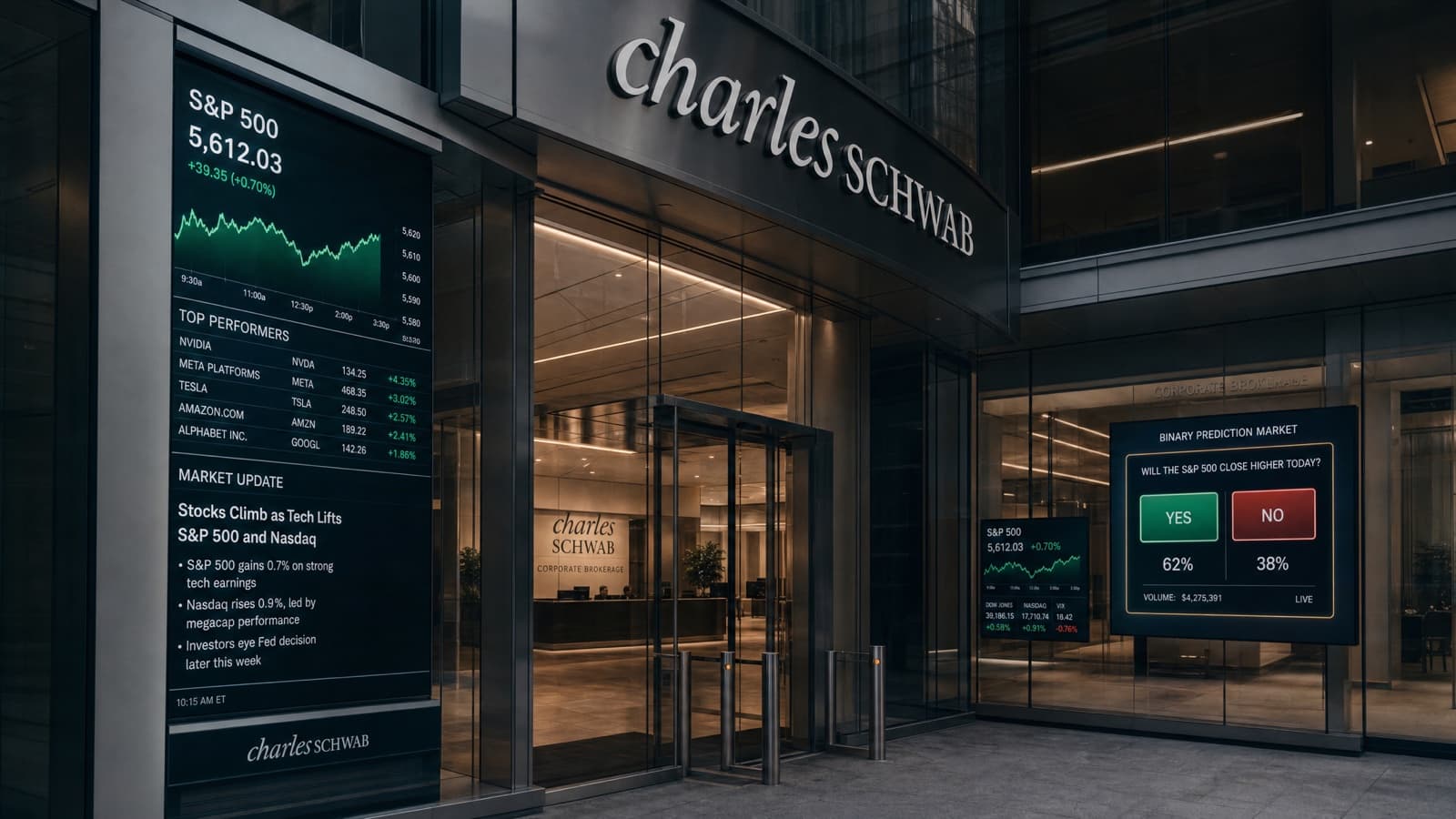
When Charles Schwab, one of America's largest brokerages, announced it would "likely have prediction markets" during its first-quarter 2026 earnings call, traders on Kalshi and Polymarket wagered on the question: would Schwab actually follow through? The answer arrived Friday, June 19, when the Wall Street Journal reported — and Reuters confirmed — that Schwab has partnered with Cboe Global Markets to launch binary-style options contracts tied to the S&P 500, with a product rollout expected in the coming months.
This is not another sports betting conversion play. Schwab is not chasing World Cup volume or NBA Finals liquidity. Its entry is narrower, more deliberate, and in some ways more consequential: it brings prediction-market mechanics to the $11.8 trillion in client assets and 47.2 million accounts already sitting inside Schwab's ecosystem — the mainstream retail investor who has never heard of Kalshi.
How the Product Works
The contracts Schwab and Cboe are building function as binary options on the S&P 500 index. Each contract poses a yes-or-no question: will the S&P 500 close above a specified price level by a set time? If your answer is right, you receive a fixed cash payout. If you're wrong, the contract expires worthless.
That structure — fixed payout or nothing — is mechanically similar to event contracts on Kalshi, where a contract on "Will the Fed cut rates in June?" settles at $1.00 if yes and $0.00 if no. The core idea is identical: trade a probability, not a price.
Schwab and Cboe are also in discussions about a related product using Cboe's "Plus Zone" feature, which would allow traders to earn a partial payout if their prediction is close to the final outcome even when the index doesn't land exactly at the target level. If you predicted the S&P 500 would close at 5,800 and it closed at 5,795, Plus Zone could still generate a partial return rather than total loss. That adds a nuance that current Kalshi-style event contracts don't typically offer.
According to the Wall Street Journal, the companies are also discussing expanding the lineup beyond the S&P 500 to other financial benchmarks — think Treasury yields, volatility indexes, or major sector ETFs — though no specifics have been announced.
Why "Finance-First" and Nothing Else
The more important part of this story isn't how the product works — it's what it deliberately excludes.
Schwab CEO Rick Wurster has been consistently clear: his firm's prediction market product will not include sports, politics, or entertainment contracts. During the Q1 2026 earnings call, Wurster acknowledged Schwab would "likely have prediction markets," but drew a hard line against the betting-as-investing framing that has drawn regulatory scrutiny to platforms like Kalshi and Polymarket.
Cboe shares this disposition. When Cboe signaled its intent to enter prediction markets in late 2025, it specifically highlighted economic data and financial market outcomes — not match winners or election results. For Cboe, whose primary business is derivatives and options on equities and volatility indices, a financial-only prediction market is a natural extension of what it already does.
This "finance-first" model sidesteps the most contentious legal battles in the industry. The sprawling litigation over whether sports event contracts constitute illegal gambling under state law — the lawsuits in Michigan, Kentucky, Illinois, Ohio, and Minnesota — is simply not Schwab's or Cboe's problem. Their contracts tie to objectively verifiable market prices, regulated under existing securities and derivatives frameworks, not the contested gambling-vs.-derivatives debate that Kalshi and Polymarket are fighting state by state.
How This Differs From Kalshi and Polymarket
The structural differences matter for users comparing platforms.
Contract type: Schwab/Cboe will offer options-style contracts, which are regulated differently from the futures-style event contracts on Kalshi. Kalshi operates as a CFTC-designated contract market (DCM) offering swaps and futures. Cboe's binary options fall under a separate framework it already uses for other index options products. This is a meaningful distinction — and likely one reason Schwab chose Cboe over a direct partnership with Kalshi itself.
Scope: Kalshi currently offers thousands of active markets spanning economics, sports, politics, and pop culture — far broader than any single financial benchmark. Polymarket globally offers a similarly wide catalog. Schwab's product is expected to start with S&P 500 contracts and potentially a handful of other financial benchmarks. Users seeking a World Cup market or a bet on the next Fed rate decision in non-index terms should look elsewhere.
Distribution model: Kalshi and Polymarket built direct-to-consumer apps and grew through social media, influencer campaigns, and sports sponsorships. Schwab's product lives inside the brokerage account millions of investors already use to buy index funds and manage their retirement savings. There's no new app to download, no new account to open. That frictionlessness could drive adoption faster than either dedicated platform's growth curve.
Audience: Kalshi has aggressively marketed to the sports-betting demographic and active traders. Schwab's natural customer is a 45-year-old index fund investor who checks their portfolio quarterly. A yes/no bet on whether the S&P 500 finishes the week higher is a familiar concept wrapped in a familiar interface — which may prove more powerful than sports-market liquidity at converting first-time prediction market users.
Wall Street Has Already Committed Billions
Schwab's entry confirms what institutional capital flows have been signaling for over a year: prediction markets are no longer a crypto sideshow.
In October 2025, Intercontinental Exchange (NYSE: ICE) — the parent company of the New York Stock Exchange — made an initial $1 billion investment in Polymarket, securing a role as the platform's exclusive global distributor of event-driven data to institutional capital markets. In March 2026, ICE followed through with an additional $600 million investment, completing its planned commitment of close to $2 billion in Polymarket.
Separately, Kalshi raised approximately $1 billion in March 2026 at a valuation of roughly $22 billion — a figure underpinned by surging trading volumes during the NBA Finals and FIFA World Cup, with Kalshi's annualized revenue topping $2 billion according to reporting by The Information, confirmed by wire services covering the company's IPO discussions.
The institutional conviction is also visible in the legal fights. CME Group — which operates the largest futures exchange in the world — filed a lawsuit against the CFTC in June 2026 challenging the agency's approval of Kalshi's cryptocurrency perpetual futures contracts. Whether or not CME wins, the fact that the world's largest derivatives exchange is suing a federal regulator over a prediction market company's products signals how seriously the traditional finance world takes this space.
Cboe's approach is notably different from CME's. Where CME is litigating, Cboe is partnering. Rather than challenging new market entrants, Cboe is offering its exchange infrastructure, options expertise, and regulatory relationships as a platform for Schwab to build on. It's a bet that collaboration outcompetes litigation.
What Schwab Brings That No One Else Has
The prediction market industry's growth story through 2025 was driven by two factors: the 2024 U.S. presidential election and crypto-native user bases already comfortable with on-chain trading. Polymarket's $1 billion election-night volume came from a global user base comfortable with USDC wallets. Kalshi's March 2026 billion-dollar valuation came from being the only fully CFTC-regulated U.S. exchange with a sports-adjacent product during the NBA Finals and World Cup.
Schwab's entry opens a third channel entirely: traditional retail investors.
According to Reuters, Schwab manages $11.8 trillion in total client assets across 47.2 million accounts as of Q1 2026. That's roughly 10 times the scale of any dedicated prediction market platform's current user base. Converting even 5% of Schwab's existing account holders into prediction market traders would double the U.S. industry's user count.
Schwab also brings something no crypto-native platform can replicate: trust. The firm has operated under regulatory oversight for decades, holds significant SIPC and FDIC protections on other products, and markets itself explicitly to long-term investors. A Schwab-branded binary option on the S&P 500 carries a reputational weight that a startup's event contract does not — particularly for users who have read headlines about offshore platforms and crypto losses.
Platform Comparison: What Each Entry Point Offers
For traders now evaluating where to get prediction market exposure:
| Platform | Contract Type | Market Scope | U.S. Regulatory Status | Key Differentiator |
|---|---|---|---|---|
| Kalshi | Futures/Swaps (DCM) | Sports, Finance, Politics, Economics | CFTC-regulated | Broadest U.S. market selection |
| Polymarket US (QCX LLC) | Event contracts (DCM) | Sports only (U.S. users) | CFTC-regulated | Invite-only; global platform has broader scope |
| Schwab + Cboe (coming) | Binary options | S&P 500 + financial benchmarks | Existing options framework | 47M accounts, zero friction for existing customers |
| Robinhood | Event contracts | Sports, Finance, limited | CFTC-registered | Existing user base; limited selection |
| Interactive Brokers | Event contracts | Finance, Economics | CFTC-regulated | Institutional-grade tools |
No single platform does everything. The Schwab product will likely be the most accessible entry point for traditional investors but the narrowest in terms of available markets. Kalshi remains the broadest CFTC-regulated exchange for U.S. users who want both sports and financial markets in one place.
Frequently Asked Questions
When will Schwab's S&P 500 prediction market product launch? According to the Wall Street Journal report and Reuters confirmation from June 19, 2026, the product is expected to roll out to Schwab customers "in the coming months." No specific launch date has been announced. Schwab did not immediately respond to Reuters' request for comment.
Is this the same as betting on the stock market? Not exactly. A binary option on the S&P 500 lets you take a yes/no position on whether the index closes above or below a specific price level at a specific time. If you're right, you receive a fixed payout; if you're wrong, you lose what you paid. Unlike traditional stock trading, there's no fractional movement — the contract is binary. This is structurally similar to how Kalshi's event contracts work, though Kalshi uses a futures/swap structure while Cboe uses an options structure.
Does Schwab's product compete with Kalshi and Polymarket? Partially. For the specific category of financial-market event contracts — "Will the S&P 500 close higher this week?" — Schwab/Cboe will compete with similar markets on Kalshi. But Kalshi's strength is its breadth across sports, politics, and economic data. Schwab's product, at least initially, covers only financial indices and will not include sports or political markets.
Why Cboe and not CME for Schwab? CME Group, the other major options and futures exchange, is currently involved in litigation with the CFTC over Kalshi's perpetual futures approval. Cboe, by contrast, has positioned itself as a partner to the prediction market industry rather than a challenger. Cboe also has deep experience with retail-accessible index options products, including the VIX and various S&P 500 products, making it a natural fit for a retail-facing binary options product.
What's the "Plus Zone" feature? Plus Zone is a Cboe feature that allows traders to earn a partial payout even if their S&P 500 price prediction doesn't land exactly. Traditional binary options pay out in full or nothing; Plus Zone adds a middle tier for predictions that are close but not precise. The Wall Street Journal reported that Schwab and Cboe are discussing incorporating this feature into the product, though details aren't finalized.
Conclusion
Charles Schwab's entry into prediction markets is not the loudest story of the week — the World Cup is generating billions in trading volume and the regulatory battles across a dozen states are producing daily headlines. But it may be the most structurally significant announcement of the year for where prediction markets are heading.
Kalshi and Polymarket built the audience. ICE legitimized the asset class at the institutional level. Schwab is the bridge to the mainstream investor — the person who has never wagered on a World Cup match but checks their S&P 500 portfolio every morning.
When a brokerage managing $11.8 trillion decides prediction markets are worth building products for, the industry's long-term trajectory becomes substantially more clear.
Explore live S&P 500 and financial market event contracts on PredictionMarkets.us.
Sources & Verification
- Schwab/Cboe partnership, binary options structure, Plus Zone feature, finance-only scope, launch timing: Reuters, June 19, 2026 (citing Wall Street Journal)
- Schwab $11.8T client assets, 47.2M accounts (Q1 2026): Reuters June 19, 2026 (above)
- Schwab CEO Rick Wurster Q1 2026 earnings statement: Schwab Q1 2026 earnings call, April 2026
- ICE $600M additional Polymarket investment (March 27, 2026): Intercontinental Exchange press release, BusinessWire, March 27, 2026
- ICE initial $1B Polymarket investment (October 2025): ICE investor relations / Reuters October 2025
- Kalshi $22B valuation, $1B raise (March 2026): Reuters/Bloomberg March 2026
- Kalshi May 2026 monthly trading volume ($16.81B): Reuters, Bloomberg/The Block reporting