
When Prediction Markets Missed Wisconsin: What Crowley's Upset Reveals
How prediction markets missed David Crowley's August 11 Wisconsin primary upset — and what it reveals about primary forecasting accuracy.
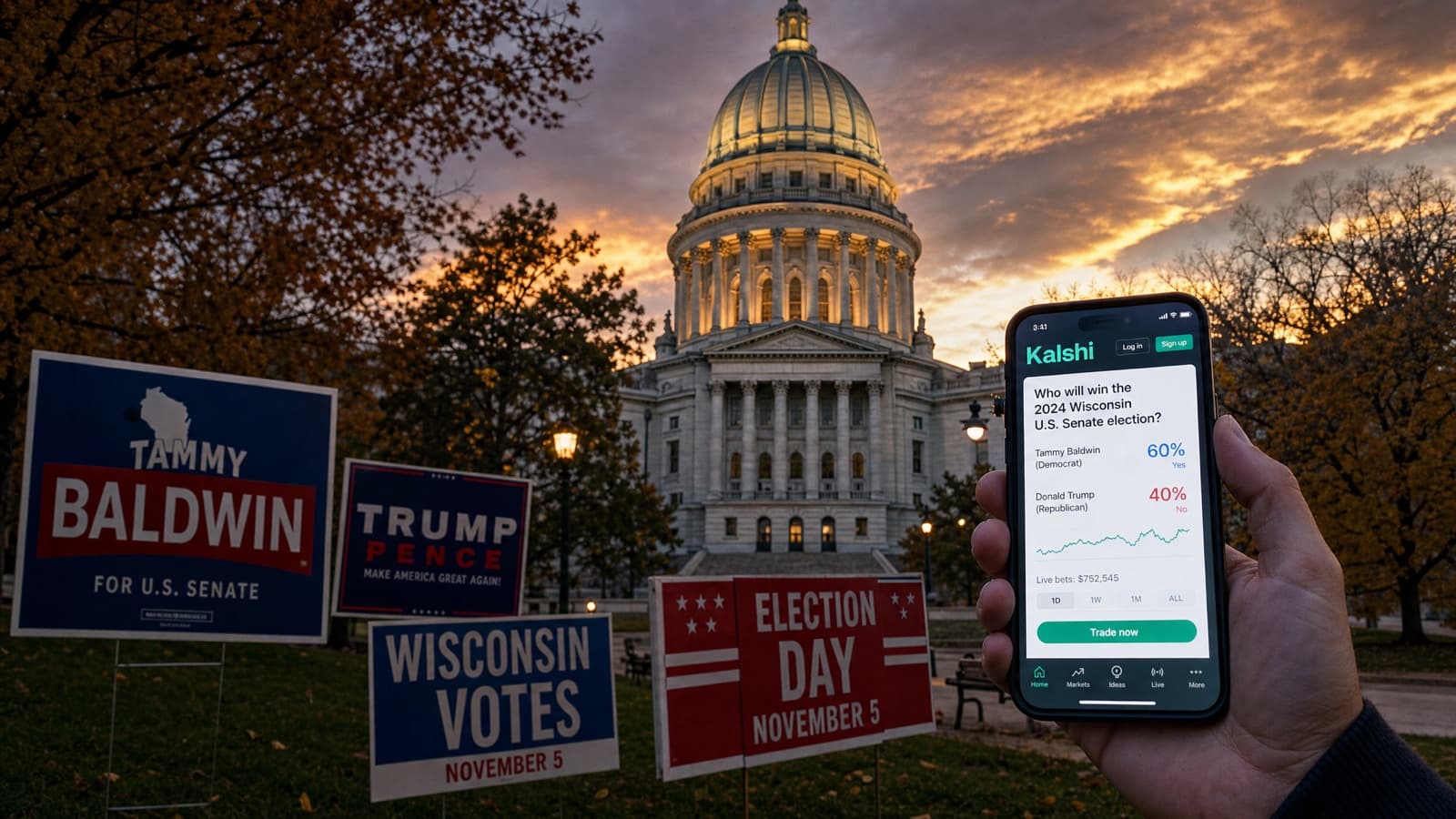
On the morning of August 11, David Crowley was the longest of long shots in Wisconsin's Democratic gubernatorial primary. Kalshi's market priced him at a single-digit probability of winning for weeks — the same picture polls painted. By the time results were finalized, Crowley had narrowly defeated progressive challenger Francesca Hong to become the Democratic nominee for governor.
He wasn't alone. In a primary season defined by upsets, Wisconsin became one of several 2026 races where prediction markets and polls agreed — and both missed the outcome. The pattern is fueling a pointed debate among political strategists, researchers, and the platforms themselves about what prediction markets actually measure in primary contests.
The Crowley Upset: What the Markets Said
Kalshi's market for the Wisconsin Democratic gubernatorial nomination listed Crowley's odds at single-digit percentages for weeks heading into the August 11 vote. The platform, which operates as a CFTC-designated contract market, aggregates real-money bets from traders who believe they have an information edge on the outcome.
But Crowley, Milwaukee County Executive, had briefly suspended his campaign before re-entering the race with the backing of outgoing Governor Tony Evers — a late-breaking development that markets failed to fully price. He edged Hong, a progressive state assemblywoman who had been the polling and market favorite, in one of the cycle's cleaner upset stories.
"It seems to me now that they're much more reaction markets than prediction markets," said Eddie Vale, a Democratic political consultant who worked on Crowley's campaign, in an interview with NOTUS. "The theory was, if people had to put money or skin in the game, sort of the collective wisdom and knowledge was going to help predict things, but it's pretty clear that people are just betting in reaction to seeing the news, seeing a new poll."
A Pattern of Missed Primary Calls in 2026
Wisconsin was not an isolated case. NOTUS documented multiple high-profile primary misses across prediction markets this cycle:
Florida Democratic Senate Primary: Kalshi projected insurgent democratic socialist state Rep. Angie Nixon at single-digit odds of winning. She won decisively — the Associated Press called the race as polls closed in the state.
Michigan Democratic Senate Primary (August 4): Polymarket projected progressive favorite Abdul El-Sayed at more than 98% odds the day before the vote, with a companion market projecting he would win by at least 15 percentage points. El-Sayed won — but by less than one percentage point over Rep. Haley Stevens. Both the outcome probability and the margin estimate were wildly off.
South Carolina Senate Republican Primary Runoff (August 26): Kalshi had Senator Darline Graham at approximately 56% when polls closed, and she won with more than $25.7 million in trading volume on the platform — one of the most liquid primary markets of the cycle. In this case, the market got the direction right.
The pattern: primary markets tend to track polling closely, meaning when polls miss, markets miss alongside them. In low-turnout primaries with late-breaking candidate dynamics — endorsements, suspensions, re-entries, abrupt shifts in endorser networks — that correlation becomes a structural liability.
The "Reaction Markets" Critique
Political consulting is coalescing around a specific critique of prediction markets in primary contexts. It isn't that platforms are corrupt or manipulated — it's that they largely aggregate the same publicly available information that operatives already hold.
"Polling can exist without prediction markets. Prediction markets cannot exist without polling," strategist John Carlson told NOTUS. "There is some value to them directionally, but there are some very clear weaknesses."
Charles Franklin, the director of the Marquette Law School Poll who has studied Wisconsin elections for decades, put it plainly in an NPR interview: "It's a wildly unrepresentative sample of the public." He noted that prediction market participants skew toward politically engaged, informationally active traders — not a cross-section of Wisconsin's electorate.
The practical result: primary markets function as a lagging indicator. When a new poll drops showing Hong ahead by twelve points, Kalshi traders update their positions. The underlying question — whether Crowley's Milwaukee base would punch above projected turnout numbers, or whether Evers' endorsement would move late-deciders — doesn't generate a polling signal, and so markets don't price it.
"Because they update hourly, well, literally, minute by minute, they're a very attractive, shiny object to rely on," Franklin told NPR. "But we don't have decades of experience with how accurate they are, in the same way that we have many decades of experience with polling."
Matthew Bartlett, a Republican strategist, offered a more direct warning in his NOTUS interview: "Win by the polls, die by the prediction markets."
Kalshi's Defense: Accuracy at Scale
Kalshi pushes back on the cycle-level critique. Elisabeth Diana, the platform's head of communications, told NOTUS that Kalshi is "more, actually, accurate than polling," and pointed to a Washington Post analysis of approximately 2,000 primary election markets that found general calibration: candidates priced at 75% probability won roughly 75% of the time across the full sample.
The company also cited the fake-poll episode that ran in parallel with the primary season as evidence of market resilience. When fabricated polls from a fictitious firm called Median Strategies circulated in August, Kalshi's markets barely moved. "Traders lose money if they act on bad information," Kalshi spokesman Jack Such told NPR. "While news outlets and campaigns touted the poll as real, the markets barely reacted at all."
The calibration defense has merit at scale. The aggregate 75% figure means markets are broadly well-calibrated across thousands of contests. Specific high-profile races can still be badly mispriced, and both claims can be true simultaneously — a well-calibrated system at the population level that systematically underperforms in specific contest types.
Primaries with late-breaking dynamics appear to be that specific type.
What Markets Miss in Primaries vs. General Elections
Political researchers point to structural reasons why primaries are harder for markets to price accurately. In a general election, the electorate is roughly defined: registered partisans plus independents within a predictable turnout range. In a primary, turnout composition is itself the core uncertainty — and it depends on GOTV operation quality, candidate enthusiasm, and hyper-local mobilization that rarely appear in publicly available signals.
Crowley's victory over Hong turned partly on Milwaukee-area mobilization and how Evers' endorsement moved late-deciders in a race with modest overall turnout. None of those variables were legible in the public data traders had access to.
The same dynamic appeared in Michigan. El-Sayed's near-miss came in a contest where registered Democrats were assumed to be the entire electorate, but the actual geographic distribution of support — and what Stevens' more conservative, suburban coalition looked like on election day — produced a margin that looked nothing like any public polling model.
"It appears that there really aren't any predictions here, they're just reacting belatedly to public information, like polls and news stories," Vale told NOTUS.
What Crowley's Win Means Now — On the Markets
Crowley faces Republican Rep. Tom Tiffany in the November 3 general election. Tiffany is a House Freedom Caucus member who voted against certifying the 2020 presidential results in Arizona and Pennsylvania. Governor Evers chose not to seek a third term, making this an open-seat race both parties have targeted from day one.
Post-primary, markets have substantially re-rated Crowley. As of late August, Kalshi had him at approximately 79% and Polymarket's global platform listed him at 81%, reflecting the latest Marquette polling that showed him leading Tiffany by five points among likely voters (49% to 44%) — though the race was tied among all registered voters at 44% each.
The general election offers a far larger and more predictable electorate than Crowley's primary did. Cook Political Report classifies the race as a toss-up. Sabato's Crystal Ball shifted it to Leans Democratic following Crowley's primary victory. The prediction markets sit closer to the Sabato framing — roughly 80% for Crowley — implying meaningful probability that Tiffany can still win a race that polls show is within the margin of error.
The data center controversy adds complexity that polls are actively measuring but markets are still digesting. Both candidates are attempting to make the other appear as the pro-data-center candidate ahead of a November electorate that shows 65% support for a temporary moratorium, according to Marquette polling.
Frequently Asked Questions
Why did prediction markets miss David Crowley's Wisconsin primary win?
Kalshi had Crowley at single-digit odds for weeks before the August 11 primary. The platform was tracking poll consensus, which showed progressive challenger Francesca Hong ahead by wide margins. Crowley's re-entry into the race with Governor Evers' endorsement and Milwaukee-area turnout advantages were not legible in the publicly available data traders used to set prices.
Does the Wisconsin miss mean prediction markets don't work for elections?
Not categorically. A Washington Post analysis of approximately 2,000 primary markets found that markets were generally calibrated in aggregate — candidates given 75% probability won roughly 75% of the time across the full sample. Wisconsin, Florida, and Michigan reflect how specific primary markets can be badly mispriced even when the broader system shows reasonable aggregate accuracy.
Are prediction markets better or worse than polls at forecasting primaries?
They tend to track polls closely, which means when polls miss, markets typically miss alongside them. Political strategists argue that prediction market projections in primary contests largely lag public information — polls and news stories — rather than incorporating private information that would give markets an independent forecasting edge.
Which platforms have Wisconsin governor general election markets?
Kalshi, the CFTC-designated contract market, carries the Wisconsin gubernatorial general election market. Polymarket's global platform also lists the race. Note that Polymarket's US entity, QCX LLC d/b/a Polymarket US, covers sports event contracts only and does not offer election markets to US users.
Conclusion
Wisconsin's August 11 Democratic primary is a clean case study in prediction market limitations. Both the markets and the polls had David Crowley as a near-certain loser. He became the Democratic gubernatorial nominee.
The honest takeaway isn't that markets are broken — it's that they face the same information constraints as polling in low-signal primary environments, and late-breaking candidate dynamics like endorsements, campaign suspensions, and re-entries can move outcomes in ways that real-money aggregation doesn't price any better than surveys do.
Crowley is now the approximately 80% general election favorite. The November contest offers a far more legible electorate than his primary did. Whether the markets' current confidence is better calibrated than their previous single-digit skepticism is a question Wisconsin voters will settle in three months.
Sources & Verification
- Kalshi Wisconsin Democratic Primary Market — Crowley projected at single-digit probability for weeks; won August 11
- NOTUS, "Political Operatives Warn Campaigns: Don't Trust Prediction Markets," August 26, 2026
- NPR, "What a fake poll reveals about worries around prediction markets and the midterms," August 28, 2026
- Newsweek, "Tom Tiffany's chances of beating David Crowley to flip Wisconsin — Polls," August 26, 2026
- Marquette Law School Poll, Wisconsin August 2026 — Crowley leads Tiffany 49%-44% likely voters, conducted August 12-20, 2026