
Election Officials Are Scrambling as Prediction Market Odds Shake Voter Confidence
New survey: 38% of likely midterm voters would lose confidence if results differ from prediction market odds. Officials nationwide are now drafting policies.
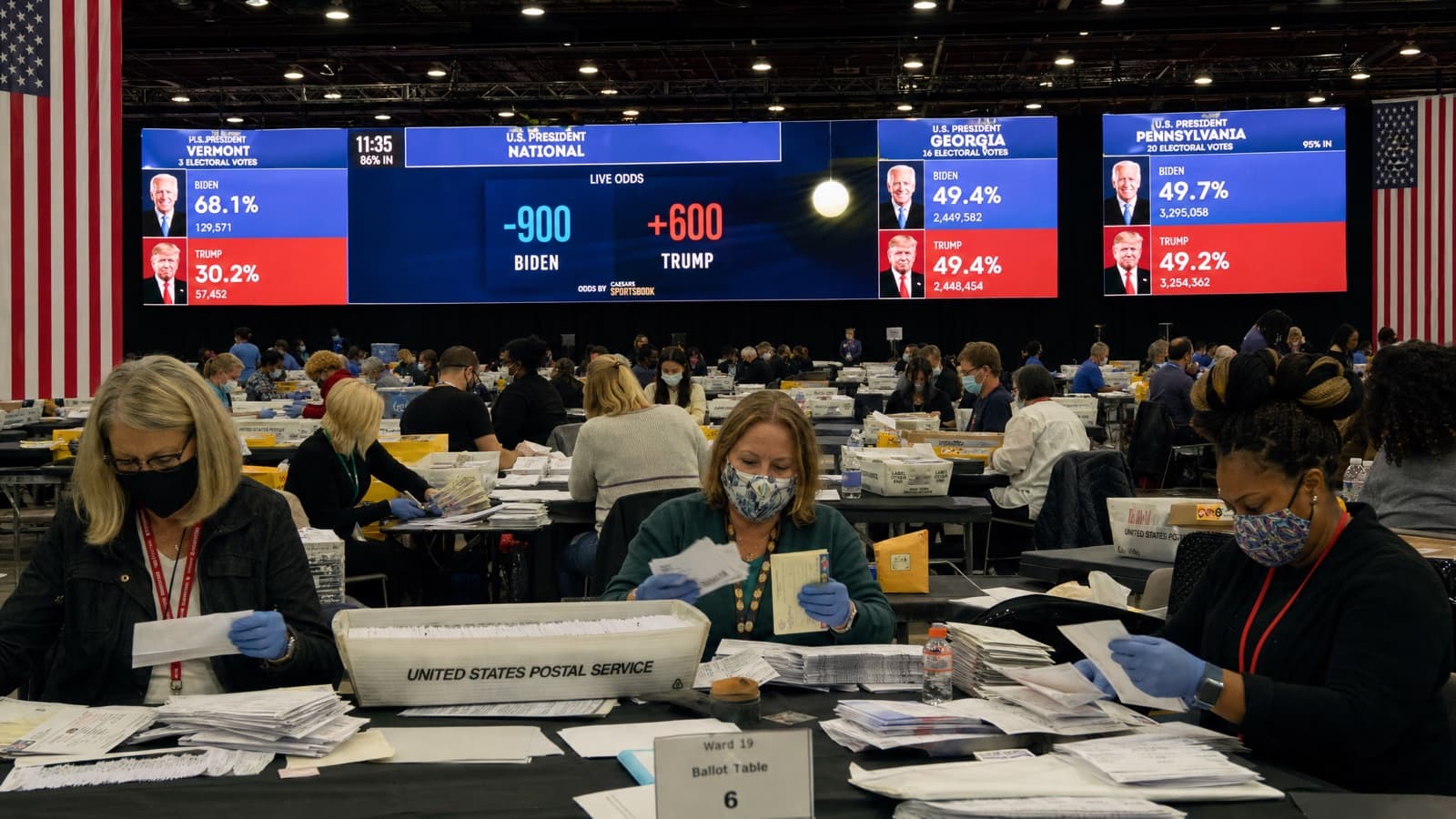
Election officials in Los Angeles County are examining whether to ban their own staff from wagering on prediction markets. Delaware County, Pennsylvania has already updated its poll worker oath to require employees to affirm they haven't bet on any race they will help administer. And a new national survey finds that roughly four in ten likely midterm voters say they would question the validity of official results that diverge from what prediction markets predicted.
The 2026 midterms arrive with a new variable that no election administrator in American history has had to manage: real-time, publicly visible market odds on every major race — odds that millions of Americans are now watching alongside the vote count.
The LA Primary Incident That Changed Everything
The specific moment that put this issue on the national radar came during the Los Angeles mayoral primary in June.
As ballot counting progressed, Republican candidate Spencer Pratt began underperforming against prediction market expectations. Traders who had purchased contracts betting on his top-two finish watched the gap between market odds and actual vote totals widen. A handful of social media influencers with connections to prediction market platforms amplified the divergence — not as normal market recalibration, but as evidence of fraud.
"Crazy how much voter fraud can be done with mail in ballots," one user wrote on Kalshi's platform, according to the Los Angeles Times. Similar posts spread on other social channels. Kalshi subsequently required the influencers to delete posts that violated company guidelines. Polymarket directed affiliated creators to remove paid partnership labels from similar content.
The incident was, in the words of election administrator Ryan Logan, "the most prominent interaction of prediction markets and a U.S. election to date." His office is now gaming out every scenario where market odds diverge from ballot counts — and how to communicate with the public when it happens.
"The potential effect on confidence is significant," Logan said.
What Voters Actually Think Prediction Market Odds Represent
The deeper problem isn't the LA incident — it's the survey data behind it.
The Partnership for Large Election Jurisdictions (PLEJ), a nonpartisan organization representing the country's largest election jurisdictions, commissioned SurveyMonkey to poll 1,037 American adults between July 16 and 19. Of those, 867 identified as likely 2026 midterm voters. The findings, released July 29, are striking:
- 75% of likely midterm voters say prediction markets create confusion around elections
- 60% say prediction markets fuel inaccurate election information
- 45% believe market participants may have access to insider information about election outcomes
- 38% say a result that differs from market odds would reduce their confidence in the official outcome
- Fewer than 1 in 4 report high trust in prediction markets as a source of election information — compared with 64% who trust their state election officials
The most consequential finding: a substantial share of voters do not know what prediction market prices actually represent. Nearly four in ten believe the odds reflect either the number of votes currently counted, or official projections issued by state and local election officials.
They are neither. Prediction market prices are determined entirely by what traders — people willing to stake real money on an outcome — collectively expect will happen. They carry no official weight. They are not vote projections. A market moving to 80% does not mean a candidate is winning 80% of ballots. It means traders collectively believe there is an 80% probability they will win.
When this distinction is murky to voters, a market diverging from an eventual result becomes instant fodder for doubt — regardless of how well-administered the election actually was.
What the Markets Are Saying
Live market view -- track Congressional balance of power prices in real time:
Nearly $200 million has been wagered on the 2026 midterm elections across prediction market platforms, according to figures cited by the Partnership for Large Election Jurisdictions. The volume reflects growing participation but also the scale of the trust problem: the more money wagered, the higher the public's perceived stakes when odds and results diverge.
On Polymarket, as of August 12, the balance of Congressional power markets showed: Democrats sweeping both chambers at 50%, a Republican Senate with a Democratic House at 38%, a full Republican sweep at 12%, and a Democratic Senate with Republican House at just 1.7%. These are prices on Polymarket's global platform, which offers full election coverage. (Polymarket's US-licensed entity, operating as QCX LLC, offers sports markets only and is not involved in these election contracts.)
Kalshi launched what it termed a "Midterms Hub" in late July — a central destination combining its market forecasts with polling data, fundraising figures, and news. The platform reports that approximately 75% of its visitors view election odds without placing any bets, using the markets as an information source rather than a trading vehicle.
Live market view -- Senate control odds, updated in real time:
How Election Officials Are Responding
The policy landscape is evolving quickly, though unevenly.
Delaware County, Pennsylvania has moved farthest. Election officials added a prediction market provision to the poll worker oath — employees must now affirm they have not wagered on any election in which they will serve an administrative role. Election officials there believe this is among the first such provisions anywhere in the country.
Orange County, California Registrar of Voters Bob Page advised his staff before the June primary — and plans to do so again before November — that participating in election markets could create a conflict of interest under county code. "Staff betting could be seen by the public as improper," Page told reporters. It "would undermine trust in the integrity of the election."
Los Angeles County is in a research phase for a formal insider trading policy covering election workers. The county is simultaneously developing public messaging frameworks for different market-divergence scenarios and building prediction market considerations into security planning for the post-election counting period.
Maryland and Wisconsin are also examining policies, according to the Los Angeles Times, though both remain in early stages.
The emerging approach — insider trading rules for election workers combined with public education — represents a pragmatic middle ground. Officials are not attempting to ban election markets. They are attempting to manage the consequences of those markets existing.
What the Platforms Are Doing
Both Kalshi and Polymarket have leaned into election coverage while acknowledging the responsibility that comes with it.
Kalshi's Midterms Hub is the clearest example: by surrounding raw price data with polling context, news, and explanatory material, the platform is attempting to help users understand what the prices represent — and what they don't. The company says it has opened roughly 200 investigations of possible market manipulation over the past year.
"By shifting focus from 'what people say' to 'where they put their money,' and filtering out social media noise and pundit bias, we are providing a level of clarity and predictive power that cannot be matched," Kalshi spokesperson Dani Lever said in comments to the Los Angeles Times. "Kalshi has become a leading indicator of where elections are headed."
Critics are less convinced. The statutory framework for policing insider trading in prediction markets remains unsettled. Unlike securities markets, where insider trading is a clearly defined federal crime, the rules for prediction markets are still being written.
The Expert Debate: Forecasting Tool or Democratic Risk?
The academic research is more favorable to prediction markets than the PLEJ survey might suggest — but also more nuanced.
Economist Korey Strumpf, whose research spans 30 years of prediction market data, argues that by his analysis, there is no evidence the markets have ever influenced a U.S. election outcome. Serious traders, he notes, conduct substantial research before staking money, meaning informed bets tend to drive prices.
But the Texas GOP Senate primary offered a more ambiguous data point. During the race, one candidate's market odds suggested a comfortable win — only for the actual vote to produce a near-tie that forced a runoff. The episode illustrated that accuracy at the macro level doesn't guarantee accuracy in specific, thinly traded markets.
Ilya Beylin, a professor at Seton Hall Law School who studies prediction market oversight, raised a systemic concern in a Reuters interview: "We may see a slow response or we may see no response if and when insider trading happens in the midterms." Suspicious trades, he warned, "would undermine Americans' faith in democracy at a time when polls show many already worry the system is in danger."
Pew Research Center found in early August that 55% of Americans are confident the November midterms will be conducted fairly and accurately — down from 61% ahead of the 2024 presidential election and 64% in 2022. Prediction market confusion is one contributing factor in that declining baseline, alongside broader concerns about federal oversight and redistricting.
Aaron Klein, senior fellow at the Brookings Institution's Center on Regulation and Markets, framed the stakes plainly: "The top goal of a society is to have free and fair elections. At a time in our nation's history where people are doubting the integrity of elections and foreign governments are stoking those flames, we ought to be pretty careful."
FAQ: Prediction Markets and the 2026 Midterms
Q: Do prediction market odds reflect actual votes being counted? No. Prediction market prices reflect the collective expectations of traders who have staked real money on outcomes. They are updated in real time as traders buy and sell contracts — not as votes are cast or counted. A price of 65 cents means traders collectively believe there is a 65% probability of that outcome.
Q: Which US-regulated platforms offer midterm election markets? Kalshi, a CFTC-designated contract market, offers a broad range of 2026 midterm election markets including Congressional balance of power, Senate races, and gubernatorial contests. Polymarket's global platform also offers extensive election coverage, though US residents can only access its sports markets through the CFTC-licensed QCX LLC entity.
Q: Why are some election officials banning staff from wagering on prediction markets? To prevent both actual conflicts of interest and the appearance of impropriety. An election worker with a financial stake in a race's outcome could face pressures — real or perceived — that compromise their impartiality, or that voters could perceive as compromising it.
Q: Are election prediction markets legal? At the federal level, CFTC-licensed exchanges like Kalshi may offer election event contracts. Several states have challenged this in court, arguing that election markets constitute gambling under state law. Multiple federal cases are pending, with courts so far reaching mixed outcomes.
Q: Should prediction market odds change how I interpret election results? They shouldn't. Election results reflect actual votes cast by eligible voters. Prediction market odds reflect what a self-selected group of traders believes will happen. When the two diverge, the vote count is authoritative. The market was simply wrong — as markets are, regularly.
What to Watch Between Now and November
The November midterms will be a test case for whether prediction markets and election administration can coexist without amplifying distrust. The key variables to watch:
- Insider trading enforcement — Whether CFTC or platform-level surveillance catches any suspicious trades before or during the election
- Public messaging — Whether Kalshi, Polymarket, and other platforms pro-actively educate users about the difference between market odds and vote projections
- Official divergence management — Whether jurisdictions like LA County have their public communications infrastructure ready when market odds and ballot counts separate
- Media framing — Whether news coverage treats market divergence as a fraud signal or as normal probabilistic calibration
The PLEJ survey's most urgent number isn't the 38% who would lose confidence in a diverging result. It's the nearly four in ten voters who don't understand what market prices represent. That's an education problem — and the window before November is closing.
Track live midterm prediction market prices on PredictionMarkets.US, updated from Kalshi and other regulated platforms.
Sources & Verification
- PLEJ survey statistics (75%, 38%, polling methodology, $200M figure): Partnership for Large Election Jurisdictions press release, July 29, 2026
- LA County, OC, Delaware County official responses; LA primary incident; Kalshi/Polymarket platform responses: Los Angeles Times, August 12, 2026
- Insider trading watchdog concerns; Seton Hall Law professor Ilya Beylin quotes: Reuters, June 8, 2026
- Election confidence decline (55%): Pew Research Center, August 5, 2026
- Congress watching prediction markets; Davina Hurt, Aaron Klein, Korey Strumpf expert quotes; Maryland/Wisconsin examining policies: Los Angeles Times, June 16, 2026
- Balance of power midterm odds (August 12, 2026): Polymarket
- Kalshi platform and Midterms Hub: Kalshi.com