
The Day Prediction Markets Made Everyone's Front Page
On September 11, 2026, the NYT published two prediction market explainers in one day alongside Rolling Stone and Bloomberg. Here's what that media moment means.
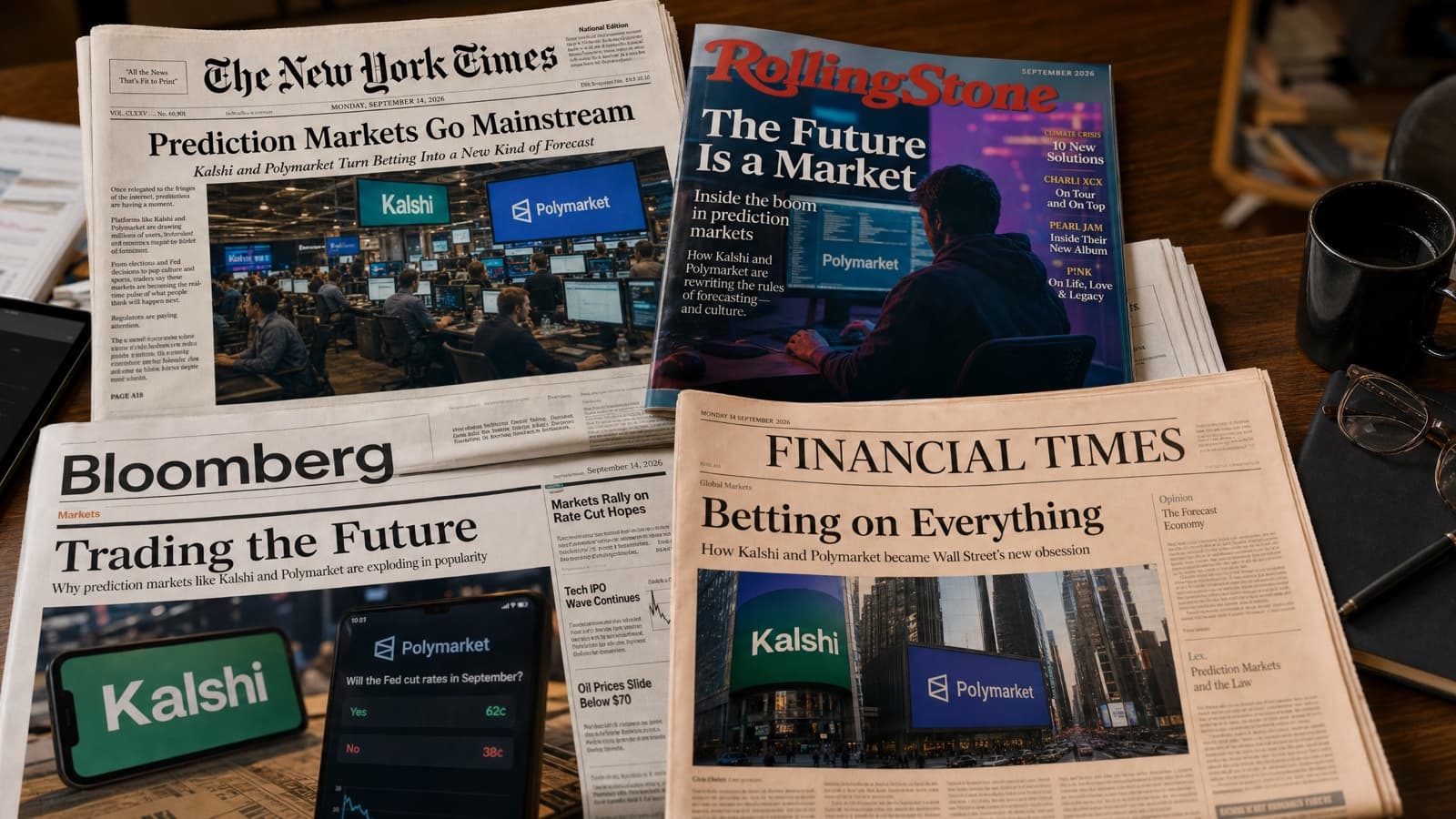
September 11, 2026 was not an ordinary Thursday for the prediction markets industry.
By early afternoon, The New York Times had published two separate, full-length pieces about Kalshi and Polymarket — in different sections of the paper, by different reporters, filed simultaneously. Rolling Stone had dropped a culture feature arguing the platforms were deliberately manufacturing viral moments to embed themselves in American life. Bloomberg had covered Cantor Fitzgerald's move to bring institutional Wall Street clients into the space. And The Athletic had traced a $662,050 trail of prediction market hedges linked to college football coaching bonuses.
None of those outlets seemed to notice the others doing it on the same day. That's the point.
That kind of convergence doesn't happen by accident — and it doesn't happen to industries that haven't arrived. September 11, 2026 may be remembered as the day prediction markets stopped being a niche and became America's business story.
Two New York Times Stories. One Day. That's Never Happened Before.
The Times doesn't normally run two editorial pieces on the same niche topic in a single news cycle. When it does, it signals the topic has reached a cultural threshold — the kind editors reserve for climate change, AI, or cryptocurrency at its peak.
The first piece, "What Are Kalshi and Polymarket?," ran in the Times' US section as a full primer for a general audience. The article explained how event contracts work: a yes-or-no question, prices between $0 and $1, with the price representing the crowd's implied probability of an outcome. It noted that the platforms "have become cultural phenomena over the past year as they have surged in popularity," and credited them with helping make the 2026 FIFA World Cup "the largest gambling event ever."
That superlative — the largest gambling event ever — attached not to a major Las Vegas operator or offshore betting exchange, but to two Silicon Valley-backed prediction market startups. A year ago that sentence would have seemed absurd.
The second Times piece, "How Minnesota Became the Front Line in the Fight Over Prediction Markets," ran in the Business section and investigated the ground-level politics of state opposition. Minnesota was the first state to pass a law specifically banning Kalshi and Polymarket. The article traced the origin of that law to teachers complaining to state officials that underage students were downloading the apps, and to a state attorney general who had grown worried that the platforms had become a backdoor to sports betting in a state that had never legalized it.
Two reporters. Two sections. Two completely different angles. Same day.
Rolling Stone Digs Into the Culture Playbook
Also on Thursday, Rolling Stone published "Prediction Markets Are Buying Their Way Onto the Internet's Front Page" — a deep culture feature with a more skeptical edge than anything the Times ran.
The piece's central argument is that Kalshi and Polymarket aren't just growing organically. They're engineering their cultural presence. The viral moment that anchored the article: after the Knicks' championship run, when 23-year-old fan MD Ahnaf Hossain grabbed a street interviewer's green microphone outside Madison Square Garden and shouted, "My mayor Muslim/My bagels Jewish/My Christian Dior/Knicks in four!" — accumulating 7 million views on TikTok before spreading everywhere.
Those street interviewers were hired by Kalshi specifically to capture that kind of moment. The clip was designed to be organic-feeling; the infrastructure behind it was anything but.
The same strategy played out during the Love Island U.S.A. finale in July, when Kalshi built targeted ads to look like the fan content already circulating — and watched trades on the show hit $77.3 million. "We've seen a lot of new users come in through these new cultural markets," a Kalshi spokesperson told Rolling Stone. "We think [it's] important that when [people] think of Kalshi, they associate Kalshi with being part of culture."
New York University marketing professor Jared Watson observed that prediction markets had "sterilized some of those perceptions [around] gambling" — framing themselves as information sources before asking users to place wagers on them.
The strategy is working whether critics like it or not. The same day Rolling Stone published its skeptical take, the piece was circulating across social media alongside the Times explainers, adding fuel to the very cultural moment it was critiquing.
Wall Street Is No Longer Watching From the Sidelines
While the culture press was debating marketing tactics, Bloomberg was tracking the institutional side of the same story.
Cantor Fitzgerald, one of Wall Street's most connected broker-dealers, announced a partnership with Kalshi on September 11. Chairman Brandon Lutnick put it bluntly in a Bloomberg Television interview: "We're just helping to bring our clients — the biggest institutions — into that space. We think it should be great for both sides."
Cantor Fitzgerald is not a crypto-adjacent firm or a fintech upstart. It's a century-old registered broker-dealer known for government securities, investment banking, and prime brokerage. When an institution with that pedigree publicly endorses a prediction market partnership, it changes the terms of the debate. The question is no longer whether Wall Street will engage with prediction markets. That question has been answered. The question now is how quickly.
This follows a pattern that has accelerated through 2026: Galaxy Digital launching an institutional over-the-counter prediction market desk, FalconX providing prime brokerage infrastructure for block trades on Polymarket, Tradeweb and FIS building connectivity to event contract exchanges. Cantor Fitzgerald is the most establishment name on that list.
The Athletic Finds Prediction Markets Inside College Sports Finance
The same week, The New York Times/Athletic published a story that illustrated just how deeply Kalshi had penetrated mainstream sports business infrastructure. An insurance company had placed five trades totaling $662,050 on LSU reaching various stages of the college football postseason — trades that aligned closely with the bonus triggers in LSU's contract with head coach Lane Kiffin.
The trades were arranged through Game Point Capital, a firm that sells insurance policies to athletic programs looking to hedge coaching bonuses. Game Point CEO Will Hall told The Times in June that his company was arranging "millions of dollars' worth of hedges" through Kalshi, describing them as cheaper and more flexible than traditional insurance structures.
The story raised questions about transparency and undisclosed hedging in college athletics. But those questions would not exist if Kalshi weren't already embedded in the financial infrastructure of American sports. The instrument being described — a CFTC-regulated event contract used to hedge a coaching performance bonus — simply didn't exist two years ago.
What This Coverage Means
The simultaneous arrival of the Times, Rolling Stone, Bloomberg, and The Athletic in a single week is significant for a few reasons.
The "what is this?" phase is over. Every piece published Thursday included a basics explainer for readers encountering these products for the first time. That boilerplate is still necessary — but the fact that major outlets are explaining them at all means prediction markets have cleared the editorial threshold for unavoidable topics. Editors at the Times don't assign explainers to things that don't matter.
The accountability press has arrived — and that's a sign of legitimacy. Rolling Stone's skeptical take on manufactured virality, the Times' investigation of underage access in Minnesota, The Athletic's questions about hedging transparency — these are not puff pieces. They're the kind of accountability journalism that follows institutions once they're established enough to be worth scrutinizing. Banks get it. Social media companies get it. Prediction markets get it now.
The political framing has become a secondary story. Both major Times pieces mentioned Donald Trump Jr.'s involvement — he joined Kalshi as an adviser receiving shares worth more than $300,000, and has invested in Polymarket through 1789 Capital, his venture capital firm. But neither piece led with it. The Trump connection has been absorbed into the broader industry narrative. Prediction markets are no longer primarily a "Trump-adjacent" phenomenon in the mainstream press; they're a regulated financial industry with their own institutional investors, legal battles, and marketing controversies.
The Regulatory Picture Remains Complicated
None of this mainstream attention resolves the underlying legal conflict that ran through most of Thursday's coverage. The 9th U.S. Circuit Court of Appeals in San Francisco recently ruled that states can regulate prediction markets — directly contradicting the 3rd Circuit in Philadelphia, which ruled in April that event contracts are financial swaps protected from state law under federal preemption. Nevada restricted Kalshi's sports markets. A Seattle state judge barred Kalshi from most operations in Washington State.
The circuit split — one court saying states have authority, another saying they don't — is the kind of conflict that typically forces a Supreme Court resolution. New Jersey has already petitioned the Court. Until that happens, or until Congress passes legislation like the CLARITY Act, prediction markets will operate in a state of productive legal uncertainty: mainstream enough to generate a wave of major media coverage on a single Thursday, contested enough that the rules change depending on what state you're in.
What This Means for Traders and Newcomers
If you've been watching from the sidelines wondering whether prediction markets are a legitimate venue, the September 2026 media moment provides useful context.
Institutions are entering. A century-old Wall Street broker-dealer is building access. The country's largest newspaper assigned multiple reporters to the beat on the same day. Corporate clients are using these markets to hedge real financial exposures. These are not the characteristics of a fringe product on the verge of regulatory extinction.
At the same time, state-level access remains unsettled in a handful of markets. Checking current platform availability in your state before depositing remains important — PredictionMarkets.US maintains a running state-by-state access tracker updated as court rulings and enforcement actions move. For a side-by-side view of how Kalshi and Polymarket compare on fees, market selection, and regulatory standing, the full platform comparison breaks it down.
The mainstream press arrived Thursday. Whether it came to celebrate or scrutinize, it showed up in force. That, by itself, tells you where this industry stands.
Frequently Asked Questions
Why did the New York Times publish two separate prediction market pieces on the same day? Editors at major outlets assign simultaneous pieces on the same topic when that topic has become unavoidable — when multiple reporters are developing stories independently because sources are talking and events are accelerating. Two NYT desks covering prediction markets on the same day reflects scale, not coordination.
What did Rolling Stone's piece actually argue? That Kalshi and Polymarket are deliberately manufacturing viral cultural moments — engineering organic-seeming content to embed themselves in popular culture in ways that will persist regardless of regulatory outcomes. The piece is skeptical of the tactic but implicitly acknowledges it's working.
Is Cantor Fitzgerald's involvement in prediction markets unusual? Yes. Cantor Fitzgerald is a traditional Wall Street institution, not a crypto firm or fintech startup. Its partnership with Kalshi to route institutional client order flow into event contracts is one of the most significant mainstream finance endorsements the industry has received. Earlier institutional entrants — Galaxy Digital, FalconX — were more crypto-adjacent. Cantor is the real Wall Street.
What does the circuit court split mean for traders today? In practical terms, it means access rules may differ depending on your state and which federal circuit governs it — and those rules may change again if the Supreme Court takes a case. Most US users outside states with active enforcement actions can access these platforms without restriction, but checking current status before depositing is always advisable.
How significant is it that insurance companies are hedging coaching bonuses through Kalshi? Very. It means prediction market contracts are being used as bona fide financial instruments by institutional actors with real financial exposures — not just retail bettors. That's a different category of use case, and it strengthens Kalshi's legal argument that event contracts are financial swaps, not gambling products.
The Bottom Line
On September 11, 2026, the mainstream American press decided prediction markets were a story worth telling — simultaneously, and from four different angles. Two New York Times pieces. Rolling Stone. Bloomberg. The Athletic. One industry. One week.
That kind of media convergence doesn't arrive on industries that aren't real. September 11, 2026 isn't the day prediction markets were born. It's the day they stopped needing to explain themselves.
Sources & Verification
- Two New York Times prediction market pieces published September 11, 2026: "What Are Kalshi and Polymarket?" and "How Minnesota Became the Front Line in the Fight Over Prediction Markets"
- Rolling Stone culture feature: "Prediction Markets Are Buying Their Way Onto the Internet's Front Page" — published September 11, 2026; Knicks/Hossain clip, Love Island volume ($77.3M), and NYU professor Jared Watson quote all from this piece
- Cantor Fitzgerald / Kalshi partnership and Brandon Lutnick quote: Bloomberg — "Cantor Making Predictions Push for Firms, Brandon Lutnick Says" — published September 11, 2026
- LSU/Kiffin insurance hedge ($662,050 in five trades): The New York Times / The Athletic — published September 4, 2026; Game Point Capital CEO Will Hall quote confirmed in same article
- 9th Circuit / 3rd Circuit split, Minnesota law, Trump Jr. adviser role (shares >$300,000): The New York Times, September 11, 2026 ("What Are Kalshi and Polymarket?" — same link above)
- World Cup "largest gambling event ever" attribution: The New York Times, September 11, 2026 (same link above)