
Prediction Markets Are Now Treated Like the Stock Market. Here's Proof.
Microsoft just added prediction markets to its SEC-filed insider trading policy. Goldman Sachs banned its traders. Here's what a wave of corporate compliance rules says about where prediction markets are headed.
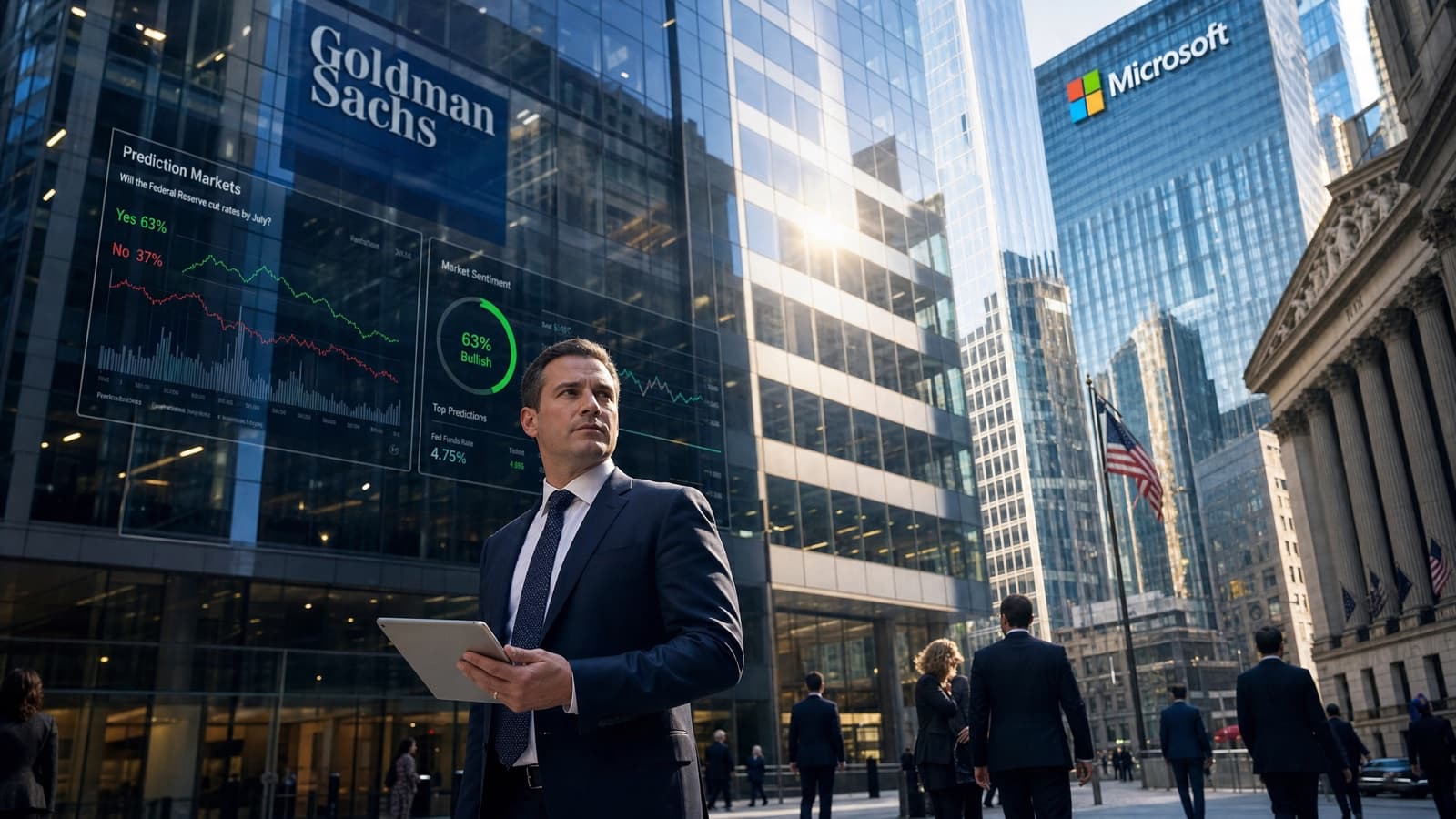
When Microsoft filed an updated trading policy with the Securities and Exchange Commission on July 30, 2026, it added three words that would have seemed absurd just eighteen months ago: prediction markets and event contracts.
The policy reads: "If you are in possession of such material, nonpublic information the securities laws and/or Microsoft prohibit you from trading in (or gifting) the securities of that company or engaging in other transactions that provide economic exposure to such company, including through prediction markets or event contracts."
No preamble. No carve-out. Prediction markets get the same sentence as stocks.
This is what mainstream legitimization looks like. Not a press release, not a Forbes profile — a quietly filed SEC document written by lawyers whose job is to minimize legal exposure. Microsoft's compliance team looked at Kalshi and Polymarket and decided they needed the same rules that govern trading in MSFT shares. That's a bigger deal than most of the prediction market news you'll read this year.
What Microsoft's Policy Actually Says
Microsoft's updated "General Insider Trading Policy" extends its insider trading restrictions to cover prediction markets and event contracts where an employee might possess material nonpublic information. According to the Business Insider report that surfaced the change, the policy covers not just information about Microsoft itself, but also about any company whose information an employee has obtained through their position — including competitors, customers, and vendors.
The policy is broad enough to cover markets on OpenAI, Anthropic, AMD, and any other company where Microsoft has relationships that generate nonpublic data. Given Microsoft's investment in OpenAI and its recent partnership with AMD for Helios racks, that universe of restricted companies is substantial.
Microsoft's policy stops short of Goldman Sachs's outright ban for many categories. Employees can still use prediction markets — they just can't use inside information to do it. That distinction matters: Microsoft is drawing a compliance line, not a prohibition.
The timing wasn't accidental. On Wednesday, both Kalshi and Polymarket ran markets for Microsoft's earnings call — traders wagered on which words CEO Satya Nadella would say. Kalshi's market alone attracted more than $165,000 in total trades. When you can bet on an earnings call the night it happens, and Microsoft employees know exactly what Nadella is going to say before he says it, a policy update stops being optional.
The Three Enforcement Cases That Built the Pressure
Corporate compliance teams don't move on instinct. They move on precedent. Three cases in 2026 gave Microsoft, Goldman, and every other major employer a reason to put prediction markets in their rulebooks.
The Army sergeant — April 2026. The first major enforcement action in the industry involved a U.S. Army Special Forces master sergeant named Gannon Ken Van Dyke, who allegedly used classified information about the operation to capture Venezuelan President Nicolás Maduro to place wagers on Polymarket. According to prosecutors, he turned a $33,034 bet into $409,881. The CFTC and DOJ brought parallel cases, establishing that insider trading law fully applies to prediction market contracts.
The Google engineer — May 2026. The case that accelerated everything. Michele Spagnuolo, a 36-year-old Italian citizen working at Google under the handle "AlphaRaccoon," allegedly used access to Google's internal "Year in Search" data to place 23 near-perfect bets on Polymarket's most-searched-person markets between October and December 2025, generating $1.2 million in profits. The CFTC filed a civil complaint seeking disgorgement and penalties; the DOJ unsealed criminal charges for commodities fraud, wire fraud, and money laundering on May 27, 2026. The charges carry a combined maximum sentence of 50 years in prison.
"As alleged, Spagnuolo violated the duties he owed to his employer and used Google's confidential business information to make more than $1.2 million in trading profits on Polymarket," said Jay Clayton, the U.S. Attorney for the Southern District of New York.
Polymarket said its market integrity infrastructure flagged Spagnuolo's suspicious trades and led to the referral that resulted in his arrest. That claim — that the platforms themselves are policing insider activity — would prove important for what came next.
The White House teleprompter operator — July 2026. Gabriel Perez, Trump's longtime teleprompter operator, is "no longer in the federal government" after allegedly using advance knowledge of presidential speeches to make more than $100,000 on Kalshi's "mention markets" — a product where traders wager on specific words or phrases that a public figure will say. According to the Associated Press, Perez was placed on unpaid leave earlier in July after ABC News first reported the activity, and was gone by July 28. Kalshi's surveillance team flagged the trades, froze his account, and referred the matter to the CFTC.
Three cases in three months, spanning the military, Big Tech, and the White House. Corporate legal teams had everything they needed.
Wall Street Was Already Writing New Rules
Two weeks before Microsoft acted, Goldman Sachs quietly updated its personal trading policy to ban employees from trading prediction market contracts tied to financial markets, elections, macroeconomic data, geopolitics, and specific companies — including Goldman itself. Reuters confirmed the policy on July 9, 2026; Bloomberg first reported it.
The Goldman ban is stricter than Microsoft's: it's a categorical prohibition, not a nonpublic-information caveat. Sports and entertainment prediction markets remain permitted, but anything touching finance or politics is off-limits for Goldman staff. Employees who violate the rule could face termination and may be required to forfeit gains or donate any profit above $200 to charity.
Reuters also confirmed similar policies at Morgan Stanley, JPMorgan Chase, and Bank of America, each with slightly different boundaries. JPMorgan's policy extends its existing prohibition on trading on nonpublic information to prediction markets explicitly. Bank of America recently provided updates to give employees more specific examples of prohibited activity, including company-specific and macroeconomic event contracts.
The pattern is consistent: every major financial institution is drawing the same line. Prediction market contracts are sensitive enough — and legally risky enough — that employees who handle nonpublic financial information need explicit rules about them.
Goldman's CEO David Solomon called prediction markets "super interesting" on a company podcast on January 20, 2026. Six months later, the firm had moved from curiosity to compliance restriction. That arc tells you everything about where the industry stands.
How the Platforms Are Responding
Both Kalshi and Polymarket now prohibit the use of nonpublic information to inform trades, and both have surveillance systems in place to detect suspicious activity.
The Perez case demonstrated Kalshi's enforcement in practice: the platform's surveillance team identified unusual trading patterns on its mention markets, froze more than $90,000 in profits, and referred the matter to the CFTC. Kalshi has since updated its platform requirements to ask users to disclose their place of employment — a direct response to the White House operator case.
Polymarket's performance in the Spagnuolo case was similar. The company said its market integrity infrastructure flagged AlphaRaccoon's trades before the arrest, and credited a criminal referral it made to authorities. Polymarket has made "2 out of 2 arrests in this industry resulted from our criminal referrals" a point of public pride.
This isn't just compliance theater. Platforms with real market integrity infrastructure are positioned differently than platforms without it. The Spagnuolo and Perez cases show that insider activity is both detectable and prosecutable — and that platforms that report it get favorable regulatory treatment in exchange.
What This Wave of Corporate Policies Signals
The instinct might be to frame these policies as headwinds for prediction markets — companies restricting employee access, compliance departments treating them like risky products. The opposite is true.
When Microsoft writes a prediction market prohibition into its SEC-filed insider trading policy, it's making a legal argument: prediction markets create real economic exposure to company information. That is a statement about the market's legitimacy, not its danger. Stocks carry the same rule because stocks are real. Prediction markets are now in that sentence.
Goldman's ban on financial and political contracts is the same signal. The bank isn't worried about sports bets on Kalshi. It's worried about its traders using information about deal flow, interest rate positioning, or client macro views to make money on event contracts. That's a concern that only exists if the contracts have real economic significance.
The trajectory is clear: prediction markets are being absorbed into the same compliance frameworks that govern every other financial product. That process is imperfect, slow, and sometimes adversarial — state gambling regulators fighting CFTC jurisdiction, congressional hearings, the occasional White House scandal. But the direction has been set by the people whose job it is to manage legal risk, and they've decided prediction markets belong in the same category as stocks.
Live market view — track the CLARITY Act's legislative odds:
Live market view — track the CLARITY Act's legislative odds:
FAQ
Does Microsoft's policy mean employees can't use Kalshi or Polymarket at all?
No. The policy specifically restricts trading when an employee has material nonpublic information relevant to the contract. An employee who doesn't have inside information about the companies or events being traded is free to participate. The restriction mirrors stock trading rules: you can trade MSFT stock unless you have insider knowledge about it.
Why did Goldman Sachs go further with a categorical ban?
Goldman's stricter approach reflects the bank's unique exposure. Goldman employees across trading, investment banking, and research regularly handle material information about companies, macroeconomic conditions, and geopolitical events — exactly the categories Goldman restricted. A blanket ban on finance and political contracts removes ambiguity about what "inside information" counts, which is the same logic behind Wall Street's prohibition on most individual stock trading by employees in relevant divisions.
Are prediction markets regulated the same way as stocks when it comes to insider trading?
Not entirely, but closer than most people realize. Event contracts under the Commodity Exchange Act are governed by the CFTC, not the SEC. Insider trading in prediction markets is prosecuted under commodities fraud law — specifically CEA Section 9(a)(2) for fraud and manipulation — rather than securities law. The Van Dyke and Spagnuolo prosecutions confirmed that using nonpublic information to trade event contracts is a federal crime with serious penalties. The legal framework is different but the practical outcome is identical: insider trading is illegal and prosecutable.
How do prediction market platforms detect insider trading?
Kalshi and Polymarket both use automated surveillance systems that flag unusual trading patterns — trades that are too accurate, too concentrated in specific markets, or that spike immediately before nonpublic information becomes public. Both platforms have demonstrated that this infrastructure works by flagging two separate enforcement cases in 2026. The platforms then refer suspicious activity to the CFTC, which investigates further.
What should a regular prediction market trader know about these rules?
If you work at a company and you have access to information about that company — or about companies it works with — that the public doesn't have, you should not trade prediction markets that reference those companies or events. The rule applies whether you're betting on an earnings call, a product launch, a merger, or any other outcome your employer has advance knowledge of. The risk isn't hypothetical: two criminal prosecutions in 2026 resulted from exactly this scenario.
The Bottom Line
Microsoft's policy update is the latest data point in a consistent pattern: the biggest institutions in finance and technology are writing prediction markets into their compliance frameworks because they've concluded — correctly — that the markets are real enough to create legal exposure.
The enforcement calendar reinforced the point. A soldier. A Google engineer. A White House teleprompter operator. The CFTC and DOJ have made clear they're treating prediction market insider trading the same way they treat securities fraud.
None of this slows down the industry. If anything, it validates it. Compliance infrastructure doesn't get built for products that don't matter. When Goldman Sachs restricts its traders and Microsoft updates its SEC filings, they're not treating prediction markets as a fringe product to be avoided — they're treating them as something real enough to manage carefully.
That's the same thing.
Sources & Verification
- Microsoft adds rules for employees using prediction markets — Business Insider, July 30, 2026
- CFTC Charges Google Employee with Insider Trading in Search Data Prediction Markets — CFTC.gov, May 27, 2026
- US charges Google engineer with insider trading on Polymarket — Reuters, May 27, 2026
- Goldman bans staff from participating in finance, politics prediction markets — Reuters via Yahoo Finance, July 9, 2026
- Teleprompter operator accused of betting on Trump speeches is out of a job — Associated Press, July 28, 2026
- White House employee under investigation for making bets on Trump speeches — CNN, July 16, 2026
- Google engineer charged with insider trading after making $1.2M on Polymarket — TechCrunch, May 27, 2026