
How Prediction Markets Responded When Fake Polls Tried to Fool the 2026 Midterms
Fake polls fooled reporters and a sitting mayor — Kalshi's markets barely blinked. What the Median Strategies hoax reveals about election prediction markets.
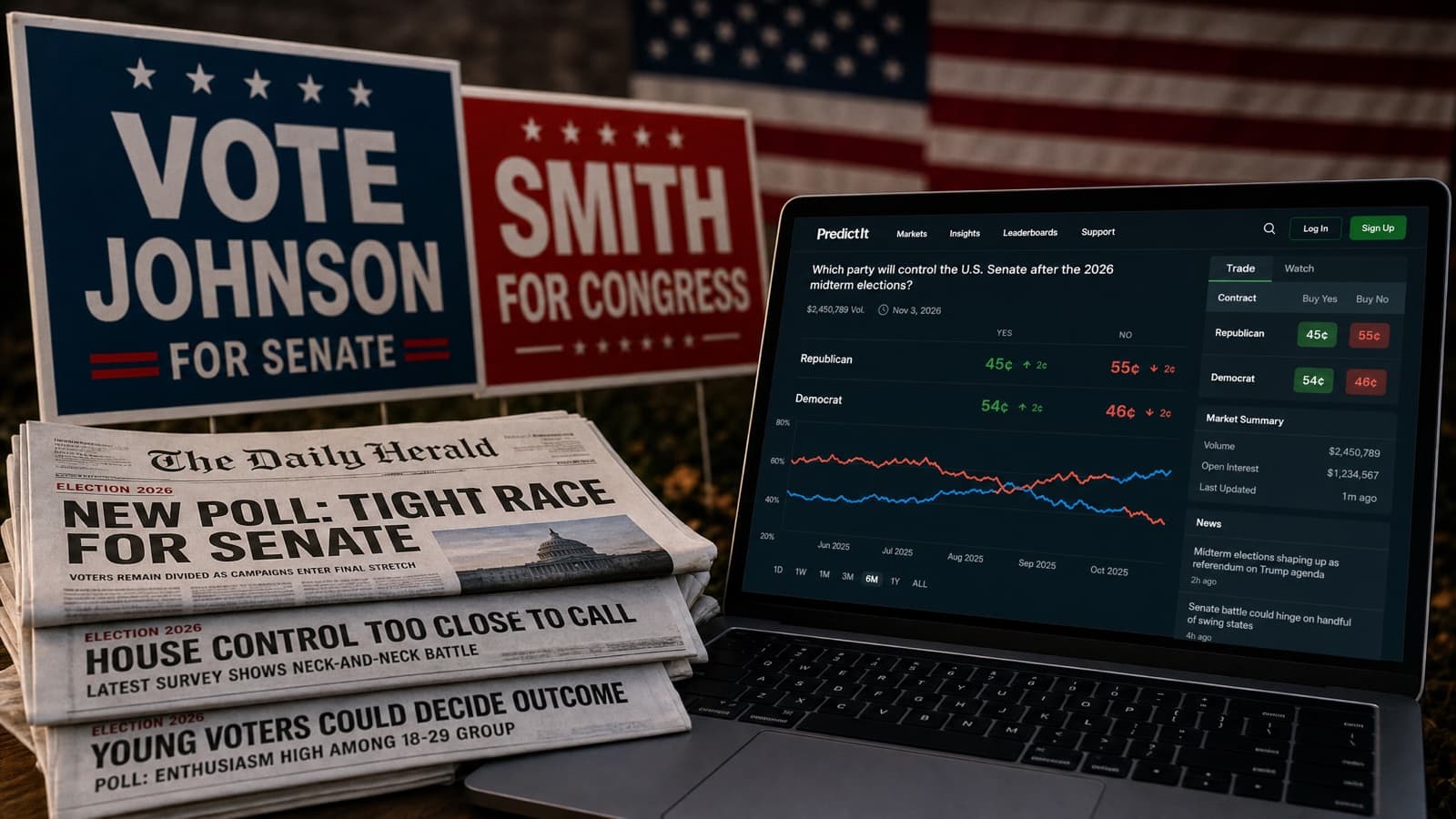
In mid-August 2026, a phony polling outfit called Median Strategies released survey numbers covering the Los Angeles mayoral race, elections in Wisconsin, and Nevada. Multiple news organizations reported the figures as legitimate. Los Angeles Mayor Karen Bass promoted one result on social media. Campaign operatives responded as if the data were real.
Kalshi's prediction markets barely moved.
That gap — between how the media reacted and how real-money traders responded — sits at the center of a heated debate heading into the November midterms. Can federally regulated prediction markets function as a meaningful filter against political misinformation? Or do they represent a new and under-examined attack surface for anyone trying to manipulate public perception of an election?
The Median Strategies episode offers the first major stress test of that question — and the results are complicated.
The Fake Poll That Fooled the Newsrooms
The Los Angeles Times first revealed the deception in August, reporting that polling numbers attributed to Median Strategies were fabricated. The Guardian subsequently identified Rahil Prakash, a 21-year-old, as the person behind the operation. In a statement, Prakash said the episode was "a short-term social experiment" to observe how quickly made-up figures would circulate through news coverage and social media.
The answer, it turned out, was quickly. Multiple outlets reported Median Strategies numbers without verification. Mayor Bass amplified the fake poll showing her with a double-digit lead over her primary opponent. The Bass campaign later called for "bad faith attempts to influence elections" to be criminally prosecuted, after the fabrication came to light.
The Commodity Futures Trading Commission, which regulates prediction markets, did not respond to requests for comment on whether it opened an investigation. The Department of Justice also declined to comment.
What Prediction Markets Did: Almost Nothing
For Kalshi — the nation's largest CFTC-regulated designated contract market for event contracts — the fake polling data registered as noise.
According to Kalshi, a trader injected more than a million dollars into contracts favoring Spencer Pratt, a Republican candidate in the Los Angeles mayoral race who attracted online attention for his provocative campaign style. That capital injection moved market odds for approximately nine seconds before other traders corrected the price back to where it had been. The market, in effect, rejected the manipulation within the span of a quarter-minute.
"Fake polling is a poignant example of why election markets are so important: they're a filter for misinformation," said Kalshi spokesman Jack Such. "Traders lose money if they act on bad information. While news outlets and campaigns touted the poll as real, the markets barely reacted at all."
The mechanism underlying that resistance is financial. A journalist or social media account that reports an unverified poll faces no direct monetary consequence when wrong. A trader who buys a contract based on false information and loses the market moves against them is simply out the money. That asymmetry, proponents argue, creates a built-in incentive for traders to investigate rather than accept polling data at face value.
Did the Fake Pollster Try to Profit?
This was the first thing platform compliance teams looked for. Kalshi confirmed to LPM, an NPR affiliate, that it reviewed Prakash's trading history — he does hold an account — and found no trades on any of the races covered by his fabricated polls. A Polymarket employee separately indicated that Prakash does not appear to have an account on the platform's U.S.-based app, which requires identity verification.
Prakash himself was direct on the point. "No bets or trades were placed on prediction or betting markets related to any of the races for which Median Strategies published polling," he said in a statement. When asked for further clarification on his motivations, he declined additional comment.
The absence of trading activity doesn't rule out future attempts by others with different motives. Fischer and other critics note that the ease with which fake polling data moved through credible media channels demonstrates the potential attack surface, even if Prakash himself didn't exploit it.
The Honest Miss: Wisconsin Crowley
The fake poll episode is not a uniformly favorable story for prediction markets.
During Wisconsin's gubernatorial primary, public polling consistently showed Democrat David Crowley trailing other candidates by meaningful margins. Kalshi's markets agreed — Crowley was priced as a long-shot. He won.
"It appears that there really aren't any predictions here, they're just reacting belatedly to public information, like polls and news stories," said Eddie Vale, a Democratic strategist who worked on Crowley's campaign. "If it was just a fun entertainment tool for political junkies, fine, but to me, all of this is a marketing sheen for an online gambling operation."
Prediction market proponents push back on this framing. A candidate priced at 15 cents — reflecting a 15% implied probability — will still win roughly one in seven times. The Wisconsin result doesn't mean the market was wrong in any meaningful sense; it means the race produced one of its less-likely outcomes. What markets claim is not certainty, but a real-money-weighted aggregation of current information. When the polls were wrong, the market was wrong too — because it was reflecting the same underlying information.
But the Crowley example is a legitimate caution: prediction market prices are only as good as the information flowing into them. If the information environment is poisoned — by fake polls, viral misinformation, or coordinated social media campaigns — prices can be distorted.
The Insider Trading Backdrop
The fake poll episode comes after an unusual run of high-profile enforcement actions that put prediction market integrity under scrutiny.
In January 2026, Polymarket grappled with trades connected to a U.S. Special Forces soldier who allegedly bet on the operation to capture Venezuelan President Nicolás Maduro before any public announcement. In June, NPR reported on former Congressman George Santos, who allegedly bet against his own attendance at the State of the Union address on Kalshi. And in August, the Commodity Futures Trading Commission fined Gabriel Perez — President Trump's teleprompter operator — $172,539 after he won 39 of 43 Kalshi contracts tied to presidential speeches by trading on knowledge of the text before Trump delivered it.
Each case ended in detection and enforcement. Platforms cite this track record as evidence that their surveillance infrastructure works. Critics note that the cases that get caught are, by definition, not the ones that don't.
Concerns Heading Into the Midterms
Not everyone is reassured.
"These markets are very easily manipulated, and the platforms say they invest in surveillance and catch people after the fact, but when it comes to elections, the consequences are really grave," said Amanda Fischer, chief policy officer at Better Markets, a financial reform advocacy group. Fischer, a former chief of staff at the Securities and Exchange Commission, warned that this November represents the first major contested midterm cycle where Kalshi and Polymarket have become mainstream. "Some folks will be looking for ways to game prediction markets, partisan interests, and worse, perhaps even foreign actors."
Those concerns are not hypothetical. According to reporting by LPM, Senators Alex Padilla of California and Mark Warner of Virginia sent letters to Kalshi and Polymarket demanding answers over payments to social media influencers accused of spreading election disinformation. The senators noted that influencers under contract with both platforms spread false conspiracy theories about California election results in June, using prediction market odds to lend apparent credibility to claims of fraud.
The CFTC has not issued specific guidance addressing poll manipulation schemes aimed at moving election market prices.
What Election Markets Are Available to US Traders
For US-based traders interested in midterm prediction markets, the landscape is defined primarily by Kalshi. As a CFTC-licensed designated contract market (DCM) and derivatives clearing organization (DCO), Kalshi offers election markets at the congressional, gubernatorial, and local levels.
The U.S. platform operated by QCX LLC — Polymarket's CFTC-authorized US entity — currently offers sports event contracts only. Political and election markets are not available through the U.S. Polymarket app.
Frequently Asked Questions
Can someone manipulate a prediction market with a fake poll?
The evidence suggests it is difficult in liquid markets. A million-dollar injection into a Kalshi market moved prices for nine seconds. Thinner local-race markets with smaller dollar volumes would be more vulnerable to sustained manipulation efforts. The Median Strategies episode did not demonstrate successful manipulation, but it demonstrated that the information environment around polls is susceptible to contamination.
Did the Median Strategies creator profit from prediction markets?
No evidence of that was found. Rahil Prakash held a Kalshi account but placed no trades on the races his fake polls covered. He denied any financial motivation. No Polymarket U.S. account for Prakash was found.
Which prediction market platforms offer election markets for US users?
Kalshi is the primary CFTC-regulated platform offering election markets to U.S.-based traders. It covers congressional, gubernatorial, and local races. The Polymarket U.S. app (operated by QCX LLC) offers sports contracts only; election markets on global Polymarket are not available to U.S. users.
Are prediction markets regulated against this kind of manipulation?
Yes. Kalshi holds both CFTC DCM and DCO designations, which require market surveillance programs, anti-manipulation rules, and cooperation with regulatory enforcement. In 2026 alone, the CFTC has pursued multiple enforcement actions related to prediction market manipulation and insider trading, including the Perez teleprompter case.
What happens if I bet on a candidate based on a fake poll?
If the fake poll was wrong about the candidate's chances, and the candidate loses, you lose your stake. This is the financial stake mechanism prediction market proponents argue makes these markets more resistant to misinformation than media reporting: bad information costs money.
The Bottom Line
The Median Strategies episode did not produce a prediction market manipulation scandal. It produced something more useful: a real-world pressure test that markets passed, while traditional media and a sitting mayor did not. A million-dollar market pump lasted nine seconds. Newsroom coverage lasted days.
But the episode also reveals that the manipulation risk is real. Thin local-race markets, coordinated influencer campaigns, and a political environment already saturated with disinformation all represent genuine vulnerabilities. The Wisconsin Crowley result is a standing reminder that prediction markets are probabilistic tools, not oracles — and that their accuracy depends on the quality of information flowing into them.
November's midterms will be the largest real-world test yet. Researchers, regulators, and traders will be watching whether CFTC-regulated prediction markets reinforce their reputation as information aggregators — or whether the warnings from Amanda Fischer and others prove prescient.
Sources & Verification
- What a fake poll reveals about worries around prediction markets and the midterms — LPM (NPR affiliate), August 29, 2026
- Fake polling website Median Strategies: The Guardian identifies Rahil Prakash — The Guardian, August 20, 2026
- Poll showing Bass leading Raman was bogus, company says — Los Angeles Times, August 17, 2026
- Polymarket, Maduro bet, insider trading — U.S. Special Forces soldier — NPR, January 2026
- George Santos, Kalshi insider trading investigation — NPR, June 2026
- Trump White House teleprompter operator bet on Kalshi — NPR, July 2026
- A fake poll tested media and poll trackers — The Washington Post, August 20, 2026