
Prediction Markets Meet Democracy: Why Election Officials Are Sounding the Alarm Ahead of 2026 Midterms
Election administrators are alarmed as billions flow into midterm prediction markets. Here's what's really at risk — and what the platforms are doing about it.
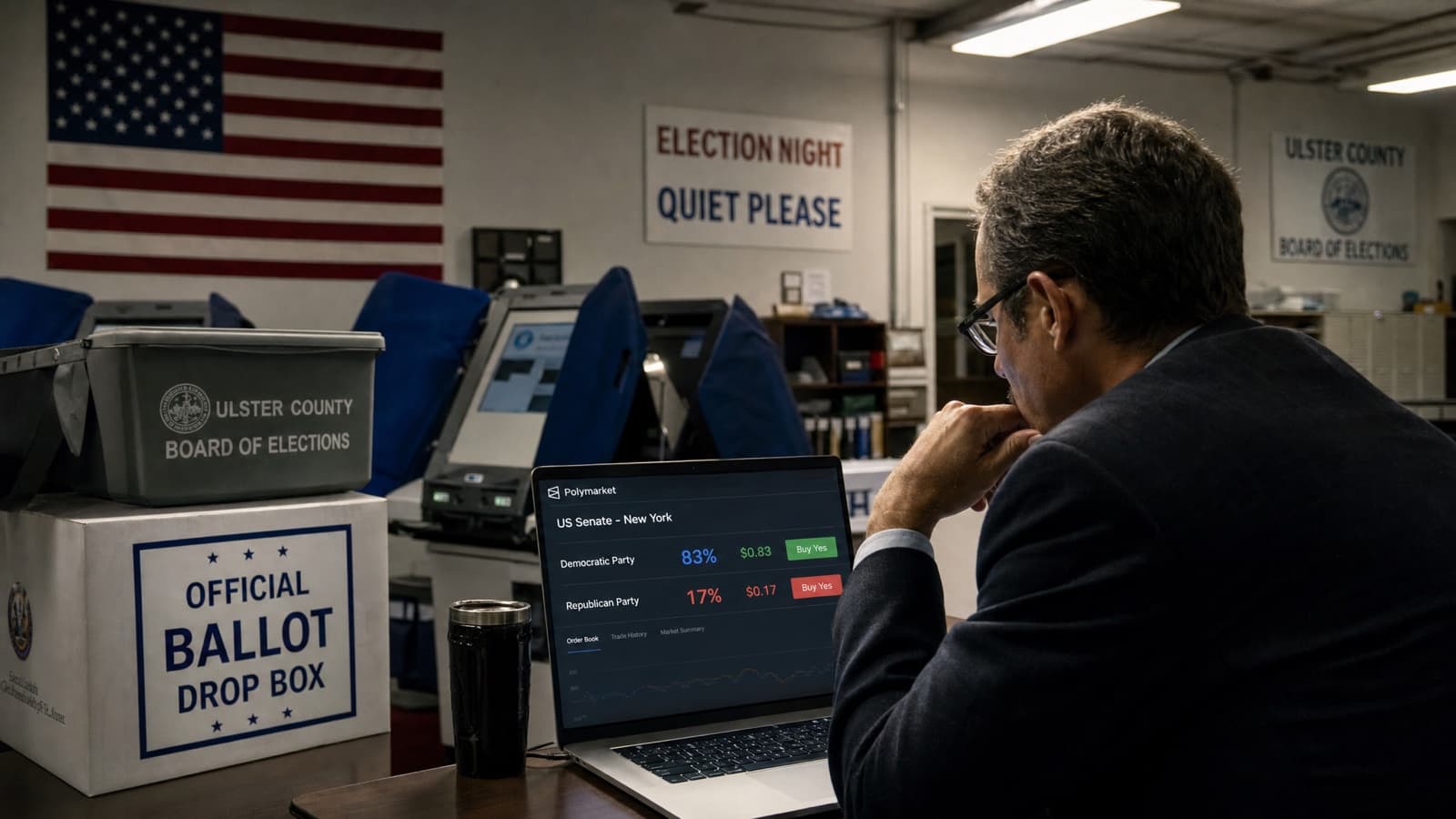
As November approaches, a new front has opened in America's long-running debate over election integrity — one playing out not in courtrooms or statehouses, but in the real-time contract prices of platforms like Kalshi and Polymarket.
On Tuesday, the Associated Press published an extensive investigation finding that election administrators across the country are increasingly alarmed by the explosion in prediction market trading on congressional, gubernatorial, and Senate races. Their concern: that billions of dollars in financial stakes could further erode public trust in elections — or, in the worst case, actually influence who wins them.
It's a tension that will play out in real time this fall, with no clear resolution in sight.
The Numbers Are Staggering
The scale of election betting in 2026 is already unprecedented. According to an August 2026 analysis by the Anti-Corruption Data Collective (ACDC), a nonpartisan research group, $133 million had already been wagered on 2026 congressional races as of August 10 — surpassing the $92.4 million bet across the entire 2024 congressional cycle, with three months still remaining until Election Day.
If betting activity accelerates as it did in 2024 — when just 8% of total election-cycle volume had been placed at this point in the cycle — total wagers on the 2026 midterms could reach $1.6 billion, ACDC projects.
The breadth is equally striking. Platforms have opened 16 times as many markets on the midterms as they did in 2024, with more than three times as many markets per House seat and more than eight times as many per Senate seat.
Kalshi, the primary CFTC-regulated US exchange for election markets, allows traders to buy contracts on nearly every congressional race in the country, as well as governor's races, Senate control, and House control. Contracts are priced between 1 and 99 cents, with the price representing the market's implied probability of that outcome. (Note: Polymarket's global platform also carries extensive election markets, though that venue is not accessible to US-based traders; trading volume in the ACDC analysis reflects global participation.)
What Election Officials Are Worried About
For officials who run elections for a living — and who have spent years battling misinformation — this trading volume is not a neutral data point.
"This is a troubling trend that election administrators across the nation must deal with," said Jared DeMarinis, the administrator for the Maryland State Board of Elections.
The concerns run in several directions. First, there is the fear that prediction market odds will be mistaken for election results or official projections — and that when those odds are wrong, as they sometimes are, voters will blame the election system rather than the market.
In Delaware County, Pennsylvania, elections director Jim Allen took concrete action: he asked the county election board to add prediction market trading to the state-required oath that election workers must swear before serving at polling places or in county offices. The oath had previously banned workers from betting on elections; Allen expanded it to explicitly cover prediction markets. Maryland's DeMarinis said he would seek a similar statewide requirement.
A more fundamental concern: the fear that markets could be manipulated — intentionally or through herd behavior — to give one candidate a false appearance of momentum, and that media and voters would follow the money.
Ben Schiffrin, director of securities policy for Better Markets, a nonprofit that advocates for public-interest financial regulation, put it plainly: "And all of a sudden, they're the front-runner, for no reason other than an outside actor places a large bet on them."
Can a Prediction Market Actually Swing an Election?
This is the question researchers and election lawyers are wrestling with most urgently.
Joshua Mitts, a Columbia Law School professor who studies corporate and securities law, offered a measured assessment: "One can make the argument that the entire stock market, at some level, is affected by elections and outcomes." Markets reflecting elections is not new — bond and equity markets move on electoral expectations every cycle.
But Mitts also acknowledged the specific concern: "You can understand why states would say from the election integrity standpoint, 'We don't want this sort of contract to trade at all.'"
Eric Talley, another Columbia University law professor, cited behavioral economics research from economist Colin Camerer showing that a single large bet in a horse race induced cascading bets from other participants who assumed the big bettor had inside information. The odds temporarily skewed — before correcting as the race approached.
"Other people thought, 'Oh my god, people know something I don't,' and they all started betting on the same horse," Talley said. It was, he suggested, "an interesting analog to the current moment."
The manipulation scenario that concerns officials most: a wealthy partisan — unconcerned about losing money — bids up the odds on their preferred candidate to create an illusion of momentum. Some voters, seeing their candidate given long odds, might stay home rather than go to the polls. Candidates could use favorable market prices in fundraising appeals or to attract endorsements.
Whether any of this is practically achievable in a major statewide race remains unclear. Mitts noted the gambit would be logistically easier in a small election decided by a hundred votes, but harder to execute in a high-volume liquid market.
The Platforms' Response: Enforcement Has Begun
Kalshi and Polymarket push back firmly on the narrative that their markets pose a danger to democratic elections. Their argument: manipulation in liquid markets is self-defeating, because financially motivated traders will immediately bet against any artificially inflated price.
"If you're going to try to manipulate the pricing in a highly liquid market with strong traders, it's not going to work. The pricing will snap back, and you'll simply lose money," said Rick Heaslip, Kalshi's general counsel.
More concretely, both platforms have insider trading rules required by CFTC regulations, specifically designed to prevent candidates and campaign staffers from trading on their own races. And Kalshi has begun enforcing them — publicly.
On August 31, 2026, Kalshi disclosed two significant disciplinary actions:
Laurie Buckhout, the Republican candidate for North Carolina's 1st Congressional District, was suspended from Kalshi for three years and fined $2,589.96 after purchasing less than $1,000 in contracts on her own race. Kalshi's compliance department found that as a candidate, she was a "direct decision maker" with influence over the outcome — a violation of Kalshi Rule 5.17(z). Buckhout cooperated with the investigation and acknowledged the mistake. "I bet on myself. Literally. It was a dumb mistake, and as soon as I learned there was an issue, I worked to make it right," she said. "Safe to say my career as a Kalshi trader was short-lived."
In the same batch of enforcement notices, Kalshi issued a lifetime ban and a $71,356 fine against former Rep. George Santos for trading on markets related to his own attendance at the February State of the Union address. Santos did not cooperate with the investigation.
Kalshi also says its market data shows odds correlate strongly with actual outcomes: events given a 60% probability end up happening close to 60% of the time, suggesting the markets are aggregating real information rather than speculative noise.
The Concentration Problem Researchers Are Flagging
Despite the headline volume numbers, there is a structural issue that the ACDC analysis surfaced in August: prediction market odds are being set by a remarkably small pool of traders.
The top 1% of digital wallets on the global Polymarket platform account for 68% of all trading volume on 2026 congressional markets. Just 10 wallets are responsible for 17% of total volume and have placed bets in 426 of the 470 House seats up for election — touching 91% of every race on the ballot.
Eighty percent of markets have fewer than 100 wallets participating. Only 10 markets in the entire 2026 congressional cycle have reached 1,000 participants — roughly the minimum respondent count in most political polls.
"Even though betting volumes are large, electoral prediction markets are highly concentrated among a small number of participants," ACDC warned. "This poses a number of threats to election integrity. Bettors could deliberately manipulate prices for a given election, offering a form of undeclared and unregulated financial support for a campaign."
The implication: in most individual races, the "wisdom of the crowd" that prediction markets are theorized to deliver is actually the judgment of a handful of very large traders — a very different thing from a scientifically weighted poll of registered voters.
When Markets Got It Wrong: Recent Examples
Prediction markets have already suffered notable failures in 2026.
In the Wisconsin governor's Republican primary, prediction markets heavily favored a candidate who ultimately lost. The polls were also wrong — but that alignment provided little comfort to administrators fielding public complaints about why the "predicted" candidate didn't win.
More consequentially, during the Los Angeles mayoral primary in June, as vote-counting was underway, online influencers pointed to prediction market odds favoring Republican Spencer Pratt finishing second and qualifying for the runoff. When vote totals showed otherwise, some accused election officials of fraud — a misinformation cascade that market prices helped ignite.
"Early election returns differed from market expectations, and that resulted in suspicion and questioning of normal ballot processing and canvassing procedures in California," one election administrator told Votebeat. That kind of distrust — seeded by a market price, amplified by social media — is precisely what officials are bracing for in November.
Where the Law Stands
Half the states have statutes that broadly ban betting on elections, according to the National Conference of State Legislatures. Those laws were motivated by a desire to ensure people vote based on their preferred candidate — not a financial stake in the outcome.
But those statutes largely predate modern prediction markets, and many haven't been tested in court against the federal CFTC framework that now governs platforms like Kalshi.
In 2024, Kalshi successfully challenged a CFTC order that had classified election event contracts as "contrary to the public interest." The CFTC under new leadership then abandoned its appeal and withdrew the proposed rule. The CFTC's June 2026 proposed rulemaking on prediction markets explicitly excludes electoral competitions from its gaming prohibition — meaning federal law now actively permits what many state laws still nominally ban.
Courts are crammed with litigation over that conflict. Judges are unlikely to resolve it before November, all but ensuring that election prediction markets will operate at historic scale in nearly every state this fall.
FAQ
Are prediction market odds the same as polls?
No. Polls are representative samples of voters in a specific geography. Prediction markets are open to anyone — and the more money a person bets, the more influence they have on displayed odds. As recent research shows, in most races, odds are primarily set by a very small number of large traders.
Can Kalshi legally offer election markets in my state?
Likely yes, under current federal law. The CFTC has authorized election event contracts. However, some states have their own laws banning election betting, and litigation over whether federal law preempts those statutes is active in multiple courts.
What happens if a candidate bets on their own race?
Kalshi Rule 5.17(z) prohibits candidates from trading on markets they can influence. Violations result in trading bans and financial penalties — as Laurie Buckhout and George Santos discovered in August 2026.
Can a wealthy trader actually manipulate a statewide race's odds?
Kalshi says no — in a liquid market with motivated traders on the other side, artificial pricing corrects fast because opponents profit by betting against the manipulation. Academic research suggests temporary distortions are possible but self-correcting. The real concern is perception: a manipulated price, even if it corrects, can generate headlines that live on after the reversal.
What are election officials doing about it?
Some, like Delaware County, Pennsylvania, are explicitly prohibiting election workers from participating in prediction markets. Maryland is pursuing a similar statewide policy. Broader public education campaigns about the distinction between market odds and official election data are being planned ahead of November.
What to Watch This November
With $133 million already traded and a potential path to $1.6 billion by Election Day, prediction markets will be the most prominent real-time odds source on the 2026 midterms. How they handle inevitable moments when markets are wrong — and when bad actors try to exploit them — will shape whether they're seen as a legitimate information tool or a threat to democratic legitimacy.
The platforms have staked their legal future on the argument that prediction markets serve a genuine forecasting function, are adequately regulated, and self-correct against manipulation. The election officials who run the actual machinery of democracy are less certain — and they're the ones who have to manage the fallout when market odds and election night results diverge.
Sources & Verification
- Associated Press (Marc Levy): "2026's elections could test how heavy trading on prediction markets affects races and results" (Sept. 8, 2026) — verified Sept. 8, 2026
- Votebeat (Carrie Levine): "Prediction markets place odds on election results. Officials say they could erode public trust." (Aug. 10, 2026) — verified Sept. 8, 2026
- Anti-Corruption Data Collective: "A Handful of Bettors Are Setting the Odds on the 2026 Midterms" (Aug. 17, 2026) — verified Sept. 8, 2026
- The Hill: "Kalshi suspends GOP House candidate in North Carolina for betting on own race" (Aug. 31, 2026) — verified Sept. 8, 2026
- New York Times: "Kalshi Suspends Republican House Candidate for Betting on Her Own Race" (Aug. 31, 2026) — verified Sept. 8, 2026
- Roll Call: "North Carolina candidate in battleground race penalized for betting on her campaign" (Aug. 31, 2026) — verified Sept. 8, 2026
- NC Political News: Kalshi disciplinary settlement notice, Buckhout (Sept. 1, 2026) — verified Sept. 8, 2026