
Prediction Markets Dropped American Odds. Here's How to Read the New Price Format.
As of August 31, CFTC-regulated prediction markets dropped American moneyline odds at regulators' request. Here's how to read the new price format.
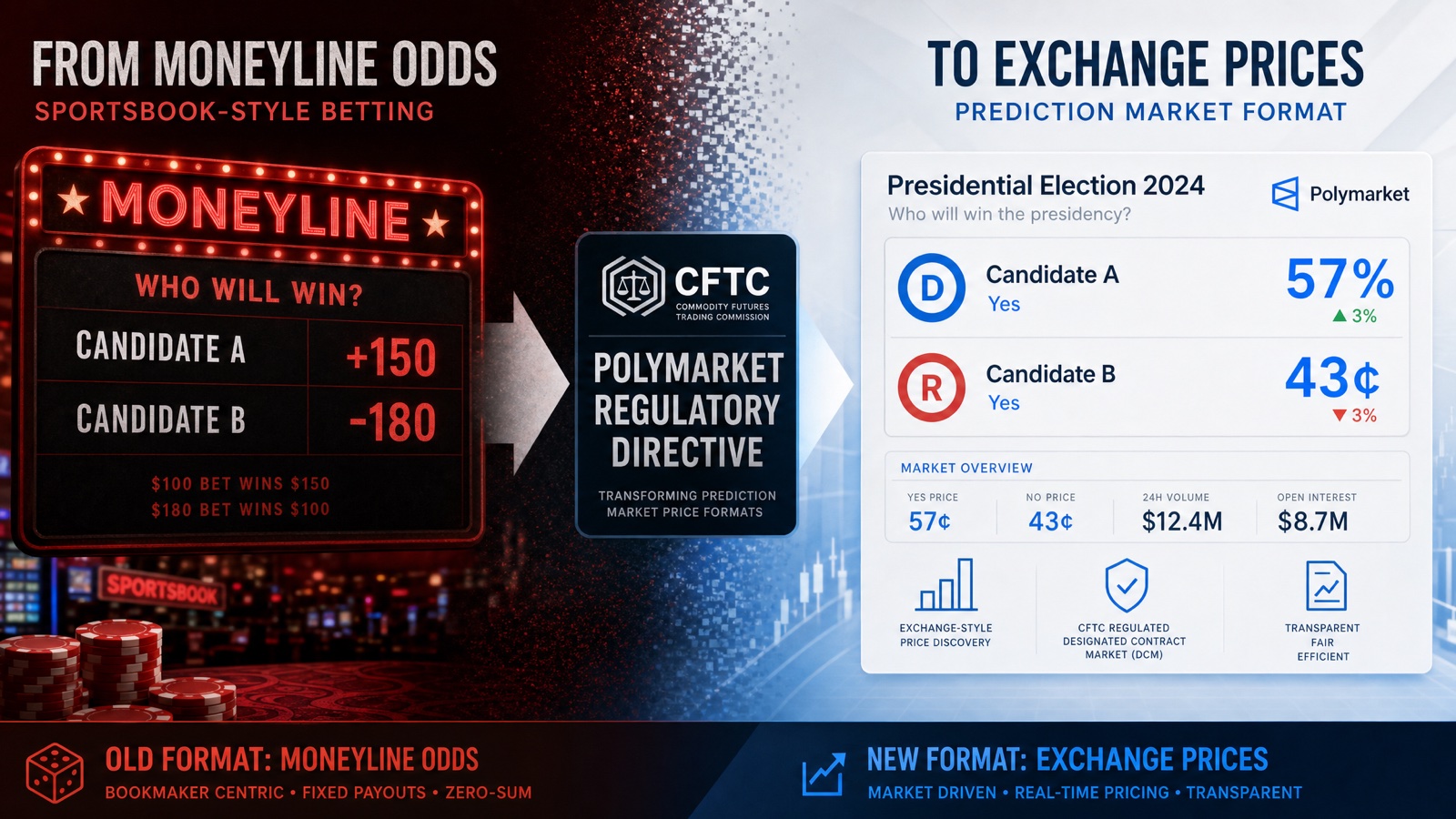
If you opened a prediction market app in September and found no +150 or -200 price displays, that's not a bug — it's a federal directive. As of August 31, 2026, every major CFTC-regulated prediction market has dropped American-style moneyline odds from their platforms, replacing them with cents-based and percentage-based pricing.
The change came after the Commodity Futures Trading Commission issued a formal guidance letter on August 7, 2026, warning regulated entities that American-style odds "likely mislead market participants about the nature of the transaction." Kalshi, Novig, ProphetX, DraftKings Predictions, and FanDuel Predicts all complied by the deadline.
Here's what actually changed, why the regulator stepped in, and how to read prediction market prices in the new format.
Why the CFTC Banned American Odds Displays
On August 7, 2026, the CFTC's Division of Market Oversight and Market Participants Division issued a joint letter to all Commission-regulated entities — exchanges, brokers, and their intermediaries and affiliates. The letter, first obtained by Bloomberg and publicly posted by the CFTC the same day, warned that displaying event contract prices in American moneyline format (the +150/−200 notation familiar from sportsbooks) was likely to violate federal law.
The agency laid out two core objections:
1. American odds obscure what the product actually is. Event contracts are priced as shares worth 1¢ to 99¢ based on implied probability. A 62¢ contract communicates "the market assigns a 62% probability to this outcome." The equivalent American odds display (−163) communicates "risk $163 to win $100" — a framing the CFTC says makes the product feel indistinguishable from a sportsbook bet.
2. American odds hide market depth information. The CFTC letter warned that bookmaker-style displays "may deprive users of access to indicia of market depth and pricing impact." On a derivatives exchange, knowing whether a contract is 62¢ bid / 63¢ ask versus 60¢ bid / 70¢ ask is financially meaningful. American odds compress this into a single number and obscure the spread.
The letter grounded both concerns in Commission Regulation 180.1, which prohibits misleading statements in regulated derivative markets. It also flagged that "market participant confusion between the two products could be exploited to drive participants into higher-margin, non-market-priced bookmaking products." Regulated entities were required to confirm receipt by August 31.
How Every Major Platform Responded
The August 31 deadline produced industry-wide compliance.
Kalshi notified customers directly: "On August 7, the CFTC — the federal agency that regulates Kalshi — issued guidance stating that regulated exchanges should not display pricing in the American odds format. In line with that guidance, American odds was removed from the Kalshi App on Aug 31. Prices can now be viewed in cents, %, or multiplier formats."
Novig moved four days ahead of the deadline, dropping American odds on August 27 and rolling out a dedicated conversion calculator to help traders make the adjustment.
ProphetX announced the change effective August 31: "American odds will not remain as a selectable display option. To be clear about what is not changing: order books, payout structures, and open positions will all continue functioning exactly as they do today."
DraftKings Predictions and FanDuel Predicts both confirmed they would comply by the August 31 deadline. Both platforms had previously displayed American-style run lines, moneylines, and over/unders as the default format for sports markets.
Robinhood required no change. Its prediction markets product launched in the traditional financial exchange format — cents and percentages only — and was already in compliance before the CFTC letter arrived.
American Odds vs. Cents: A Quick Translation Guide
For traders who learned markets through a sportsbook, the new format takes a moment to internalize. Here's the conversion table:
| Cents Price | Implied Probability | American Odds Equivalent |
|---|---|---|
| 10¢ | 10% | +900 |
| 20¢ | 20% | +400 |
| 33¢ | 33% | +200 |
| 50¢ | 50% | +100 (even money) |
| 60¢ | 60% | −150 |
| 75¢ | 75% | −300 |
| 90¢ | 90% | −900 |
The math goes both directions. For underdog contracts (below 50¢): American odds = (100 ÷ probability) − 100, expressed as a positive. For favorite contracts (above 50¢): American odds = −[(probability ÷ (1 − probability)) × 100].
The simpler frame: on a prediction market, the price is the probability. That's not true of American odds, where the same probability can yield different numbers depending on how a house builds in its margin.
How to Read Prediction Market Prices in Practice
Take the Federal Reserve's September 2026 meeting — currently the most-watched contract on prediction markets. On Kalshi, as of early September:
- Fed maintains rate (hold): 57¢ — the market assigns a 57% probability to no rate change
- Hike 25bps: 43¢ — a 43% probability of a quarter-point increase
In a sportsbook, a 57% implied probability would appear as roughly −133 on the favorite side. On a CFTC-regulated prediction market, you see the probability directly. The CFTC's goal is exactly this: the number that tells you the crowd's actual forecast, not a casino-style payout calculation layered on top of it.
When reading any Kalshi contract, three things to check:
- Bid and ask: These bracket the tradeable price. A market showing 57¢ bid / 58¢ ask means you can sell at 57¢ or buy at 58¢
- Volume: Higher lifetime volume means the price reflects more trading activity and is generally more credible
- Yes/No relationship: On a binary market, Yes + No should sum to near $1.00. The small difference reflects fees
Kalshi also lets users switch between cents, percentage, and multiplier displays in settings — so if one format clicks better for you, the option is there.
Why This Matters Beyond User Interface
The American odds removal is part of a larger regulatory argument that goes well beyond display preferences.
Prediction markets have faced lawsuits in Michigan, Maryland, Washington, New York, and other states alleging the platforms are operating illegal gambling businesses. The CFTC, which licenses Kalshi, ProphetX, Novig, and others as federally regulated derivatives exchanges, has maintained that event contracts are financial instruments, not wagers — and has gone to court to defend that position.
The American odds format handed critics a concrete example of the platforms behaving like sportsbooks. If a prediction market displays +220 and −180 instead of 31¢ and 69¢, it's harder to argue the product is a derivatives exchange rather than a gambling operation wearing a different label.
Better Markets, a financial reform advocacy group that has consistently opposed the expansion of prediction markets into sports, called the guidance "the CFTC telling prediction markets how to avoid resembling a sportsbook." The group's statement framed the CFTC's move as an implicit acknowledgment that the two products had been presented too similarly to consumers.
From the CFTC's perspective, the guidance is a consumer protection measure and a regulatory clarification — not a concession. The agency's position is that derivatives must be marked in nominal or percentage terms that reflect market pricing, not in the style of bookmakers.
The two readings aren't entirely incompatible. The change is both good regulatory hygiene for a derivatives market and, not coincidentally, useful ammunition in the ongoing legal fight to keep prediction markets operating under federal jurisdiction.
Frequently Asked Questions
Will American odds come back to prediction markets?
Unlikely under current CFTC leadership. The August 7 letter reflects a formal agency position that American-style odds displays violate consumer-protection rules for regulated derivatives. Reversing course would require a new CFTC interpretation or a change in leadership.
What if I prefer American odds?
The math is straightforward. For any cents price below 50¢, your American odds equivalent is +[(100/probability) − 100]. Above 50¢, it's −[(probability/(1−probability)) × 100]. Novig's free conversion calculator — released alongside its own odds-removal announcement — does this instantly if you'd rather not do the arithmetic manually.
Does this change my open positions or how markets resolve?
No. As ProphetX confirmed: "Order books, payout structures, and open positions will all continue functioning exactly as they do today." Only the display format changed. Your contracts still pay $1.00 if the outcome is yes, $0.00 if no.
Does this apply to Polymarket?
QCX LLC — the US-licensed CFTC entity doing business as Polymarket US — is subject to the same guidance and has updated its displays accordingly. The global Polymarket platform at polymarket.com is not accessible to US users and operates under different rules.
Why do prediction markets show separate Yes and No prices?
Because both sides of the contract trade as separate instruments. On a binary market, the Yes price and No price should add up to approximately $1.00, with the small difference reflecting exchange fees. Seeing both prices tells you the implied probability and the cost of taking either position — information that a single American odds number doesn't provide.
The Bottom Line
American odds are gone from prediction markets, and they're unlikely to return under current regulations. The practical impact for most traders is minimal — the underlying contracts, payouts, and market mechanics are unchanged. Only the display format shifted.
For users who came to prediction markets from a sportsbook background, the adjustment is short. A 60¢ contract means a 60% implied probability. If you think the actual probability is higher, buy it. If you think it's lower, sell it. The rest is arithmetic.
Explore live prediction market prices — in cents, percentages, and across every major regulated exchange — at PredictionMarkets.US.
Sources
- CFTC Division of Market Oversight advisory letter, August 7, 2026 — Bloomberg first obtained the letter; CFTC publicly posted the same day
- Boston Herald, "Federal regulator warns prediction markets not to use American-style casino odds," August 8, 2026 — verifying CFTC letter text and regulatory framing
- Better Markets, statement of Benjamin Schiffrin, August 7, 2026 — policy organization opposing prediction market expansion; verified quote
- Legal Sports Report, "CFTC Reminds Prediction Markets They Do Not Run Sportsbooks," August 10, 2026 — verifying August 31 deadline and platform compliance framing
- Kalshi customer notification, August 31, 2026 — platform email confirming removal; text reported in industry coverage
- InGame, "CFTC's American Odds Letter Draws A Line For Prediction Markets," August 12, 2026 — verifying DraftKings and FanDuel compliance commitment by August 31 deadline