
Polymarket US Sues Ohio: A New Constitutional Playbook for Prediction Markets
Polymarket US filed a federal suit against Ohio today, using the Dormant Commerce Clause — a novel constitutional theory no prediction market has tried before.
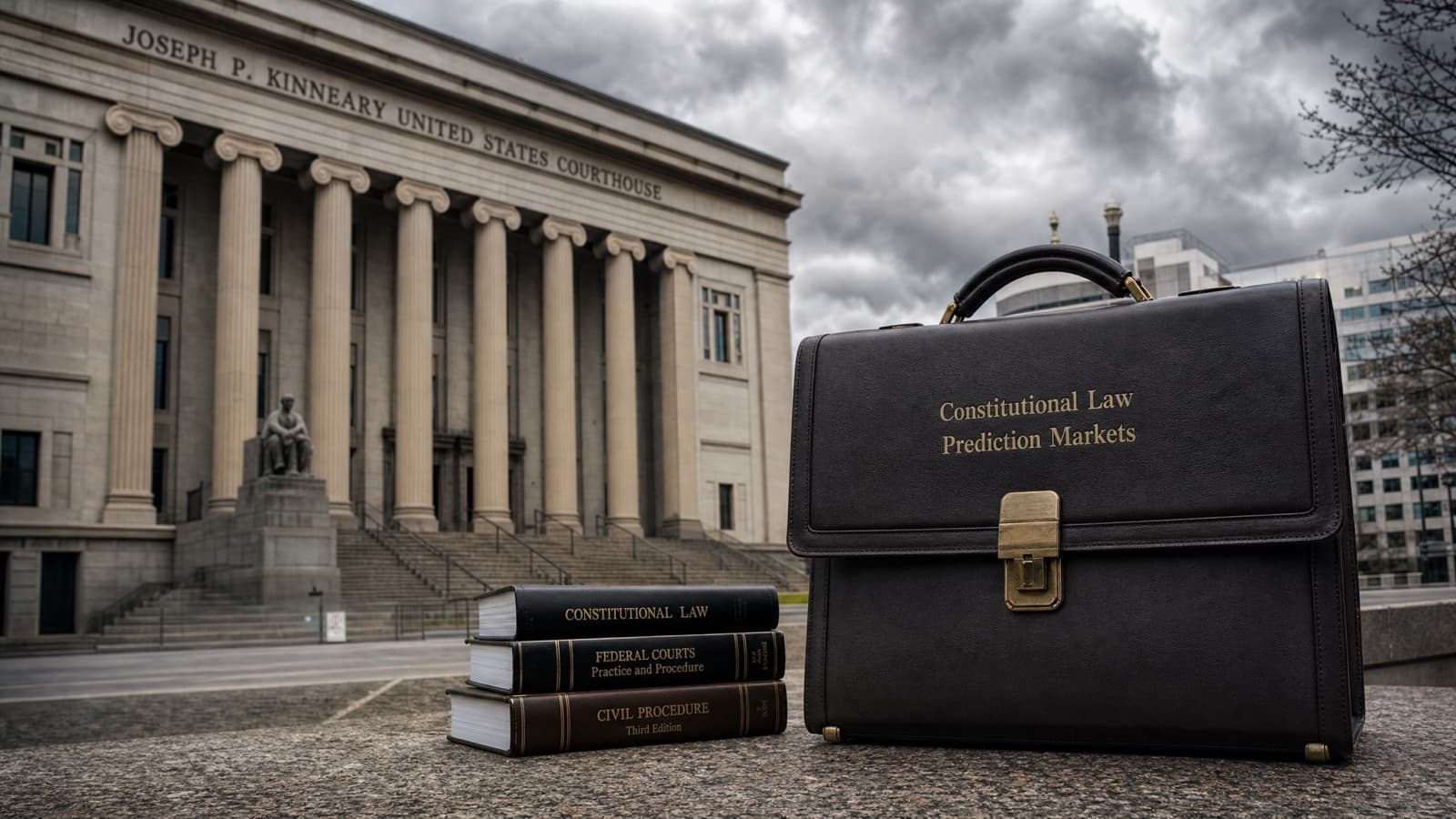
Polymarket US filed a federal lawsuit against Ohio officials on Tuesday, October 20, 2026, introducing a legal argument that prediction market operators haven't tried before in their long-running battle with state regulators. Rather than relying solely on the Commodity Exchange Act preemption argument that Kalshi took to the Sixth Circuit—and lost last month—Polymarket is reaching for the U.S. Constitution's Commerce Clause, arguing that Ohio's sports betting infrastructure requirements amount to unconstitutional protectionism against out-of-state businesses.
The lawsuit, shared by Miami Law School professor Daniel Wallach, targets Ohio's in-state server requirements and mandatory corporate presence rules that the Ohio Casino Control Commission (OCCC) uses to regulate licensed sports betting operators. Polymarket claims those requirements, written for brick-and-mortar sports betting infrastructure, illegally burden interstate commerce when applied to federally-regulated prediction market platforms.
The move comes two weeks after Ohio issued cease-and-desist letters to 10 prediction market operators—including Polymarket, Coinbase, and Robinhood—demanding they stop offering sports event contracts to Ohio residents by October 16.
The Lawsuit: What Polymarket Is Arguing
Polymarket US—the CFTC-regulated American venue operated by QCX LLC—filed the complaint in the Southern District of Ohio Eastern Division on Tuesday morning. The defendants are the Ohio Casino Control Commission and Ohio Attorney General Andy Wilson.
The complaint raises two independent claims:
1. Dormant Commerce Clause violation. Ohio gaming law requires licensed sports betting operators to maintain physical servers within the state's borders and a local corporate presence. Polymarket argues these requirements unconstitutionally discriminate against out-of-state businesses by forcing exclusively local infrastructure on what is inherently an interstate transaction. Under the implied Dormant Commerce Clause doctrine, states cannot pass laws that function as economic protectionism against out-of-state competitors—even when those laws don't explicitly target out-of-state parties.
2. CEA preemption. Polymarket also argues that Ohio's sports gaming laws are preempted by the Commodity Exchange Act, the same argument Kalshi made before the Sixth Circuit in September. Unlike Kalshi's now-failed preemption claim, Polymarket is pairing it with the Commerce Clause argument—giving the Southern District a constitutional basis to rule in Polymarket's favor even if it follows the Sixth Circuit's preemption holding.
The lawsuit asks the court to prevent "imminent and irreparable harm" and block Ohio from enforcing its cease-and-desist notices against Polymarket.
Ohio's Regulatory Escalation: How We Got Here
The Ohio crackdown on prediction markets traces back to a key appellate ruling. On September 25, 2026, the U.S. Sixth Circuit Court of Appeals ruled that the Commodity Exchange Act does not preempt Ohio's sports gaming law—the opposite conclusion from the Third Circuit, which had ruled for Kalshi against New Jersey in April. That Sixth Circuit ruling handed state regulators their first major legal victory and gave Ohio the green light to act.
The OCCC moved quickly. In early October, the commission sent cease-and-desist letters to 10 prediction market operators and brokers, including Polymarket, Coinbase, Robinhood, Underdog, and Novig. The letters gave companies until October 16 to confirm in writing that they had stopped offering sports event contracts to Ohio residents.
Ohio Attorney General Andy Wilson made the state's position clear: "The law is on our side, and they've lost up to this point. They need to come into compliance, or we're gonna force them into compliance."
Polymarket's response: file a new lawsuit.
The Dormant Commerce Clause — Prediction Markets' New Legal Weapon
The Dormant Commerce Clause argument represents the most creative legal theory prediction markets have deployed in the state-federal battle so far.
The Commerce Clause of the U.S. Constitution gives Congress the power to regulate interstate commerce. Courts have long held that this power also carries an implied restriction on state laws—what legal scholars call the dormant Commerce Clause. States cannot pass laws that discriminate against interstate commerce or impose undue burdens on it, even in areas where Congress hasn't explicitly legislated.
Ohio's sports betting regulations require licensed operators to maintain physical servers within the state and a local corporate presence. These requirements were designed for the era of physical sportsbooks and mobile sports betting apps launched by domestically-licensed operators.
Polymarket's argument is that applying these requirements to a federally-regulated prediction market—which operates as an interstate commodity exchange, not a licensed Ohio betting operator—constitutes unlawful protectionism. By forcing out-of-state businesses to replicate expensive local infrastructure, Ohio effectively creates a barrier to interstate commerce that favors established in-state operations.
If Polymarket wins this argument, the implications extend far beyond Ohio. Every state that imposes similar in-state infrastructure requirements on gaming or financial operators could face Commerce Clause challenges. The ruling would apply to any state using infrastructure mandates as a de facto barrier to out-of-state prediction market platforms.
The Wire Act Complication
Ohio has a potential defense that goes beyond simply disagreeing with Polymarket's legal theory.
Section 1084(a) of the federal Wire Act explicitly prohibits the use of a wire communication facility for the transmission in interstate or foreign commerce of bets or wagers on sporting events. For decades, states have built sports betting regulatory frameworks—including the in-state server and infrastructure requirements now targeted by Polymarket—partly to ensure compliance with Wire Act restrictions on cross-border wagering.
Ohio could argue that its server localization requirements aren't protectionism. They're compliance infrastructure. If sports betting data and transaction processing must originate and terminate within state borders to satisfy the Wire Act, then requiring in-state servers isn't discriminatory—it's legally necessary.
Whether that defense holds up depends on how the Southern District of Ohio reads the intersection of the Wire Act, the Dormant Commerce Clause, and the CFTC's designation of Polymarket's sports event contracts as commodities rather than bets.
Gibson, Dunn & Crutcher's "Wild Heel Turn"
The law firm representing Polymarket US is Gibson, Dunn & Crutcher LLP—a detail that gaming attorney Daniel Wallach described as a "wild heel turn."
Gibson Dunn's work for state-based sports betting legalization is well documented. From 2012 to 2018, the firm was retained by then-New Jersey Governor Chris Christie and worked through the courts to dismantle PASPA, the federal law that banned state-licensed sports betting. Two Gibson Dunn partners wrote a 2020 op-ed for Law.com arguing for the constitutionality of mobile sports wagering in New York. The firm's reputation was built partly on expanding states' rights to regulate sports betting.
Now, Gibson Dunn is arguing—in federal court—that an Ohio state law designed to regulate sports betting is unconstitutionally interfering with a federally-regulated interstate exchange. The same legal firepower used to win state jurisdiction over sports betting is now pointed at state regulators trying to exercise that jurisdiction.
Gibson Dunn also represented Polymarket in its $112 million acquisition of the entity that now operates as QCX LLC, which is how the firm came to represent Polymarket US across its regulatory battles.
Where This Fits in the National Legal Landscape
Live price — Will a federal law banning sports prediction markets be enacted in 2026?:
The Polymarket-Ohio lawsuit opens a second legal front in a national battle that is already generating a circuit split likely headed toward the Supreme Court.
The current landscape:
- Third Circuit (April 6, 2026): Ruled 2-1 that the Commodity Exchange Act preempts New Jersey's sports gaming law. Kalshi won.
- Sixth Circuit (September 25, 2026): Ruled that the CEA does not preempt Ohio's sports gaming law. Ohio won.
- New York (September 24, 2026): The New York AG and Governor Hochul sued QCX LLC, alleging it operates an illegal gambling operation. Polymarket countersued the same day.
- Michigan: A federal judge ruled in June that prediction market sports contracts are materially similar to conventional sports betting, opening the door to Michigan enforcement.
- Ohio (October 20, 2026): Polymarket sues on Commerce Clause grounds—a distinct constitutional track from the preemption question.
The Third Circuit / Sixth Circuit split on preemption means the question of whether federal commodities law overrides state sports betting law is already ripe for Supreme Court review. The Commerce Clause question is separate and could reach SCOTUS independently.
Critically, Polymarket's Commerce Clause argument could succeed even if the Sixth Circuit's preemption ruling stands. A court could hold: (1) the CEA doesn't preempt Ohio law, but (2) Ohio's specific infrastructure mandates unconstitutionally burden interstate commerce. That outcome would strike down the most restrictive parts of Ohio's regulatory regime without resolving the broader preemption question.
What Ohio Bettors and Prediction Market Users Should Know
For Ohio residents, the OCCC's October 16 compliance deadline has already passed. Several platforms continued operating through the deadline without formally complying.
A key distinction: Polymarket US (QCX LLC) offers sports event contracts only to US users under its CFTC Designated Contract Market license. This is not the global Polymarket platform. Political markets, financial markets, and other non-sports categories are not part of the Ohio regulatory dispute.
The same sports-event-contract questions apply to Kalshi and other CFTC-regulated platforms operating in Ohio—but Kalshi's regulatory posture differs from Polymarket's. Kalshi had been the original plaintiff in 2025 Ohio litigation, with Ohio enforcement paused until the Sixth Circuit ruled. That pause expired when the Sixth Circuit sided with Ohio in September.
Frequently Asked Questions
Is Polymarket legal in Ohio right now? Contested. The Ohio Casino Control Commission issued a cease-and-desist to Polymarket in early October 2026, and the October 16 compliance deadline has passed. Polymarket US argues its CFTC-regulated sports contracts are legal under federal law and that Ohio's enforcement is unconstitutional. The Southern District of Ohio will ultimately decide.
What is the Dormant Commerce Clause and why does it matter here? The Dormant Commerce Clause is an implied limitation on state power derived from the Constitution's Commerce Clause. It prevents states from passing laws that discriminate against interstate commerce or burden it disproportionately. Polymarket is arguing Ohio's requirement that all servers and corporate infrastructure be located in-state imposes an unconstitutional burden on a national, federally-regulated exchange.
What happens if Polymarket wins this lawsuit? A Commerce Clause victory would invalidate Ohio's server and in-state presence requirements as applied to federally-regulated prediction markets. It could force other states to revisit similar infrastructure mandates. It would not necessarily resolve whether states have authority to ban sports event contracts entirely—that's the preemption question the Sixth Circuit already answered in Ohio's favor.
How is this different from the Kalshi Sixth Circuit case? Kalshi's Sixth Circuit case argued only that the Commodity Exchange Act preempts Ohio's sports gaming law—a statutory argument that the Sixth Circuit rejected in September. Polymarket is now adding a constitutional argument: that Ohio's specific infrastructure requirements violate the Dormant Commerce Clause regardless of whether preemption applies.
Does a Polymarket win help Kalshi and other platforms too? Yes. A Commerce Clause ruling against Ohio's infrastructure mandates would benefit all prediction market platforms facing similar state requirements. Kalshi, Robinhood, Coinbase, and Underdog—all of which received Ohio cease-and-desist letters—could benefit from a ruling that Ohio's in-state server mandates are unconstitutional.
Conclusion
Polymarket US's decision to file on Dormant Commerce Clause grounds is the most significant legal development in the state-federal prediction market battle since the Third-Sixth Circuit split emerged. Prior lawsuits focused on the preemption question—whether federal commodities law overrides state gambling statutes. Polymarket is now asking whether state gambling statutes, as written, can legally impose infrastructure requirements on an interstate federal exchange at all.
The outcome matters beyond Ohio. Every state that relies on in-state server mandates and physical presence requirements to regulate sports betting is watching this case. A Commerce Clause ruling against Ohio would disrupt the physical infrastructure assumptions baked into state gaming regulation nationwide.
Track the developing odds on whether federal legislation resolves this dispute at PredictionMarkets.us.
Sources & Verification
- Polymarket US Files Federal Lawsuit Against Ohio Officials — Deadspin, October 20, 2026 — lawsuit details, Commerce Clause claims, Wire Act analysis, Gibson Dunn background
- Ohio Sends Cease-and-Desist Notices to 10 Prediction Market Operators — Sports Betting Dime, October 5, 2026 — C&D letter details, platform names, deadline
- Ohio Orders 10 Prediction Markets, Brokers To Stop Sports Event Contracts — Legal Sports Report, October 5, 2026 — OCCC enforcement action details
- Ohio expands prediction markets crackdown after Sixth Circuit win — SBC Americas, October 5-8, 2026 — Sixth Circuit ruling context, enforcement escalation
- Ohio Orders 10 Prediction Markets to Stop Offering Sports Contracts — RG.org — Sept 25 Sixth Circuit ruling, C&D background
- Gibson Dunn Representing Polymarket in CFTC Exchange Acquisition — Gibson, Dunn & Crutcher LLP — firm representation history
- NY Accuses Polymarket Of Illegal Gambling Operation — Law360, September 24, 2026 — parallel NY case context
- Ohio Governor Says Action Forthcoming Against Prediction Market Operators — Sports Betting Dime — Ohio AG Wilson quote