
Researchers Flag 152 Polymarket Wallets for Military Insider Trading—With a 97% Win Rate and $8 Million in Profits
ACDC researchers found 152 Polymarket wallets made $8M on military bets with a 97.2% win rate. Copycat bots may broadcast those signals to adversaries.
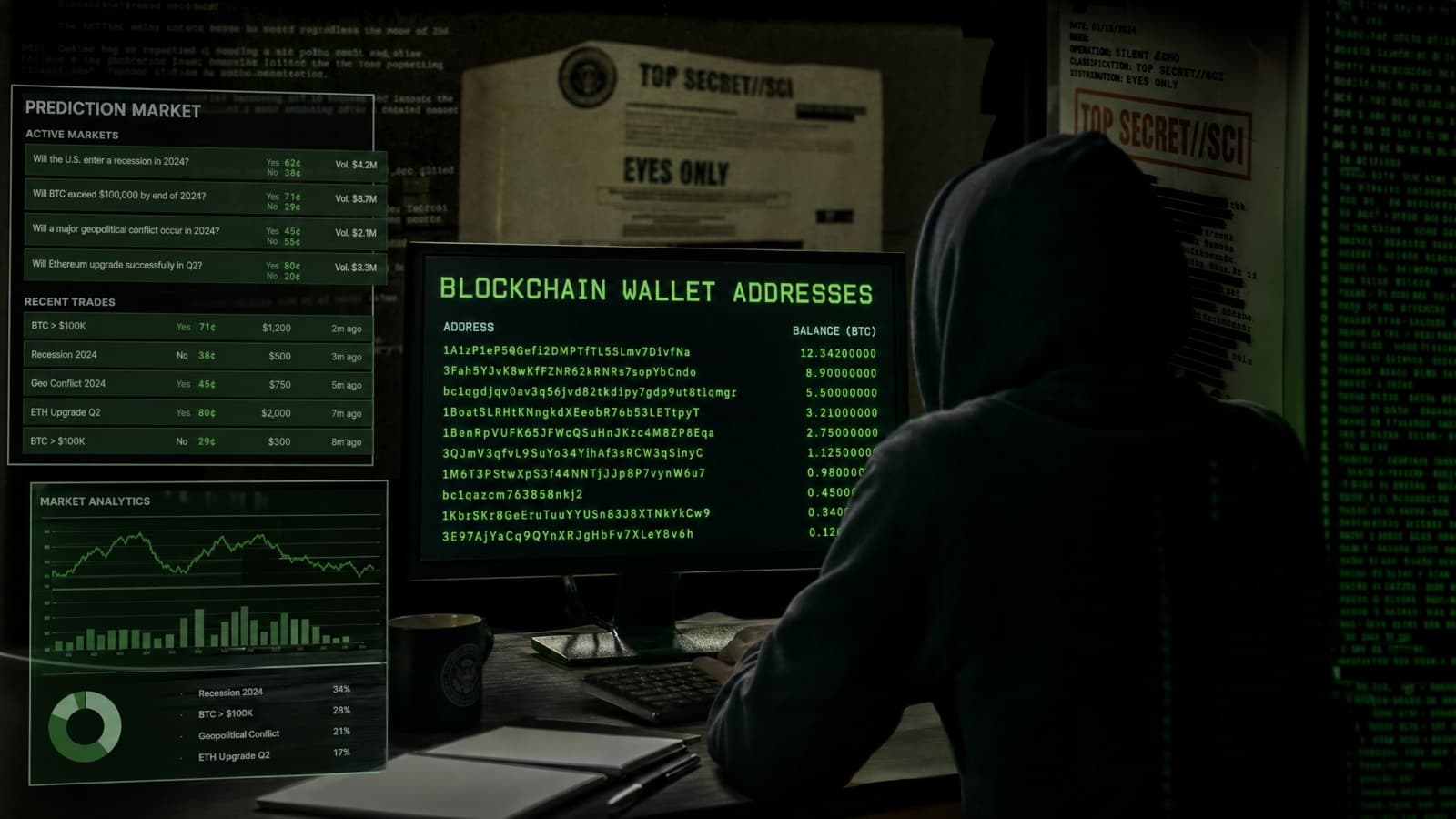
A new investigation has identified 152 anonymous wallets on Polymarket's international platform that made a combined $8 million betting on military and defense outcomes—with an average win rate of 97.2 percent. The findings, by the nonprofit Anti-Corruption Data Collective (ACDC) and first reported by Reuters on August 20, 2026, suggest that likely insider trading on the prediction market may be more widespread and structurally embedded than previously understood.
The report lands at a critical moment: the industry is already under congressional scrutiny, the Commodity Futures Trading Commission has charged a U.S. Army soldier with insider trading on the same platform, and a growing body of legal precedent is establishing that prediction market fraud is prosecutable under federal commodities law.
What the Research Found
ACDC analyzed every settled market on Polymarket International from January 2021 through May 2026—a dataset spanning 435,672 markets and $54.4 billion in total wagers. The group focused on what it calls "longshot bets": cumulative wagers of at least $2,500 placed within one hour on outcomes carrying odds of 35 percent or lower.
Across the full dataset, 14 percent of longshot bets landed on the winning outcome—roughly what random chance and mild market-mispricing would predict. In military and defense markets, that figure was 52 percent. More than half of all long-shot wagers on niche military outcomes proved correct, a discrepancy that ACDC says is not explained by luck alone.
Within that universe of unusually successful longshot traders, ACDC identified 556 wallets it calls "Orcas"—a reference to the killer whale's precise and selective hunting behavior. Orca wallets share a pattern: an account is opened, a highly profitable long-shot bet is quickly placed in a category where insiders may hold an informational edge, and the wallet then cashes out and, in many cases, goes dormant or disappears.
Of those 556 Orca wallets, 152 were concentrated in military and defense markets. Collectively, these accounts earned roughly $8 million, with an average win rate of 97.2 percent.
"While some of those 152 wallets have previously been flagged by other researchers and the media, ACDC says it has discovered dozens more previously unreported wallets," Reuters reported, citing the published findings.
The Blockchain Double-Edged Sword
Polymarket International settles trades on a public blockchain, meaning every wager is visible to anyone who looks—even if the wallet addresses themselves are pseudonymous. The platform has long cited that transparency as a feature, arguing its public ledger allows for greater oversight.
ACDC's research suggests that same transparency creates a significant secondary risk: the potential for copycat trading to amplify whatever informational signal an insider bet carries.
The group found that Orca wagers in military markets tend to attract follow-on bets from two distinct categories of sophisticated actors: deep-pocketed "Whale" accounts and automated trading bots. These copycats monitor on-chain activity and respond to statistically unusual wagers—whether or not those wagers were made using non-public information.
The result is an amplification effect. A single insider placing a $10,000 bet may trigger $300,000 or more in follow-on capital betting on the same outcome within hours.
ACDC documented two specific cases. Before U.S. military strikes on Iranian nuclear facilities in June 2025, an Orca placed a wager on U.S. military action. A Bot then made a copycat bet of $200,000, and a Whale followed with $100,000—both wagering on the same outcome before any public announcement. A similar sequence played out before February 2026 U.S.-Israeli airstrikes on Tehran, where Orca trades appeared to trigger a flurry of first-time long-shot bets from Bots and Whales targeting the same contract.
"Most people vastly underestimate how observable unusual betting activity actually is on Polymarket," said ACDC co-founder David Szakonyi in a statement accompanying the report. "It's all right there on the internet, and we can see clear signs that big traders and bots are copying potential insider trades. It would be naive to think foreign-intelligence agencies aren't monitoring these markets."
The Van Dyke Case: Not an Orca, But Proof of Concept
The new ACDC findings build on a legal precedent established four months ago. In April 2026, the CFTC charged Master Sergeant Gannon Ken Van Dyke, an active-duty U.S. Army Special Forces soldier, with insider trading on Polymarket using classified information about "Operation Absolute Resolve"—the military mission that resulted in the capture of Venezuelan President Nicolás Maduro.
Van Dyke allegedly invested approximately $33,034 across multiple Polymarket contracts tied to Maduro's removal and generated more than $404,000 in profits. The CFTC filed a civil complaint in the Southern District of New York; the U.S. Attorney's Office unsealed parallel criminal charges the same day. Van Dyke has pleaded not guilty.
Notably, Van Dyke is not among the 152 military Orca wallets identified by ACDC. He built his position more gradually than the Orca pattern requires, falling outside the group's specific detection methodology. ACDC explicitly notes this gap—meaning the total universe of potential insider traders likely extends well beyond both the 152 flagged wallets and the Van Dyke case.
The CFTC's press release on the Van Dyke charges described the action as the first ever use of the CEA's specific prohibition on the misuse of government information—the so-called "Eddie Murphy Rule"—applied to prediction market trading. CFTC Chair Michael Selig stated that Van Dyke "was entrusted with confidential information about U.S. operations and yet took action that endangered U.S. national security and put the lives of American service members in harm's way."
What Platforms and Regulators Are Saying
Polymarket did not respond to Reuters' requests for comment on ACDC's findings. In prior public statements, the platform has said it maintains strict controls, closely monitors for suspicious activity, and has referred dozens of trader wallets to authorities—including the activity connected to the Maduro case.
The CFTC declined to comment specifically on the ACDC report. The agency has previously stated it will "strictly police misconduct" in prediction markets and has now brought civil charges in at least three separate insider trading cases. Together, Kalshi and Polymarket reported flagging more than 100 potential insider trading cases to authorities in 2026 alone—Kalshi reporting more than 50 cases, Polymarket referring more than 90 accounts.
The Department of Defense issued a brief statement indicating it "does not comment on intelligence-related matters or the findings of third-party research."
On Capitol Hill, the House Oversight Committee formally launched an investigation into insider trading risks at both Kalshi and Polymarket earlier this year, demanding documentation on user verification systems, geo-blocking mechanisms, and suspicious-activity monitoring protocols. Congress has also moved to close what members describe as a related loophole, targeting elected officials who may trade on government-privileged information through prediction markets.
What Reform Looks Like—and Why It's Contested
ACDC has put forward a clear reform agenda: mandatory identity verification for all Polymarket traders, withholding of payouts on flagged suspicious trades pending investigation, and—for the markets where the risk of insider abuse is highest—outright bans on categories where non-public information is most actionable and profitable.
"Limiting the type of people who can bet on prediction markets or relying on law enforcement investigations will not be enough," ACDC wrote in its published report.
The platform has previously pushed back against calls for mandatory KYC on its main global product, arguing that identity verification would undermine the accessibility that has made Polymarket a major venue for political and geopolitical markets.
The tension is unlikely to resolve quickly. The CFTC has broad authority over prediction markets in the United States, but Polymarket International operates on a blockchain accessible globally, and its primary governance is outside U.S. jurisdiction. The agency is currently advancing a rulemaking process for prediction market contracts and has said it intends to address misconduct rigorously—but the scope of that authority over non-U.S. platforms remains contested in ongoing federal litigation.
Tracking the Regulatory Odds on PredictionMarkets.US
The regulatory and legal battles shaping the prediction market industry are themselves priced into markets on PredictionMarkets.US. You can follow the odds on key legislative outcomes—including whether a law banning certain categories of sports and event contracts passes this session—in real time.
Explore prediction market regulation odds at PredictionMarkets.US
Frequently Asked Questions
Is Polymarket legal for U.S. users? Polymarket operates two distinct entities. QCX LLC (d/b/a Polymarket US) is a CFTC-regulated venue that offers sports-only event contracts to U.S. users. The separate global Polymarket platform—the one studied by ACDC—operates on a blockchain and is not accessible to U.S. users through the regulated QCX entity. The insider trading research applies to the global platform.
Is insider trading on prediction markets illegal? Yes, under U.S. federal law. The Commodity Exchange Act prohibits the use of classified or non-public government information to trade event contracts. The Van Dyke case established this as an enforceable principle—CFTC applied the CEA's "Eddie Murphy Rule" to prediction market trading for the first time in April 2026.
What is an "Orca" wallet? ACDC's term for a wallet that opens an account, quickly places a large bet on an unlikely outcome in a niche market, records a highly successful result, and then disappears. The name is a reference to the killer whale's precise, selective hunting behavior. ACDC identified 556 such wallets across all Polymarket markets; 152 were concentrated in military and defense categories.
What happens if you're caught trading on classified information? The Van Dyke case is instructive. Van Dyke faces criminal charges carrying a maximum of 20 years on the top wire fraud count, plus separate counts for theft of government information, commodities fraud, and unlawful monetary transactions. The CFTC's parallel civil complaint seeks restitution, disgorgement, trading bans, and a permanent injunction against further CEA violations.
Conclusion
The ACDC report released today is not the first suggestion that prediction markets attract insider trading on military outcomes—but it is the first systematic, data-driven analysis of the full scope. The 97.2 percent win rate across 152 wallets betting $8 million on military and defense contracts is not a statistical anomaly that luck can explain.
What makes the findings particularly acute is the amplification problem. Even if the CFTC shuts down every identifiable insider account, the public blockchain means their bets are already broadcasting signals—and bots and whales are already copying them. For foreign intelligence services monitoring these markets in real time, that's a feature, not a bug.
The prediction market industry is navigating an inflection point. A growing number of courts are wrestling with CFTC jurisdiction. Congress is scrutinizing both the platforms and the officials who might trade on privileged information. And now a formal research record exists documenting the scale of military insider trading that appears to have gone largely undetected for years.
Whether that record produces meaningful reform—or gets absorbed into the industry's ongoing legal battles—will be one of the defining questions of the next regulatory cycle.
Sources & Verification
- Reuters: "More than 150 Polymarket wallets may have traded on military secrets, research finds" — Douglas Gillison, August 20, 2026
- Anti-Corruption Data Collective: "Insider Risks in Polymarket Political Markets" — ACDC, April 30, 2026
- ACDC: "Profiting from War: Mysterious Bets on Polymarket" — ACDC / Der Standard, June 11, 2026
- CFTC Press Release 9217-26: "CFTC Charges U.S. Service Member with Insider Trading in Nicolás Maduro-Related Event Contracts" — CFTC, April 23, 2026
- CNBC: "U.S. soldier arrested for Polymarket bets on Maduro capture" — CNBC, April 23, 2026
- CNBC: "Regulators and banks step up scrutiny of prediction markets" — CNBC, August 14, 2026
- Politico: "American soldier arrested over Polymarket wagers tied to Maduro's capture" — Politico, April 23, 2026