
Kalshi Faces Day-Long Contempt Hearing Thursday: Nevada Wants $120,000-a-Day Fines for Geofencing Failures
Nevada's First Judicial District Court holds a full-day evidentiary hearing July 16 on whether Kalshi violated a court order to geofence the state. The NGCB is seeking $120,000-per-day sanctions.
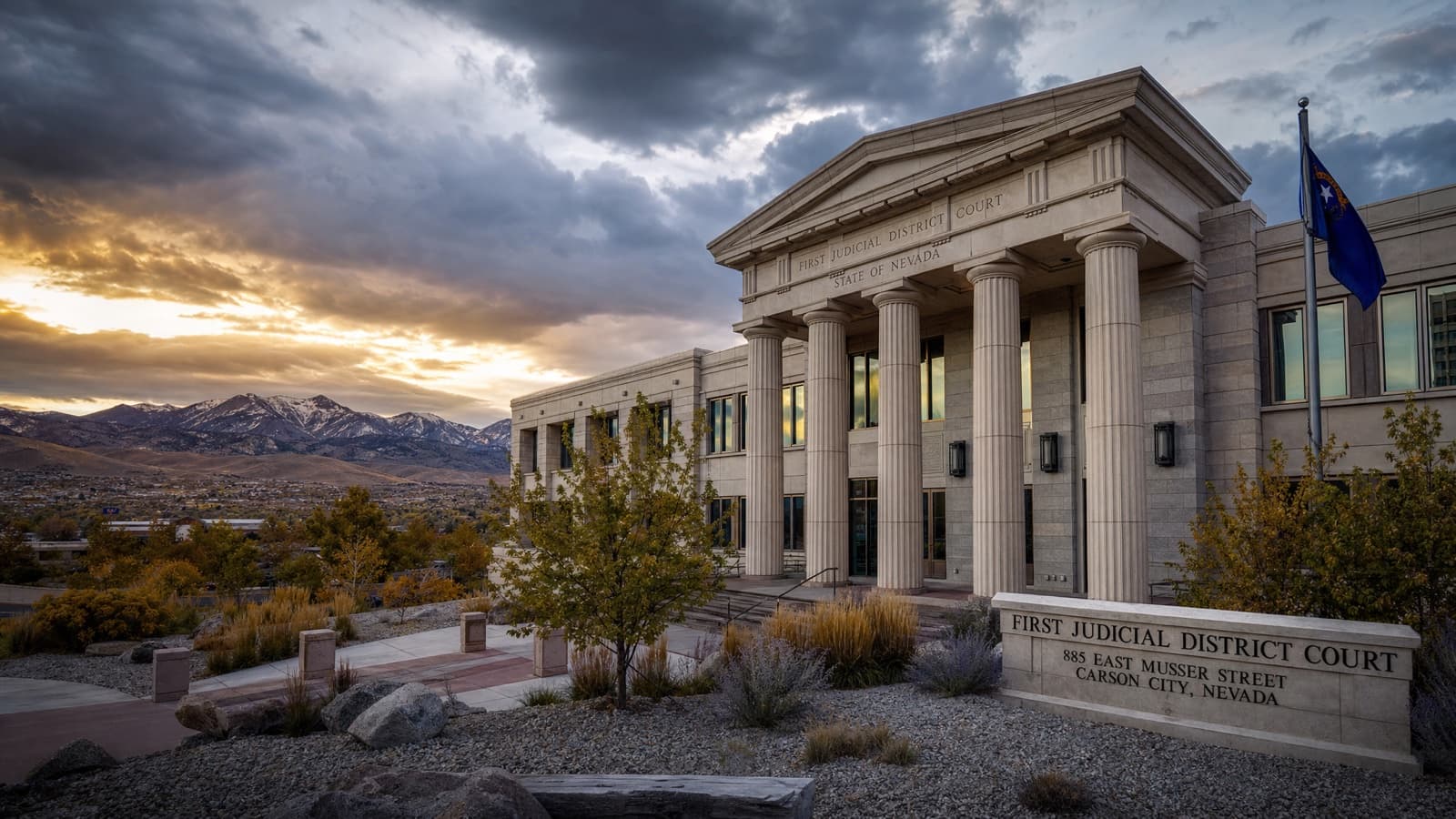
When prediction market operator Kalshi walks into a Carson City courtroom on Thursday, July 16, it won't be to argue whether its contracts are sports betting. That fight is already underway in multiple courts. Thursday's hearing is about something more immediate: whether Kalshi defied a judge's direct order and, if so, how much it should pay.
The Nevada Gaming Control Board (NGCB) is asking the First Judicial District Court to hold KalshiEX LLC in contempt of court. The board says Kalshi's geofencing technology is so inadequate that its own investigators were able to purchase prohibited event contracts from inside Nevada eight separate times — even after a court ordered the company to block Nevada users from accessing sports, election, and entertainment-related contracts. The potential sanctions are steep: $120,000 per day of non-compliance, or disgorgement of all revenue Kalshi collected from Nevada users during the violation period.
Why Thursday's Hearing Matters
Contempt proceedings are unusual in prediction market litigation. States have filed civil enforcement actions, obtained injunctions, and appealed to higher courts — but forcing a company to appear and show cause why it should not be punished for disobeying a court order is a more direct escalation. The outcome of Thursday's evidentiary hearing could determine whether Kalshi faces immediate financial penalties and, more significantly, whether a court mandates specific geofencing standards that could become a template for enforcement across other states.
For Kalshi's roughly 400,000 registered users and the broader prediction market industry watching from the sidelines, Thursday is a checkpoint in a fight that has been building for more than a year and shows no signs of slowing down.
A Year of Escalating Legal Conflict in Nevada
The Nevada dispute began in March 2025, when the NGCB sent Kalshi a cease-and-desist notice ordering it to stop offering sports event prediction contracts in the state. Kalshi declined to comply and instead filed its own lawsuit against the board, arguing that Congress gave the Commodity Futures Trading Commission (CFTC) exclusive jurisdiction over federally approved derivatives exchanges — and that state gaming law cannot override that federal framework.
Nevada disagreed and filed a civil enforcement action in February 2026. On March 20, 2026, the First Judicial District Court of Nevada issued a temporary restraining order barring Kalshi from offering sports-, election-, and entertainment-related event contracts to users located in the state. Judge Woodbury converted the TRO into a preliminary injunction on April 3, giving Kalshi 30 days to implement geolocation controls.
The key detail is in how that injunction was worded. A May 18, 2026 amended order made the geographic requirement explicit: the prohibition applied to anyone within Nevada, not just to users whose Nevada addresses were on file. That distinction matters because Kalshi's initial compliance effort — restricting accounts associated with Nevada addresses — did not catch users who had registered addresses in other states but were physically present in Nevada.
The Geofencing Dispute at the Center of Thursday's Hearing
The NGCB's contempt motion, filed June 12, 2026, lays out the factual case in blunt terms.
"Kalshi simply is not complying with the court's preliminary injunction order," the board's attorneys wrote. "People located in Nevada are easily able to go to Kalshi's platform and purchase Kalshi's sports-, election-, and entertainment-related contracts. The board's investigators have confirmed it over and over again."
The investigators tested the geofence on four separate days: May 28, 30, and 31, and June 1, 2026. On eight separate occasions across those days, board staff — physically located in Nevada — successfully purchased event contracts that the court had prohibited. The purchases included contracts tied to the ongoing FIFA Men's World Cup, the NBA Finals, and the Stanley Cup Finals.
The board's filing identifies what it says is the root cause: Kalshi spent approximately $190,000 developing an in-house geolocation system that relies exclusively on IP address data to determine a user's physical location. IP-based geofencing is widely understood in the gaming industry to be unreliable. Commercial geofencing services that use GPS signals, Wi-Fi triangulation, and carrier-level data — the same tools licensed Nevada sportsbooks are required to use — are readily available, but Kalshi has declined to adopt them.
"Kalshi has spent only a small amount of money ($190,000) on a homegrown 'solution' that relies only on internet protocol (IP) addresses, which are notoriously unreliable for determining users' locations," the NGCB filing states. "Accurate commercial geofencing solutions are readily available, but Kalshi refuses to use them here, contending that its homegrown solution is good enough."
Kalshi contests this characterization. The company has maintained that it is in compliance with court orders and that its geofencing implementation is adequate. Kalshi argues that the CFTC's exclusive regulatory authority over its exchange means that state court enforcement is itself preempted by federal law — a question that has not been resolved at the appellate level.
The Nevada Supreme Court Already Said No
Before Thursday's hearing, Kalshi made one more attempt to halt the state enforcement action. On July 1, 2026, the Nevada Supreme Court denied Kalshi's emergency motion for a stay pending appeal. The ruling came from Justices Linda Marie Bell, Ron D. Parraguirre, and Kristina Pickering, who wrote that the four factors for granting a stay did not support Kalshi's request.
The Supreme Court's denial means Kalshi must continue to comply with the district court's injunction throughout the course of the appeal — and that Thursday's contempt hearing will proceed without any stay blocking it. The denial also gives the district court a clearer runway to impose sanctions if it finds Kalshi violated the May 18 order.
A federal court had previously denied a separate request to stay the state court injunction, leaving Kalshi fighting on both state and federal tracks simultaneously.
What Contempt Could Mean for Kalshi
If Judge Woodbury finds Kalshi in contempt, the consequences could take several forms.
The NGCB is seeking monetary sanctions of $120,000 per day for each day Kalshi was not in compliance with the preliminary injunction. The board is also seeking disgorgement — meaning Kalshi would be required to repay all revenue it collected from Nevada users during the period of alleged non-compliance. Given that Nevada users were reportedly accessing NBA Finals, Stanley Cup, and World Cup contracts throughout June 2026, the disgorgement figure could be substantial.
Beyond the financial penalties, a contempt finding would likely come with a court-ordered compliance mandate. That could require Kalshi to adopt a NGCB-approved commercial geofencing solution — the same technology licensed Nevada sportsbooks use. GeoComply, which processes roughly 95% of geolocation verifications for legal US sports betting operators, is one of the services the NGCB has pointed to as an industry standard.
Any court-mandated geofencing requirement would be difficult to appeal quickly, potentially forcing Kalshi to accept the commercial solution as a condition of continued operation.
The Broader State-Level Enforcement Wave
Nevada's contempt hearing comes as Kalshi faces enforcement actions in more than a dozen states. The legal landscape as of mid-July 2026 looks like this:
States with active injunctions or TROs: Nevada (preliminary injunction), Michigan (temporary restraining order issued June 30 by Ingham County Circuit Court, $120,000-per-day fine), Massachusetts (preliminary injunction)
States with criminal proceedings: Arizona (20 misdemeanor counts filed by Attorney General Kris Mayes, including sports betting charges — the first criminal prosecution of a CFTC-registered exchange)
States with pending legislation: Minnesota (felony ban on prediction market operation scheduled to take effect August 1, though a federal court heard arguments July 2 on whether to block it)
Federal appellate courts: The Ninth Circuit Court of Appeals heard consolidated oral arguments in April 2026 involving Kalshi, Robinhood, and Crypto.com against Nevada. All three judges on the panel reportedly expressed skepticism about the preemption argument. The Sixth Circuit is expected to hear consolidated oral arguments on July 30, 2026. The Third Circuit ruled in Kalshi's favor in April, creating an active circuit split.
The CFTC has filed suit against at least nine states, seeking declaratory judgments that federal law grants it exclusive authority to regulate event contracts. CFTC Chairman Michael Selig has described state enforcement as "invading" the agency's exclusive regulatory jurisdiction.
Nevada's Gaming Industry Stakes
Nevada's push for contempt sanctions is not abstract. The state has a direct financial interest in keeping sports prediction markets out of its borders.
Nevada's licensed sportsbooks reported wagering volume down approximately $249 million in 2026 compared to the prior year. Casino and sports betting executives who appeared before the NGCB at a July 9 meeting argued that Kalshi is capturing customers who would otherwise bet through licensed Nevada operators — while avoiding the state taxes, licensing fees, and compliance costs those operators face.
"Is it having an impact in Nevada? Of course it is. They're advertising in Nevada," testified Joe Asher, CEO of Boomer's Sportsbook, at the July 9 NGCB meeting. Asher described personally observing people in Nevada using Kalshi while a court order was in effect, and said that Kalshi ads appeared in App Store searches for Nevada-licensed sportsbook apps even after the court order.
Caesars Digital President Eric Hession said at the same meeting that prediction markets "have to be impacting us from a volume perspective," though the revenue impact had not yet shown clearly in reported figures.
Former Nevada Senator Dean Heller has broken with the gaming industry's position, publicly defending Kalshi. Heller appeared on CNBC on July 10 to argue that prediction markets function as peer-to-peer exchanges rather than bookmakers — and that Kalshi's CFTC license represents four years of legitimate federal regulatory oversight. Heller acknowledged the political sensitivity of championing an industry that directly competes with Nevada's core economic sector.
What Happens to Nevada Users Thursday?
For users in Nevada, Thursday's hearing does not directly change anything in the short term. Kalshi has already restricted sports, entertainment, and election contracts for Nevada accounts. The hearing will determine whether Kalshi's existing compliance is adequate — and whether the court imposes additional requirements or penalties for the period before compliance was improved.
If the court orders Kalshi to adopt a commercial geofencing solution, implementation could take weeks. If the court finds Kalshi's current measures sufficient, Nevada users would remain restricted by whatever geofencing is already in place. If the court imposes a disgorgement order, that would be a financial matter for the company, not individual users.
The geofencing question matters beyond Nevada. A court-mandated technology standard would be the first instance of a state court specifying acceptable geolocation tools for a federally regulated prediction market operator — and could be cited in Michigan, Minnesota, and other pending enforcement proceedings.
The Federal Preemption Question
Kalshi's core legal argument — that the CFTC's exclusive jurisdiction over futures exchanges preempts state gaming law — has produced sharply divided results across different courts and circuits.
The Third Circuit sided with Kalshi in April 2026, finding that sports event contracts likely qualify as federally regulated swaps. Tennessee's district court granted a preliminary injunction in Kalshi's favor in February 2026. New Jersey courts have largely moved in Kalshi's favor.
But Nevada, Massachusetts, Ohio, and Michigan courts have reached the opposite conclusion — finding that prediction market sports contracts are substantially similar to gambling under state law. New York's federal court denied Kalshi's preemption argument in July 2026, with all four factors for a preliminary injunction weighing against the company.
The Ninth Circuit's pending decision in the Nevada case — expected sometime after oral arguments held in April — is the next major federal appellate ruling on this question. Given the skepticism the panel expressed during arguments, a ruling against preemption in the Ninth Circuit would create binding precedent across eleven western states and significantly complicate Kalshi's operational map.
What to Watch Thursday
Thursday's hearing is a full-day evidentiary proceeding. Key questions the court will address:
-
Did Kalshi violate the May 18 order? The NGCB's investigators documented purchases inside Nevada. Kalshi's legal team will argue the company's geofencing was adequate or that the order's requirements were unclear.
-
Is the $190,000 IP-based system good enough? The court will evaluate whether Kalshi's technology meets the injunction's requirements or whether commercial geofencing is required.
-
What are the appropriate sanctions? If the court finds contempt, it must set penalties. $120,000 per day of non-compliance, disgorgement, or some combination are all on the table.
-
Will the court mandate a specific technology? The most consequential outcome would be a compliance mandate specifying which geofencing tools Kalshi must adopt — a question with implications well beyond Nevada.
The hearing takes place as the industry awaits three additional developments: the Ninth Circuit's opinion on federal preemption in the Nevada case, the Sixth Circuit's consolidated arguments on July 30, and a federal court ruling on whether Minnesota's August 1 felony ban can be temporarily blocked.
Nevada's contempt case is one node in a sprawling legal architecture that will ultimately be resolved at the federal appellate level — but what happens Thursday in Carson City will set the cost of defying state courts in the meantime.
Sources & Verification
-
Nevada Gaming Control Board contempt filing, June 12, 2026: Nevada Requests Kalshi Be Held in Contempt After Alleged Geofencing Failure — SportsBettingDime — verified July 15, 2026
-
Nevada Supreme Court July 1 stay denial: Nevada Supreme Court Upholds Kalshi Geofencing Mandate — SportsBettingDime — verified July 15, 2026
-
NGCB press release and contempt details: Nevada Regulators Say Kalshi Has Defied Geofencing Order — SBC Americas — verified July 15, 2026
-
Nevada sportsbook meeting, July 9: Sportsbook Execs Push Back On Prediction Markets At Nevada Meeting — Legal Sports Report — verified July 15, 2026
-
Nevada gaming regulators enforcement details: Nevada gaming regulators push to punish Kalshi over court order dispute — KTNV Channel 13 Las Vegas — verified July 15, 2026
-
NGCB contempt motion and penalty details: Nevada Pushes Court to Sanction Kalshi for Alleged Injunction Breach — PlayUSA — verified July 15, 2026
-
Dean Heller CNBC appearance, July 10: Dean Heller defects from Nevada gaming interests to champion prediction markets — Las Vegas Sun — verified July 15, 2026
-
State-by-state legal status, July 2026: Are sports prediction markets legal? — CBS Sports — verified July 15, 2026
-
July 16 hearing confirmed by gaming law attorney Daniel Wallach: Nevada Supreme Court Upholds Kalshi Geofencing Mandate — SportsBettingDime — verified July 15, 2026