
Netflix's Prediction Market Documentary 'Instadocs: The Prediction Games' Arrives Sunday — Everything You Need to Know
Netflix premieres Instadocs: The Prediction Games on July 26, featuring Kalshi CEO Tarek Mansour, Polymarket CEO Shayne Coplan, and CFTC Chairman Michael Selig. Here's the industry context you need before you watch.
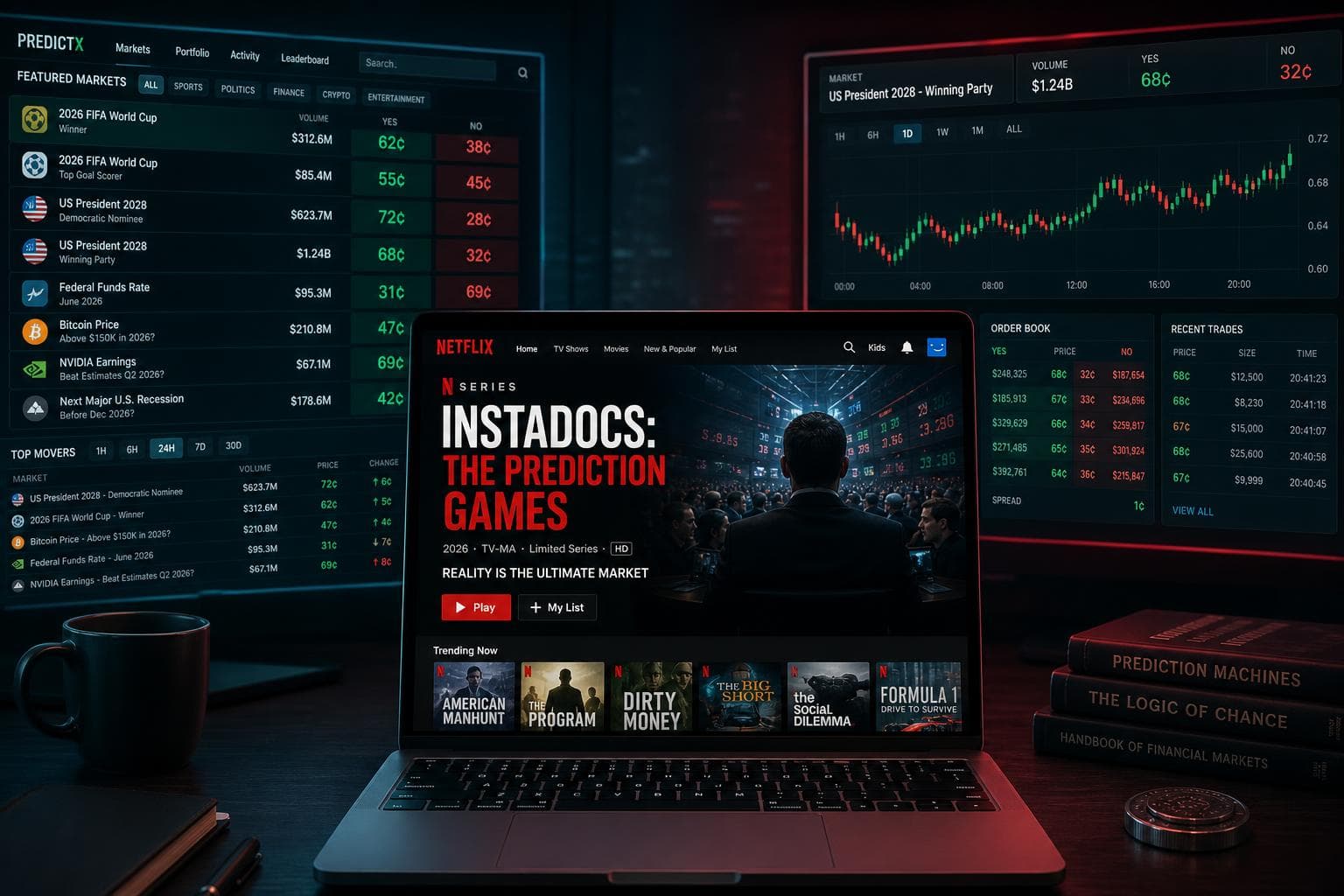
Netflix's Instadocs: The Prediction Games documentary premieres Sunday, July 26, 2026 — arriving one week after more than $5.6 billion was wagered on the FIFA World Cup final through Polymarket and Kalshi alone. The timing is no accident. Prediction markets are having the biggest moment in their history, and Netflix is moving at the speed of the story to cover it.
The documentary is the second installment of Netflix's Instadocs series, a quick-turn format designed to deliver investigative documentary content while major stories are still actively unfolding. Here's everything you need to know about the film — and the industry it's examining — before you hit play.
What Is Instadocs: The Prediction Games?
Instadocs: The Prediction Games drops viewers into what Netflix describes as "the red-hot center of betting fever," tracking fortunes made and lost in a financial market where people bet real money on the outcome of almost anything — from World Cup finals and Taylor Swift's wedding to elections, weather events, and armed conflict.
The film is produced by Words + Pictures and executive produced by Josh Tyrangiel, Connor Schell, Steve Yaccino, Libby Geist, Aaron Cohen, and Alexa Conway, with Yaccino serving as showrunner. The Instadocs format was built for exactly this moment: its first installment, Instadocs: Alex Murdaugh, Unconvicted, premiered just 17 days after the South Carolina Supreme Court overturned Alex Murdaugh's murder convictions. This time, Netflix appears to have been filming through the World Cup tournament itself — the trailer opens with a title card dated July 19, 2026, the day of the World Cup final.
The film examines prediction markets as "a legal but controversial way to gamble on the outcome of almost anything," exploring both the financial opportunity and the risks that arise when millions of dollars in real money depend on how events unfold.
Who's in It — and Why That Matters
Netflix secured access to the three most important figures in the prediction markets story:
Polymarket CEO Shayne Coplan leads the global platform that has become the dominant venue for prediction market trading on politics, entertainment, and world events — and recently opened a US sports-only exchange through its acquisition of QCX LLC, a CFTC-registered Designated Contract Market.
Kalshi CEO Tarek Mansour leads the largest CFTC-regulated prediction market in the United States, which raised $1 billion at a $22 billion valuation in its Series F round in March 2026 and has since been reported to be exploring new funding at a valuation approaching $40 billion. Kalshi holds roughly 59% of US prediction market volume and generated more than $2 billion in annualized revenue as of mid-2026.
CFTC Chairman Michael Selig represents the federal regulator at the center of a major legal battle: the Commodity Futures Trading Commission has filed lawsuits against more than nine states asserting that sports event contracts on CFTC-registered exchanges are regulated exclusively by federal law, preempting state gambling rules. Selig's presence in the documentary signals this is not just an industry story — it's a regulatory and legal story with national implications.
Getting all three on camera is a genuine coup. It means the documentary will have to navigate real tension: the industry's own CEOs defending their platforms while the regulator they answer to discusses the legal questions that could reshape or constrain them.
The Scale of What Netflix Is Covering
The numbers behind this story are staggering. According to Netflix's own press release for the documentary, more than $5.6 billion was wagered on last weekend's World Cup final through Polymarket and Kalshi combined — and Netflix describes that figure as "just a sliver of the action on prediction markets."
That framing is accurate. Q2 2026 saw $113.8 billion in total notional trading volume across prediction markets — a 48.7% jump quarter over quarter — driven by the World Cup, the NBA Finals, and Wimbledon. Kalshi held approximately 59% of US market share in Q2, while Polymarket held around 30%, according to The Motley Fool.
The scale has moved into territory that major financial institutions are tracking seriously. Bernstein has forecast annual prediction market volume could reach $1 trillion by 2030. Prediction market trading during the World Cup was equivalent to roughly 27% of legal US sports-betting volume — up from about 9% at the start of 2026, according to H2 Gambling Capital estimates cited in financial media. For context, combined monthly global trading volume on prediction markets reached approximately $24 billion as of mid-2026, compared to roughly $14 billion per month in legal US sportsbook volume in 2025, per a Pew Research Center analysis cited by CBS Sports.
That crossover is exactly what prediction markets have been building toward — and it's what makes this Netflix moment so significant.
The Controversies the Documentary Explores
Netflix isn't making a promotional film for the industry. The documentary raises sharp questions about what happens when financial incentives meet information markets.
The trailer and official descriptions specifically highlight two manipulation cases: bettors allegedly harassing war reporters to publish false information — which would move prediction market prices — and hackers manufacturing Spotify streams to profit from music chart prediction markets. These aren't hypothetical risks; both incidents have been documented in the industry's explosive growth period.
The film's central question, as Netflix frames it: "Has reality itself become a target for manipulation? Has the wisdom of crowds turned into mob rule?"
That framing reflects genuine incidents. In one high-profile case from mid-2026, bot activity on a Kalshi market drove a song to the top of Spotify's US chart, prompting Spotify to remove more than 500,000 fake streams. Polymarket has separately documented more than 1,150 disputed market settlements through the first months of 2026 — already exceeding its full-year 2025 total — including a $60 million market that resolved against documented regulatory filings when token-holder governance voted against available evidence.
It's also worth noting: Kalshi has reportedly taken issue with how the documentary portrays at least one featured trade, saying in public statements that the company examined a trade highlighted in the trailer and determined it was placed in 2025, before the Nevada court order the documentary may use as context. That dispute — an industry leader pushing back on a Netflix documentary about its own conduct — is itself part of the story.
The Regulatory Battle Underneath
The documentary arrives at a critical regulatory moment. The Commodity Futures Trading Commission published a proposed rulemaking in June 2026 defining which categories of event contracts it considers permissible — and the public comment period closes July 27, the day after the documentary premieres.
The CLARITY Act, a federal bill that would provide clearer legal footing for prediction markets, has seen its odds shift significantly in recent days. Floor-vote prospects have dimmed before the congressional recess, with odds on major prediction markets reflecting the uncertainty.
Live price — will the CLARITY Act be signed into law in 2026?:
Meanwhile, state courts are fighting back. At least 18 states have taken legal action against prediction market operators. States have won preliminary injunctions in roughly 19 of 23 attempts, according to gaming attorney Daniel Wallach. Minnesota passed the country's first outright ban, making participation a state felony beginning August 1. Washington state, Michigan, Massachusetts, and Nevada each have active court orders or pending litigation. The CFTC, for its part, has filed lawsuits against more than nine states asserting exclusive federal jurisdiction.
The sports-specific regulatory markets tell that story in real time:
Live price — will a law banning sports prediction markets be enacted in 2026?:
Kalshi spent $990,000 on federal lobbying in the first half of 2026 alone — nearly matching its entire 2025 lobbying budget — while the casino and gaming industry spent aggressively on the other side, according to CNBC's July 21 reporting on lobbying disclosures.
What US Prediction Markets Actually Look Like Right Now
For viewers who haven't used these platforms, here's the practical reality the documentary will be covering:
Kalshi is the dominant US platform, operating as a CFTC-regulated Designated Contract Market and Derivatives Clearing Organization. It holds user funds in US dollars, offers contracts across sports, politics, finance, entertainment, and macroeconomic events, and is currently the subject of state-level lawsuits arguing its sports contracts constitute unlicensed gambling. It raised $1 billion at a $22 billion valuation in its March 2026 Series F.
Polymarket operates two venues: a global exchange on the Polygon blockchain open to non-US users covering all categories, and a US sports-only exchange operated through its acquisition of QCX LLC, a CFTC-regulated DCM. The global exchange processes USDC stablecoin transactions. US users can access only sports markets through the QCX entity and the Polymarket US app.
PredictIt operates under a CFTC no-action letter and focuses on political and electoral markets with per-contract and withdrawal fee structures different from the other major platforms.
Multiple additional platforms — including Robinhood (via Kalshi), Coinbase (via Kalshi), FanDuel Predicts (via CME Group), and others — have also entered the space as prediction market trading has gone mainstream.
What to Watch For When You Stream It
A few things worth keeping in mind when you watch the documentary Sunday:
The Kalshi pushback. The company has disputed at least one featured trade, arguing publicly that it was placed in 2025 before the Nevada court order — suggesting the film's timeline framing may be contested. Watch for how the documentary handles disputed facts and whether Mansour's interview addresses those concerns directly.
The CFTC's dual role. Selig is both the regulator who has been defending prediction markets in court against states AND the regulator who published the NPRM proposing limits on which event contracts are permissible. His documentary appearance is an unusual position for a sitting agency chair.
The manipulation framing. The Spotify stream case and the war reporter harassment allegations are real — but they reflect edge-case bad actors rather than typical platform use. The documentary will need to balance genuine concerns against the reality that the vast majority of prediction market trading is straightforward financial activity.
The speed. Netflix is releasing this one week after the World Cup final with footage apparently shot through the final itself. That turnaround will either make this a genuinely urgent piece of financial journalism or a documentary that missed context it didn't have time to gather. Given that the legal landscape is evolving in real time — with the CFTC comment deadline the very next day — that speed cuts both ways.
FAQ
When does Instadocs: The Prediction Games premiere on Netflix? Sunday, July 26, 2026.
What are prediction markets, and are they legal? Prediction markets are exchanges where users buy and sell shares in binary or multi-outcome contracts tied to real-world events. Share prices reflect market-assigned probabilities — a contract priced at 65 cents implies a 65% chance of that outcome. They currently operate legally in most US states under CFTC oversight, though at least 18 states have taken legal action to restrict or ban them. Minnesota's outright ban takes effect August 1, 2026. The legal question of whether federal commodity law preempts state gambling rules is working its way toward the Supreme Court.
Who are the main platforms covered in the documentary? The documentary focuses primarily on Kalshi and Polymarket — the two largest platforms by US trading volume. Kalshi is a CFTC-registered exchange holding user funds in USD, with roughly 59% of US market share. Polymarket's US venue (through QCX LLC) is sports-only, while its global exchange covers all categories but is not available to US users.
Why does the CLARITY Act matter for prediction markets? The CLARITY Act is federal legislation that would explicitly clarify CFTC jurisdiction over prediction market contracts, potentially resolving the state-versus-federal legal battle that has produced injunctions in 18+ states. Its odds of passage before the 2026 congressional recess have declined significantly, with the CFTC's own proposed rulemaking — open for public comment through July 27 — serving as the regulatory alternative.
What does "Instadocs" mean? Instadocs is Netflix's new documentary format designed to deliver documentary content at the speed of breaking news. The series' first installment, Instadocs: Alex Murdaugh, Unconvicted, premiered 17 days after the South Carolina Supreme Court overturned Murdaugh's convictions. The prediction markets installment appears to have been assembled within weeks of the World Cup.
Conclusion
Sunday's Netflix premiere marks the moment prediction markets graduate from a niche financial product to mainstream public conversation. Whatever the documentary concludes about manipulation, regulation, or the wisdom of crowds, it will introduce tens of millions of viewers to an industry that processed more than $113 billion in trading volume last quarter — and is fighting a live legal battle in federal and state courts that will shape American gambling and financial regulation for years.
The CFTC comment deadline is Monday. The Minnesota ban takes effect in eight days. Court dates are stacking up. The story Netflix is telling didn't end when cameras stopped rolling — it's still being written.
Explore current prediction market odds across all platforms at PredictionMarkets.us.
Sources & Verification
- Netflix documentary premiere, CEOs featured, $5.6B World Cup wager: Netflix Tudum — verified July 23, 2026
- Instadocs series description, executive producers, production company: BroadwayWorld press release — verified July 23, 2026
- Q2 2026 notional volume $113.8B, Kalshi 58.9% share, Polymarket 30.2%: The Motley Fool — verified July 24, 2026
- Kalshi $22B valuation, $1B Series F March 2026: Sports Business Journal — verified June 29, 2026
- Kalshi $990K H1 2026 lobbying: CNBC — verified July 21, 2026
- Monthly PM volume ~$24B vs sportsbook ~$14B: CBS Sports, citing Pew Research Center — verified July 23, 2026