
Prediction Market Midterm Trading Tops $750 Million — And $1.6 Billion Could Follow
Traders have poured more than $750 million into 2026 midterm election contracts on Kalshi and Polymarket — eight times the entire 2024 congressional cycle — and watchdogs project $1.6 billion before Election Day.
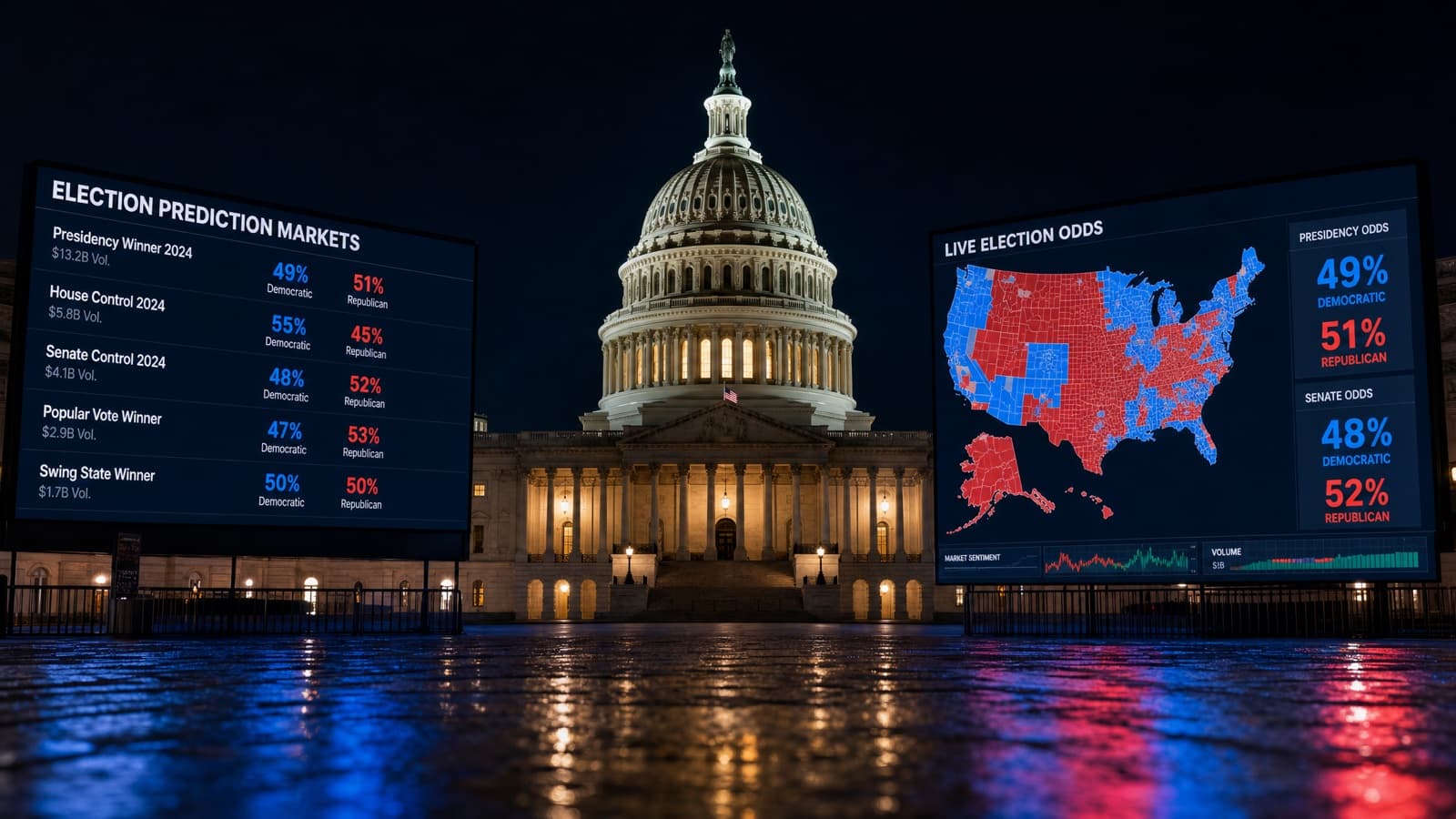
The 2026 midterms are making prediction market history. As of October 15, traders had committed more than $750 million in notional volume to congressional and gubernatorial election contracts on Kalshi and Polymarket — a figure that was essentially unimaginable two years ago and that watchdogs now project could reach $1.6 billion before polls close on November 3.
That $750 million milestone, first reported by CNN's data team, represents a nearly eightfold increase from the $92.4 million that changed hands on all 2024 congressional races combined. The growth isn't incremental. It's a structural break — the first midterm cycle where prediction markets are fully legal, publicly accessible, and backed by infrastructure capable of handling millions of traders simultaneously.
The Numbers Behind the Milestone
The scale is worth sitting with. According to the Anti-Corruption Data Collective (ACDC), a nonprofit that tracks election betting, there are now 21,811 separate prediction market contracts covering 2026 congressional races across Kalshi and Polymarket — individual yes/no questions on everything from which party controls the Senate to whether specific candidates will win their primary runoffs.
Those 21,811 markets generated $221 million in trading by late September — just on congressional contracts, just through September 30 — compared to $92.4 million for the entire 2024 congressional cycle. The full $750 million figure includes gubernatorial races, generic ballot contracts, and broader political questions like which party controls Congress as a whole.
ACDC's modelers project $1.4 billion to $1.6 billion in total midterm trading by Election Day. Their lower bound applies the 2024 average volume-per-market to the number of 2026 markets. Their upper bound assumes volume ramps up the way it did in 2024, when the final weeks of the presidential campaign generated a surge of late-stage trading.
"The 2026 midterms are the first U.S. congressional race since prediction markets became mainstream," iGaming Business noted in its October 16 roundup. The timing matters: Kalshi's legal victory in 2023, followed by Polymarket's US expansion under QCX LLC, transformed what had been a regulatory gray zone into a legitimate, CFTC-regulated market category.
What Prediction Markets Are Saying About November
With three weeks until Election Day, here is where Kalshi's markets stood on October 21:
- Democrats control the Senate: 62%
- Democrats control the House: 90%
- Democratic sweep (both chambers): ~61%
Democrats have moved significantly since the start of the cycle. On March 10, Republicans were priced at 56% for Senate control and Democrats at 44%. By September 18, Democratic Senate odds climbed to 57%. As of this writing, traders are giving Democrats roughly three chances in five of winning the chamber — which remains the more competitive race.
The House picture is more one-sided. Democrats are priced at 90%, reflecting a consensus view that the generic ballot environment and historical midterm patterns strongly favor the party out of power.
Key individual Senate races — Texas, Maine, Michigan, and South Carolina — have attracted the most volume, according to ACDC's Gambling on Democracy tracker. By contrast, most individual House races have generated less than $100,000 each, consistent with the pattern CNN reported in its September analysis.
October 2026: The Busiest Month in Prediction Market History
October isn't just a big month for midterm trading — it's the biggest month either platform has ever recorded.
Polymarket hit an all-time high of 477,850 monthly active traders in October, up 93.7% from September's 246,610, according to data reported by The Block. That surpassed the previous record of 462,600 set in January. The platform listed 38,270 new markets — nearly three times August's total — and monthly volume rebounded to $3.02 billion after months below $1 billion.
Kalshi has also set records in October, with midterm election contracts driving significant traffic alongside its sports and financial markets. The company's blog noted sustained growth in both its retail and institutional trading desk over the fall cycle.
Part of October's surge reflects anticipation rather than just the election itself: Polymarket has teased a POLY token, and traders have been building more sophisticated strategies around liquidity provision and arbitrage — a maturation from the simpler directional bets that dominated retail activity a year ago.
Who's Actually Moving the Market?
One of the more striking findings in ACDC's research is how concentrated the actual trading is. According to the group's analysis of Polymarket midterm contracts, just 1% of wallets control 68% of trading volume.
This concentration has implications for how much weight to assign to prediction market prices as forecasting signals. If a handful of large, sophisticated traders are setting the odds, those prices may reflect institutional views more than the "wisdom of crowds" that prediction market advocates cite. On the other hand, concentrated sophisticated money may also be better-calibrated than a diffuse crowd of small bettors.
The thin-markets problem compounds this. While 21,811 contracts sound like a lot, only a fraction of those have enough trading activity to generate meaningful price discovery. The Senate-level and chamber-control markets are liquid; most individual House races are not.
ACDC researcher Michelle Kendler-Kretsch put it bluntly in a Reuters interview: "Election prediction markets focus a disruptive new financial technology on our democratic process." Her group's concern isn't just about market integrity — it's about whether thin, concentrated markets give an accurate picture of electoral outcomes, and whether that picture influences campaigns and voters.
Candidates, Conflicts, and Platform Responses
The scale of election trading has also produced governance challenges. Kalshi confirmed it has suspended a handful of candidates who were found trading on their own races — a practice the platform explicitly prohibits. NPR reported in May that campaign staffers were also placing bets on races they worked on.
Both Kalshi and Polymarket say their compliance systems routinely flag and refer misconduct cases to US authorities. Kalshi blocks trades by registered politicians and campaign workers. But enforcement of these rules at scale remains an open question, especially for smaller races with less platform oversight.
Public opinion data suggests these concerns resonate. A Reuters/Ipsos poll published October 13 found that most Americans oppose using prediction markets to wager on elections — a finding that gives ammunition to lawmakers who have introduced bills restricting political event contracts.
What $1.6 Billion Would Mean for the Industry
To put ACDC's $1.6 billion projection in context: a $1.6 billion midterm cycle would mean election prediction markets are processing, in a single two-year cycle, volume in the range that major US sports betting markets handle in a single marquee weekend.
That comparison matters for the regulatory debate. If prediction markets are processing that level of money on congressional races, the stakes around market integrity, insider information, and potential market influence on voter behavior are no longer theoretical. They're operational concerns that regulators, courts, and Congress will have to engage with — regardless of whether they think prediction markets are a good idea.
For traders, the volume milestone also signals a maturing market structure. More volume means tighter spreads, better price discovery, and more reliable signals. The 62% Senate probability and 90% House probability on Kalshi reflect substantial liquidity, not thin-market noise.
FAQ
Are prediction markets legal for betting on the 2026 midterms?
Yes, on CFTC-regulated platforms like Kalshi and Polymarket (via its US venue operated by QCX LLC). These platforms are licensed as Designated Contract Markets and can legally offer election contracts to US users. State-level restrictions may apply depending on where you live; check your platform's availability map.
How accurate were prediction markets in the 2024 election?
Prediction markets gave Donald Trump a roughly 58% win probability as polls closed on Election Night 2024 — ahead of most national polls, which showed a near-dead-heat. That performance significantly boosted the credibility of prediction markets as forecasting tools and is one reason trading volumes surged in the 2026 cycle.
Can politicians or campaign staffers trade on election markets?
Platforms explicitly prohibit it, and Kalshi has suspended candidates caught betting on their own races. NPR reported that some campaign staffers have traded on races they worked on despite the prohibition. Whether enforcement is effective at scale remains an open question.
Which platform has the most midterm contracts?
ACDC's count of 21,811 contracts spans both Kalshi and Polymarket. Kalshi and Polymarket's US venue (operated by QCX LLC) both list political contracts for US-based traders, while Polymarket's global platform offers additional markets accessible to international traders.
What are the current odds for a Democratic sweep of Congress?
As of October 21, Kalshi traders are pricing a Democratic sweep of both chambers (House and Senate) at approximately 61%. Democrats are heavily favored in the House (90%) and lead in the Senate (62%), though Senate control remains contested.
The Bottom Line
A $750 million midterm — or potentially a $1.6 billion one — is more than a statistical milestone. It marks the moment prediction markets fully entered the US political ecosystem, moving from a 2024 presidential novelty to a permanent fixture of how Americans interpret elections.
Whether those prices are more accurate than polls, who's actually setting them, and what happens when candidates and staffers start trading on inside information are questions that will outlast this election cycle. But the volume is not going away. The industry has crossed a threshold, and the regulatory and political debate will increasingly happen in the context of markets this large.
Track live midterm odds across both platforms at PredictionMarkets.US.
Sources & Verification
- $750M midterm trading volume: CNN analysis, September 24, 2026
- 21,811 markets, $221M congressional volume, $1.4–1.6B projection: ACDC Gambling on Democracy tracker
- 1% of wallets control 68% of trading: ACDC, October 2026
- 2024 congressional total $92.4M, volume breakdown: Reuters via US News, October 14, 2026
- iGaming Business prediction market roundup, October 16, 2026
- Kalshi midterm odds — D Senate 62%, D House 90%: Kalshi official market blog
- Polymarket October ATH 477,850 monthly traders: Startup Fortune / The Block, October 2026
- RG.org summary of CNN and ACDC data