
Michigan Primary Day 2026: What Prediction Markets Say About El-Sayed, Stevens, and November
Michigan Democrats are voting today in a nationally watched Senate primary. Here's what prediction markets on Kalshi show about the race—and the November stakes that matter more.
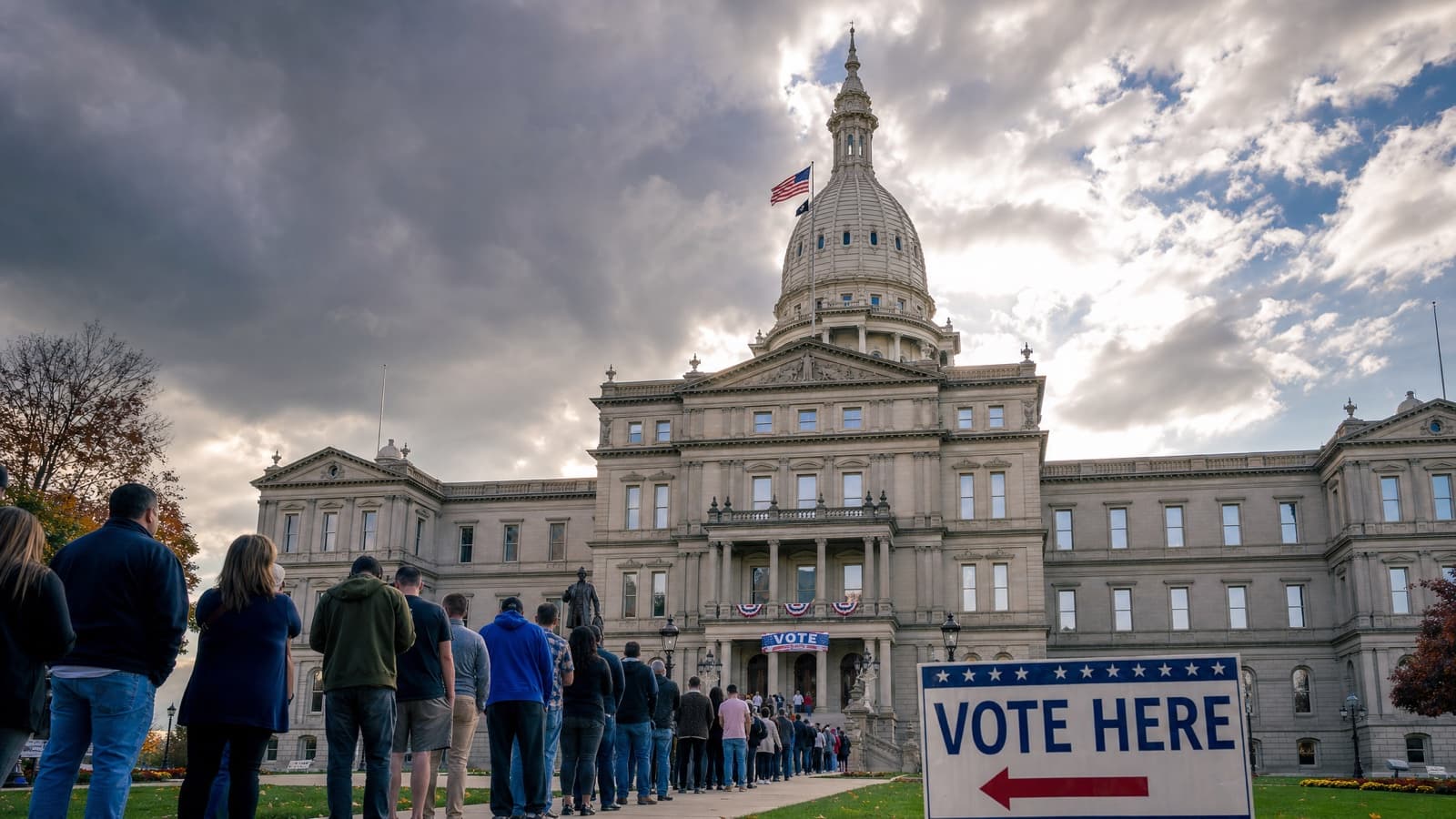
Michigan Democrats are voting today in one of the year's most consequential Senate primaries. The high-stakes contest between progressive candidate Abdul El-Sayed and moderate U.S. Representative Haley Stevens has drawn national attention, hundreds of millions in outside spending, and one clear verdict from regulated prediction markets: El-Sayed is the overwhelming favorite to win the nomination. But the more interesting bets—and the more open questions—are what happens in November.
The Race: Progressive vs. Establishment in a Must-Win Battleground
The Michigan Senate seat is open because Senator Gary Peters chose not to seek reelection. Republican former U.S. Representative Mike Rogers, who narrowly lost a Senate race in 2024, is running unopposed for the GOP nomination and enters November as a credible challenger in a state Donald Trump carried by fewer than 2 percentage points in 2024.
El-Sayed, a physician and former Wayne County health director, has built his campaign around Medicare for All, reducing corporate political influence, and economic populism. He has earned endorsements from Sen. Bernie Sanders and Rep. Alexandria Ocasio-Cortez, and has driven strong turnout among younger Michigan Democrats. State Sen. Mallory McMorrow, who had been viewed as a potential top-three finisher, withdrew from the race in early July, effectively consolidating the progressive lane behind El-Sayed.
Stevens, a two-term U.S. Representative, is the candidate of the Michigan Democratic establishment. She has secured the backing of Gov. Gretchen Whitmer, Senate Democratic leader Chuck Schumer, former Senators Peters and Debbie Stabenow, and AIPAC, which has invested heavily in outside spending on her behalf. Stevens has argued consistently that she is the more electable candidate in a battleground state Democrats cannot afford to lose.
The primary had grown contentious in its final week. Stevens positioned herself as a pragmatic fighter; El-Sayed campaigned with the progressive energy that has defined a wave of primary upsets earlier in the 2026 cycle.
What the Final Polls Showed
Multiple polls conducted in the final week before the primary showed El-Sayed with a substantial lead:
- Mitchell Research & Communications (July 28–29, 406 likely voters): El-Sayed +14, 52% to 38%
- Zenith Research (July 26–30, 536 likely voters): El-Sayed +18 on pushed ballot, 59% to 41%
- Emerson College (July 26–27, 700 likely voters): El-Sayed +16, 57% to 41%
- Tavern Research (July 26–27, 914 likely voters): El-Sayed +11, 48% to 37%
An earlier Glengariff Group/Detroit News poll from July 8–11 showed Stevens with a 7-point lead, but that survey predates McMorrow's withdrawal and the significant late movement in the race.
CNN data analyst Harry Enten said Monday that El-Sayed is poised to "deliver the biggest blow so far against the establishment of the Democratic Party" and called him "the heavy favorite going into tomorrow."
What Prediction Markets Show Today
With polls open across Michigan, regulated U.S. prediction markets have formed a clear consensus on the primary outcome. Kalshi, the CFTC-licensed designated contract market, has El-Sayed as the heavy favorite on more than $8 million in notional volume—one of the largest sums for a state-level primary this cycle. Polymarket's global platform, which serves non-U.S. traders and is not accessible to U.S. residents for political contracts, shows near-identical odds with roughly $741,000 in volume. The alignment between both platforms signals strong market conviction rather than noise.
Live market view — track these prices yourself:
County-level markets offer a more granular picture and remain in actively tradeable ranges. On Polymarket's global platform, El-Sayed is priced at roughly 93 cents to win Wayne County (which includes Detroit), and approximately 86 cents to carry Macomb County—the suburban county that serves as a critical swing-area bellwether in Michigan Democratic primaries. These county markets reflect meaningful residual uncertainty about turnout patterns in specific geographies, even as the statewide outcome looks settled.
The Real Question: November
Here is where prediction markets become genuinely interesting—and where there is real money to be made or lost.
Kalshi shows Democrats at roughly 67 cents to win the Michigan Senate seat in November. Polymarket's global platform has it at approximately 68 cents for Democrats. That is a meaningful lean, not a lock.
The Cook Political Report rates the November general election a toss-up. The race sits in a state where Donald Trump won twice, where Rogers is a well-funded incumbent-quality candidate with strong name recognition, and where the winner of today's primary will enter November carrying either the progressive brand or the establishment brand of the Democratic Party.
The electability question is not hypothetical. An EPIC-MRA poll conducted July 24–31, 2026, sponsored by Michigan Information & Research Service, found Stevens leading Rogers 44% to 42% in a hypothetical general election matchup—but found Rogers leading El-Sayed 46% to 43%. If that differential holds, today's primary choice carries real consequences for November.
Prediction market traders are pricing those concerns in. At 67 cents for Democrats, the Kalshi market is saying this is a Democratic-leaning seat with meaningful Republican upside—not a comfortable hold. The Senate control market adds context: Kalshi prices Republicans at roughly 53 cents to hold their Senate majority, consistent with a close national environment where individual seats like Michigan genuinely matter.
Michigan's Congressional Primaries: Three Races Worth Watching
Today's ballots extend well beyond the Senate race. Three Michigan House primaries have drawn significant prediction market volume:
Michigan's 13th District (Detroit): Progressive state Rep. Donavan McKinney is challenging incumbent Rep. Shri Thanedar in a heavily Democratic district that represents Detroit and surrounding Wayne County. Thanedar, who won in 2022 when the district first elected him, has backing from House Democratic leadership. McKinney has earned endorsements from Bernie Sanders and several Detroit-area progressive organizations. Kalshi and Polymarket's global platform both price McKinney at approximately 88 cents to win the primary—a competitive but directional market. McKinney's campaign has explicitly framed the race as a call to restore Black congressional representation in Detroit. A McKinney win would be another data point in the progressive wave's 2026 momentum.
Michigan's 7th District (Lansing area): Progressive William Lawrence, a co-founder of the Sunrise Movement, faces moderate former Ambassador Bridget Brink and Navy veteran Matt Maasdam in a district Cook Political Report rates as a general election toss-up. Kalshi has Lawrence at approximately 92–95 cents to win the primary—a near-consensus market. But the general election in MI-7 will be genuinely competitive: the district backed Trump by just 1 point in 2024, and Lawrence's progressive profile will be tested against Republican incumbent Tom Barrett in November.
Michigan's 11th District (Oakland County suburbs): State Sen. Jeremy Moss is the heavy favorite on Kalshi to win the Democratic nomination in this competitive suburban district.
Why This Matters for Prediction Markets as a Tool
The Michigan primary is a live illustration of what regulated prediction markets do—and don't do—well. They aggregate real money behind public information efficiently, producing odds that closely track the polling averages. On the primary outcome, markets and polls agree: El-Sayed is the heavy favorite, and the county-level markets show exactly where residual uncertainty is concentrated.
But markets don't vote. They price the probability of outcomes based on available information, and that information changes. In November, new polls, new events, and new campaign dynamics will shift the Michigan Senate odds. The 67-cent Democratic probability on Kalshi today will move—perhaps significantly—as the fall campaign develops.
For traders and political observers, the most actionable market today isn't the primary itself. It's whether the November odds adjust sharply depending on who wins. If El-Sayed wins tonight and the November Democratic odds drop meaningfully—reflecting the EPIC-MRA electability data—that would be a market signal worth watching.
FAQ
Do US users have access to Michigan senate primary prediction markets? Yes. Kalshi, the CFTC-licensed designated contract market, offers Michigan senate primary and general election markets accessible to U.S. users. Polymarket's global platform (polymarket.com) also has these markets, but is not accessible to U.S. residents for political contracts. Kalshi is the primary venue for domestic prediction market traders on this race.
What is the Michigan Senate seat's importance for Senate control? Michigan is an open seat—Senator Gary Peters chose not to run again—in a state Donald Trump won twice. Prediction markets currently price Republicans at roughly 53 cents to hold their Senate majority. Michigan is one of a handful of seats where the November outcome could flip overall control, making it one of the highest-stakes general elections in the country.
What were the final prediction market odds heading into today's vote? Kalshi showed El-Sayed as an overwhelming favorite in the Democratic primary. The cross-platform consensus is that this race is effectively called by the markets before the votes are counted. The more contested market is November: Kalshi shows Democrats at roughly 67 cents to hold the seat against Republican Mike Rogers.
Conclusion
Michigan's Democratic Senate primary is the most-watched state race in the country today—and prediction markets have given a clear verdict before a single vote is tabulated. El-Sayed enters primary day as the heavy favorite on both Kalshi and Polymarket's global platform, backed by polling leads and the momentum of McMorrow's exit.
But the real bet isn't the primary. It's November. With Kalshi pricing the general election at 67 cents for Democrats—competitive, but not comfortable—the choice Michigan Democratic voters make today carries direct consequences for which candidate faces Rogers in the fall, and which way the state's crucial Senate seat ultimately breaks.
Track live odds on PredictionMarkets.us as results come in tonight.
Sources & Verification
- Michigan primary candidates and race overview: Associated Press, August 4, 2026
- El-Sayed and Stevens final primary events: Associated Press, August 3–4, 2026
- AP live primary coverage: Associated Press live blog, August 4, 2026
- Polling summary, EPIC-MRA electability data, Newsweek analysis: Newsweek, August 4, 2026
- Progressive primary races overview, MI-7 / MI-13 market odds: Newsweek, August 4, 2026
- Michigan primary overview: The Guardian, August 4, 2026
- Live primary updates including Michigan: The New York Times, August 4, 2026
- Kalshi prediction market odds: Kalshi.com
- Polymarket global platform odds (non-U.S. users only): Polymarket.com