
LeBron James Signed With the 76ers. Prediction Markets Had Over $250 Million in the Wrong Direction.
LeBron James shocked $250 million in prediction market bets by signing with the Philadelphia 76ers on July 25, 2026. Here's how the markets moved — and what they got right and wrong about the biggest NBA free agency in prediction market history.
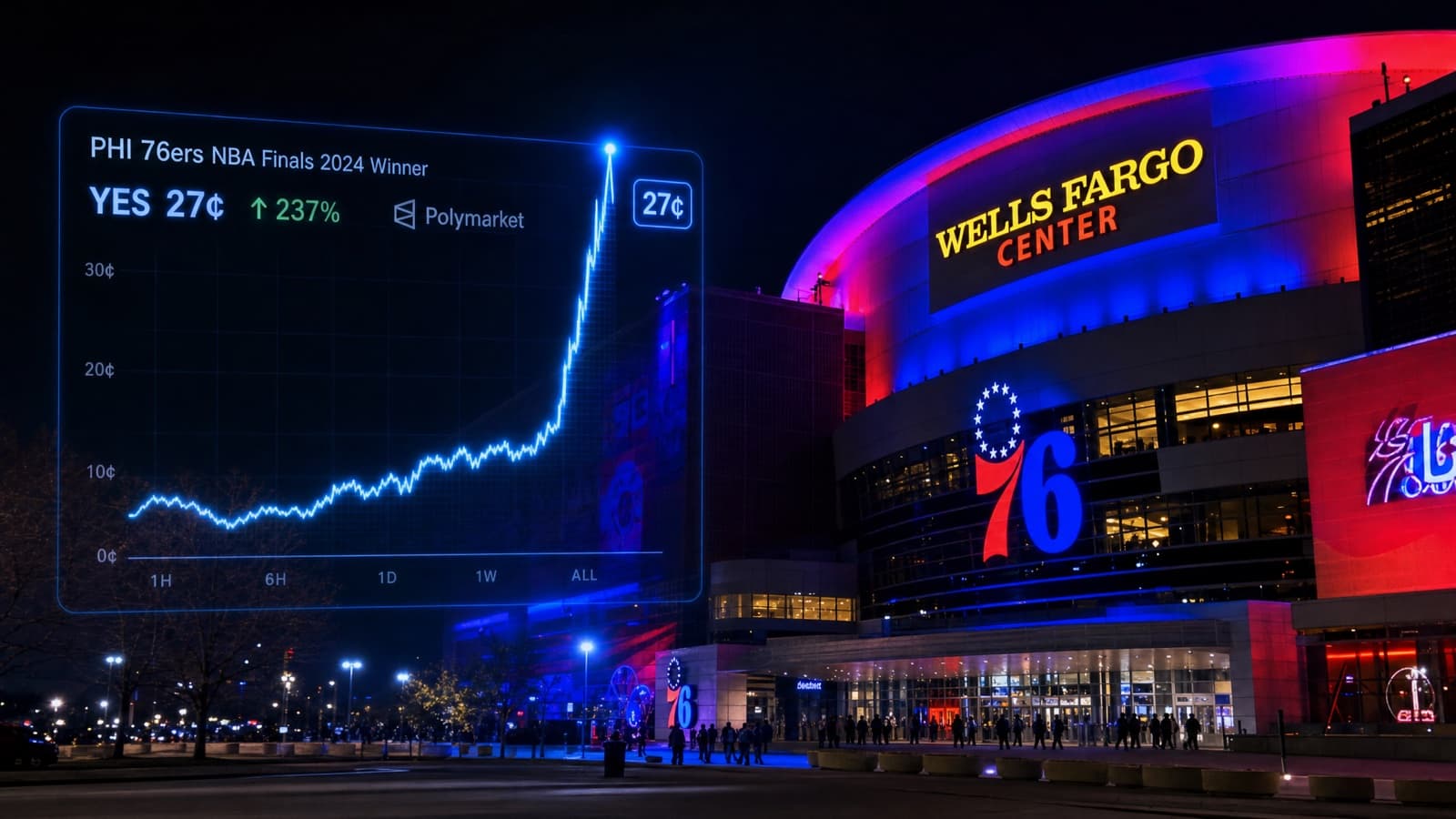
The moment ESPN's Shams Charania broke the news on July 25, 2026 that LeBron James was signing a two-year, $8 million deal with the Philadelphia 76ers, more than $250 million in prediction market contracts scrambled to catch up with reality.
Philadelphia was priced at roughly 9 cents on Kalshi heading into the announcement — implying about a 9% chance of landing the four-time NBA champion. Miami, the clear pre-announcement favorite, sat near 45 cents. Within minutes of ESPN's report, Philadelphia surged toward the top and Miami collapsed, delivering one of the most dramatic repricings in prediction market history tied to a single sports decision.
For an industry that markets itself as a real-time information aggregator capable of synthesizing everything the crowd collectively knows, the LeBron James market raised a pointed question: what exactly did $250 million in "collective intelligence" actually predict?
Live market view — LeBron James Next Team:
The Biggest Sports Free-Agency Market in Prediction Market History
The LeBron James next-team market grew into something the prediction market industry had never seen before at this scale.
According to Fortune, combined trading tied to James' destination topped $245 million across Kalshi and Polymarket, with more than $200 million of that concentrated on Kalshi alone. The Washington Post, reporting on the same data, put the combined figure above $250 million. A separate report from USA Today noted Kalshi had crossed $170 million in volume as of July 20 — five days before the announcement — with activity accelerating by the hour.
The numbers place James' free agency in genuinely rare company. According to Fortune, fewer than 30 markets in Kalshi's history have ever surpassed $100 million in total trading volume. At its peak, the James market ranked as the platform's third-largest ever, trailing only the 2026 FIFA World Cup championship contract and the 2028 Democratic presidential nomination.
By comparison: a Kalshi market on Kawhi Leonard's free agency drew roughly $760,000 in total trading volume, according to the Washington Post. A market on Bronny James attracted about $395,000. Kyle Tucker's market brought in $157,000. The LeBron market was operating on a fundamentally different order of magnitude.
How Miami "Accidentally" Became the Favorite
For most of the spring and early summer, Cleveland held the top spot in Kalshi's LeBron market. Golden State briefly surged to 47% in early July before fading. But what shifted the entire complexion of the market was a Tuesday night publishing error that the NBA and prediction market industry are still processing.
On July 22, the Miami Heat's official YouTube channel briefly posted — then quickly deleted — a scheduled livestream titled "LeBron James Introductory Press Conference | July 27, 2026." A team spokesperson told ESPN and the Miami Herald the posting was accidental, created while staff prepared materials for the possibility that James might eventually choose Miami.
The clip was live for only minutes. The market reaction was immediate and large. According to Fortune, Miami's implied probability on Polymarket jumped roughly 20 percentage points following news of the posting. On Kalshi, the Heat moved from approximately 37% to 47% before settling near 45% as traders processed the signal, per the Washington Post.
The Heat dismissed the social media team members responsible and posted a job listing for a director of YouTube strategy. But on prediction markets, the information was already priced in. Miami entered the final days of James' deliberations as the overwhelming favorite, carried by a wave of money that had poured in after what was, according to the team, an honest mistake.
The Prediction Market Landscape Before the Decision
Heading into July 25, the market showed a picture that almost every analyst and observer shared: Miami was the clear favorite.
According to al.com's reporting on Kalshi data, the Heat held approximately 43-45% odds in the final hours before the signing. Philadelphia sat at roughly 9%. Cleveland and Golden State held meaningful but secondary positions that had been fading since mid-July.
Polymarket's global platform, which U.S. users cannot legally access, showed a nearly identical picture. Per Yahoo Sports, Polymarket's global book had Philadelphia at 7.6% as of early Friday morning, far behind Miami at 47.5%.
The NBA had explicitly flagged this type of market as a problem. In an April letter to the Commodity Futures Trading Commission, NBA executive Dan Spillane argued that markets on "player or team transactions" should be prohibited because they are "readily susceptible to manipulation and/or improper use of confidential information," per the Washington Post. The Heat's YouTube mistake had illustrated a related concern: market-moving information can surface through an unintentional error rather than a deliberate leak, creating volatility no regulator had specifically anticipated.
James himself had given no timeline for his decision. His agent Rich Paul told ESPN that nobody — including NBA Commissioner Adam Silver — knew when the announcement was coming.
The Moment $250 Million Was Wrong
When ESPN's Shams Charania reported the signing Friday morning, the market's consensus was decisively off. Philadelphia was a roughly 9-cent contract — about a one-in-ten shot — at the time the news dropped, per al.com.
The 76ers had barely registered as a serious possibility for most of the summer. They entered conversations only after trading for Jaylen Brown from the Boston Celtics in a move that reshaped their roster from a team in transition to a genuine contender. Charania, appearing on ESPN following the announcement, explained what happened: "The Sixers were not even in the picture, on the map, until Bob Myers traded for Jaylen Brown. LeBron looked at that roster, he looked at the Cavs roster, he looked at the Heat roster and he is choosing the Philadelphia 76ers."
James himself framed the decision in terms of championship pursuit rather than legacy or money. In a post on social media, he wrote: "I still truly love this game, and I have more to give. This is my last decision. I'm not going for money." The reported $8 million deal represented a pay cut from a final Lakers contract that paid him nearly $53 million, per ESPN.
What the Market Actually Got Right: Integrity Under Pressure
Here is the counterintuitive takeaway from the largest sports free-agency prediction market ever run: despite being wrong about the outcome, the market's behavior before the announcement may actually validate prediction markets' core integrity claim.
According to analyses of Kalshi's trading data reported by multiple outlets, Philadelphia's price did not begin meaningful movement until the moments immediately surrounding the ESPN report — consistent with a market where no trader had advance, nonpublic knowledge of the outcome. The crowd was wrong, but wrong for understandable reasons: James' decision was genuinely private, confined to a small circle of family members, agents, and team executives.
Kalshi has previously banned and fined traders found to have used nonpublic information in unrelated markets, per the Washington Post. The company also partners with blockchain analytics firm Chainalysis to detect patterns suggestive of insider activity on its platforms.
Marty Conway, a sports business professor at Georgetown University, told Fortune that the James episode reflects a broader truth about what prediction markets can and cannot do. "There's a market for everything, and I think people have recognized that there's a market for everything — there are individuals in every pocket of that area who think they can either influence it, make a market in it, or take advantage of it."
When the outcome is genuinely private and limited to a small circle, prediction markets aggregate public signals and conventional wisdom — not insider knowledge. In this case, the public signals pointed to Miami. They were wrong. And that wrongness, paradoxically, is evidence the market was functioning exactly as designed.
The NBA's Ongoing Opposition
The NBA's regulatory concern with these markets extends beyond LeBron James' specific free agency. The league's April letter to the CFTC argued that contracts on player transactions, injuries, officiating and disciplinary decisions should be banned outright. The Heat's YouTube error illustrated exactly the kind of scenario the NBA had warned about: a small, internal mistake — not deliberate insider activity — capable of moving hundreds of millions of dollars in market exposure within minutes.
The CFTC's June proposed rulemaking on sports event contracts would formalize which market types are permitted under federal law. Whether player transaction markets survive that rulemaking — or face restrictions similar to the NBA's request — remains an open question heading into the next legislative and regulatory cycle.
Where the 76ers and the Markets Stand Now
Philadelphia's prediction market positioning transformed overnight. According to al.com's reporting on post-announcement Kalshi data, the 76ers moved into third place in the NBA Championship market at roughly 12%, behind only the Oklahoma City Thunder (21%) and San Antonio Spurs (20%). The Heat, which had been trading as high as 19% on championship odds driven by the Giannis Antetokounmpo acquisition and the LeBron speculation, fell sharply.
Yahoo Sports reported that BetMGM's trading strategy manager described the immediate aftermath: "It's been nothing but 76ers... After the first hour, 98% of the title bets were on the Sixers."
James will play alongside Joel Embiid, Tyrese Maxey, Jaylen Brown and rookie VJ Edgecombe in Philadelphia. The signing aims to break a 43-year championship drought for a franchise that last won a title in 1983 — the same task James completed for Cleveland in 2016 after a 52-year drought, per ESPN.
Whether this version of the 76ers can deliver on the market's newly elevated expectations — or whether prediction markets will once again find itself scrambling to reprice a surprise — will take the entire 2026-27 NBA season to determine.
Frequently Asked Questions
How much money was traded on LeBron James' NBA free agency decision? More than $250 million in total trading volume accumulated across prediction market platforms, including over $200 million on Kalshi alone, making it the third-largest market in Kalshi's history and one of the largest single sports free-agency markets ever. Source: Washington Post and Fortune, both July 23, 2026.
What were LeBron James' prediction market odds right before he signed with the 76ers? Heading into the announcement, Kalshi showed Miami as the favorite at approximately 43-45%, with Philadelphia priced at roughly 9%, per AL.com. Cleveland and Golden State held secondary positions. Polymarket's global platform showed Philadelphia at 7.6%, per Yahoo Sports.
Why did prediction markets fail to predict LeBron James signing with the 76ers? LeBron James' decision was genuinely private, confined to a small circle of family, agents and team executives. Markets aggregated public signals and conventional wisdom, which pointed strongly toward Miami — especially after the Heat's YouTube video incident — but had no access to the private deliberations that led James to Philadelphia.
Did the Heat's YouTube video cause the LeBron James prediction market spike? Yes. When the Miami Heat accidentally posted a scheduled YouTube livestream titled "LeBron James Introductory Press Conference | July 27, 2026" on July 22 before quickly deleting it, Miami's odds surged by roughly 20 percentage points on both Kalshi and Polymarket, per Fortune and the Washington Post. The team said the posting was a mistake prepared in case James chose Miami.
What are the Philadelphia 76ers' championship odds after signing LeBron James? Following the signing, Kalshi showed the 76ers at approximately 12% to win the 2027 NBA Championship, placing third behind the Oklahoma City Thunder (21%) and San Antonio Spurs (20%), per AL.com.
Sources & Verification
- $250M+ total trading volume: Washington Post, Rick Maese, July 23, 2026 — verified July 26, 2026
- $200M+ on Kalshi, ~$40M on Polymarket global: Fortune, July 23, 2026 — verified July 26, 2026
- $170M milestone by July 20: USA Today, July 20, 2026 — verified July 26, 2026
- Third-largest Kalshi market ever; fewer than 30 markets cleared $100M: Fortune, July 23, 2026 — verified July 26, 2026
- Kawhi Leonard ~$760K, Bronny James ~$395K comparable volumes: Yahoo Sports / Washington Post, July 23, 2026 — verified July 26, 2026
- Heat YouTube video incident, Miami's odds surge: Fortune and Washington Post, both July 23, 2026 — verified July 26, 2026
- Philadelphia at ~9%, Miami at ~44% pre-announcement; post-signing Kalshi odds: AL.com, July 25, 2026 — verified July 26, 2026
- LeBron signs with 76ers, two-year $8M deal: ESPN / Shams Charania, July 25, 2026 — verified July 26, 2026
- Charania quote on 76ers entering mix after Jaylen Brown trade: ESPN, July 25, 2026 — verified July 26, 2026
- NBA letter to CFTC warning against player transaction markets: Washington Post, July 23, 2026 — verified July 26, 2026
- Marty Conway (Georgetown professor) quote: Fortune, July 23, 2026 — verified July 26, 2026
- Polymarket global: Philadelphia at 7.6% pre-announcement: Yahoo Sports, July 25, 2026 — verified July 26, 2026