
White House Teleprompter Operator Made $100,000 Betting on Trump's Speeches Using Kalshi
Gabriel Perez, Trump's teleprompter operator since 2016, allegedly made over $100K on Kalshi 'Mentions' markets using advance access to prepared speeches. Kalshi's surveillance caught it, referred the case to the CFTC. Here's what happened.
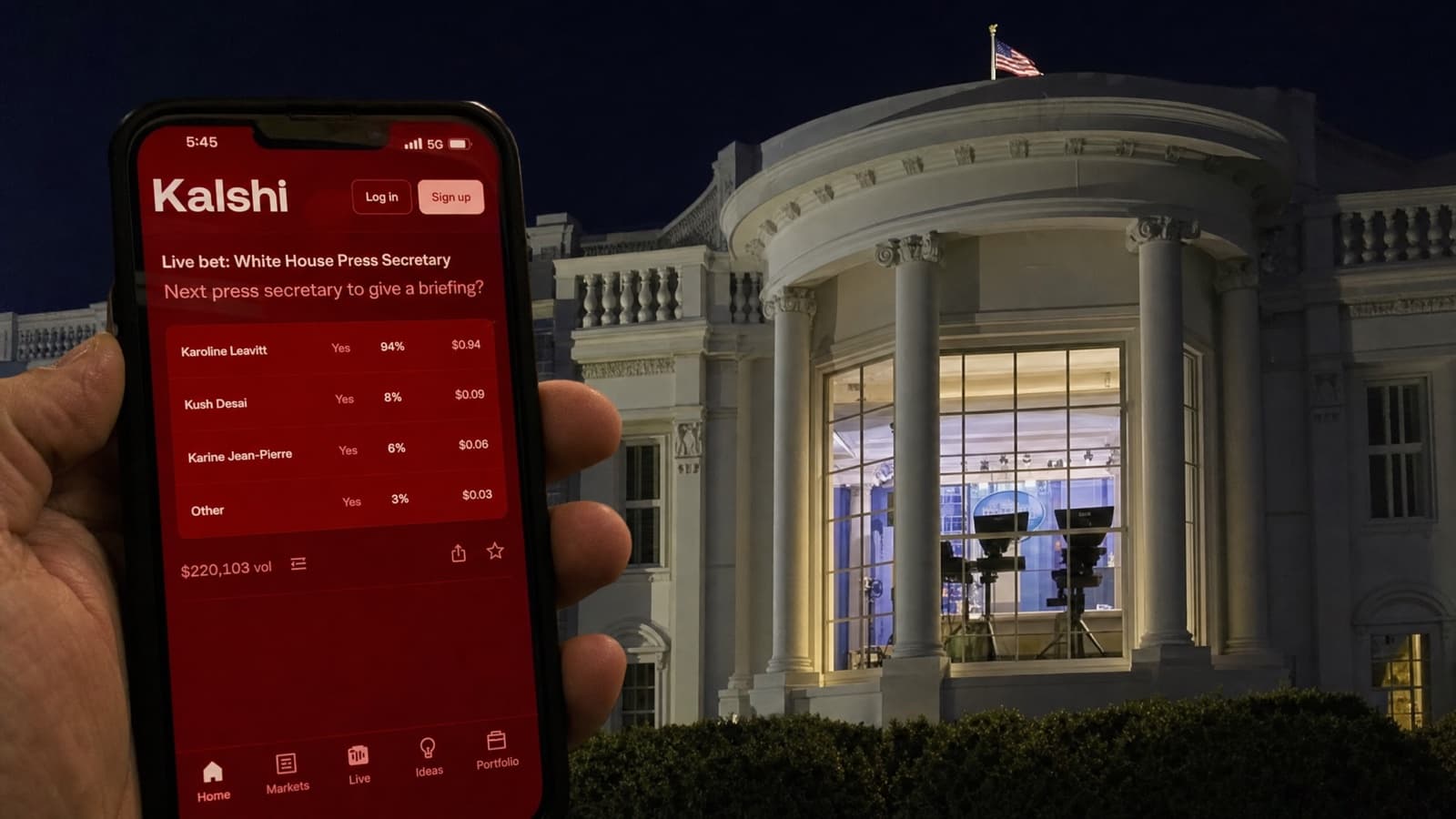
A White House staffer has been caught trading on his insider access to Donald Trump's prepared remarks — and the surveillance system that caught him belongs to the prediction market he was exploiting.
Gabriel Perez, a technical assistant to the president who has operated Trump's teleprompter since his first presidential campaign in 2016, allegedly made more than $100,000 over three months placing bets on Kalshi's "Mentions" markets — contracts where users wager on whether specific words, phrases, or topics will be spoken during a public speech.
Kalshi's own surveillance team flagged the suspicious trades, investigated, and then referred the case to the Commodity Futures Trading Commission (CFTC). Federal prosecutors in Manhattan declined to open a criminal investigation. The CFTC is now pursuing a civil settlement.
On Thursday afternoon, White House Press Secretary Karoline Leavitt confirmed that Perez had been placed on unpaid administrative leave — the announcement coming within hours of ABC News first publishing the story. President Trump, she said, called the situation "a disgrace" and personally made the decision to take action.
What Kalshi's "Mentions" Markets Are
Kalshi's "Mentions" markets are one of the more distinctive products in the prediction market ecosystem. Rather than betting on the outcome of an event — who wins an election, whether the Fed cuts rates — users bet on the content of a specific speech.
A contract might ask: Will Trump mention the word "tariff" during his State of the Union? Will he discuss Elon Musk during remarks at the World Economic Forum? Traders buy "Yes" shares if they think the word or topic will come up, "No" shares if they think it won't.
The contracts resolve immediately once the speech ends and a transcript can be verified. For most traders, it is a pure information game — they read news coverage, study Trump's prior speeches, and estimate his likely talking points.
For someone with advance access to the actual prepared remarks, it is a structurally different game.
Live market view — see Kalshi Mentions markets yourself:
The Trades: Three Months, Fourteen-Plus Speeches
According to sources familiar with the investigation cited by ABC News, Perez placed bets across more than a dozen Trump speeches over a three-month period. The events included:
- A December primetime address
- Trump's January speech at the World Economic Forum in Davos, Switzerland
- The State of the Union address in February 2026
- Trump's March remarks at a Medal of Honor ceremony
Perez's role gave him access that almost no other trader had. As the president's teleprompter operator, he typically has "the final eyes on nearly all of the president's prepared remarks" — and, per sources, often receives last-minute edits from Trump himself. He has held the role since Trump's first presidential campaign.
What made investigators suspicious was not just the win rate but the mechanism. Trump famously goes off-script. Investigators uncovered instances where Perez had placed a bet on a specific word being mentioned — and then cancelled the bet mid-speech, precisely when Trump skipped that section of the prepared text.
That is not a trader guessing from public information. That is someone reading along in real time.
How Kalshi Caught It: Self-Initiated Surveillance
The investigation started not with a government referral but with Kalshi's own compliance team.
"Our surveillance team promptly flagged and referred these trades to the CFTC, and we are cooperating and assisting regulators," said Bobby DeNault, Kalshi's head of enforcement, in a statement to ABC News.
Kalshi is a CFTC-regulated Designated Contract Market (DCM) and Derivatives Clearing Organization (DCO) — the same federal regulatory framework that governs traditional futures exchanges such as the CME Group. That status carries real compliance obligations, including trade surveillance systems designed to detect anomalous patterns.
The statistical signature here was distinctive: trade outcomes that correlated not with public information but with the prepared draft of speeches, right up until Trump deviated from script. Kalshi froze more than $90,000 in alleged profits while the investigation was active.
The voluntary referral matters. Kalshi was under no external pressure to act — they identified the pattern internally and handed it to their regulator without prompting. For an industry where critics frequently argue prediction markets lack adequate market integrity protections, this is a substantive counter-argument.
The Legal Outcome: Civil Track, No Criminal Charges
After Kalshi referred the matter to the CFTC, the agency alerted federal prosecutors in the Southern District of New York. The SDNY declined to open a criminal investigation.
The CFTC is now pursuing a civil settlement. Terms reportedly under discussion would require Perez to return his profits and agree to refrain from making similar trades. Perez sat for a regulatory interview and acknowledged some of the trades, per sources familiar with the discussions.
The civil-versus-criminal split reflects where prediction market insider trading law currently stands. The Commodity Exchange Act — which governs Kalshi — prohibits manipulation and fraud, but the specific application to speech-content markets and non-public government information has not been definitively tested in court. Civil enforcement requires a lower evidentiary standard than criminal prosecution. SDNY passed; the CFTC is proceeding.
Context: Growing Insider Trading Enforcement Across Prediction Markets
The Perez case is the most prominent prediction market insider trading investigation to date, but it follows a pattern of increasing enforcement.
The Department of Justice brought two earlier prediction market insider trading prosecutions in 2026. In the first, a U.S. Army special forces soldier was arrested for allegedly betting on the capture of Venezuelan President Nicolás Maduro using information from classified military channels. In the second, a Google employee was charged with using inside corporate information to profit from prediction market trades.
Both cases were prosecuted criminally under wire fraud and commodities fraud theories. The Perez case reached SDNY and was declined for criminal prosecution — it will be resolved civilly.
The pattern across all three cases is the same: individuals with access to material non-public information in their professional roles used it to gain an edge on prediction market contracts tied to outcomes they had advance knowledge of. The legal theories are being developed in real time, and the line between what triggers criminal prosecution versus civil enforcement appears to depend significantly on prosecutorial discretion and the specific facts.
Policy Fallout: White House Memo and New Kalshi Rules
This case has not emerged from a regulatory vacuum. In March 2026, in direct response to earlier reports of White House staff trading prediction markets, the White House issued an internal memo warning employees against using non-public information to place bets. That memo was apparently insufficient to stop Perez, whose alleged conduct began before and continued through the period of the warning.
Kalshi also moved proactively before this investigation became public. Last month, the platform updated its terms to require users to disclose their employer when registering. The intent: give Kalshi's compliance team a better foundation for flagging potential conflicts of interest before trades are placed, not after the fact.
Perez's trades violated Kalshi's existing policy, which prohibits users from placing bets "based on information obtained as part of their jobs." The employment disclosure requirement was intended to strengthen enforcement of that prohibition.
The White House's formal response arrived within hours of the ABC News story. Leavitt announced the unpaid administrative leave at a press briefing Thursday afternoon, stating she had spoken directly with Trump. She added that she was unaware of any other White House staffers making similar trades.
What This Means for the Industry
The Perez case is significant for several reasons beyond the specific facts:
The surveillance model works. Kalshi's compliance team caught this without any government referral or whistleblower tip. Critics who argue prediction markets are inherently unmonitorable have a harder case to make when the exchange's internal systems identified a well-positioned insider's suspicious trading pattern.
Speech-content markets create novel risk vectors. Traditional prediction markets resolve on publicly observable outcomes. Mention and speech markets resolve on what a president actually says — and the gap between prepared text and delivered speech is material non-public information available only to a small number of aides. This is a product category that structurally creates insider trading exposure that standard political event contracts don't have.
Employment disclosure is becoming a compliance standard. Kalshi's new requirement to disclose employer may foreshadow industry-wide policy. As prediction markets draw in users across government, finance, and technology — all of whom may have access to material non-public information relevant to tradeable contracts — employment-based conflict screening is an obvious if imperfect response.
The civil-versus-criminal question will be resolved. The CFTC is building its prediction market enforcement record. At some point, Congress may explicitly define what "insider trading" means under the Commodity Exchange Act in the context of prediction markets — or the courts will resolve it through case law. The Perez settlement, when it is finalized, will add to that record.
For now, the clearest conclusion is this: Kalshi identified and reported a White House staffer exploiting a product it designed. The government's criminal prosecutors passed. The civil enforcement track is moving. The industry's self-regulatory credibility is, for this moment, intact.
FAQ
What are Kalshi "Mentions" markets? Kalshi's Mentions markets are contracts that let users bet on whether specific words, phrases, or topics will be spoken during a particular speech or public appearance. They resolve as soon as a verified transcript of the speech is available.
Is trading on insider information legal on prediction markets? No. The Commodity Exchange Act prohibits manipulation and fraud on CFTC-regulated exchanges like Kalshi. Using material non-public information to gain a trading advantage can constitute fraud under this framework. The DOJ has criminally prosecuted at least two prediction market insider trading cases in 2026.
Why wasn't Gabriel Perez criminally charged? The CFTC referred the case to federal prosecutors in Manhattan, who declined to open a criminal investigation. The reasons have not been publicly disclosed. The CFTC is pursuing a civil settlement, which carries a lower evidentiary standard.
What happened to Perez's profits? Kalshi froze more than $90,000 in alleged profits during the investigation. The proposed civil settlement terms reportedly include returning all profits.
What did Kalshi do when they discovered the trades? Kalshi's internal surveillance team identified the suspicious pattern independently, froze the account assets, and referred the case to the CFTC without any external complaint or government request.
Sources & Verification
- ABC News — "White House teleprompter operator made more than $100K betting on Trump's speeches" — July 16, 2026 — Gabriel Perez identification, $100K+ figure, CFTC referral, speech list, mid-speech bet cancellations, employment disclosure update, settlement terms, White House leave
- The Wall Street Journal — "White House Teleprompter Operator Investigated for Alleged Bets on Trump Speeches" — July 16, 2026 — Independent reporting confirming investigation
- Financial Times — "White House aide investigated over Kalshi prediction market bets" — July 16, 2026 — Independent reporting confirming case
- CFTC DCM Registration — KalshiEX LLC — Kalshi regulatory status as CFTC DCM + DCO
- CFTC Press Release 8302-20 — November 2020 Kalshi DCM designation