
When Bettors Rig the Charts: Inside the Kalshi-Spotify Music Manipulation Case
Prediction market bettors allegedly used bots to push Malcolm Todd's 'Earrings' to No. 1 on Spotify, winning a $3M Kalshi market. Here's how the manipulation worked and what it means for the industry.
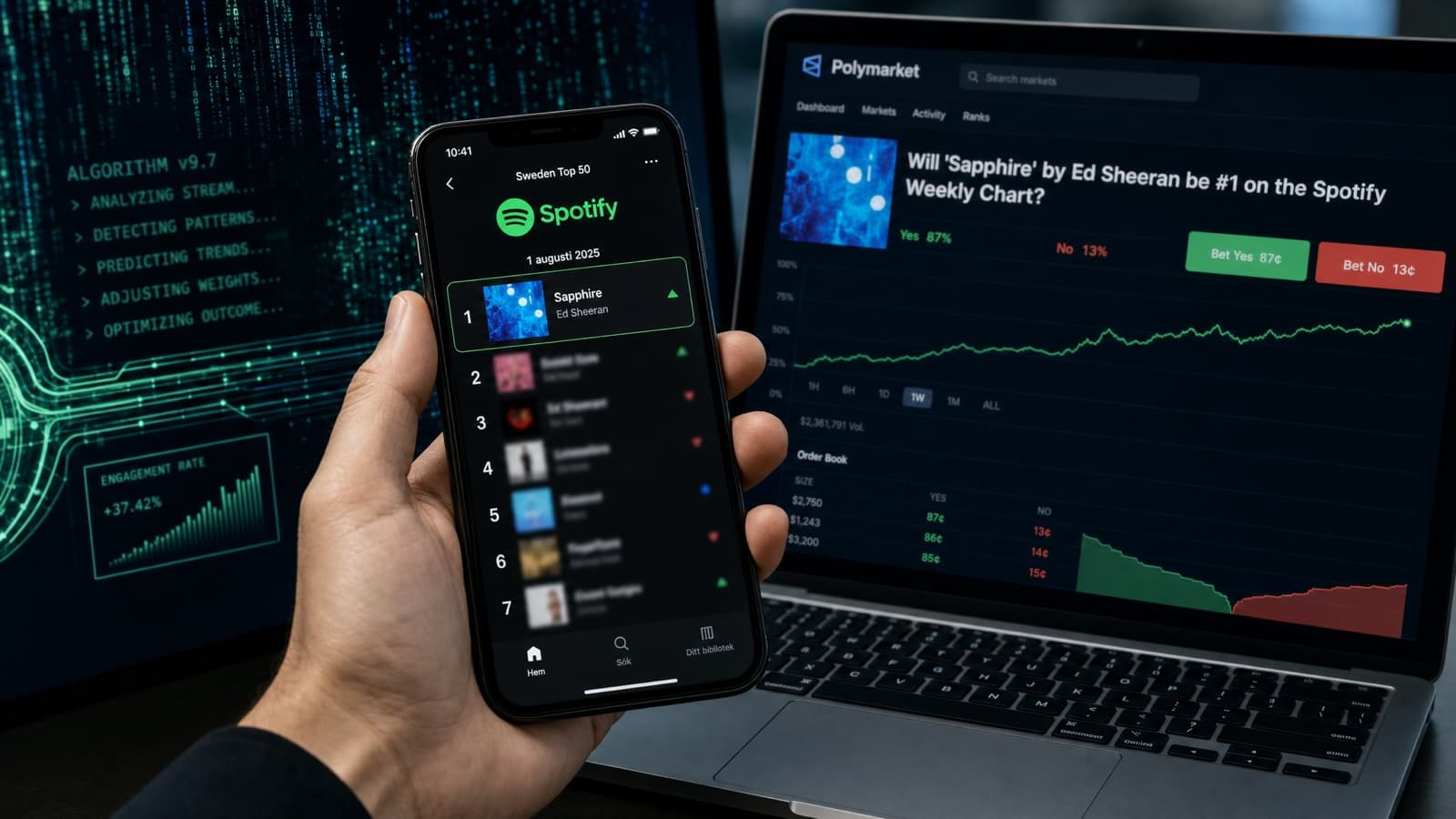
A pop song by a relative unknown rocketed to No. 1 on Spotify's daily U.S. chart last week. Traders on Kalshi, the federally regulated prediction market, cashed out on a $3 million bet tied to that chart position. Then Spotify investigated, found over 500,000 artificial streams, stripped them from the tally — and the song fell to No. 4.
The market had already been settled.
The incident involving Malcolm Todd's 2024 track "Earrings" is more than a strange footnote in music industry news. It's the clearest documented case yet of prediction market economics creating a direct financial incentive to manipulate real-world data — and of that incentive actually being acted upon. Spotify has since demanded that both Kalshi and Polymarket remove its logo from their websites. Regulators and watchdogs are asking whether prediction market operators are listing contracts they cannot protect.
What Happened: The Timeline
Malcolm Todd's "Earrings," released in 2024, had been gaining organic traction on TikTok when something unusual happened the weekend of June 28–29, 2026. The song's U.S. streams on Spotify surged roughly 70% in a single day, catapulting it to the top of Spotify's daily U.S. chart for the first time.
At the same time, a Kalshi market tied directly to the outcome — "Most-streamed Spotify song in the US in June" — was generating unusual trading activity. The market had attracted approximately $3 million in trading volume. Traders who selected Malcolm Todd's song stood to earn roughly 20 times their initial outlay.
Spotify investigated. What the company found was artificial streaming — bots, not listeners, responsible for hundreds of thousands of plays. Spotify removed more than 500,000 streams from "Earrings," dropping the song from first to fourth on the chart.
The problem: Kalshi had already resolved the market and paid out winners based on the inflated, pre-correction streaming figures. Traders on the losing side of the bet — those who had correctly predicted the chart would not reflect Malcolm Todd organically — collectively lost approximately $145,000 to the manipulated outcome, according to data from Kalshi's own API.
The Economic Incentive That Made This Possible
The manipulation worked because the math made sense. Buying 500,000 artificial streams costs a fraction of what a winning position in a $3 million prediction market can return. One widely cited estimate puts the cost of bot-streamed plays at roughly a fraction of a cent per stream — meaning the entire artificial streaming campaign could have cost just a few thousand dollars. The potential payout dwarfed that cost by orders of magnitude.
This is what makes prediction markets tied to influenceable real-world metrics structurally different from markets tied to election results or economic data. A bettor can't manufacture a Federal Reserve rate decision. A motivated trader with access to streaming bots, however, can push a relatively obscure song toward a chart position.
Caleb Davies, a prominent trader who the WIRED reported has earned an estimated $1.2 million across prediction platforms, was among the first to flag the anomaly. Using streaming data, he calculated the odds of "Earrings" hitting No. 1 organically: approximately 1 in 77 octillion — an 11.24 sigma event that falls so far outside normal distribution as to be statistically impossible by chance.
"Looking at the dataset of Sunday to Monday changes, it was a 11.24 sigma event, or a roughly 1 in 77 octillion chance of happening randomly," Davies wrote in a series of posts on X, where he documented his growing alarm about systematic botting of chart-linked markets.
Davies reached out to Spotify, Kalshi, and Polymarket with his concerns. He lost approximately $4,500 in this incident. For now, he's done with chart-based markets. "They've been a big gainer for me historically, but I can't play it anymore," Davies told WIRED.
Spotify and Kalshi: What Each Said
Spotify's response was swift and public. After removing the streams, the company issued a statement: "All streaming services face ever-changing stream manipulation. Spotify has best in class detection and mitigation practices for manipulated streams, and we don't pay out associated royalties."
Crucially, Spotify went further than just correcting the chart. The company sent formal notices to both Kalshi and Polymarket demanding they remove Spotify's logo from their websites — a signal that Spotify views the relationship between the platforms not as a partnership but as an unauthorized use of its brand to legitimize a product Spotify did not sanction.
Kalshi moved quickly on the logo request and adjusted language on its music markets that had initially implied Spotify verified chart results. A Kalshi spokesperson told WIRED: "We're in touch with Spotify and are actively investigating this matter."
Polymarket's position was categorical. "It's actually not plausible since we didn't even have Malcolm Todd as an option on this Spotify market," spokesperson Annabel Walsh told WIRED. Unlike Kalshi, Polymarket did not list a Malcolm Todd bracket — meaning no trader on that platform had a financial incentive to push his song to No. 1. The company confirmed it is reviewing the broader streaming manipulation situation but found no evidence of manipulation tied to its own markets.
The CFTC Standard Kalshi May Have Failed to Meet
The incident carries significant regulatory weight. Kalshi is a federally regulated Designated Contract Market (DCM) licensed by the Commodity Futures Trading Commission. Under federal commodities law, exchanges are required to make an affirmative determination that contracts they list are "not readily susceptible to manipulation" before those contracts go live.
Amanda Fischer, a former chief of staff to the Securities and Exchange Commission and currently the policy director and chief operating officer of Better Markets, a nonprofit financial watchdog, told WIRED the music chart market failed that standard.
"The platforms are not supposed to list contracts at all, unless they make an affirmative determination that they are not readily susceptible to manipulation," Fischer said. "It is clear that in this market, and many other markets, they are not doing that. They're obviously readily susceptible to manipulation."
Kalshi's music markets have become a substantial business. Kalshi's co-founder and COO Luana Lopes Lara told Billboard in late April 2026 that music market trading on the platform had already topped $400 million for the year. The Spotify streaming chart market — tracking who gets the most plays in a given month — was one of the most traded in that category.
The question regulators will now face is whether Kalshi conducted an adequate pre-listing review of a market where a winning trade could be manufactured with a few thousand dollars in bot streams, and where the settlement source was a third-party platform with no formal relationship or data-sharing agreement with the exchange.
What It Means for Malcolm Todd
There is no suggestion that Malcolm Todd or anyone connected to his team was involved in the manipulation. The singer-songwriter appears to be an innocent bystander — his song briefly elevated to a chart position he didn't earn and hadn't sought, his streaming numbers then publicly corrected in a way that can only draw attention to the episode.
A label manager with knowledge of similar situations told The Hollywood Reporter that the case represents a different category of streaming manipulation than the industry has faced before. "We've seen bot campaigns before for royalties, but this is the first time I've seen one clearly tied to a betting market," the source said. "It turns chart position into a direct financial instrument."
A Growing Pattern of Market Integrity Failures
The Spotify case is the latest in a string of incidents highlighting market integrity vulnerabilities across the regulated prediction market industry.
In early 2026, a suspiciously timed position in Polymarket's market on Venezuelan leader Nicolás Maduro's fate attracted federal scrutiny. U.S. Army Special Forces soldier Nicholas Van Dyke later pleaded not guilty to charges that he used classified information about the military operation that led to Maduro's capture to trade on prediction markets — a case the CFTC characterized as a landmark insider trading prosecution.
The structural pattern is the same in each case: a financial incentive sufficient to motivate misconduct, a third-party data source as settlement mechanism, and insufficient safeguards at the platform level to detect or prevent manipulation before markets resolve.
What Changes Now
Spotify said it is implementing additional checks to its charts before publication, a direct response to this incident. The goal is to reduce the window during which fraudulent streams can influence chart rankings that are used as settlement data for financial contracts.
Whether Kalshi changes its approach to listing chart-linked markets remains to be seen. The exchange faces a difficult choice: music markets have become a meaningful revenue line, but the manipulation incentives are now publicly documented and the CFTC is watching.
The broader question for the prediction market industry is about the quality of oracle design — how exchanges select and verify settlement data sources. Markets tied to chart positions, social media metrics, or other third-party rankings all share the vulnerability that surfaced in the Earrings case: the settlement source can be gamed by someone with a financial reason to do so.
FAQ
Was Malcolm Todd involved in the manipulation? No. There is no suggestion that Todd or anyone associated with his team was involved. He is an innocent bystander whose song was exploited without his knowledge or consent.
Did Kalshi pay out the winning bettors? Yes. Kalshi resolved the market and distributed payouts based on the inflated streaming figures before Spotify completed its fraud investigation and removed the artificial streams. The market cannot be unresolved retroactively.
What does Polymarket have to do with this? Polymarket did not list a market with Malcolm Todd as an option and no Polymarket traders had a financial incentive to push his song to No. 1. Spotify's logo removal request was directed at both platforms because Polymarket does operate Spotify-related music markets.
Is Kalshi regulated by the CFTC? Yes. Kalshi holds a CFTC Designated Contract Market license, which requires the exchange to make affirmative determinations that listed contracts are not readily susceptible to manipulation before they go live. This case raises questions about whether that standard was applied to chart-linked markets.
Can this happen again? Spotify says it is adding pre-publication chart checks to reduce this risk on its end. Whether prediction exchanges change their approach to listing markets tied to influenceable third-party data sources will depend in part on regulatory pressure and platform policy decisions.
What happened to traders who bet correctly (against the fraud)? Traders who correctly bet that Malcolm Todd would not organically top the chart — the side that was right — collectively lost approximately $145,000, because the market was settled on manipulated data before the fraud was uncovered.
Conclusion
The Kalshi-Spotify case is a first: the clearest documented evidence that prediction market economics can create financial incentives strong enough to motivate real-world data manipulation at scale. When a $3 million market resolves based on third-party chart data, and the cost of gaming that data is a few thousand dollars, the math is dangerous.
Spotify is now a more hostile environment for chart-linked prediction markets. The CFTC has the legal standard — contracts must not be "readily susceptible to manipulation" — and now has a high-profile case study demonstrating that standard may not have been met. What happens next will depend on whether Kalshi, other exchanges, and regulators treat this incident as an aberration or as a blueprint for a class of market that needs fundamental redesign.
For traders, the lesson is narrower: any market that settles based on publicly influenceable data carries manipulation risk that cannot be priced from the order book alone.
Sources & Verification
- Spotify statement, stream removal, logo demand: WIRED, "Spotify Confirms Streaming Fraud After Kalshi Trader Cries Foul," July 2, 2026
- $3 million Kalshi market volume, settlement before correction: Bloomberg, "Spotify Challenges Prediction Markets After Song Chart Rigging," July 2, 2026
- 70% stream surge, Spotify investigation, Kalshi investigating: CBS News, "Spotify removes streams of No. 1 song after suspicious Kalshi bets," July 2, 2026
- Spotify logo removal demand, 500,000 streams: The Hollywood Reporter, "Spotify Pulls Streams On a Hit Song Over Alleged Fraud Tied to Kalshi Betting," July 2, 2026
- 20x trader payout, Kalshi investigating: PYMNTS, "Kalshi Probes Trading Spike After Spotify Detects Song Chart Manipulation," July 2, 2026
- Kalshi $400M music market trading 2026, COO Luana Lopes Lara: Music Business Worldwide, "Spotify slashes streams of hit song after suspicious activity on prediction market Kalshi," July 3, 2026
- Amanda Fischer quote on CFTC manipulation standard: WIRED, July 2, 2026
- $145,000 lost by traders on wrong side: International Business Times, "Spotify Removes 500,000 Fake Streams After Chart Manipulation Roils $3 Million Prediction Market," July 3, 2026
- Caleb Davies statistics, quotes: WIRED, July 2, 2026
- Label manager quote on new manipulation category: The Hollywood Reporter, July 2, 2026