
Kalshi Traders See 66% Shot at S&P 8,000 — How Prediction Markets Are Reading the AI Revival
Kalshi traders price a 66% chance the S&P 500 hits 8,000 in 2026 after a record AI rally. What the prediction markets reveal about where stocks go next.
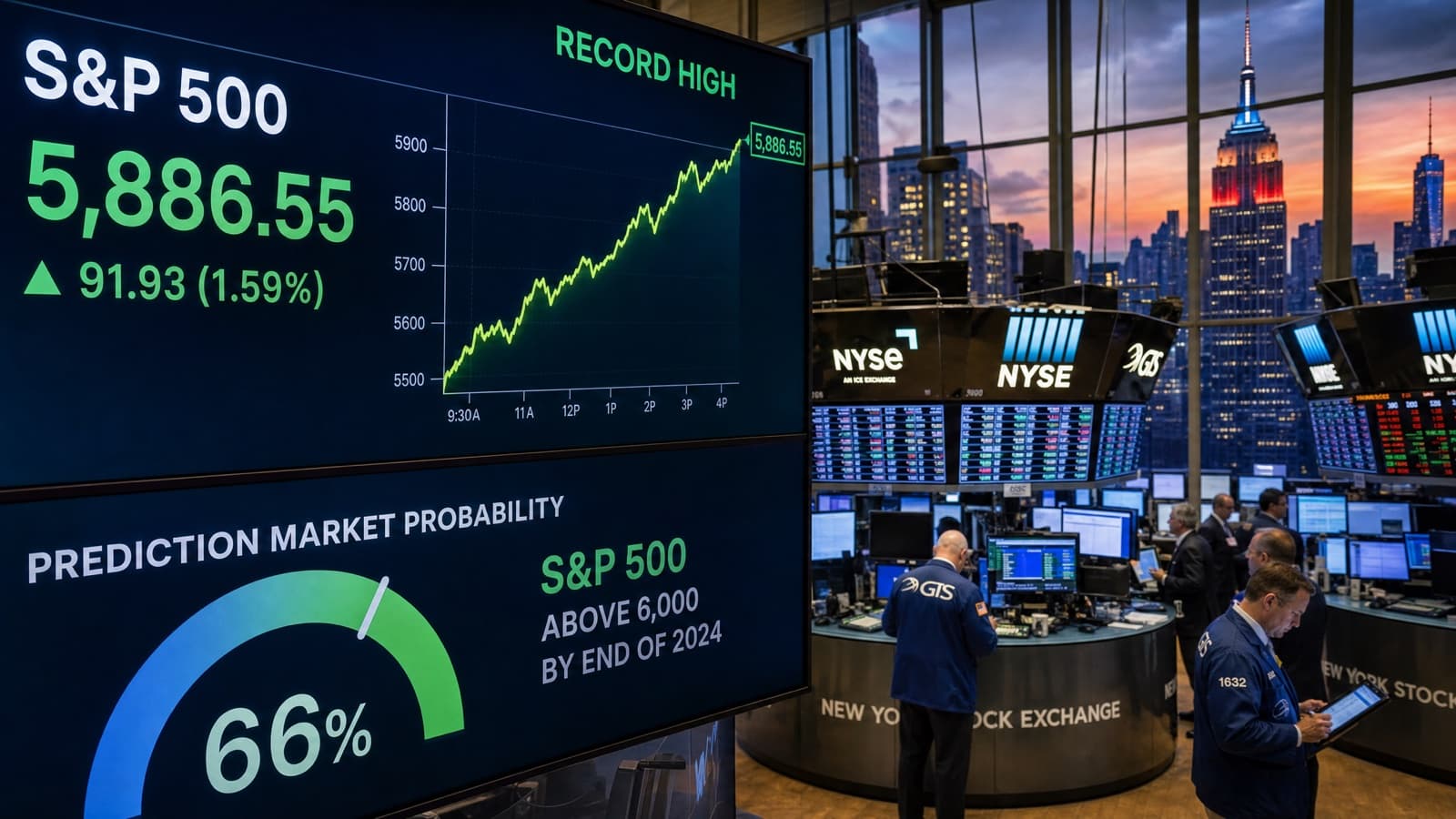
Prediction market traders are watching the S&P 500's best stretch of 2026 the same way Wall Street analysts are — but they're doing something Wall Street can't: putting real money behind exactly where they think it lands.
After a four-day rally that pushed the benchmark index up more than 5.5% and drove it to new all-time highs, speculators on Kalshi now see a roughly two-in-three chance that the S&P 500 crosses 8,000 at some point before the end of 2026. As of Wednesday's close, the index sat at 7,723.55 — just 3.6% away from that milestone.
Whether you're following the markets as a trader, an investor, or a curious observer, the prices on prediction market exchanges offer a real-time read on collective confidence. And right now, the crowd is the most bullish it's been all year.
What Are Prediction Markets Saying About the S&P 500?
Kalshi — one of the few CFTC-designated exchanges offering legally traded prediction market contracts in the United States — has listed a series of event contracts asking whether the S&P 500 will trade above various price levels at any point in 2026. The contracts resolve using Google Finance data.
As of August 6, 2026, Kalshi traders had priced the probability of the S&P 500 reaching 8,000 at approximately 66%, according to CNBC. A contract asking whether the index crosses 8,200 was trading at roughly one-in-three odds.
The numbers reflect a sharp sentiment shift. The same markets were considerably more skeptical just two weeks ago, when a rotation out of high-momentum AI names had dragged the Nasdaq-100 into a correction while the broader market stalled.
The four-day stretch from July 30 through August 4 changed that calculation. After the S&P 500 broke decisively above the 7,620 resistance level — representing its June record high — buyers came back in force. The index closed above 7,700 for the first time ever on August 4 and notched a fresh all-time closing high of 7,736.52 on August 5.
What Drove the Four-Day Rally?
Three catalysts combined to unlock the August breakout, according to market analysts:
1. Earnings are genuinely beating. Second-quarter earnings have been a standout, coming in roughly 27% ahead of the prior year on a comparable basis (excluding markup effects at Google's parent company Alphabet and Amazon), representing a 4% beat versus Wall Street's consensus entering earnings season, according to Bank of America Securities. Companies from Palantir Technologies to Microsoft and Amazon reported results that validated continued investment in artificial intelligence — and the market responded accordingly. Palantir surged 29.5% after its Q2 results showed strong sales of AI software to corporate clients.
2. Iran tensions eased. After months of elevated oil prices driven by U.S.-Iran conflict, a de-escalation in the Middle East helped reduce one of the major macro overhangs that had weighed on equities through the summer. Energy stocks had already surged more than 30% year-to-date on Iran-related price action; the easing gave broader markets room to run without the same geopolitical drag.
3. The Aschenbrenner fund implosion cleared the tape. The near-collapse of hedge fund manager Leopold Aschenbrenner's Situational Awareness fund — which had to unwind large AI-related positions — created forced selling pressure in July that, paradoxically, cleaned out the technical overhang. Once those sellers were out, momentum names snapped back hard. The Nasdaq Composite gained nearly 5% in just two sessions as the shorts were forced to cover.
Truist Wealth's chief market strategist Keith Lerner framed it succinctly in a Tuesday note: "Our investment thesis remains intact. Earnings remain our north star. Estimates continue to trend higher, economic growth remains resilient, and market participation has improved. Those are not conditions typically associated with the end of a bull market."
Tom Lee, head of research at Fundstrat Capital, said Wednesday he thinks the S&P 500 could reach 7,900 to 8,000 before August is over — a call that aligns closely with where Kalshi's prediction market contracts were already pricing.
Why Prediction Markets Matter for Macro Analysis
Traditional analyst forecasts come with caveats, disclaimers, and delayed updates. A Wall Street strategist who sets a year-end S&P 500 target in January isn't necessarily repricing it in real time as market conditions shift. Prediction markets are different: they update continuously, in response to new information, with real money at stake.
That's the core appeal for macro-focused traders watching Kalshi's S&P contracts. Every price you see represents the aggregate bet of thousands of market participants who've weighed the same earnings reports, geopolitical signals, and Fed signals you have — and are putting real capital behind their conviction.
The contracts on Kalshi aren't options or futures in the traditional sense. They're binary event contracts: you buy a "Yes" position that pays $1 if the S&P 500 trades above a certain level before year-end, and a "No" position that pays $1 if it doesn't. The market price of the "Yes" contract is the implied probability.
At 66¢, the 8,000-strike contract says traders collectively believe there's a 66% chance the index hits 8,000 before December 31.
Live market view — track these prices yourself:
How Wall Street Targets Compare
Prediction market consensus at 66% for 8,000 sits comfortably within the range of mainstream Wall Street forecasts, though it implies a more bullish lean than the median target.
Tom Lee's August call of 7,900–8,000 by month-end is the most aggressive near-term target currently circulating. Truist's Keith Lerner is less specific on price but broadly constructive. The AI spending narrative — hyperscalers are expected to spend roughly $800 billion on AI-related capital expenditures this year according to FactSet data cited by Axios — continues to provide the demand backdrop that underpins earnings optimism.
The notable difference between prediction market prices and analyst targets is granularity. Kalshi's contract ladder goes beyond 8,000: contracts for 8,200, 8,400, 8,600, and higher are actively trading, giving investors a continuous probability distribution across potential outcomes rather than a single point estimate.
This is how serious macro traders are using prediction markets: not as a replacement for fundamental analysis, but as a real-time read on where the informed crowd is positioned.
What Could Derail the Rally?
Prediction market prices at 66% for 8,000 imply roughly one-in-three odds that it doesn't happen. That 34% is doing a lot of work.
The main risk factors the market appears to be weighing:
The Fed. Rate policy remains a key variable. Market participants are watching the September FOMC meeting closely. Any signal of a prolonged hold — or concern that inflation is re-accelerating — could reset rate-sensitive equity valuations quickly.
AI capex sustainability. The 5%+ four-day rally was partly a bet that the AI spending cycle has legs. If major hyperscalers revise capex guidance downward, the same stocks that just surged would face the sharpest corrections.
Geopolitics. Iran tensions eased enough to help trigger the current rally. A reversal — or a new conflict — could undo it equally fast. The market has shown it can absorb geopolitical shocks, but oil price spikes remain a headwind for risk assets.
Midterm election uncertainty. The 2026 midterms are approaching, and markets historically dislike election-season volatility. Prediction markets for congressional balance of power have drawn significant trading volume, with over $9.4 million traded on the midterms balance-of-power contract on Polymarket alone.
How to Trade S&P 500 Prediction Markets
For readers who want to engage directly with these contracts rather than just track them:
On Kalshi, the S&P 500 contracts are available under the macro/finance category. You buy a "Yes" position for the level you think the index will hit (e.g., 8,000 in 2026) and a "No" position if you think it won't reach that level. The contracts resolve using Google Finance data.
Key considerations:
- These are event contracts, not ETFs. They pay $1 at resolution, not the index's dollar value. You're betting on whether an event occurs, not participating in the index's appreciation.
- Liquidity varies across the strike ladder. The 8,000 and 8,200 contracts tend to have the deepest markets; higher strikes are thinner.
- Unlike stock index futures, these contracts don't margin against your full portfolio — your maximum loss on a "Yes" position is the price you paid.
PredictionMarkets.US tracks macro prediction market data across Kalshi and Polymarket. You can monitor real-time S&P 500 contract prices alongside other economic and financial event markets in one place.
FAQ
Are S&P 500 prediction markets the same as stock market futures?
No. S&P 500 prediction market contracts on Kalshi are binary event contracts that pay $1 if a specific level is reached before year-end. They're not leveraged futures that track the index's actual dollar move. You're betting on whether an event occurs, not on the size of the price change.
Who can trade S&P 500 prediction markets in the US?
Kalshi is a CFTC-designated contract market available to US residents. You can sign up, fund an account, and trade these contracts legally. Polymarket's US platform (operated by QCX LLC) is currently restricted to sports markets only for US users; its global platform offers equity markets but is not accessible to US-based traders.
Do prediction market odds predict what the S&P 500 will do?
Prediction markets aggregate the beliefs of participants with skin in the game — they're a useful signal, but not a guarantee. Studies on prediction market accuracy suggest they perform well as a consensus mechanism, but like any market, they can be wrong. A 66% probability for 8,000 means traders see it as more likely than not — not certain.
How does Kalshi resolve its S&P 500 contracts?
According to CNBC, Kalshi uses Google Finance data to resolve its S&P 500 level contracts. The contract settles at $1 if the specified level is reached at any point during the contract period.
Conclusion
The AI rally's return, a blowout earnings season, and easing geopolitical pressure combined to produce one of the strongest four-day runs of 2026 — and prediction market traders moved quickly to price in what it means for the year ahead. With Kalshi's S&P 500 contracts now at 66% for 8,000 and one-in-three odds for 8,200, the crowd is telling a clear story: this bull market isn't done.
Whether those odds prove right depends on whether the earnings momentum holds, the Fed stays patient, and the AI spending cycle continues to translate into real profits. The prediction market, for its part, has priced in more optimism than it's shown all year.
Follow real-time S&P 500 prediction market odds and macro event contracts at PredictionMarkets.US.
Sources
- Traders on Kalshi now think it's likely that the S&P 500 will hit 8,000 in 2026 — CNBC, Davis Giangiulio, August 6, 2026
- The stock market soars. 5 reasons behind the big surge Tuesday — CNBC, August 4, 2026 (earnings data, Bank of America Securities)
- S&P 500 surges to record as the AI trade returns — Axios, August 5, 2026 (AI trade catalysts, Palantir, hyperscaler capex)
- S&P 500 Opens at Another Record as AI Spending Narrative Holds — Bloomberg, August 5, 2026
- The S&P 500 Hit Another Record High in 2026. So What? — Bloomberg, August 6, 2026 ($3.7 trillion rally, earnings growth)
- Tom Lee's bold August forecast: S&P 500 going to 8,000 — CNBC, August 6, 2026 (Fundstrat forecast, Truist quote)
- Kalshi — Primary source for S&P 500 event contracts and market structure