
New York's $36 Billion Kalshi Case Isn't About Gambling. It's About Who Gets to Decide.
New York's suit against Kalshi reads as a gambling case. The real question is a federalism one the Supreme Court created in 2018 — and may have to answer again.
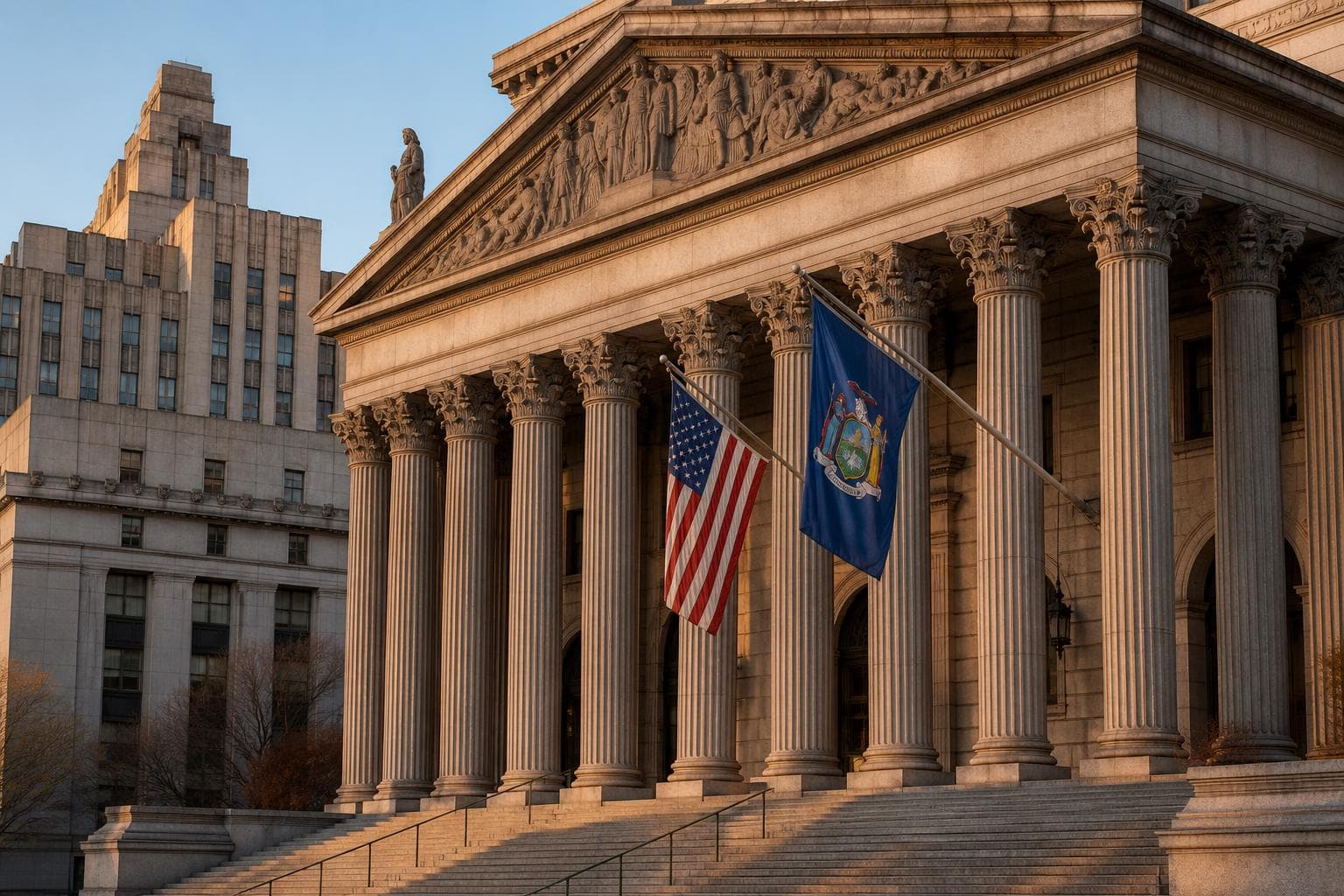
New York Attorney General Letitia James, joined by Governor Kathy Hochul, sued KalshiEX on Friday, July 31, 2026, in New York Supreme Court in Manhattan. The state is seeking at least $36 billion, plus treble damages and a $100,000 penalty for every unauthorized sports wagering offer, and it filed a simultaneous motion for a temporary restraining order to halt Kalshi's event contracts in New York immediately.
The coverage has almost uniformly led with the dollar figure. That is understandable — $36 billion is roughly 1.6 times Kalshi's reported $22 billion valuation, and it is the kind of number that writes its own headline.
But the number is the least interesting thing about this case. Strip out the damages demand and what remains is a constitutional question that the Supreme Court itself created eight years ago, and which it has so far declined to finish answering: when Congress authorizes something federally, can a state still call it illegal?
The irony at the center of the case
In 2018, the Supreme Court decided Murphy v. NCAA and struck down the Professional and Amateur Sports Protection Act. PASPA was the federal law that had effectively banned sports betting outside Nevada. The Court's reasoning was a federalism holding, not a gambling one: Congress could not commandeer state legislatures by forbidding them from authorizing sports wagering. Whether to permit sports betting was a decision reserved to the fifty states.
That ruling is the reason sports betting is now legal in most of the country. It is also the reason state attorneys general believe they have standing here. If gambling policy belongs to the states, New York's argument goes, then New York gets to decide whether a Super Bowl contract sold to an 18-year-old in Buffalo is legal.
Kalshi's position inverts the same logic. Its contracts are not gambling, the company argues; they are event contracts listed on a designated contract market registered with the Commodity Futures Trading Commission since 2020. Federal commodities law governs them, and the Commodity Exchange Act preempts conflicting state law. "States can't just shut down a federally licensed exchange," a Kalshi spokesperson said, calling the suit "political theater from the leadership in our own state."
So the 2018 decision that freed states to allow sports betting is now being used to argue that states can forbid a federally regulated version of it. The federal government was accused of overreach for keeping sports wagering out of states that wanted it. The same accusation is now made in reverse — for bringing it into states that don't.
What New York actually alleges
The complaint is not a technicality. It alleges Kalshi operated an unlicensed gambling business without a New York State Gaming Commission license and without paying state gaming taxes, and it is specific about how the office knows.
Rather than rely on third-party data, the AG's investigators built the record themselves. According to the filing, they created accounts and placed live wagers: four "Yes" contracts on a UConn–Michigan basketball game at $1.14 in April 2026, and ten contracts on the winner of Big Brother in July 2026. Both transactions completed without obstruction.
That detail matters for the TRO. The state is not arguing that illegal gambling could occur in New York. It is presenting firsthand evidence that it did, on specific dates, from New York accounts.
The complaint also alleges Kalshi permitted users aged 18 to 20 to trade, against New York's 21-and-over minimum for mobile sports betting. "New York's gambling laws protect children from underage betting and help combat gambling addiction," James said. "No matter what they call themselves, prediction markets like Kalshi are gambling platforms, plain and simple."
And it adds a count under the federal Interstate Wire Act. That is the quietly significant one. Every other count depends on state gambling law, which is exactly what the preemption fight is about. The Wire Act is federal. If Kalshi's CFTC registration were held to preempt New York's gambling statutes, a Wire Act claim would still stand on its own footing.
The regulator filed against the state before the state filed
The most unusual feature of this case is the sequence.
The CFTC filed an emergency motion for a temporary restraining order in the U.S. District Court for the Southern District of New York on Thursday, July 30 — the night before the attorney general's state-court filing. The motion sought to block New York from pursuing criminal or civil enforcement against Kalshi or any other CFTC-registered entity, describing state action as overreach that would irreparably harm the agency and the markets it regulates.
A federal regulator moved preemptively to stop a state attorney general from filing a lawsuit that had not yet been filed. Gaming attorney Daniel Wallach publicly described it as a "Hail Mary filing" intended to get ahead of the state-court petition and establish federal jurisdiction before a state judge could act.
Kalshi, for its part, sought to remove the case to Manhattan federal court roughly eight hours after James filed it.
The procedural posture is therefore genuinely strange: a federal agency, a federally registered exchange, and a state attorney general are all racing to have the same dispute heard in the forum most likely to favor them.
The courts do not agree with each other
The reason both sides can argue in good faith is that appellate courts have split.
U.S. District Judge Analisa Torres denied Kalshi's motion for a preliminary injunction in early July (sources report the ruling as July 7 or July 8), finding the Commodity Exchange Act unlikely to preempt New York's gambling laws as applied to sports-event contracts. She denied an injunction pending appeal on July 27, holding that Kalshi's claimed harms were largely financial and therefore not irreparable. The Second Circuit denied emergency relief on July 29. New York filed two days later — the state action became practically available precisely because federal interim relief had been exhausted.
Notably, Torres declined to defer to the CFTC's proposed June rule asserting express preemption, reasoning that under the Supreme Court's Loper Bright decision courts must interpret federal statutes independently, and that a proposed rule is not a final one.
The Third Circuit went the other way, holding that New Jersey could not regulate Kalshi's sports-event contracts because they fell within the CFTC's exclusive jurisdiction.
And in Minnesota, Judge Katherine Menendez temporarily blocked the state's new prediction market ban before its August 1 effective date, finding the plaintiffs likely to succeed at least in part — while explicitly cautioning that the ruling was preliminary and that some event contracts may not meet the statutory definition of swaps at all.
Massachusetts, Michigan, Nevada, Washington, and Wisconsin have produced orders or rulings restricting Kalshi's operations. A bipartisan coalition of 38 state attorneys general filed an amicus brief supporting Massachusetts. The CFTC has challenged state enforcement in at least nine states.
When the Second and Third Circuits reach opposite conclusions on the same federal statute, that is the textbook condition for Supreme Court review.
The number that actually threatens the business
Buried in the AG's release is a figure that deserves more attention than the $36 billion: Kalshi users wagered more than $1 billion per month in 2025, and roughly 90% of that volume was sports.
Sports are not a feature of the platform. They are the platform.
That concentration is what makes every one of these fronts existential rather than annoying. State-by-state TROs remove geography. A federal ban on CFTC-licensed sports event contracts would remove the product. Either path takes out the large majority of recorded consumer activity. A $22 billion valuation implies a diversified event-contract venue spanning elections, weather, economics, and entertainment; a 90/10 sports split describes something considerably narrower.
What the tradeable markets say — and why we're not quoting a price
There are listed markets on adjacent questions, and we checked them against our own data rather than repeating a number from a screenshot.
They are not usable as a signal right now, and it is worth saying so plainly instead of dressing up a stale quote as market consensus.
Polymarket's "Law banning sports prediction markets enacted in 2026" carries an end date of June 30, 2026 — already past — with roughly $310 in liquidity and a bid/ask spread running from 12¢ to 32¢. A market with a lapsed resolution date and a 20-point spread is not pricing anything.
Polymarket's "Sports Prediction Markets taxed as gambling?" is thinly traded at roughly $2,800 in liquidity, with the "Yes" side quoted near 9–11¢ against about $44,000 in lifetime volume.
On Kalshi, the regulatory questions that would most directly resolve this dispute are not offered as liquid standalone contracts.
The honest read: there is no deep, liquid market pricing the outcome of the federalism question. The legal fight is moving faster than the contracts written about it. Anyone quoting a confident percentage on how this resolves is quoting noise.
What happens next
Three clocks are running at different speeds.
The TRO motions move in days or weeks. If New York's is granted, Kalshi faces an immediate choice between suspending New York operations and risking contempt. If the CFTC's federal motion succeeds first, the state action is at least slowed.
The Second Circuit appeal moves in months, and it is the one that matters most in the near term, because a published circuit opinion squarely on Commodity Exchange Act preemption sharpens the split with the Third Circuit.
The Supreme Court moves in years, if it takes the case at all. But the conditions are assembling: a genuine circuit split, a federal agency litigating against states, 38 attorneys general on one side, and a multi-billion-dollar industry whose legality currently depends on which state line you are standing behind.
The question the Court answered in 2018 was whether Washington could stop states from allowing sports betting. The question it may have to answer next is whether Washington can stop states from banning it.
FAQ
Is this the same as the lawsuit filed on July 31? Yes — this is analysis of the federalism dimension of that filing. Our news coverage of the complaint itself is here.
Does the $36 billion figure mean Kalshi will pay $36 billion? No. It is an opening demand, contingent on a full accounting, and it reflects the state's theory that the entire economic benefit of allegedly unlicensed wagering should be returned. Damages demands of this size are routinely reduced or resolved.
Why does the Interstate Wire Act count matter? Because it is federal. Most of New York's counts rely on state gambling law, which is what the preemption argument targets. A Wire Act claim survives independently of whether the Commodity Exchange Act preempts state gambling statutes.
Which court decides this? Unresolved, and that is the point. State court, federal district court, the Second Circuit, and potentially the Supreme Court all have plausible claims to a piece of it. All three parties are actively forum-shopping.
Can New Yorkers still use Kalshi? As of publication, no restraining order has been reported as granted in the New York action. That could change quickly if the state's TRO motion is heard.
Sources & Verification
- New York State Attorney General's office announcement and petition, filed July 31, 2026, New York Supreme Court, Manhattan
- Reuters (Jonathan Stempel), "New York sues Kalshi, calls it illegal gambling," July 31, 2026
- CNBC, "New York sues Kalshi, says prediction market is running 'illegal gambling operation,'" July 31, 2026
- Al Jazeera, July 31, 2026
- ProFootballTalk / NBC Sports (Mike Florio), August 2, 2026
- Rulings: Judge Analisa Torres (S.D.N.Y.), early July (reported as July 7 or July 8) and July 27, 2026; Second Circuit denial, July 29, 2026; Third Circuit (New Jersey); Judge Katherine Menendez (D. Minn.)
- Murphy v. NCAA (2018); Loper Bright Enterprises v. Raimondo (2024)
- Market data verified against the PredictionMarkets.US backend and Polymarket's public API on August 2, 2026
This is educational analysis, not legal or investment advice.