
FlightAware Sues Kalshi Over Flight-Cancellation Markets: A New Legal Front for Prediction Markets
FlightAware sued Kalshi in federal court over unauthorized use of its flight data and trademark in prediction markets on airline cancellations.
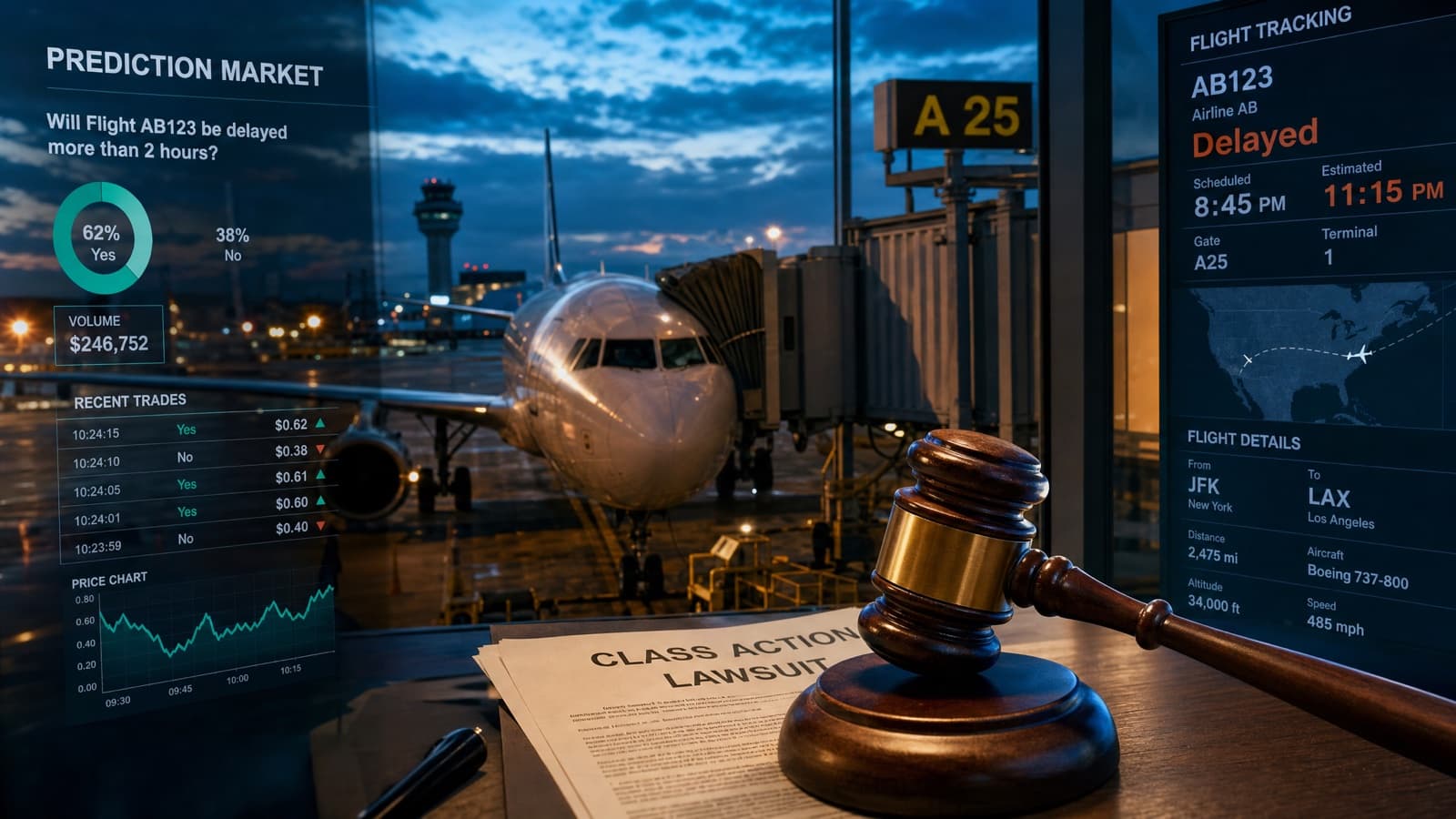
A flight-tracking company and the largest prediction market exchange in the United States are now adversaries in a federal courtroom — and the outcome of their fight could reshape how prediction markets secure the data that makes their contracts work.
FlightAware filed suit against Kalshi on August 10, 2026 in the U.S. District Court for the Southern District of New York, accusing the exchange of using its flight data and trademarked name without authorization to settle bets on airline cancellations. The complaint alleges breach of contract, trademark infringement under the Lanham Act, and unfair competition. FlightAware is seeking a temporary restraining order, preliminary and permanent injunctions barring Kalshi from any market involving FlightAware's services, unspecified damages, and a jury trial.
Unlike the wave of state gambling lawsuits that have confronted Kalshi over the past year, this case is not about whether prediction markets constitute illegal gambling. It is about a narrower but consequential question: Can a prediction market platform name a third-party data provider as the arbiter of a contract's settlement without that company's permission?
How the Dispute Began
In July 2026, Kalshi launched a new category of prediction contracts allowing users to trade on whether specific flights would be canceled. The platform told users the outcomes of those contracts were "verified from FlightAware," a flight-tracking service that operates the world's largest commercial aviation database.
According to the complaint, FlightAware had never agreed to that arrangement. It says Kalshi obtained access to its AeroAPI service through an account registered by a Kalshi employee in 2022 — an account governed by terms of service that explicitly prohibit commercial use of FlightAware data. The company says Kalshi never disclosed that it intended to use the feed to determine payouts in a prediction market.
"Kalshi never informed FlightAware that it would rely on FlightAware's data to determine the outcome of these betting markets," FlightAware wrote in the complaint, according to Reuters reporting on the filing.
FlightAware sent Kalshi a cease-and-desist letter after learning its name was appearing in the contract terms. Kalshi responded by denying it had violated FlightAware's license and arguing that identifying the service as the settlement source constituted "nominative fair use" — a trademark doctrine that allows limited use of a brand name to accurately identify its product.
Kalshi subsequently added a disclaimer stating that the markets were not endorsed by FlightAware. But according to the complaint, that disclaimer did not resolve the underlying problem: Kalshi continued to rely on FlightAware data to determine whether traders collected their payouts. FlightAware then canceled Kalshi's API account.
On July 16, Kalshi announced it was shelving the flight-cancellation markets amid criticism over safety concerns. However, the complaint alleges that a small number of those markets remained active at the time the lawsuit was filed.
What FlightAware Is Asking For
FlightAware is not only seeking to stop Kalshi from using its data. The complaint asks the court to bar Kalshi from offering any prediction market that involves FlightAware's services, names, or trademarks — essentially requesting a permanent exit from this product category if it relies on FlightAware as its settlement oracle.
The company argues it has suffered "imminent and irreparable harm" to its reputation. Its business depends on providing accurate, neutral flight data to airlines, airports, and aviation professionals. Being publicly identified as the settlement arbiter for a commercial betting product — one that critics argued could incentivize interference with flight operations — undermined that neutrality.
"As a company whose business depends on the safety and integrity of aviation, FlightAware is facing imminent and irreparable harm by having its data and name associated with conduct that could compromise flight operations and passenger safety," lawyers for FlightAware wrote in the complaint.
The safety concern is not theoretical. Critics of the flight-cancellation markets argued that a contract paying out when flights are canceled creates a financial incentive for traders, aviation workers, or other participants to interfere with flight operations. Kalshi's contract rules excluded payouts for cancellations caused by malicious or security-related events, but FlightAware argued that exclusion does not adequately insulate the product from creating dangerous incentives.
How Kalshi Has Responded
Kalshi did not immediately respond to Reuters' request for comment on the lawsuit. Its stated position prior to the lawsuit was that identifying FlightAware as the settlement source constituted nominative fair use — a legitimate legal argument, though courts apply it narrowly.
Kalshi also disclosed in a self-certification filing with the Commodity Futures Trading Commission that U.S. Department of Transportation flight data could serve as an alternative settlement source for the contracts. FlightAware argues in the complaint that the availability of that alternative undermines any claim that Kalshi needed to use FlightAware's proprietary data and brand.
Why This Case Is Different From the State Gambling Battles
Kalshi is already fighting legal battles on multiple fronts. New York, Nevada, Wisconsin, Utah, and more than a dozen other states have filed suits arguing that the platform's sports event contracts constitute illegal gambling subject to state licensing requirements rather than exclusive federal oversight by the CFTC. A federal appeals court ruled for Kalshi in the Third Circuit (New Jersey) in April 2026, affirming CFTC preemption of state law, but other circuits have reached different conclusions.
The FlightAware case runs on an entirely different legal track. It does not challenge whether Kalshi's contracts are legal derivatives or illegal gambling. Instead, it focuses on how prediction markets obtain and use the external data they need to settle contracts — and whether they owe commercial agreements to the companies providing that data.
This question matters across the industry, not just for flight-related markets. Prediction markets routinely name specific data sources to resolve contracts: official sports statistics for game-outcome markets, government price indexes for inflation markets, regulatory agency decisions for drug approval markets. If a court finds that Kalshi violated FlightAware's terms of service by commercially exploiting data obtained under a non-commercial license, it could prompt every prediction market platform to audit its data arrangements and formalize commercial agreements it may have assumed were unnecessary.
Live market — track the regulatory environment yourself:
Kalshi's Legal Scorecard in 2026
The FlightAware lawsuit is the latest legal complication for an exchange that has simultaneously been Kalshi's best year commercially — the company raised $1 billion at a $22 billion valuation in March 2026 — and its most legally turbulent.
By the summer of 2026, Kalshi was contending with:
- New York AG suit (July 31, 2026): Attorney General Letitia James sued Kalshi, alleging it operates an unlicensed gambling business in New York and seeking more than $36 billion in forfeited gains.
- Nevada TRO (March 20, 2026): A Nevada state court issued a temporary restraining order blocking Kalshi from offering sports, election, and entertainment contracts.
- Ohio $5 million fine notice (April 14, 2026): The Ohio Casino Control Commission issued a notice of intent to fine Kalshi for operating without a gaming license.
- Michigan state court order: An Ingham County Circuit Court issued an order to temporarily halt Kalshi's Michigan operations.
- Third Circuit win (April 6, 2026): In the most favorable ruling of the year, a federal appeals court ruled 2-1 in New Jersey that the CFTC has exclusive jurisdiction over Kalshi's sports event contracts, affirming federal preemption of state gaming law.
The company has also partnered with Nasdaq to deploy the exchange operator's market surveillance technology — announced August 10, 2026 — as it seeks to bolster its compliance posture ahead of what may be an IPO in late 2026 or early 2027.
What Traders Should Know
The contracts are effectively off. Kalshi shelved the flight-cancellation markets on July 16, 2026, before the lawsuit was filed. Any trader who had open positions in those markets should check Kalshi's platform directly for settlement status and payout timelines.
This is not a trading suspension. The FlightAware lawsuit targets a specific set of markets that Kalshi had already withdrawn. It does not affect Kalshi's broader product catalog — including its sports, politics, economics, and weather markets — which remain operational subject to state-specific restrictions.
Watch the data-agreement question. The outcome of this case matters for anyone trading on markets where the settlement source is a third-party private company. If courts require formal commercial agreements between prediction markets and their data providers, platforms will need to renegotiate contracts or find alternative oracles for a broad range of market types.
The DOT data alternative matters. Kalshi disclosed in its CFTC self-certification that U.S. Department of Transportation data could serve as an alternative settlement source for flight-cancellation contracts. If the court finds that DOT data is a viable substitute, Kalshi could theoretically relaunch the product category without using FlightAware at all — though the safety and reputational concerns that drove the original withdrawal would remain.
FAQ
What is FlightAware alleging against Kalshi? FlightAware alleges that Kalshi used its flight-tracking data and trademark without authorization to run prediction markets on flight cancellations, violating its terms of service and infringing its brand.
What is Kalshi's defense? Kalshi argued prior to the lawsuit that identifying FlightAware as the settlement source constitutes "nominative fair use" — a trademark doctrine allowing limited use of a brand name to accurately describe its product.
Does this affect my ability to trade on Kalshi? The lawsuit specifically concerns flight-cancellation markets that Kalshi had already withdrawn. It does not affect Kalshi's broader market catalog.
Could this case affect other prediction market platforms? Yes. If a court rules that prediction markets must have commercial agreements with any third-party data source they use to settle contracts, platforms across the industry would need to audit and potentially renegotiate their data relationships.
What happens next? The court will first decide whether to issue a temporary restraining order preventing Kalshi from using FlightAware's data or name. The case will then proceed through discovery and briefing. Kalshi has not yet filed a formal response to the complaint.
Conclusion
The FlightAware lawsuit adds a new dimension to the legal landscape surrounding prediction markets — one that has nothing to do with whether event contracts are derivatives or gambling, and everything to do with the commercial infrastructure that makes those contracts work. Kalshi built a product category that named FlightAware as its settlement oracle without securing FlightAware's agreement. Now a court in Manhattan will decide whether that was legally defensible.
For traders, the immediate impact is limited: the flight-cancellation markets are already gone. The longer-term significance is structural. Every major prediction contract relies on some external data source to determine outcomes. The FlightAware case asks, for the first time in federal court, what obligations prediction markets owe to those sources.
Explore live prediction market odds across politics, economics, and sports at PredictionMarkets.us
Sources & Verification
- Reuters, "FlightAware sues Kalshi over flight-cancellation markets," August 11, 2026 — via Yahoo Finance
- Reuters, "FlightAware sues Kalshi over flight-cancellation markets," August 11, 2026 — via Globe and Mail
- Cryptopolitan: FlightAware sues Kalshi, seeks injunction over flight cancellation bets — August 11, 2026; details of SDNY complaint and claims
- Kalshi.com official platform — platform facts verified
- CFTC.gov — regulatory context and self-certification process