
Kalshi Files for Stock Index Perpetual Futures, Escalating Challenge to CME and Wall Street
Kalshi filed with the CFTC on Aug. 18 to launch stock index and copper perpetual futures, challenging CME and Wall Street's derivatives business.
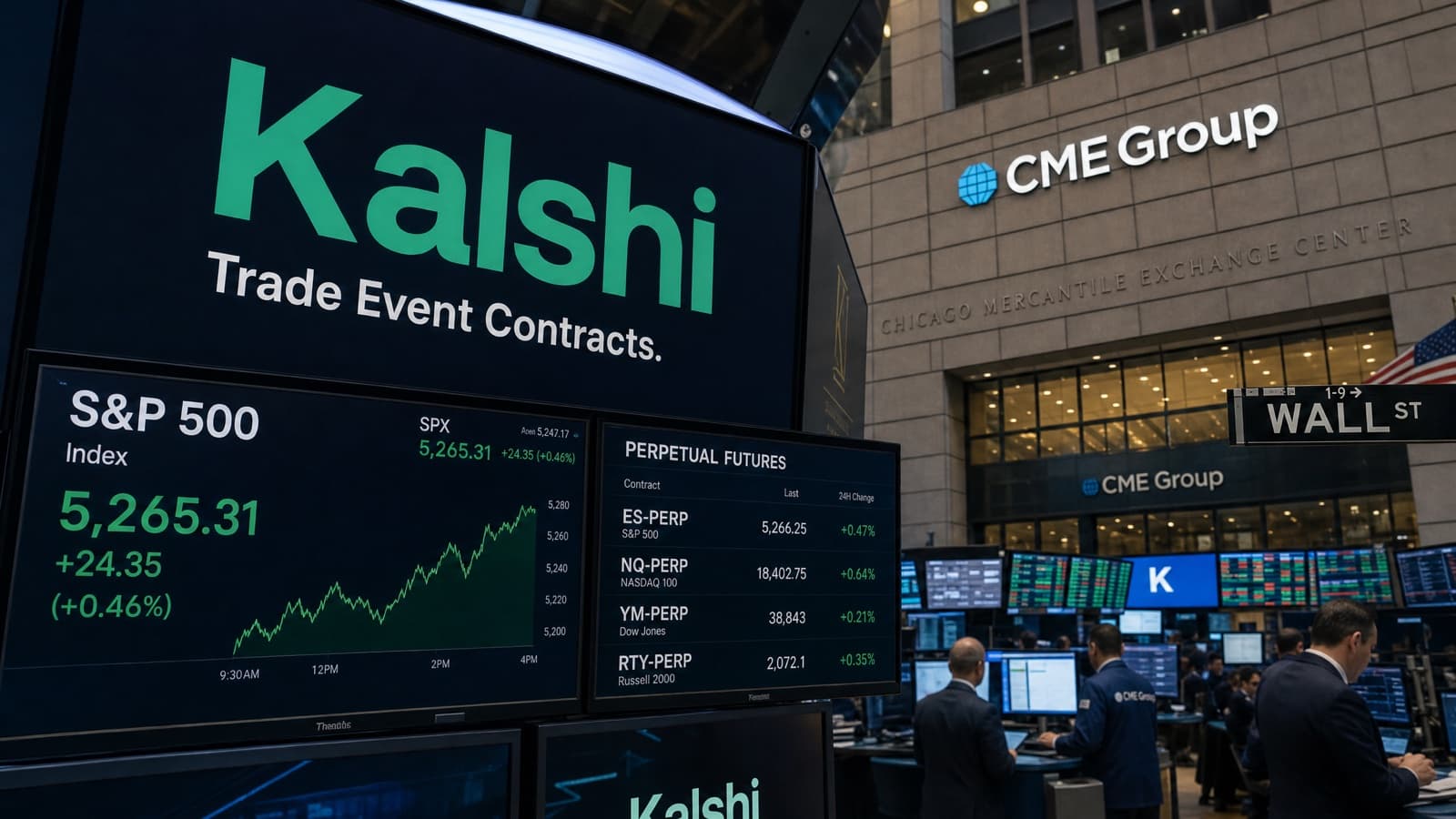
Prediction market platform Kalshi filed two new contracts with the U.S. Commodity Futures Trading Commission on Tuesday, seeking regulatory approval to launch perpetual futures tied to equity indexes and copper — its most direct encroachment yet on the traditional derivatives exchange business dominated by CME Group and CBOE Global Markets.
The filings, submitted on August 18, 2026, continue a methodical expansion that has transformed Kalshi from a niche event-contract platform into a challenger for mainstream financial markets. In just three months, the company has moved from cryptocurrency perpetuals to precious metals to equity indexes, building toward what its engineering team has called the ambition of "the largest exchange on the planet."
What Kalshi Filed
Kalshi submitted two separate self-certification filings with the CFTC on August 18. The first covers equity index perpetuals, proposing a contract the company calls "US500" — tied to the MerQube U.S. Large Cap Index, which tracks the 500 largest companies listed and headquartered in the United States.
The second filing covers perpetuals tied to copper, an industrial metal whose futures market is currently dominated by CME's COMEX exchange.
Broad-based equity index products fall under CFTC jurisdiction rather than the Securities and Exchange Commission under the Commodity Exchange Act, meaning Kalshi would not need SEC approval for these contracts. That jurisdictional classification was a deliberate design choice, according to Reuters and CNBC reporting on the filings.
How Perpetual Futures Work
Perpetual futures — or "perps" — are derivatives contracts that behave like futures but carry no expiration date. A trader who takes a long or short position on a perp can hold it indefinitely without rolling the contract over as settlement approaches.
Instead of expiration anchoring a contract's price to the underlying asset, perps use a funding rate mechanism — a periodic payment between traders holding long and short positions that nudges the perp's price back toward the index it tracks. When a perp trades at a premium, longs pay shorts; when it trades at a discount, shorts pay longs.
The structure was pioneered in offshore cryptocurrency markets, where perps became the dominant derivative format. According to Kalshi, perps had over $90 trillion in global notional volume in 2025 — dwarfing traditional futures in the crypto space. Until Kalshi received CFTC approval in late May 2026, perpetual futures were entirely offshore from the U.S. regulatory framework.
The MerQube US500: Not the S&P 500, but Close
The US500 perp will not directly track the S&P 500 — that index is owned by S&P Global, and licensing it requires a separate commercial arrangement. Kalshi instead chose the MerQube U.S. Large Cap Index, an independently constructed benchmark from financial analytics firm MerQube that covers the same universe of 500 large U.S. companies listed domestically.
Reuters initially published its report with "S&P 500" in the headline before issuing a correction: the filing is for a perpetual tied to a stock index, not the S&P 500 specifically. The distinction matters commercially — using an alternative index avoids licensing costs — but the economic exposure is substantially similar. Both benchmarks track the same broad slice of U.S. equity markets.
Platform-by-Platform: Who Has Live S&P 500 Prediction Markets Now
Kalshi already offers event contracts on U.S. equity market milestones — including whether the S&P 500 will close above specific thresholds by year-end. The equity index perp filing would add a fundamentally different product alongside those event contracts: a leveraged, continuously settling instrument rather than a binary outcome contract. The two products serve different use cases for different trader profiles.
Kalshi's Perps Expansion: Three Months, Three Asset Classes
Kalshi's perps expansion has followed a deliberate sequence since CFTC approval began:
May 2026 — Crypto: Kalshi launched Bitcoin and other cryptocurrency perpetuals, becoming the first CFTC-regulated U.S. exchange to offer the product class domestically. Within the first week of launch, Kalshi's crypto perps crossed $1 billion in notional trading volume. Exchange stocks fell on news of the approval.
July 2026 — Precious Metals: Kalshi filed with the CFTC for gold and silver perpetuals, extending into commodity markets where CME and COMEX have historically held dominant positions.
August 18, 2026 — Equity Indexes + Industrial Metals: Tuesday's dual filings add US500 equity index perps and copper perps — completing an initial expansion that touches crypto, precious metals, base metals, and equity indexes, the four major asset classes where CME holds meaningful exchange business.
"This is the next step towards building the largest exchange on the planet," Kalshi engineer Lior Hirschfeld said at the company's June perps launch event.
Wall Street's Reaction
When the CFTC first approved Kalshi's cryptocurrency perps in June, CME and CBOE sold off sharply. CME Group CEO Terrence Duffy subsequently announced the company would sue the CFTC over the approval, and CME filed in federal court later that month.
Tuesday's reaction was more muted — and directionally reversed. CME was up approximately 2% and CBOE rose around 0.2% after the equity index filing became public. Markets may be pricing in that CME's pending lawsuit creates regulatory uncertainty that could slow CFTC's processing of the newer filings, or that the exchange industry has better absorbed the competitive risk from perps than it initially feared.
The CME federal lawsuit against the CFTC over perpetual futures approval remains pending. A ruling against the CFTC's authority could complicate Kalshi's ability to launch any of the newer perp categories.
The Timing: One Day Before the White House
Kalshi submitted Tuesday's filings the day before a scheduled White House roundtable on prediction markets and financial innovation, where Kalshi CEO Tarek Mansour is expected to meet with administration officials alongside representatives from CME, CBOE, Coinbase, and others including major crypto and financial industry figures.
The sequence — file new contracts, then meet with the executive branch — positions Kalshi as a comprehensive financial exchange, not just a sports and election prediction platform. CFTC Chair Brian Quintenz Selig has publicly defended the perps approval decision against industry criticism, and the current administration has been broadly supportive of prediction market platforms.
What This Means for Prediction Market Traders
For users of Kalshi, Coinbase, and Robinhood — which routes orders through Kalshi's infrastructure — equity index perps would offer something genuinely new: a CFTC-regulated, leveraged long/short vehicle on U.S. stock market performance, accessible through a consumer mobile app without the complexity of a traditional futures account.
Traditional equity index futures at CME — the E-mini S&P 500 — require a futures-qualified brokerage account and impose contract sizes that carry significant per-point exposure. Kalshi's perps model is designed for simpler onboarding, with no contract expiration, no mandatory rolling, and the same account infrastructure already used for event contracts.
Whether CFTC approval for the equity index and copper perps comes quickly or faces extended review is not yet clear. Self-certification filings can take effect after the CFTC's standard review window, though the commission may issue a stay for additional scrutiny — particularly given the pending CME litigation over its earlier perp approvals.
Frequently Asked Questions
Is the US500 perp the same as CME's E-mini S&P 500 futures? No. Both offer economic exposure to the U.S. large-cap equity market, but they are structurally different products. CME's E-mini contracts expire quarterly and require rolling. Kalshi's US500 perp is a perpetual with no expiration, tied to the MerQube U.S. Large Cap Index rather than the S&P 500 itself. A funding rate mechanism replaces the expiration-driven price anchor.
What is the MerQube U.S. Large Cap Index? A benchmark constructed by financial analytics firm MerQube that tracks the 500 largest U.S.-listed companies headquartered domestically — the same universe as the S&P 500, but independently maintained and not subject to S&P Global licensing.
Do I need a separate futures account to trade Kalshi perps? No. Kalshi perps are available on the same platform as Kalshi's event contracts, using the same account and funding methods. This is a key distinction from traditional CME futures, which require a futures-qualified brokerage.
What is a funding rate, and why does it matter? The funding rate is a periodic payment exchanged between holders of long and short positions on a perpetual contract. It keeps the perp's price aligned with the underlying index. When the perp trades above the index (premium), longs pay shorts. When it trades below (discount), shorts pay longs. Without this mechanism, a perp with no expiration would drift away from its reference price indefinitely.
Will the CFTC approve these new contracts? The CFTC has approved each of Kalshi's previous perp filings, but CME's pending federal lawsuit over those earlier approvals creates regulatory uncertainty. The CFTC can also stay a self-certification filing for additional review. No approval timeline for the equity index or copper perps has been announced.
Conclusion
Tuesday's equity index and copper filings are the clearest evidence yet that Kalshi intends to compete across the full spectrum of U.S. derivatives markets — not just event contracts. With cryptocurrency perps already live, precious metals in the pipeline, and now equity indexes and copper filed, Kalshi's product roadmap looks increasingly like a full-scale derivatives exchange that happens to have started in prediction markets.
The day-before-White-House timing adds a political dimension: Kalshi is filing new expansion contracts at the same moment it is seeking executive branch backing for the regulatory framework that makes that expansion possible.
For traders tracking equity market probabilities on PredictionMarkets.us, Tuesday's filing is a signal about where the prediction market industry is heading: from binary yes/no event contracts, toward a comprehensive derivatives platform with the same asset classes as Wall Street, designed for consumer access.
Sources & Verification
- Kalshi CFTC self-certification filing — equity index perpetuals, August 18, 2026
- Kalshi CFTC self-certification filing — copper perpetuals, August 18, 2026
- Reuters: Kalshi files for stock index perpetuals in challenge to traditional exchanges, August 18, 2026
- CNBC: Kalshi seeks to launch perps on equity indexes as it moves in on traditional exchanges' turf, August 18, 2026
- CNBC: CME CEO Terrence Duffy says exchange will sue CFTC over perpetual futures, June 17, 2026
- MerQube U.S. Large Cap Index