
Kalshi Files for Copper Perpetual Futures, Its Boldest Step Yet Beyond Prediction Markets
Kalshi filed with the CFTC for COPPERPERP, a perpetual futures contract on copper spot prices — expanding its regulated derivatives lineup beyond crypto.
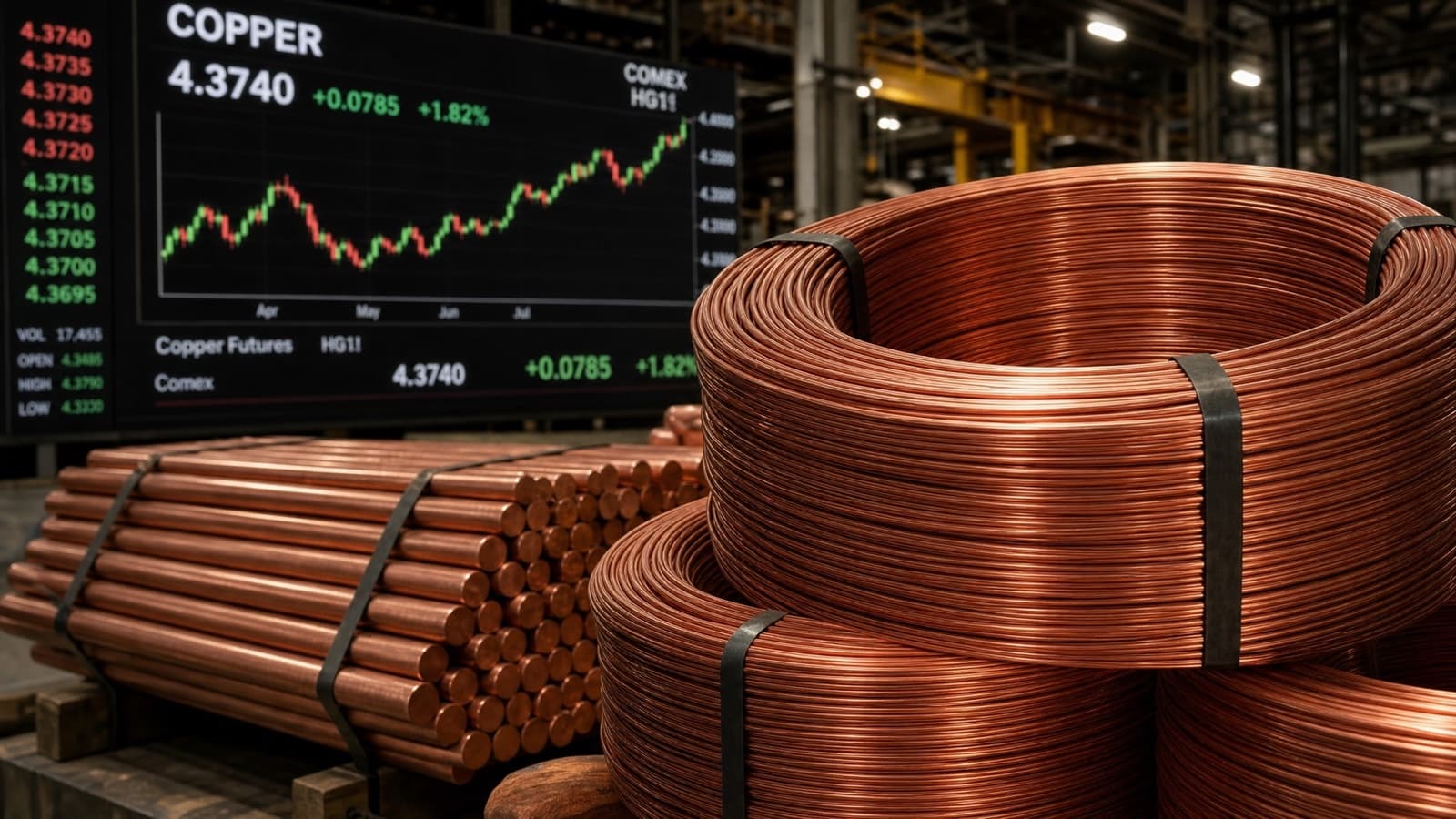
Kalshi, the CFTC-regulated New York exchange best known for prediction markets on sports, politics, and weather, has filed with federal regulators to launch perpetual futures on copper — an industrial metal central to the global electrification economy. The filing, submitted to the Commodity Futures Trading Commission on August 18, signals that Kalshi's ambitions extend well beyond event contracts.
If approved, COPPERPERP would make Kalshi the first U.S.-regulated exchange to offer continuous, non-expiring futures on an industrial metal. It also deepens a regulatory confrontation with CME Group, which has sued the CFTC over the very legality of this product category.
What Is COPPERPERP?
COPPERPERP is a cash-settled perpetual futures contract on the spot price of copper, quoted in U.S. dollars per pound. Like Kalshi's existing crypto perpetuals, it has no fixed expiration date. Instead, a periodic funding rate mechanism — calculated at regular intervals — keeps the contract price anchored to the continuously observed copper spot price, as tracked by the Pyth Network XCU/USD price feed.
"The COPPERPERP Contract is a perpetual futures contract on the spot price of copper, quoted in U.S. dollars per pound, referencing the Pyth Network XCU/USD price feed," the CFTC filing states directly.
Pyth Network is a blockchain-based oracle that aggregates pricing data from market makers, exchanges, and other financial participants. The contract would trade weekdays from 6:00 PM Eastern Sunday through 5:00 PM Eastern Friday, matching the trading schedule of COMEX copper futures. Position limits would mirror those of CME Group's COMEX enumerated copper contract — a structural choice that ensures COPPERPERP does not create manipulation risk beyond what already exists in the established copper derivatives market.
Approval route: Unlike many of Kalshi's self-certified crypto perpetuals, COPPERPERP was filed under Regulation 40.3(a) as a voluntary submission for Commission review and formal approval. The CFTC must affirmatively approve the contract before it trades. Kalshi says it "intends to list the Contract on a continuous basis" following that approval.
Kalshi's Perp Arc: From Bitcoin to Industrial Metals
COPPERPERP is the latest in a systematic campaign to build out a regulated U.S. perpetual futures market from scratch.
The CFTC established the legal framework on May 29, 2026, when it issued an order formally approving BTCPERP — the first CFTC-regulated perpetual futures contract in U.S. history. The order concluded that perpetual futures could be classified as futures contracts under the Commodity Exchange Act, using the funding rate mechanism as a functional substitute for the traditional expiration-based convergence mechanism. That ruling opened the door for Kalshi to move rapidly.
Within weeks of the BTCPERP approval, Kalshi self-certified perpetuals on Solana (SOLPERP, June 2), Chainlink (LINKPERP, June 1), and Hyperliquid (HYPEPERP, June 5) — all crypto assets. Then on July 21, Kalshi filed GOLDPERP for Commission approval, extending into precious metals. COPPERPERP, filed August 18, pushes further still into industrial commodities.
The trajectory is deliberate. Crypto perpetuals established the regulatory precedent. Gold tested the CFTC's willingness to extend that precedent to physical commodities. Copper — the most industrially critical metal in the global energy transition — tests it further.
CNBC reported this week that Kalshi traded more than $20 billion in perpetual futures within the first month of launching the product, a figure that rattled incumbent exchanges and knocked a combined $18 billion off the market values of CME Group, Cboe Global Markets, the Intercontinental Exchange, and Miami International Holdings in two days.
Why Copper? The Electrification Angle
The COPPERPERP filing makes the case explicitly: "Copper is one of the world's most important industrial commodities and the base metal most central to the electrification of the global economy — essential to power generation and transmission, construction, electric vehicles, electronics, and the data-center and grid buildout driving artificial-intelligence infrastructure."
That framing does real regulatory work. It tells the CFTC that copper has bona fide economic exposure across a broad range of market participants: EV manufacturers, power utilities, construction firms, mining companies, and increasingly, data-center operators who need copper-intensive grid connections for AI infrastructure. All of these participants carry continuous, long-duration copper price exposure — the kind better served by a perpetual (no rolling required) than by monthly dated futures.
Copper price discovery currently occurs on three primary venues: the London Metal Exchange, COMEX copper futures, and the Shanghai Futures Exchange. Kalshi argues that a U.S.-regulated domestic perpetual adds an additional, regulated layer to this market — particularly for participants who want a funding-anchored instrument that tracks spot prices continuously without the roll costs of monthly contracts.
Perpetual copper contracts already trade on offshore crypto exchanges with no U.S. regulatory oversight. Kalshi frames COPPERPERP as an onshoring exercise: "Listing a perpetual on a CFTC-registered DCM brings this economically significant activity into a regulated environment featuring trade surveillance, know-your-customer verification, risk-based margin, central clearing, and disciplinary procedures consistent with the CEA," the filing states.
Platform-by-Platform: The Regulated Perps Landscape
Kalshi currently holds a distinctive position in the U.S. regulated perpetuals market. The BTCPERP order established the legal basis for perpetual futures on Kalshi's DCM, and Coinbase received separate no-action relief for perpetual contracts through its Deribit subsidiary — but Kalshi's full DCM registration gives it the broadest latitude to file new perpetual contracts using the self-certification or approval-request process.
Traditional prediction-market rivals operate offshore. ForecastEx (Interactive Brokers) and CME Group operate their own CFTC-registered venues but have not pursued perpetuals — in CME's case, actively opposing them.
CME Group CEO Terrence Duffy filed suit against the CFTC in June 2026, arguing that perpetual futures should be classified as swaps under Dodd-Frank rather than as futures contracts. The distinction carries significant regulatory consequence: swaps require different registration, higher capital requirements, and different margin treatment. A successful reclassification would impose substantially more onerous requirements on Kalshi's exchange economics — and could retroactively complicate the BTCPERP approval that set the precedent.
"We are not taking this lightly," Duffy told CNBC before filing the suit. The CFTC has called the suit "frivolous."
The timing of each new Kalshi filing matters strategically. Every perpetual filed under the BTCPERP framework — gold, copper, and eventually more — deepens the regulatory entrenchment of the futures classification. The more active contracts trading under that classification, the stronger the reliance-interest argument for the CFTC to defend it against CME's challenge.
What This Means for Prediction-Market Traders
Kalshi's perpetual futures and prediction markets are distinct products on the same regulated exchange. Prediction markets resolve YES or NO on a specified date based on a stated event outcome. Perpetual futures are open-ended directional positions on an asset price, with no resolution event.
The two product lines serve different users — though both operate under the same CFTC oversight, margin framework, and compliance infrastructure. That shared infrastructure is the point: Kalshi's derivatives expansion provides exchange revenue separate from its event-contract business, potentially more scalable, and insulated from the state-level legal challenges that have restricted its prediction markets in more than 18 states.
For traders using PredictionMarkets.US to track cross-platform market data, COPPERPERP itself will not appear as a prediction-market contract. But the strategic significance is clear: the platform hosting your prediction-market contracts is becoming one of the most aggressive participants in the U.S. regulated derivatives market — and the financial runway that generates funds the regulatory defense protecting the entire operation.
COPPERPERP is pending CFTC approval. No launch date has been announced.
Frequently Asked Questions
What is COPPERPERP? COPPERPERP is Kalshi's proposed perpetual futures contract on the spot price of copper, priced in U.S. dollars per pound. It references the Pyth Network XCU/USD price feed, has no fixed expiration date, and uses a funding rate mechanism to track spot copper prices continuously.
Has the CFTC approved COPPERPERP yet? Not yet. Kalshi filed under Regulation 40.3(a) — a voluntary submission for formal Commission review and approval — on August 18, 2026. Trading cannot begin until the CFTC formally approves the contract.
What is Kalshi's legal entity? KalshiEX LLC is the registered Designated Contract Market (DCM) and Derivatives Clearing Organization (DCO) that operates Kalshi's exchange under CFTC oversight.
What other perpetual futures has Kalshi launched? Kalshi launched BTCPERP (bitcoin) on May 29, 2026 — the first CFTC-regulated perpetual in U.S. history — followed by self-certified perpetuals on Solana, Chainlink, and Hyperliquid, and Commission-review filings for gold and copper.
Why is CME fighting Kalshi's perpetuals? CME Group argues perpetual futures should be classified as swaps rather than futures under the Dodd-Frank Act, a reclassification that would impose significantly higher capital and margin requirements on Kalshi. CME sued the CFTC in June 2026 over the approval of BTCPERP. The CFTC has called the suit frivolous.
Sources & Verification
- COPPERPERP contract terms, filing rationale, and copper market context: KalshiEX LLC COPPERPERP CFTC filing, August 18, 2026
- BTCPERP approval as first domestic perpetual and futures classification framework: CFTC Order approving BTCPERP Futures Contract, May 29, 2026
- GOLDPERP submission and perp arc timeline: KalshiEX LLC GOLDPERP CFTC filing, July 21, 2026
- $20B+ first-month volume, CME lawsuit and exchange market cap impact: CNBC, August 21, 2026