
Kalshi's $40 Billion Moment: Inside the Fastest-Rising Startup in Financial History
Kalshi is targeting a $40 billion valuation in new funding talks — nearly doubling its worth in under two months. Here's what that trajectory, a CNBC-confirmed IPO countdown, and surging competition mean for prediction market traders.
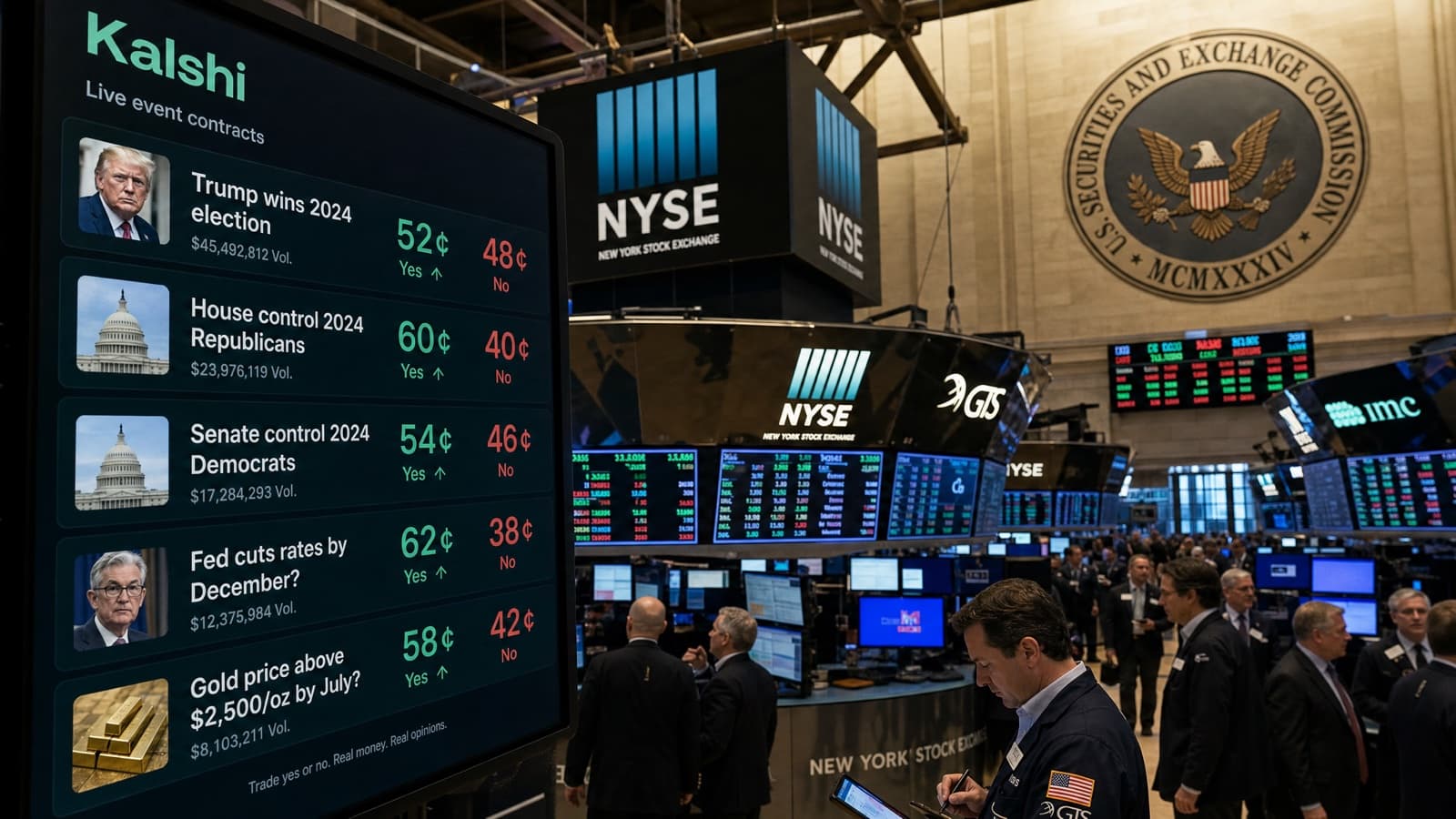
There is no polite way to frame what has happened to Kalshi's valuation over the last 18 months. It is, by any conventional measure, extraordinary.
In October 2025, Kalshi raised $300 million at a valuation of roughly $5 billion. By December, that figure had climbed to $11 billion. Then came a $1 billion Series F round — led by Coatue Management, with Sequoia Capital, Andreessen Horowitz, Morgan Stanley, and Ark Invest all signing on — that valued the company at $22 billion. Now, according to the Financial Times, Kalshi is in discussions to raise fresh capital at a valuation of approximately $40 billion, with a deal that could close as early as Q3 2026.
That is an eightfold increase in valuation in under a year. And the company's chief executive isn't ruling out going even higher — toward a public market listing.
The Business That Got Wall Street's Attention
Kalshi is not a typical startup. It is a federally licensed derivatives exchange — holding both a Designated Contract Market (DCM) and Derivatives Clearing Organization (DCO) designation from the Commodity Futures Trading Commission — that allows anyone to trade contracts on the outcome of real-world events.
The CFTC license is the core asset. It means Kalshi operates under the same regulatory framework as the Chicago Mercantile Exchange, not as an offshore gambling platform. That distinction has attracted the kind of institutional capital that would never have considered a consumer-facing prediction market app just a few years ago.
"A company of our financial profile with the rate of growth that we're seeing, that sort of conversation has to happen," CEO Tarek Mansour told CNBC's Squawk Box in June 2026, speaking openly about IPO planning for the first time. He added that a public market debut "would not take place before 2027" — but the acknowledgment itself was historic. Kalshi is no longer asking whether it belongs on Wall Street. The question now is when and at what price.
The Valuation Trajectory
Here is how Kalshi got to this point:
| Date | Round | Valuation |
|---|---|---|
| October 2025 | Series D | ~$5 billion |
| December 2025 | Series E | ~$11 billion |
| March 2026 | Series F | $22 billion |
| Q3 2026 (target) | New round | ~$40 billion |
The Series F alone was remarkable: $1 billion raised at a $22 billion valuation in a single round. The $40 billion target, if achieved, would nearly double that figure in under two months — a pace of capital appreciation that makes most unicorn stories look pedestrian.
The Financial Times, citing people familiar with the matter, first reported the new fundraising discussions on June 24, 2026. Kalshi declined to comment on the reported talks. Polymarket, its closest rival, is separately seeking funding at a $15 billion valuation, according to Bloomberg — roughly the valuation floor Kalshi sat at eight months ago.
What Justifies the Number
To skeptics, $40 billion might sound like a number conjured from the same logic that produced the WeWork era. But Kalshi's financials are different: the company has real, rapidly growing revenue.
According to The Information, Kalshi surpassed $2 billion in annualized revenue earlier this year. As of April 2026, the company reported $178 billion in annualized trading volume — a 32-fold increase year over year. The 2026 FIFA World Cup pushed those figures even higher: Kalshi generated $21.1 billion in trading volume in June 2026 alone, compared to Polymarket's $9.7 billion during the same period.
Sports contracts remain the volume engine, accounting for roughly 65% of total activity. That concentration is also the company's primary regulatory risk. More than a dozen U.S. states have filed lawsuits arguing that sports event contracts constitute unlicensed gambling under state law, with Minnesota going furthest — the state legislature made it a felony to operate event contracts on sporting outcomes without a state gaming license. The August 1, 2026 deadline for that felony provision to take effect has been described by legal analysts as a significant forcing function.
Investors, evidently, are betting that federal preemption holds. Courts have so far validated that bet.
The Federal Preemption Case
The Third Circuit Court of Appeals ruled in April 2026, in KalshiEX LLC v. Flaherty, that CFTC-regulated event contracts are subject to federal preemption — meaning the Commodity Exchange Act supersedes state gaming statutes when contracts are registered with and approved by the CFTC. That ruling directly protected Kalshi's ability to operate sports event contracts in the states covered by the Third Circuit (New Jersey, Delaware, Pennsylvania, and others).
The Ninth Circuit heard oral arguments on a similar question in April. The CFTC issued a Notice of Proposed Rulemaking (NPRM) in June 2026 that would formally codify sports event contracts as permissible — allowing scores, spreads, and statistical outcomes while prohibiting single-play props. The AGA and tribal gaming associations have opposed the NPRM, and eight federal court cases remain active.
None of that has cooled institutional enthusiasm. The $40 billion fundraising conversation began after the Third Circuit victory, not before it.
The IPO Pipeline
Mansour's CNBC confirmation of IPO planning — the first public acknowledgment — came the same day the FT reported the $40 billion fundraising talks. The timing was not coincidental: companies in early IPO conversations typically want their valuation narrative in the market before bankers begin formal investor outreach.
According to The Information, Kalshi has surpassed $2 billion in annualized revenue and has begun early conversations with investment banks about a potential listing. The IPO window is most likely 2027 or 2028 based on those conversations.
A $40 billion fundraising valuation sets an implicit floor for what Kalshi's public investors would need to see in order for an IPO to succeed. The gap between a private market raise and a successful public offering is not guaranteed — but Kalshi's revenue base and CFTC licensing give it a more defensible foundation than most pre-IPO startups at comparable valuations.
Polymarket is on a parallel, if more complicated, track. Bloomberg has reported the company is seeking funding at a $15 billion valuation. Polymarket's U.S. entity — QCX LLC, d/b/a Polymarket US — is currently restricted to sports-only markets under CFTC oversight, with its global platform (polymarket.com) not accessible to U.S. users. That structural constraint narrows its near-term U.S. addressable market relative to Kalshi.
The Competitive Picture
Kalshi's fundraising discussions are happening against a backdrop of intensifying competition from every direction.
Meta is building a standalone prediction market app internally called "Arena." CEO Mark Zuckerberg personally directed a small team to build the product after acquisition talks with Kalshi's CEO broke down, according to the New York Times. Arena is expected to launch with virtual "play money" rather than real-money wagers — sidestepping CFTC oversight for now — but Meta's distribution advantage (3.56 billion daily active users across its apps) means it doesn't need regulatory approval to reach scale in awareness.
Robinhood, Coinbase, CME Group (through FanDuel Predicts), Interactive Brokers, DraftKings, and more than a dozen other platforms have entered the prediction market space. The CFTC itself approved ProphetX and Novig as new designated contract markets in June 2026, adding regulated competitors within a single week.
The market Kalshi helped build is crowded now. But Kalshi's revenue lead, institutional relationships, and CFTC licensing position it as the infrastructure layer — the exchange that others may eventually route through rather than compete against directly.
What This Means for Traders
For users of PredictionMarkets.US, the Kalshi fundraising story has practical implications worth understanding.
Financial stability: A company in active discussions at a $40 billion valuation, with $2 billion in annualized revenue and backing from Sequoia, Andreessen Horowitz, and Morgan Stanley, is not at risk of the kind of sudden shutdown that has ended other prediction market platforms. Kalshi is building to last.
Product expansion: IPO-track companies invest aggressively in growth. Kalshi has already launched crypto perpetual futures contracts and an institutional block-trade desk. Traders should expect continued new product launches as the company positions its IPO narrative.
State-level restrictions: If you are in Minnesota, Wisconsin, Michigan, Arizona, New York, or another state with active litigation, access to sports contracts may change depending on court outcomes. The federal preemption argument has held in the Third Circuit, but the Supreme Court has not weighed in. The CFTC's June 2026 NPRM, if finalized, would provide stronger federal authority — but it has not been finalized yet.
Fee transparency: Kalshi's fee structure for standard event contracts is a probability-weighted formula (0.07 × P × (1 − P) per share, with a maximum of 1.75¢) applied to your position size. This is unchanged by the fundraising news.
Frequently Asked Questions
Is Kalshi going public? Kalshi CEO Tarek Mansour confirmed in June 2026 that the company is weighing an IPO, but said a public listing would not happen before 2027. The company has begun early conversations with investment banks.
What is Kalshi's current valuation? Kalshi's last confirmed funding was a Series F that valued the company at $22 billion. The company is reportedly in discussions for a new round targeting approximately $40 billion, which could close as early as Q3 2026, per the Financial Times — but that round has not been confirmed as closed.
How does Kalshi compare to Polymarket? In June 2026, Kalshi generated $21.1 billion in trading volume versus Polymarket's $9.7 billion. Kalshi's last confirmed valuation is $22 billion; Polymarket is seeking funding at approximately $15 billion (Bloomberg). Structurally, Kalshi offers a broader range of U.S.-accessible markets; Polymarket US is currently sports-only.
What are the risks to Kalshi's growth? The primary risk is ongoing state-level litigation over sports event contracts. Courts have so far sided with Kalshi on federal preemption, but the Supreme Court has not ruled. Minnesota's August 1 felony deadline for unauthorized sports event contracts is the most immediate pressure point.
When will Kalshi hold an IPO? Not before 2027, per CEO Tarek Mansour's public statement on CNBC in June 2026. The company is in early conversations with investment banks about a listing in 2027 or 2028.
Conclusion
Kalshi's race to $40 billion is not a story about speculative excess. It is a story about what happens when a new financial product class — federally regulated, institutionally backed, and genuinely useful — gets discovered by the kind of capital that shapes markets.
The valuation trajectory from $5 billion to $40 billion in under a year reflects genuine revenue growth, a defensible regulatory moat, and an industry adoption curve that hasn't plateaued. Whether the number holds in public markets is a question for 2027 or 2028.
What the fundraising talks tell you today: the institutions betting on prediction markets are doing so with conviction at a scale that would have seemed implausible 18 months ago. Kalshi is building toward the public markets, and the countdown has started.
Sources & Verification
- Kalshi $40 billion fundraising target, Q3 close timeline: Financial Times, June 24, 2026
- CEO Tarek Mansour on IPO planning, "not before 2027": CNBC Squawk Box, June 24, 2026
- $2B+ annualized revenue, early IPO banking conversations: The Information, June 2026
- Polymarket $15 billion valuation: Bloomberg, June 2026
- Series F investors (Coatue, Sequoia, A16z, Morgan Stanley, ARK): Kalshi official announcement, March 2026
- Kalshi $21.1B vs. Polymarket $9.7B June 2026 volume: Investing.com, July 2026 — data from platform reporting
- Meta Arena development: New York Times, June 23, 2026
- Third Circuit federal preemption ruling (KalshiEX LLC v. Flaherty): CFTC Press Room
- CFTC DCM + DCO designation: CFTC DCM Registry
- CFTC NPRM on sports event contracts, June 2026: CFTC.gov
- Minnesota felony provision: Minnesota Revised Statutes, Chapter 299L (2026)
- Kalshi fee formula (0.07 × P × (1−P), max 1.75¢): Kalshi official help center