
July CPI Preview: Prediction Markets See Tamer Inflation Than Wall Street
Kalshi gives less than 55% odds July CPI tops 3.3%—below the 3.4% Wall Street consensus. What the data shows before Wednesday's 8:30 AM print.
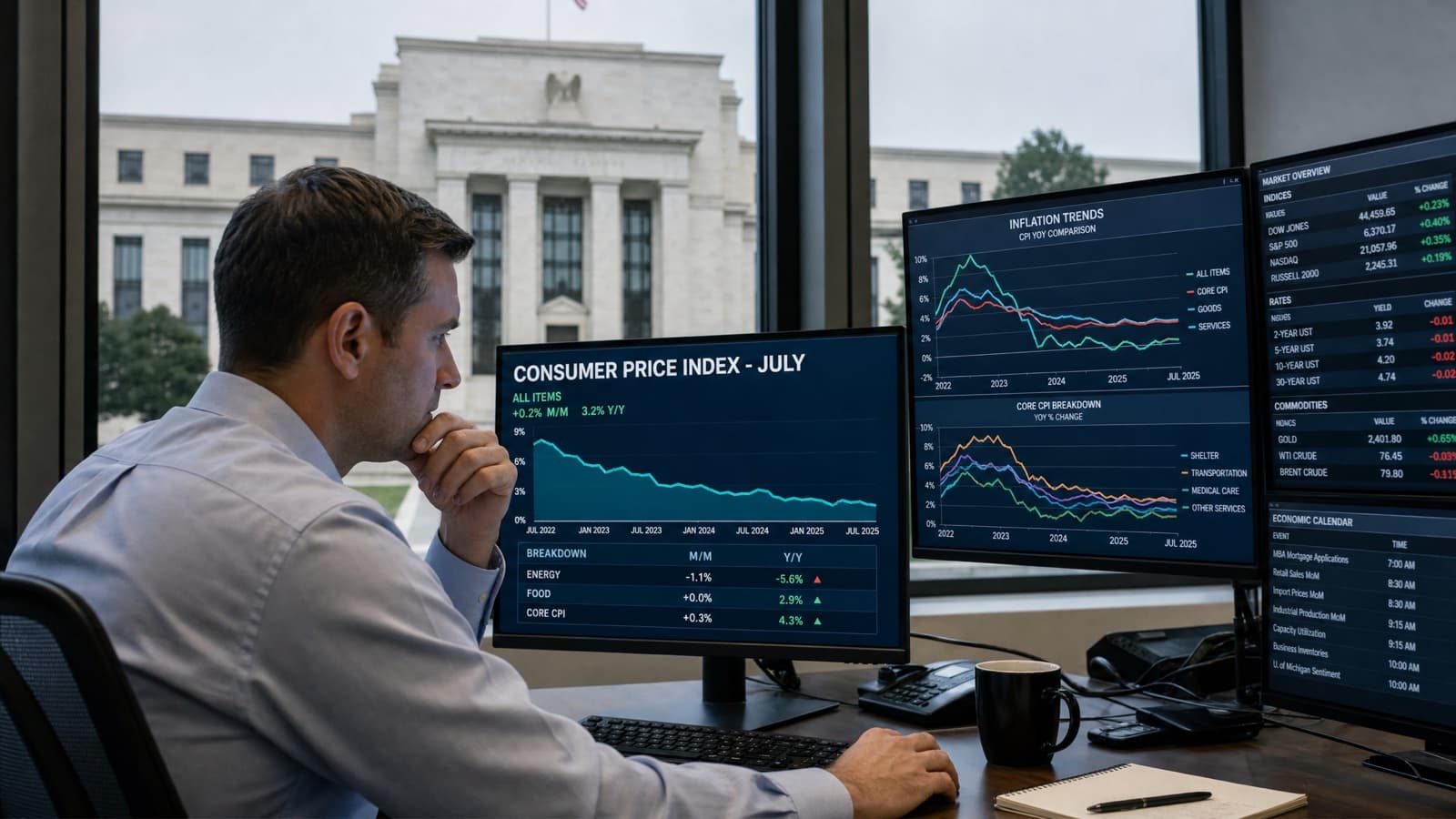
Wednesday morning, 8:30 a.m. ET, the Bureau of Labor Statistics drops the most consequential piece of economic data between now and the Federal Reserve's September 16 meeting. Wall Street economists expect July's Consumer Price Index to come in at 3.4% year-over-year. Prediction market traders, pricing in real money across thousands of positions, are leaning somewhere softer — and the divergence is worth tracking closely before the number lands.
What June's Data Set Up
June CPI was a genuine surprise. The headline index fell 0.4% month-over-month, pulled down sharply by a 5.7% drop in energy prices tied to Middle East supply dynamics. Year-over-year, headline inflation dropped from 4.2% in May to 3.5% in June — a full three-tenths below what forecasters had projected. Core CPI (excluding food and energy) was unchanged month-over-month and rose 2.6% year-over-year, well below the headline print.
That sets up a central question for July: was the energy-driven decline a genuine inflation turning point, or a one-month reprieve about to reverse?
Recent data from the Cleveland Federal Reserve's inflation nowcasting model (updated August 7, 2026) projects July CPI at +0.09% month-over-month and 3.42% year-over-year — marginally below the Wall Street consensus. The model projects core CPI at +0.21% MoM and 2.52% year-over-year.
Prediction Market Odds
Kalshi traders are pricing a notably tamer July print than the economist consensus. According to data reported by CNBC on Monday, August 10:
- Less than 55% probability that headline CPI exceeds 3.3% year-over-year
- 15% odds that CPI exceeds 3.4% year-over-year (the Dow Jones consensus number)
- 47% probability that core CPI exceeds 2.4% year-over-year
- 11% probability that core CPI exceeds 2.5% year-over-year (the Dow Jones consensus for core)
That last figure is the sharpest divergence. Wall Street's median forecast is exactly 2.5% for core — yet Kalshi traders give that outcome only an 11% shot. Prediction market participants appear to be betting that cooling energy costs combined with stabilizing shelter prices will push both headline and core below what most economists expect.
Polymarket's July inflation markets, also active heading into Wednesday, show a somewhat wider range of outcomes but lean in the same direction:
- 3.4% (annual headline): 45% probability
- 3.3%: 27%
- 3.5%: 22%
- 3.2%: 6%
The Polymarket monthly print contract prices at least a +0.1% monthly gain with 61% probability, a flat month at 28%, and a second consecutive monthly decline at 12%.
Live market view — track these prices yourself:
The Fed's September Decision
The Federal Reserve held the federal funds rate at 3.50–3.75% at its July meeting. Three committee members voted in favor of raising rates at that gathering.
The September 16 FOMC meeting now turns largely on Wednesday's data. Markets are currently pricing approximately a 50-50 probability of a rate hike in September, with the balance tilting toward a hold in recent sessions as commodity prices stabilize. Any inflation print that materially deviates from consensus — high or low — will move those odds.
Bill Adams, chief economist at Comerica Bank, stated Monday: "CPI and PPI inflation are both forecast to be slightly cooler in July, helped by stable petroleum product prices. If these data come in as expected, they will bolster the case for the Fed to refrain from hiking at their next decision on September 16. Either way, the July inflation reports will have more bearing on the next Fed decision than the month's jobs report."
Live market view — track these prices yourself:
What Wall Street Economists Are Saying
Deutsche Bank: "Our expectations are for a roughly 2% decline in gas prices to weigh on July's headline CPI relative to core. Should our forecasts hit the mark, the year-over-year rate for both would tick down a tenth."
Wells Fargo: "The report should reinforce the view that the worst of the inflationary effects from a higher-tariff regime and the conflict in the Middle East are behind us. Increases appear driven by a narrow set of categories rather than a broadening in underlying price pressures."
UBS Global Research: "Although year-over-year inflation should have moved lower, the projected July pace remains noticeably above pre-Iran conflict levels and above a year ago, underscoring that headline inflation remains elevated despite recent moderation. We expect core inflation firmed after June's unexpectedly weak reading, driven primarily by a rebound in core non-rent services."
E*TRADE from Morgan Stanley (Chris Larkin): "The S&P 500's breakout from a nearly two-month trading range could get a test this week from inflation and geopolitics. Those concerns could hit new highs without cooler-than-expected inflation numbers this week."
The consensus narrative across these views: a modest step-down in headline CPI is widely expected, but risks are asymmetrically to the upside given potential energy price rebounds and lingering services stickiness.
Scenario Playbook
| Outcome | Headline CPI | Core CPI (MoM) | Fed implication |
|---|---|---|---|
| Soft (prediction-market base case) | ≤3.3% | ≤0.1% | September hike odds fall; bond yields ease |
| In-line with consensus | 3.4% | 0.2% | Markets unchanged; September remains coin-flip |
| Modestly hot | 3.5% | 0.3% | September hike becomes the base case |
| Significantly hot | ≥3.6% | ≥0.3% | September hike highly likely; equity volatility spikes |
Prediction market traders are collectively leaning toward the first scenario. The gap between that collective bet and the 3.4% Wall Street consensus is the story heading into Wednesday.
FAQ
When is the July 2026 CPI report released? Wednesday, August 12, 2026 at 8:30 a.m. Eastern Time. The Bureau of Labor Statistics issues the report at bls.gov.
What is the Wall Street consensus for July CPI? Economists surveyed by Dow Jones and Bloomberg project headline CPI at 3.4% year-over-year (from 3.5% in June) and core CPI at 2.5% year-over-year (from 2.6% in June). Month-over-month, headline is expected at +0.1%.
Why are prediction market traders pricing below the economist consensus? Kalshi traders give only a 55% probability that headline CPI exceeds 3.3%, suggesting the market-implied median is at or below that level. The Cleveland Fed nowcast at 3.42% supports a below-consensus read. Traders may be weighting the possibility of further energy price relief or stronger-than-expected shelter disinflation.
What happens to the Fed's September decision if CPI surprises hot? Markets are currently pricing September at roughly 50-50 for a rate hike. A headline print at 3.5% or higher would likely push that probability above 65-70% and push bond yields sharply higher.
Where can I trade CPI and Fed decision markets? Kalshi and Polymarket both list active markets on July CPI outcomes and the September FOMC decision. PredictionMarkets.US aggregates live odds across both platforms in one place.
Conclusion
One of two groups is going to be wrong Wednesday at 8:30 a.m. Wall Street economists have the print pegged at 3.4%. Prediction market traders are betting on something softer — and putting real money behind that view on Kalshi and Polymarket.
The divergence narrows with every passing hour. Track the live odds before the Bureau of Labor Statistics settles the debate at https://predictionmarkets.us/events/july-inflation-us-annual-20260714150613267
Sources & Verification
- Bureau of Labor Statistics CPI Release Schedule 2026 — official CPI release date and schedule
- CNBC — Prediction markets show tamer July CPI, August 10, 2026 — Kalshi odds data
- Bloomberg — US CPI to Show Inflationary Pressures Cooling Some, August 9, 2026 — consensus forecast and monthly MoM projection
- Cleveland Federal Reserve — Inflation Nowcasting, updated August 7, 2026 — July CPI nowcast at 0.09% MoM, 3.42% YoY
- Kiplinger — What to Expect From the July CPI Report, August 10, 2026 — Deutsche Bank, Wells Fargo, UBS, E*TRADE analyst quotes
- US News — July CPI Could Show Further Easing in Inflation, August 10, 2026 — Comerica Bank economist quote
- Polymarket — July Inflation US Annual market — annual CPI market odds
- Polymarket — Core CPI MoM July 2026 — core monthly CPI market odds