
How Prediction Markets Settle: A Complete Guide to Resolution, Payouts, and Disputes
A complete guide to how prediction markets settle contracts—covering Kalshi, Polymarket, and ForecastEx resolution mechanics, payout timing, and dispute windows. Know before you trade.
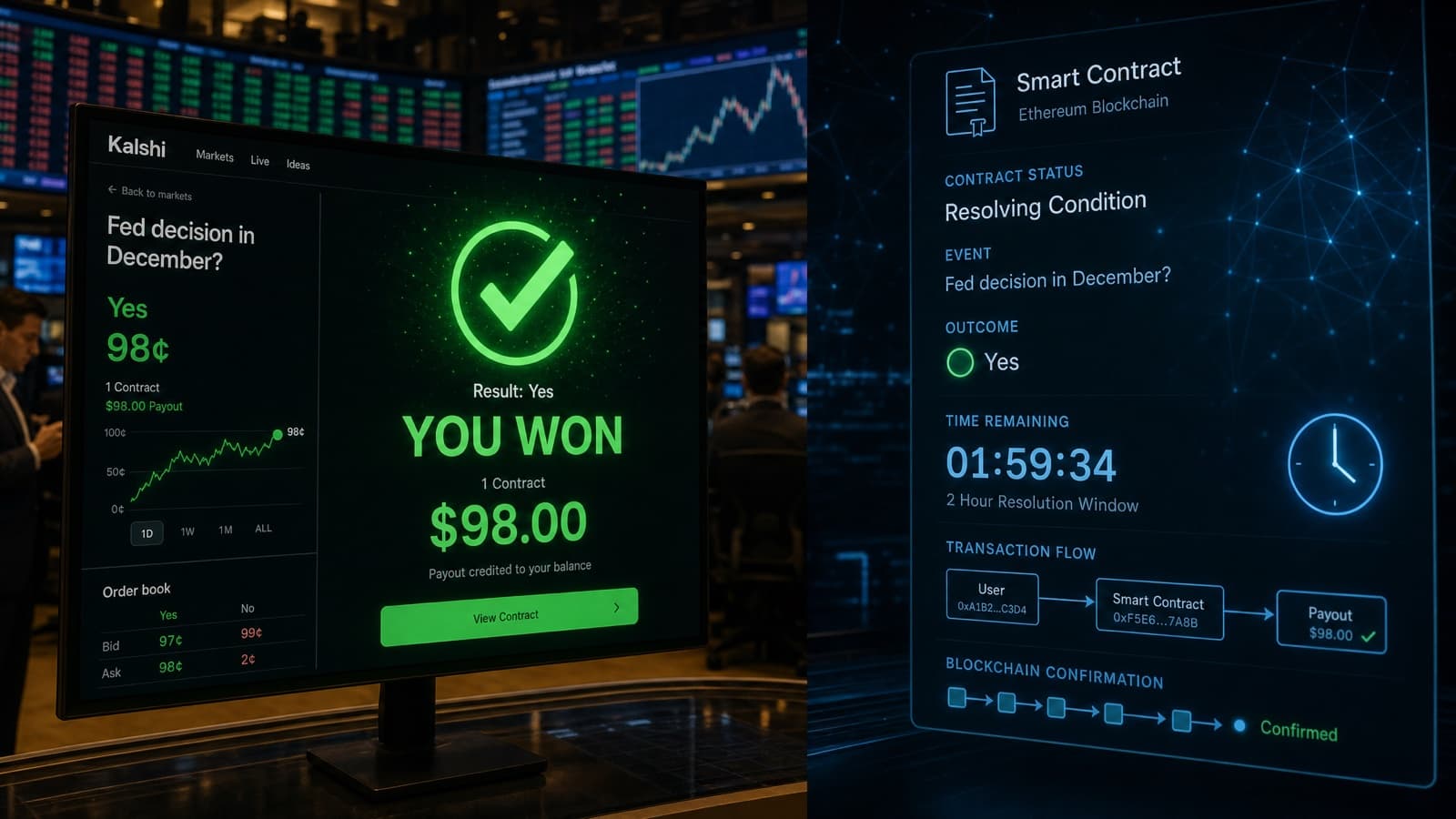
You've traded a contract and the event is over. Now what? Understanding how prediction markets settle is critical—yet most guides skip the mechanics entirely. Whether you're trading on Kalshi, Polymarket, or ForecastEx, the path from "event ends" to "cash in account" is more nuanced than it looks.
This guide covers the full settlement lifecycle: how each platform determines the winning outcome, how long payouts take, what happens when outcomes are disputed, and the key differences you need to know before placing your next trade.
What Does "Settlement" Actually Mean?
In prediction markets, settlement is the process of determining the winning outcome and distributing payouts to contract holders. When a market "settles," two things happen simultaneously: contracts on the losing side become worthless, and contracts on the winning side pay out $1 each (the contract's face value).
The timing and mechanics of this process vary significantly by platform. On Kalshi, settlement is centralized and managed by Kalshi's markets team. On Polymarket, it's decentralized and governed by a smart-contract oracle. On ForecastEx (via Interactive Brokers), a defined rulebook specifies each outcome source in advance. Same concept, very different execution.
Understanding these differences matters for two reasons: it affects how quickly you get paid, and it determines what recourse you have if something goes wrong.
How Kalshi Settlement Works
Kalshi operates as a CFTC-regulated Designated Contract Market (DCM) and Derivatives Clearing Organization (DCO). Its settlement process is centralized—Kalshi's markets team determines the outcome and triggers the payout.
The Kalshi Settlement Lifecycle
- Event occurs — The real-world event happens (e.g., the Fed announces its rate decision, a game ends, election results are certified)
- Official source confirms — Kalshi waits for an official source agency to publish finalized results. This could be a government data release, official league statistics, or a recognized event authority
- Markets team finalizes — Kalshi's team confirms the outcome matches the market's pre-defined resolution criteria
- Payout executes — Winning contracts pay out to your Kalshi cash balance; losing contracts expire worthless
How Long Does Kalshi Settlement Take?
According to Kalshi's Market FAQs, most markets settle within a few hours after the outcome is known—often within about 3 hours. However, several factors can extend this timeline:
- Official data delays: If Kalshi is waiting on a government agency, sports league, or other official body to publish finalized data, settlement may be delayed regardless of when the event appears to end
- Market rules and determination time: The market's displayed close time may not equal determination time. Trading can end before or after an event for operational reasons, while settlement occurs only once the official result is confirmed
- Revision periods: For markets using government economic data (CPI, jobs reports), Kalshi may wait through potential initial revision windows
Typical ranges by market type:
- Sports markets: 2–6 hours post-event (waiting on official league stats)
- Economic releases (CPI, Fed rate decisions): Usually 1–3 hours post-announcement
- Election markets: Days to weeks, depending on vote-counting and official certification
- Long-duration markets: Determined at the contract's specified date if no earlier resolution
Does Kalshi Have a Dispute Window?
No. Kalshi does not have a formal trader dispute window for contesting outcomes. If you believe a market was resolved incorrectly, you can contact Kalshi's support team via in-app chat—but this is a support escalation path, not a structured dispute mechanism. Kalshi has discretion in whether to review and adjust a settlement.
If the event ended and 12+ hours have passed with no settlement, Kalshi recommends reviewing the market's Rules and Important Information sections before contacting support.
How Polymarket Settlement Works
Polymarket uses a decentralized resolution system powered by the UMA Optimistic Oracle—a smart-contract mechanism that resolves markets through economic incentives rather than a centralized team.
The Polymarket Resolution Lifecycle
Polymarket's resolution has three distinct phases, as detailed in Polymarket's official documentation:
Phase 1: Proposal Once an outcome becomes clear, any user can propose a resolution by posting a $750 USDC bond and submitting to the UMA Oracle. If the proposal is correct and goes uncontested, the proposer receives their bond back plus a reward.
Phase 2: Challenge Period (2 Hours) After a proposal, there is a 2-hour window where anyone can dispute the proposed outcome. This is the formal protection mechanism for Polymarket traders:
- If no dispute occurs: The proposal is accepted and the market resolves
- If disputed: A new proposal round begins. If the second proposal is also disputed, resolution escalates to UMA's Data Verification Mechanism (DVM)
Phase 3: Finalization (or DVM Vote) If no dispute occurs in the 2-hour window, the market finalizes. If escalated to DVM, UMA token holders vote on the correct outcome—a process that can take 24–48 hours.
⚠️ Bond risk: If you propose a resolution incorrectly or too early, you lose your entire $750 bond. Polymarket's help center is explicit: propose only if you understand the process and are confident in the outcome.
How Long Does Polymarket Settlement Take?
- Uncontested, clear outcomes: 2–4 hours after the event (allowing for the 2-hour challenge period)
- Contested outcomes: 24–48+ hours if escalated to DVM token voting
- Ambiguous market language: Potentially much longer if the resolution rules create edge cases
Winning on Polymarket: Redeeming Positions
When a Polymarket market resolves, winning token holders can redeem each share for $1 in USDC. Losing shares become worthless. The redemption is on-chain and permissionless—you control the timing once the market resolves.
How ForecastEx (Interactive Brokers) Settlement Works
ForecastEx LLC is a CFTC-regulated DCM that powers Interactive Brokers' event contract trading. Its settlement process is governed by a formal rulebook. According to ForecastEx's September 2026 Rulebook, each contract pre-specifies:
- The designated official source: The exact data provider, government agency, or official body that determines the outcome
- The measurement window: Precisely when and how the outcome is measured
- Settlement price calculation: How the official outcome converts to the contract's final settlement price
ForecastEx contracts typically settle on a binary basis (100 or 0), with settlement triggered by official source publication. Settlement funds are credited directly to your Interactive Brokers brokerage account—no separate prediction market wallet required.
Platform-by-Platform Settlement Comparison
Live market view — track a real settlement in progress:
| Platform | Resolution Mechanism | Typical Timing | Formal Dispute? | Payout Format |
|---|---|---|---|---|
| Kalshi | Centralized (markets team) | 2–6 hours post-event | No formal window (support only) | Kalshi cash balance |
| Polymarket | UMA Oracle (decentralized) | 2–4 hours after challenge period | ✅ 2-hour challenge window; DVM escalation | USDC redemption |
| ForecastEx/IBKR | Rulebook-specified | Hours post-official publication | Formal rulebook grievance | IBKR brokerage account |
| PredictIt | Centralized (admin team) | 1–7 days post-event | Admin petition process | Account balance |
Note: PredictIt operates under a CFTC no-action letter—a different regulatory basis than Kalshi or ForecastEx. Its settlement and dispute processes reflect that distinct structure.
Reading Market Rules Before You Trade: The Most Underused Tool
Every prediction market platform publishes pre-defined resolution rules for each contract. Most traders never read them. This is a mistake that costs real money in edge cases.
Here's what to look for in any market's rules:
1. Resolution source: What specific entity confirms the outcome? "Official league stats" is vague; "NBA.com boxscore, first posted official stats" is specific. The difference matters when stats are revised.
2. Determination time: When is the outcome officially "confirmed"? Some sports markets settle on final score; others require official league approval, which can come hours or days later.
3. Edge cases: What happens if the event is postponed? What if the outcome is delayed? What if there's a tie or an unusual scenario? Well-written market rules address these explicitly.
4. Close time vs. determination time: As Kalshi's FAQ explicitly notes, these are not the same. A market might still be tradeable after an event ends while awaiting official confirmation from the designated source.
Timing Your Exit: Sell vs. Hold Through Settlement
A question every prediction market trader faces: do you hold the winning contract to settlement, or sell it at the current market price?
If a market is trading at 97¢ and you're confident it will resolve at $1, holding means earning roughly 3 cents on each contract—but your capital is locked until settlement triggers. Selling at 97¢ frees that capital immediately for redeployment.
The math depends on:
- How long until settlement: A 3¢ gain over 2 hours is very different from the same gain over 5 days
- Whether the market is still tradeable: If trading has closed, you have no choice but to wait
- Your available opportunities: If you have a higher-expected-value trade to fund, selling early often makes sense
There's no universal right answer—but understanding each platform's typical settlement timeline helps you model the tradeoff accurately.
Frequently Asked Questions
Q: How long does Kalshi take to pay out after a market settles? Payout to your Kalshi cash balance is typically near-instantaneous once settlement is triggered—usually within minutes of the determination. The delay is in the settlement process itself, not the payout. Once determined, funds are available immediately for withdrawal or new trades.
Q: Can a Polymarket market be cancelled or resolve "N/A"? Yes. Markets can be cancelled if the underlying event doesn't occur, or resolved N/A if resolution rules specify cancellation criteria. When a market cancels, all positions are refunded at the original purchase price (your cost basis).
Q: What is the UMA challenge window on Polymarket? The challenge window is 2 hours after a resolution is proposed. This is your formal opportunity to dispute an incorrect outcome before it becomes final. If disputed, the resolution can escalate to a DVM token holder vote for final determination.
Q: Does Kalshi have a dispute mechanism for traders? Kalshi does not have a formal trader dispute window. If you believe a market was incorrectly resolved, contact Kalshi support via in-app chat. Kalshi has discretion on whether to review and revise a settlement.
Q: Why is my Kalshi market still open after the event ended? A market remaining open is not an indication that the outcome isn't known. Kalshi often must wait for an official source agency to publish finalized data before determining the result. Check the market's Rules section for the designated official source and its typical publication timeline.
Q: What happens if I hold a Polymarket contract through resolution without redeeming? Your winning tokens simply remain in your wallet, redeemable at $1 each at any point after resolution. There's no expiration on redemption—you can redeem immediately or months later.
The Bottom Line
Prediction market settlement is more layered than most traders realize. The distinctions that matter most:
- Centralized vs. decentralized resolution: Kalshi and ForecastEx have centralized processes; Polymarket uses a decentralized oracle with economic incentives
- Close time ≠ determination time: Don't confuse when trading stops with when the outcome is officially determined
- Dispute windows are short and platform-specific: Polymarket's 2-hour window is the primary formal mechanism across all major platforms
- Always read the resolution rules: The resolution source, measurement window, and edge cases in each market's rules determine exactly how your contract settles
For live markets with real-time prices across Kalshi and Polymarket—and to see contracts approaching settlement right now—explore PredictionMarkets.US.
Sources & Verification
- Kalshi settlement process, timing, and FAQ: Kalshi Market FAQs — verified October 17, 2026
- Polymarket UMA oracle, challenge period, and resolution lifecycle: Polymarket Resolution Documentation — verified October 17, 2026
- Polymarket resolution process overview: Polymarket Help Center — How Are Prediction Markets Resolved? — verified October 17, 2026
- ForecastEx settlement rulebook: ForecastEx LLC Rulebook, September 2026 — verified October 17, 2026