
Google Chrome Just Banned Prediction Market Extensions. Here's What Traders Need to Know.
Google's Chrome Web Store banned extensions enabling real-money prediction market trading as of August 1, 2026. Here's exactly what changed, what the policy says, and what traders can still do.
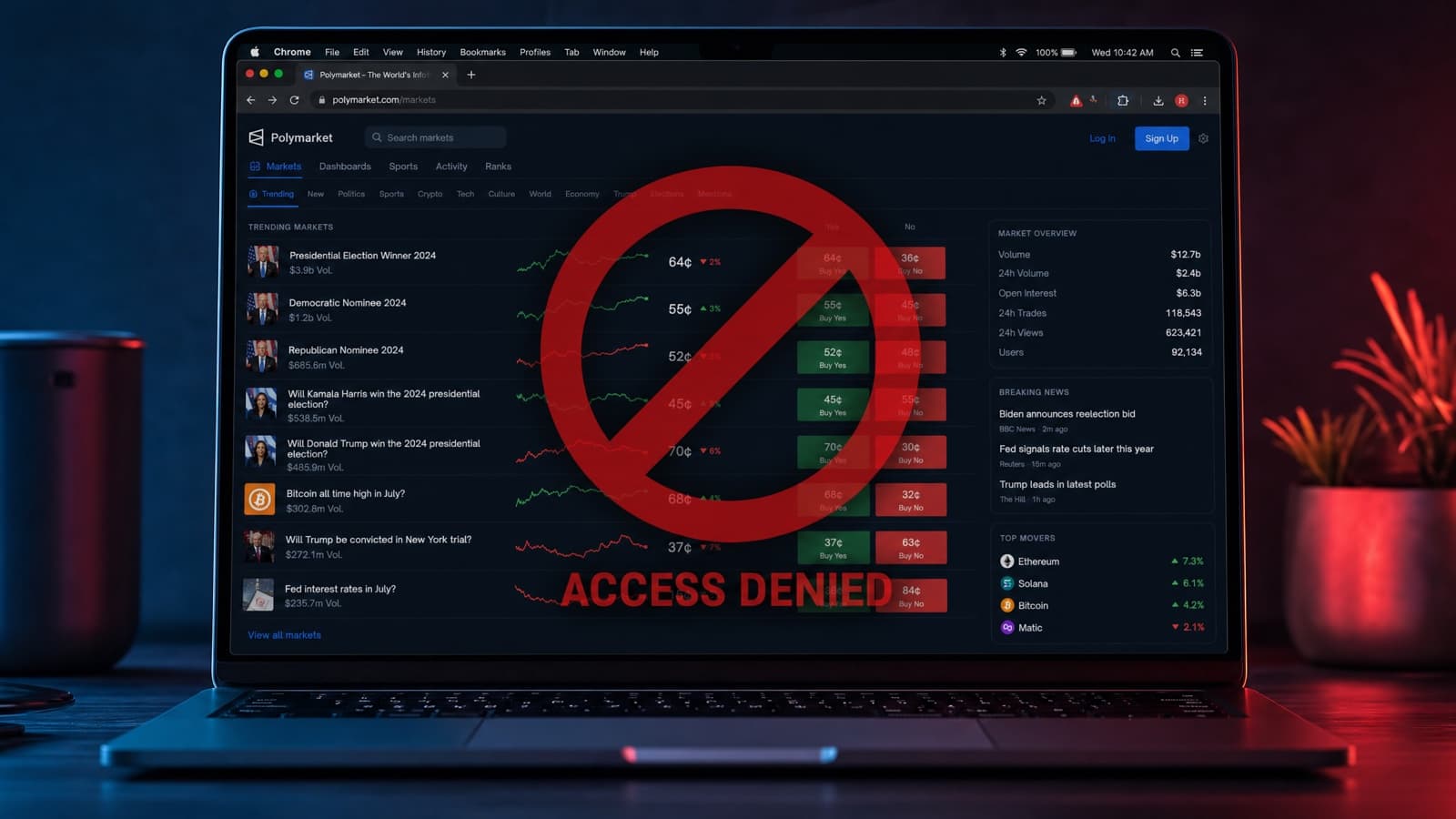
Enforcement began August 1. If you've been using browser tools to track odds on Kalshi or Polymarket, here's what changed — and what didn't.
The Chrome Web Store quietly crossed a line last month, and the deadline arrived yesterday. As of August 1, 2026, Google prohibits browser extensions that "facilitate or enable real money transactions on predictive outcomes" — putting dozens of third-party tools used by prediction market traders in the removal queue.
For the growing community of US traders who use browser extensions to monitor live odds, set price alerts, or streamline their workflow on Kalshi and Polymarket, the policy shift raises an immediate practical question: what's actually gone, what still works, and why did Google do this?
Here's a clear-eyed look at what changed and what it means for you.
What the Policy Actually Says
Google updated its Chrome Web Store Developer Program Policies on July 1, 2026, with enforcement beginning August 1. The revised Regulated Goods and Services policy now reads:
"We don't allow content or services that facilitate or promote real money gambling or prediction markets, including but not limited to online casinos, sports betting, lotteries, or games of skill that offer prizes of cash or other value."
The addition of "prediction markets" to a list that already included casinos, sports betting, and lotteries is the key change. Prediction markets were not explicitly covered under the prior policy — they are now.
One specific carve-out remains: extensions that simulate prediction markets without real money, provided they clearly communicate that users cannot win real money, may still be permitted. Every real-money extension, however, is subject to removal.
Google framed the broader update as a trust and safety initiative: "The policy changes are intended to maintain a secure and trustworthy Chrome extension ecosystem," the company stated in its developer program policy update.
What Got Banned — And What Didn't
The prohibition targets the distribution layer — tools that sit between traders and the platforms — rather than the platforms themselves. Specifically, any Chrome extension that:
- Executes or routes trades on prediction market platforms
- Displays real-time contract prices with an integrated trading interface
- Automates participation in event-based markets
- Provides price-alert or order-management functionality tied to real-money trading
All of these are now prohibited in the Chrome Web Store.
What the ban does not cover is equally important:
The platforms themselves are fully accessible. You can open kalshi.com or polymarket.com in Chrome right now. The ban restricts what can be distributed through the Chrome Web Store — not what websites you can visit.
Simulated or educational extensions that clearly disclose no real money is involved may remain permitted.
Mobile apps are unaffected. Kalshi's iOS and Android apps are entirely separate from the Chrome Web Store.
Other browser ecosystems — Firefox Add-ons, Microsoft Edge extensions, Safari extensions — operate under their own policies. Google's change does not touch them.
Live regulatory pressure on prediction markets — tracked in real time:
The Google Finance Contradiction
Here's the curious part. In November 2025, Google announced a major overhaul of Google Finance that included integrating live prediction market data from Kalshi and Polymarket directly into its platform. Users could search for questions like "Who will win the 2026 midterms?" and see real-time event contract prices alongside traditional financial data, according to Bloomberg and NBC News.
That Google Finance integration isn't going anywhere.
So the situation, as of August 2, is this: Google's own financial platform displays Kalshi and Polymarket prices to millions of users, while Google simultaneously prohibits Chrome extensions that help those same users act on that information.
The policy draws a narrow line between displaying information (allowed) and facilitating transactions (prohibited). It's the same logic that lets financial data terminals show stock prices without executing trades. Whether prediction market extensions actually fit that concern is a more complicated question — many were purely informational, offering price overlays and alerts rather than trade execution. But Google's policy does not distinguish between them.
Why Google Drew This Line — and Why Now
Google did not publicly link the Chrome Web Store change to specific legal proceedings. The policy statement positions it as a general trust and safety update.
The timing, however, is hard to ignore. The July 1 announcement came as prediction market platforms were navigating legal battles in multiple states simultaneously. Washington state obtained a preliminary injunction blocking Kalshi from offering event contracts in-state on July 21. New York's attorney general filed a $36 billion lawsuit against Kalshi on July 31, the same day the CFTC filed an emergency motion arguing exclusive federal jurisdiction. More than 20 federal lawsuits are now pending over whether platforms like Kalshi should be regulated as financial exchanges or as gambling businesses.
By explicitly grouping prediction markets with online casinos, sportsbooks, and lotteries in its regulated-goods policy, Google is implicitly accepting the "gambling-adjacent" framing that state regulators have argued in court. Kalshi and Polymarket strongly contest that characterization — both platforms are federally regulated by the Commodity Futures Trading Commission (CFTC) as derivatives exchanges.
The irony of Google's position is that the same company showing Kalshi odds on Google Finance is now treating those markets as off-limits for Chrome extensions. That tension is likely to generate legal and policy scrutiny of its own.
What Traders Can Still Do
The practical impact on most retail traders is modest. The core options remain:
Access platforms directly. Kalshi.com and Polymarket.com are fully functional in Chrome. Everything you did on those sites before the extension ban still works — you just lose any workflow shortcuts a third-party extension provided.
Use an aggregator. Sites like PredictionMarkets.US track live odds from Kalshi, Polymarket, and other regulated platforms in a single dashboard, accessible from any browser with no extension required.
Try a different browser. Firefox, Microsoft Edge, and other Chromium-based browsers have their own extension stores, each with separate policies. Extensions that were removed from the Chrome Web Store may still be available elsewhere, depending on each developer's response.
Mobile apps. Kalshi's iOS and Android apps are unaffected by Chrome's policy change. The QCX LLC-operated Polymarket US app (sports markets only for US users) is similarly unaffected.
Build your own. For technically inclined traders, nothing prevents locally-installed browser scripts or standalone desktop apps that interact with platform APIs directly. The Chrome Web Store prohibition is a distribution constraint, not a technical one.
Part of a Larger Pattern
The Chrome Web Store ban is the latest in a series of platform-level restrictions that have accumulated around prediction markets. In March 2026, Apple and Google both removed Polymarket's apps from their respective app stores in Argentina following that country's nationwide block. In July 2026, Ireland geoblocked both Kalshi and Polymarket after the Gambling Regulatory Authority of Ireland threatened legal action.
Each restriction has targeted a specific distribution channel while leaving the underlying platforms intact. That pattern — platform operational, access channel restricted — is the consistent shape of how large technology companies and foreign regulators have responded to the jurisdictional uncertainty surrounding prediction markets.
The US regulatory question is still being litigated. The CFTC, which oversees Kalshi and other federally regulated prediction market exchanges, argues it holds exclusive federal jurisdiction. Forty-four state attorneys general sent a letter arguing the opposite when the CFTC's public comment period closed in late July. Courts in different circuits have reached different interim conclusions.
Until that question is resolved, technology platforms like Google face their own regulatory risk in supporting prediction market infrastructure. The Chrome extension ban, in that context, is a conservative hedge — a policy choice that reduces legal exposure while preserving the more defensible integration on Google Finance.
Frequently Asked Questions
Can I still trade on Kalshi or Polymarket using Chrome? Yes. The ban covers Chrome extensions, not websites. You can access kalshi.com and polymarket.com directly in Chrome as you always have.
Were any of these extensions official Kalshi or Polymarket products? No. The extensions affected were third-party tools built by independent developers, not official products from the platforms themselves.
Which types of extensions were specifically affected? Any extension that facilitated or enabled real-money transactions on prediction market platforms — including tools that displayed real-time prices with trading functionality, executed trades, or automated market participation. Read-only, simulated products with no real-money component may still be allowed under the policy if they clearly communicate this.
Does this ban apply to Firefox, Edge, or Safari? No. The Chrome Web Store Developer Program Policies apply specifically to Chrome extensions. Firefox Add-ons, Microsoft Edge Add-ons, and Safari Web Extensions are governed by their own policies.
What does Google's policy position mean for Kalshi's legal status? Nothing definitive. Chrome's extension policy reflects a business and compliance decision by Google, not a legal ruling on whether prediction markets constitute gambling. That question is before federal and state courts. Kalshi is a federally regulated Designated Contract Market (DCM) overseen by the CFTC, and the company disputes the gambling characterization.
The Bottom Line
Google Chrome's ban on prediction market extensions is real and in effect — but narrower than the headline suggests. The platforms themselves are fully operational. Traders lose some workflow convenience; they don't lose access.
What the ban signals is more consequential than what it does. As the largest browser ecosystem in the world, Google's explicit categorization of prediction markets alongside casinos and sportsbooks shapes how millions of developers, advertisers, and platform partners think about this industry. That framing will matter as state legislatures, federal courts, and the CFTC continue working through the most fundamental question in the prediction market space: are these financial exchanges, or are they gambling?
The market's answer, so far, is that it doesn't really care. Trading volume continues to grow. Until the legal definition question resolves, the access landscape will remain a patchwork — and traders will keep finding ways around each new restriction, one browser at a time.
Sources & Verification
- Google Chrome Web Store Developer Program Policies, Regulated Goods and Services: developer.chrome.com/docs/webstore/program-policies/regulated-goods-and-services — verified August 2, 2026
- Bloomberg, "Google to Offer Kalshi and Polymarket Data on Finance Searches," November 6, 2025: bloomberg.com/news/articles/2025-11-06/google-to-offer-kalshi-and-polymarket-data-on-finance-searches
- NBC News, "Google will integrate Kalshi and Polymarket predictions into its finance AI tools," November 7, 2025: nbcnews.com/business/consumer/google-kalshi-polymarket-prediction-markets-rcna242670
- Yahoo Finance, "Google Puts a New Prediction Markets Ban on Chrome," July 8, 2026: finance.yahoo.com/markets/crypto/articles/google-puts-prediction-markets-ban-195831819.html
- CNBC, "44 states say CFTC has no authority over sports prediction markets," July 28, 2026: cnbc.com/2026/07/28/44-states-say-cftc-has-no-authority-over-sports-prediction-markets.html