
Fed Holds for the Fifth Time — But Three Dissenters Just Made September the Most-Watched Meeting of the Year
The Fed voted 9-3 to hold at 3.5%-3.75% for a fifth straight meeting. Three hawkish dissenters wanted a hike — the most unified dissent since September 2016. Here's what prediction markets priced before and after.
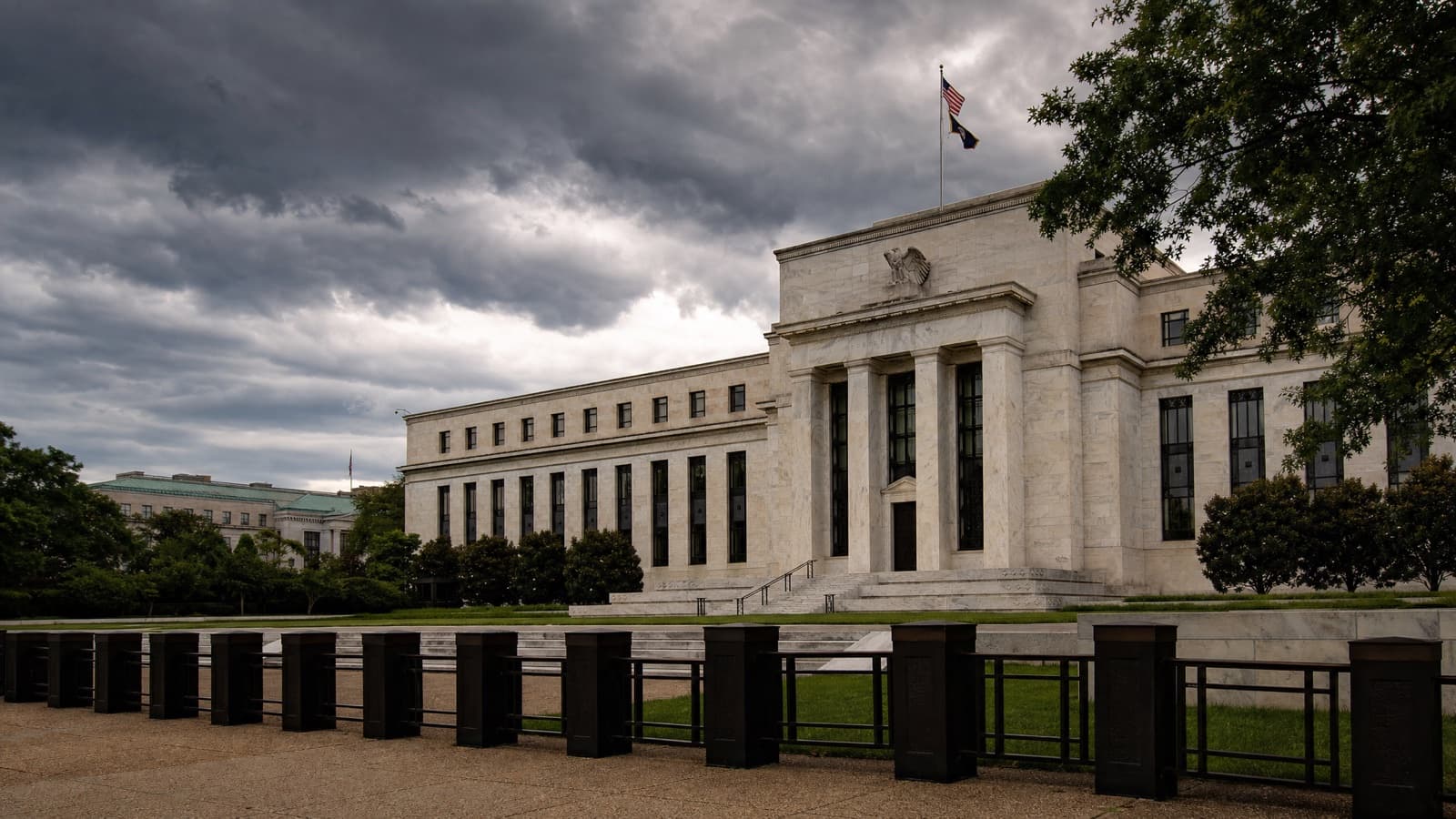
The Federal Reserve on Wednesday left interest rates unchanged for the fifth consecutive meeting, extending its pause at a range of 3.5% to 3.75%. The decision itself was expected. What wasn't: a fractured 9-3 vote that marked the most dissents with a unified direction since September 2016 — and sent prediction-market traders scrambling to reprice the September meeting.
Under the new leadership of Fed Chair Kevin Warsh, who has deliberately scrapped the forward guidance his predecessors relied on, this was always going to be one of the hardest Fed meetings in recent memory to call. Prediction markets — which aggregate trader expectations in real time — showed it. Going into the 2 p.m. ET announcement, forecasters on Kalshi and Polymarket were pricing roughly a 65% chance of a hold and a 35% chance of a surprise quarter-point hike. That is an unusually uncertain distribution for a Fed meeting, where the consensus is typically well above 90% by decision day.
The hold came in, as the majority expected. But the three dissenters changed the calculus for everything that follows.
The Three Hawks Who Voted for a Hike
Beth Hammack of the Cleveland Fed, Neel Kashkari of the Minneapolis Fed, and Lorie Logan of the Dallas Fed all voted to raise the federal funds rate by 25 basis points at Wednesday's meeting. The Fed's official post-meeting statement confirmed: the three "preferred to raise the target range for the federal funds rate by ¼ percentage point at this meeting."
That is not a minor footnote. Three unified hawkish dissents is the highest since September 2016 — nearly a decade ago. It signals that a sizable and vocal contingent within the FOMC believes the current rate level is not restrictive enough to finish the job on inflation.
"We're reading this as a Committee with vocal hawks, but the majority is siding with Warsh to keep rates stable until at least September when policymakers will have the benefit of the July and August CPI reports," wrote Ian Lyngen, head of U.S. rates at BMO Capital Markets, in a note following the decision.
Hammack and Logan are considered the committee's most hawkish voices. Kashkari, while hawkish, is seen as somewhat less extreme. What matters is that all three spoke with one voice: higher rates, now, not later.
Governor Christopher Waller, who had publicly flagged inflation concerns in the weeks ahead of the meeting, ultimately voted with the majority to hold — but his recent public statements make him a potential future defector if inflation data continues to run hot.
Warsh's "Family Fight" and What It Means
Kevin Warsh took office as Fed Chair on May 22, 2026, and this is only his second FOMC meeting. He has made a point of eliminating the kind of soft-signaling and forward guidance that defined the Powell era. No dot plots. No rate projections. No hints.
That change creates a genuinely novel situation: prediction markets become one of the best available tools for aggregating expectations about Fed policy, precisely because the Fed itself is saying less.
Warsh was asked at his press conference about the three dissents. His response was characteristically blunt: "I asked for a good family fight, and I got one. That's the designed feature."
He went on: "There was a lot of agreement that I heard that we have the powers, the tools, also the authority to deliver stable prices... There was nothing inertial about that discussion, it was an active, robust discussion about what's in the full range of what we can do and might want to do in the period ahead."
On the inflation timeline, Warsh refused to give a roadmap: "The path to central bank heaven requires delivering on our remit. These days, that means delivering on price stability. I wouldn't measure that path on 42 days or any one particular meeting."
In other words: no guidance. No pre-commitment. The data will decide.
Why Prediction Markets Were More Uncertain Than Usual
The unusual ~35% hike probability going into Wednesday's decision is worth unpacking, because it reveals something important about how prediction markets function in a low-guidance environment.
Under Jerome Powell, the Fed typically telegraphed its next move weeks in advance through speeches, interviews, and the carefully calibrated language of the post-meeting statement. By decision day, markets had near-perfect information. The CME FedWatch probability for the correct outcome was usually above 95%.
Warsh changed that. With no forward guidance, traders had to price the meeting based on raw macro data — persistent inflation above 2%, rising energy prices from the Iran conflict, a surprisingly firm labor market — and the explicit hawkish signaling from three regional presidents. That created a 35/65 split rather than the typical 5/95.
"This week brings an FOMC meeting with one of the most uncertain outcomes in recent history," Jeffrey Palma, head of multi-asset and macro research at Cohen & Steers, wrote ahead of the decision. He was right.
The post-decision move in equities was swift: the Dow Jones Industrial Average fell 741 points (1.4%). The S&P 500 declined 0.3% and the Nasdaq slipped 0.1%. The market didn't react to the hold — it reacted to the three dissenters, and what they imply about September.
What the September Market Is Pricing Now
Live price — will the Fed raise rates at September 2026 meeting?
Before Wednesday's meeting, markets had already begun pricing in a high probability of a rate hike at the September 15-16 meeting. According to CME FedWatch data cited by multiple wire services, those odds stood at approximately 79.4% for September, climbing to 85.8% for October and 90.6% by December.
The three hawkish dissents in July do not guarantee a September hike — the majority still voted to hold, and two months of CPI and employment data will shape the September decision. But they meaningfully shift the burden of proof. The committee is not collectively willing to wait indefinitely.
As QZ noted, citing CNBC reporting: "Broad expectation in markets that the Fed will move to raise rates at its September meeting."
For prediction-market traders, the next two months are about watching three things:
-
July and August CPI reports — If core inflation remains sticky or re-accelerates, the September hike becomes a near-certainty. If June's negative monthly core reading is sustained, the hawks may stay in minority.
-
Warsh's Jackson Hole speech (August) — The Fed Chair acknowledged at his press conference that he hadn't started thinking about his Jackson Hole address, but acknowledged the historical weight of those speeches. A hawkish Jackson Hole is the clearest pre-September signal available.
-
Iran conflict and energy prices — The FOMC statement cited "supply shocks" from the conflict in the Middle East as a key driver of above-target inflation. Any escalation or de-escalation in the Strait of Hormuz would move energy markets and, with them, the Fed's calculus.
How to Trade the September Fed Market on Prediction Markets
PredictionMarkets.US aggregates live odds from Kalshi and Polymarket on major macro events, including Federal Reserve rate decisions. As of Wednesday afternoon, the September meeting is actively traded on both platforms — with significantly higher volumes than a typical summer meeting.
Kalshi, which holds a CFTC license as a designated contract market, offers markets on both the direction of the July decision (now resolved) and on subsequent meetings. Polymarket's global platform carries similar contracts for international traders. The pre-decision divergence between platforms was minimal — both were aligned at roughly 65/35 in favor of a hold — which itself is a signal that the distribution of informed opinion was genuinely uncertain, not simply a case of thin liquidity.
For anyone watching the September 15-16 meeting, the key Kalshi and Polymarket contracts to track are:
- Will the Fed raise rates at the September 2026 meeting?
- Will the Fed raise rates at least once in 2026?
- End-of-year federal funds rate level
These contracts update in real time as inflation data, Fed speeches, and geopolitical developments shift the probability distribution.
The Warsh Effect on Prediction Markets
Warsh's elimination of forward guidance is, counterintuitively, good for prediction market engagement. When the Fed tells you what it's going to do, there's nothing to bet on. When it doesn't — as in this meeting — the contract becomes genuinely valuable as a price-discovery mechanism.
Wall Street is already adapting. CNBC reported that F/m Investments has rolled out "WarshGPT," an AI tool designed to help analysts parse Warsh's communication style for policy signals. UBS sent clients a note analyzing the relevance of Warsh's first press conference comments to future policy. The industry is working around the information gap.
Prediction markets are doing the same thing — aggregating dispersed information from thousands of traders who are reading the same macro data, the same Fed speeches, the same oil-price moves, and arriving at a collective probability. The July meeting showed that the aggregate was broadly right (65% hold won), but the uncertainty was real and the three-dissenter outcome is now priced into September.
The next major data points are July CPI (expected mid-August) and the Jackson Hole conference in late August. Both will move the September probability materially. Track it in real time at PredictionMarkets.US.
FAQ
Q: Why did the Fed hold if inflation is still above 2%? The majority of the FOMC believes the current rate level (3.5%-3.75%) is restrictive enough to bring inflation down without a hike, at least for now. The inflation above 2% is partly attributed to supply-side shocks — energy prices driven by the Iran conflict — rather than demand-side overheating, which rate hikes are best suited to address. The three dissenters disagree with that assessment and believe modestly higher rates are warranted now.
Q: What is Kevin Warsh's track record as Fed Chair? Warsh took office on May 22, 2026. This is only his second FOMC meeting. He previously served as a Fed Governor from 2006 to 2011. His most distinctive early policy move has been eliminating forward guidance — the practice of signaling upcoming rate decisions through speeches and statement language.
Q: When is the next Fed meeting? The next FOMC meeting is scheduled for September 15-16, 2026. That meeting will have the benefit of two additional CPI reports and the Jackson Hole conference. Prediction markets currently price approximately a 79% probability of a rate hike at that meeting.
Q: Where can I track Fed rate probabilities in real time? PredictionMarkets.US aggregates live Kalshi and Polymarket odds on all major upcoming Fed decisions. The Fed rate hike markets update continuously as economic data comes in.
Q: What does a September rate hike mean for everyday borrowers? A 25-basis-point hike would raise the federal funds rate from 3.5%-3.75% to 3.75%-4.0%. This would translate to higher rates on variable-rate mortgages, home equity lines of credit, auto loans, and credit cards. Fixed-rate mortgages move with Treasury yields, which often price in Fed expectations well in advance.
Sources & Verification
- Fed holds at 3.5%-3.75%, 9-3 vote, three dissenters (Hammack, Kashkari, Logan) preferred 25bp hike: Federal Reserve official FOMC statement, July 29, 2026
- "Vocal hawks" BMO Capital Markets quote: CNBC, July 29, 2026
- "Most uncertain outcomes in recent history" Jeffrey Palma/Cohen & Steers: CNN live updates, July 29, 2026
- First time since September 2016 for three unified hawkish dissents: CNBC, July 29, 2026
- Warsh "family fight" and "path to central bank heaven" press conference quotes: Fox Business, July 29, 2026
- S&P 500 -0.3%, Dow -741 points, Nasdaq -0.1% post-decision market reaction: CNBCTV18, July 29, 2026
- September hike probability ~79.4%, CME FedWatch data: ET Now, July 29, 2026
- Fed holds rates 5th consecutive meeting: CNN, July 29, 2026
- WarshGPT and UBS client note: CNBC, July 29, 2026
- Warsh took office May 22, 2026, 4-year term: ET Now News, July 29, 2026
- Broad expectation of September hike: QZ, July 29, 2026