
Election Officials Are Preparing for Prediction Markets in the 2026 Midterms
With the midterms 80 days out, election officials are requiring staff oaths, studying insider trading risks, and watching prediction markets closely.
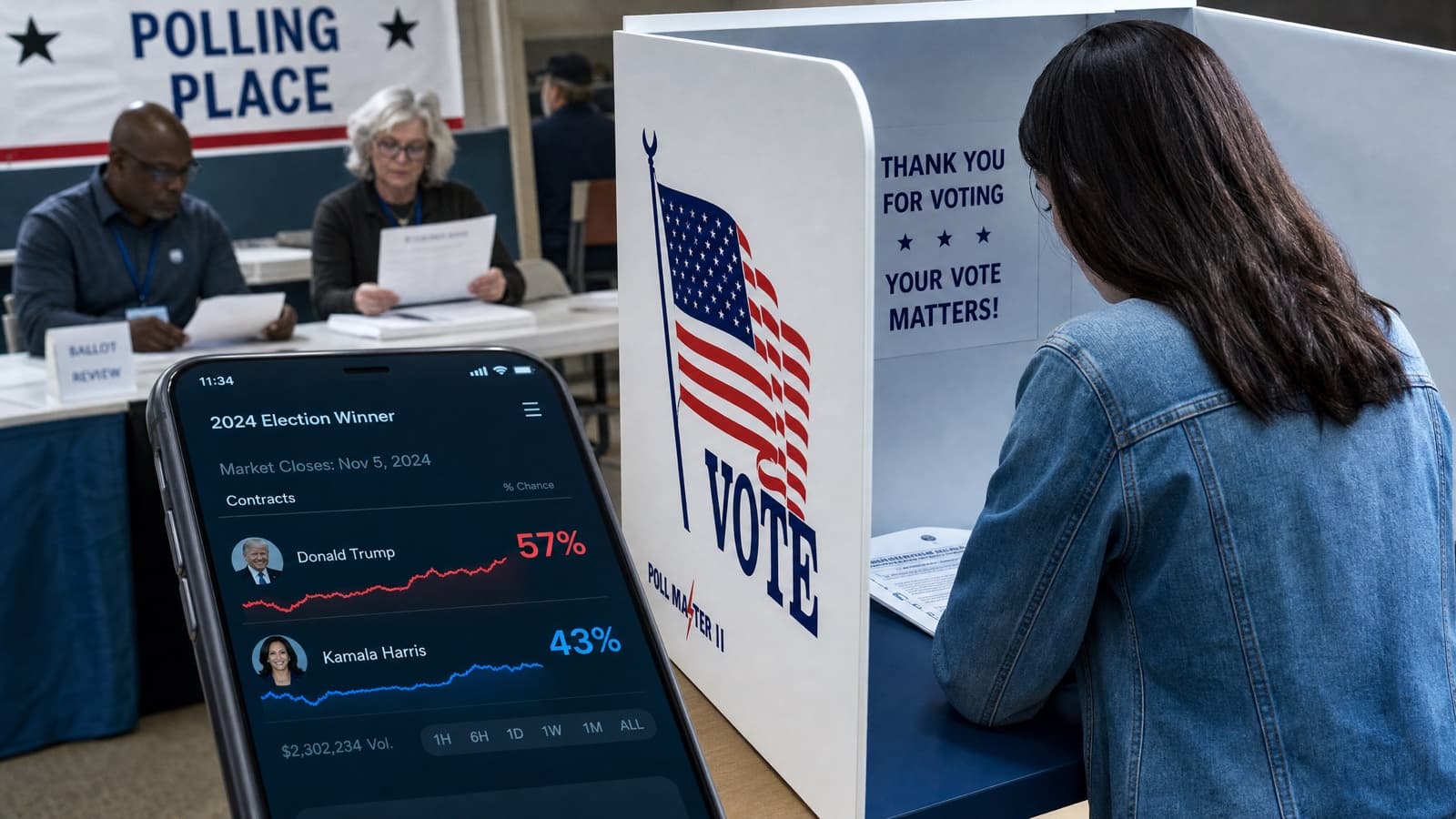
With less than 100 days until the 2026 midterm elections, America's election administrators are dealing with a challenge that did not exist in prior cycles: prediction markets that trade continuously on the outcomes of the very elections they help run.
A WIRED investigation published Monday, based on interviews with election officials across the country, found that administrators from Delaware County, Pennsylvania, to Los Angeles County have begun writing new staff oath requirements, tightening internal policies, and building surveillance systems specifically designed to address risks posed by prediction markets. The measures represent the most organized official response to prediction market election trading since the industry gained federal regulatory approval.
"This is our first real, full election cycle for national elections where prediction markets have been fully unleashed," Amanda Fischer, a former SEC official who now directs policy for the financial reform nonprofit Better Markets, told WIRED.
A Market Now Trading at Scale
The scale of election trading has grown considerably since the 2024 presidential cycle. An NBC News analysis found nearly $200 million in trading volume on midterm election outcomes on Kalshi and Polymarket combined -- numbers that did not exist two years ago, when prediction markets were a niche product.
As of Monday, Democrats hold approximately an 85 to 88 percent probability of taking control of the U.S. House on both Kalshi and Polymarket, according to their public odds pages. Senate control markets show a similarly lopsided picture. Both platforms operate dedicated midterm election hubs where users can trade on hundreds of individual races.
Kalshi is a CFTC-regulated Designated Contract Market founded in 2018. Polymarket's U.S. exchange, operated by QCX LLC (a CFTC-licensed Designated Contract Market acquired by Polymarket in July 2025), relaunched for U.S. users in December 2025 and currently offers sports markets, with election and other categories available to non-U.S. users on the global platform.
The Wisconsin Warning
The August 12 Wisconsin Democratic gubernatorial primary offered a concrete example of the mismatch that has election officials worried. Both Kalshi and Polymarket had state representative Francesca Hong as the likely winner in the race going into primary night, according to CNBC reporting. Instead, she lost to Milwaukee County Executive David Crowley by less than one percentage point as late-counted votes shifted the result.
Live market view -- track House and Senate control odds yourself:
The miss came one week after prediction markets also overestimated progressive candidates in the Michigan U.S. Senate Democratic primary. The two consecutive errors generated widespread coverage about prediction market accuracy, though market defenders noted that a market assigning low probability to an outcome is not the same as saying that outcome is impossible.
"Before the 'prediction markets got it wrong' headlines roll in: a 5 percent probability doesn't mean it won't happen. It means it should happen 1 in 20 times. If 5 percent candidates never won, the markets would be broken," Kalshi co-founder Tarek Mansour wrote on X after the Wisconsin result.
Still, officials expressed concern about what happens when voters interpret market odds as certainty rather than probability. A survey conducted by the Partnership for Large Election Jurisdictions found that 75 percent of respondents were unable to correctly say what prediction market odds represent, with 35 percent claiming they were either counted votes or official projections from state officials.
"What happens when there's a difference between what the prediction markets show and what the certified results show?" Amy Cohen, executive director of the National Association of State Election Directors, told WIRED. "That's hard, because you're combining two topics that the general public doesn't have a great understanding of, which is elections and prediction markets."
Oaths, Bans, and Internal Policies
The most concrete responses have come in the form of new restrictions on election workers.
In Delaware County, Pennsylvania, elections director Richard Allen and the county board of elections amended the oaths signed by people involved in elections to include an affirmation that workers have no direct or indirect interest in any bets, wagers, or prediction markets. Roughly 2,500 people -- from full-time staff to temporary ballot-processing workers -- signed the new language ahead of November, according to WIRED.
"The rapid growth of prediction markets, and their plans to prey on elections, are direct threats to undermining trust in electoral outcomes," Allen told WIRED.
In Arizona, Secretary of State Adrian Fontes banned his staff in July from using nonpublic information to place bets on elections on prediction markets. Maryland elections administrator Jared DeMarinis told WIRED his office was also considering requiring similar declarations. Cook County, Illinois clerk Monica Gordon said her office was "reinforcing internal policies to ensure that non-public information, particularly information related to election administration, is never used or shared by staff for personal gain or unauthorized purposes."
The concerns about election workers extend beyond insider trading. Dean Logan, county clerk for Los Angeles County, said at a Partnership for Large Election Jurisdictions webinar that prediction markets "fed a lot of the volatility in the aftermath of the June election," a reference to the Los Angeles mayoral race in which a heavily favored candidate lost. Logan told WIRED that election officials see risk when people place too much confidence in market odds and then become angry when results differ.
The Wisconsin Elections Commission took a broader step, warning voters in July that state law means they "cannot, even indirectly, make a bet or wager on the outcome of an election and then vote in that same election." A Kalshi employee on X described the move as "active voter suppression." Election officials in the state said they had seen aggression from observers with a financial stake in outcomes, though they did not detail specific incidents.
The Insider Trading Problem
The concern that resonates most with regulators and officials is insider trading. Election officials and their staff often have access to preliminary results, equipment status updates, or other nonpublic information hours before public release. The question of whether any of that information could flow into prediction markets -- intentionally or otherwise -- has prompted both official and private responses.
"Prediction markets lead to possible manipulation or even insider trading," DeMarinis told WIRED. "The threat grows as these sites become increasingly popular and legitimatized by the media in lieu of polling."
Live market view -- follow Senate control odds:
It is already illegal to trade on nonpublic information in CFTC-regulated prediction markets. Platforms also maintain their own internal rules. Kalshi spokesperson Jack Such told WIRED the platform keeps "a broad list of people that are not allowed to be in the markets, where if you're a donor, a staffer, a family member of staffers, and many more, you're not allowed in the markets." In the past year, Kalshi reported a number of market manipulation and insider trading cases to the CFTC, including a Senate candidate who later claimed he bet on himself deliberately.
Polymarket hired Shana Bautista, a former FBI official who also worked at Coinbase, as its global head of investigations and intelligence. The company told WIRED it has increased the size of its team monitoring elections ahead of the midterms.
The CFTC itself is monitoring election markets, though without a dedicated midterm surveillance program. "The CFTC is extensively monitoring election markets, just like all other markets, for manipulation, fraud, or insider trading," spokesperson Brooke Nethercott told WIRED.
PredictIt, the original U.S. election prediction market that has operated since 2014 under a CFTC no-action letter, maintains a different approach: it caps individual position sizes at $3,500 per race -- a structural limit that its competitors do not apply. "Unlike Kalshi and Polymarket, PredictIt caps individual positions," PredictIt public relations director Toni Galeassi told WIRED. "As prediction markets grow, we believe responsible market design, including appropriate limits and clear communication about what market probabilities represent, are important."
Can Markets Self-Correct?
Defenders of prediction markets argue that manipulation is much harder to sustain than critics suggest. When an actor with a financial interest tries to push odds in a direction unsupported by actual information, other traders recognize the opportunity to profit by correcting the mispricing.
"They sound like valid concerns, but I just don't think that they hold up to much scrutiny," prominent prediction market trader Caleb Davies told WIRED. He described a scenario where someone attempts to inflate an underdog's odds: "A smart trader is going to see that and then drive them right back to being an underdog almost immediately and just make the profits from it -- it's not a wise strategy."
The Spencer Pratt example from the Los Angeles mayoral race offered a real-world test of this theory. Someone placed a large bet on the reality television personality to win the race, out of proportion to how he was polling. The skewed odds lasted nine seconds before other traders corrected the position, according to a Kalshi case study cited in WIRED.
That example also illustrates the limits of the self-correction argument: high-volume markets like the Los Angeles mayoral race with many active traders do correct quickly. But Texas-based election law attorney Andrew Cates told WIRED that smaller markets -- some House races currently have only a few thousand dollars wagered -- have fewer counterparties to push back. "Anybody could place a big bet on a race and skew at least the perception of the odds of that person winning," he said.
Both Kalshi and Polymarket told WIRED they will not allow markets about whether there will be unrest at the polls. Kalshi also told WIRED it has developed surveillance software that "preemptively blocks certain prohibited traders -- rather than just enforcing retroactively -- for all political markets." Polymarket spokesperson Annabel Walsh pointed to the platform's market correction track record.
Some critics want structural changes that go further than current voluntary policies. Alexandra Thornton, senior director for financial regulation at the Center for American Progress, told WIRED that all federal government employees "at any level, any part of the federal government, and the military, should be banned from using prediction markets at all."
Frequently Asked Questions
Is it legal to trade on election prediction markets in the U.S.? Trading on election prediction markets through CFTC-regulated platforms like Kalshi is legal in most U.S. states, though state-level legal challenges are ongoing in several jurisdictions. Polymarket's global platform is available internationally; the U.S. platform via QCX LLC currently offers sports markets to American users, with election markets available on the global version to non-U.S. traders. Check each platform's current state availability before trading.
Can prediction market odds predict election outcomes? Prediction market odds represent the collective judgment of traders, not a guarantee of outcomes. As the Wisconsin and Michigan primaries showed in August 2026, markets can miss significantly when polling is scarce, partisan data dominates, or candidate dynamics shift. A 5 percent probability means an outcome should happen roughly 1 in 20 times -- it does not mean the outcome is impossible. Officials are particularly concerned that many voters misread odds as vote counts or official projections.
How do prediction markets prevent insider trading? Both Kalshi and Polymarket maintain lists of restricted participants, including candidates, campaign staffers, donors, and family members. Kalshi reports suspected insider trading cases to the CFTC. Polymarket added a former FBI official as global head of investigations. The CFTC monitors election markets for manipulation and insider trading alongside all other markets it oversees. PredictIt limits individual positions to $3,500 per race as an additional structural safeguard.
What are election officials doing about prediction markets? Officials are taking varied approaches: Delaware County, Pennsylvania amended worker oaths to require no prediction market interests; Arizona banned staff from using nonpublic information for trading; and Wisconsin warned that state law may bar voters from both voting and betting on the same race. The Partnership for Large Election Jurisdictions is tracking public understanding of prediction market odds and found significant confusion among surveyed respondents.
What happens when prediction markets get an election wrong? When markets are wrong, the primary immediate effect is financial losses for traders who bet on the losing side. Officials are more concerned about downstream effects: that people who placed losing bets become angry and direct that anger at election workers, or that public confusion about what odds represent leads to greater distrust of certified results when they differ from market expectations.
The Bottom Line
The 2026 midterms will mark the first major national election cycle in which CFTC-regulated prediction markets are fully operational at scale and accessible to the general public. Officials from Pennsylvania to California are writing rules they did not need in 2024. The platforms are adding investigators and surveillance tools. Whether the precautions are adequate -- and whether prediction markets ultimately clarify or muddy public understanding of election results -- will become clearer after November 4.
Explore current House, Senate, and individual race prediction market odds at predictionmarkets.us
Sources & Verification
- WIRED investigation (David Gilbert and Kate Knibbs, August 17, 2026): Election Officials Are Preparing for Prediction Markets to Sow Chaos in the Midterms
- CNBC (Garrett Downs and Davis Giangiulio, August 13, 2026): Wisconsin, Michigan primaries expose limits of polls and prediction markets
- Votebeat (Carrie Levine, August 10, 2026): Prediction markets place odds on election results. Officials say they could erode public trust.
- Los Angeles Times (August 12, 2026): As Americans bet on elections, L.A. officials weigh how to safeguard voters
- CNN (August 12, 2026): What a safe-bet candidate's loss means for Democrats' odds in November
- Wisconsin Elections Commission advisory on election betting (cited in WIRED and Votebeat): Wisconsin Elections Commission
- CFTC on prediction market regulation: CFTC.gov
- Kalshi CFTC DCM designation: CFTC Press Release 8302-20
- QCX LLC (Polymarket US) CFTC amended DCM order, November 25, 2025: CFTC Polymarket US Amended Order