
DraftKings Down 51%, Robinhood Rising: What Wall Street’s Bet Tells Us About Prediction Markets
DraftKings hit a 52-week low while Robinhood climbs. The same prediction-market catalyst produced opposite stock moves. Here's what that tells traders.
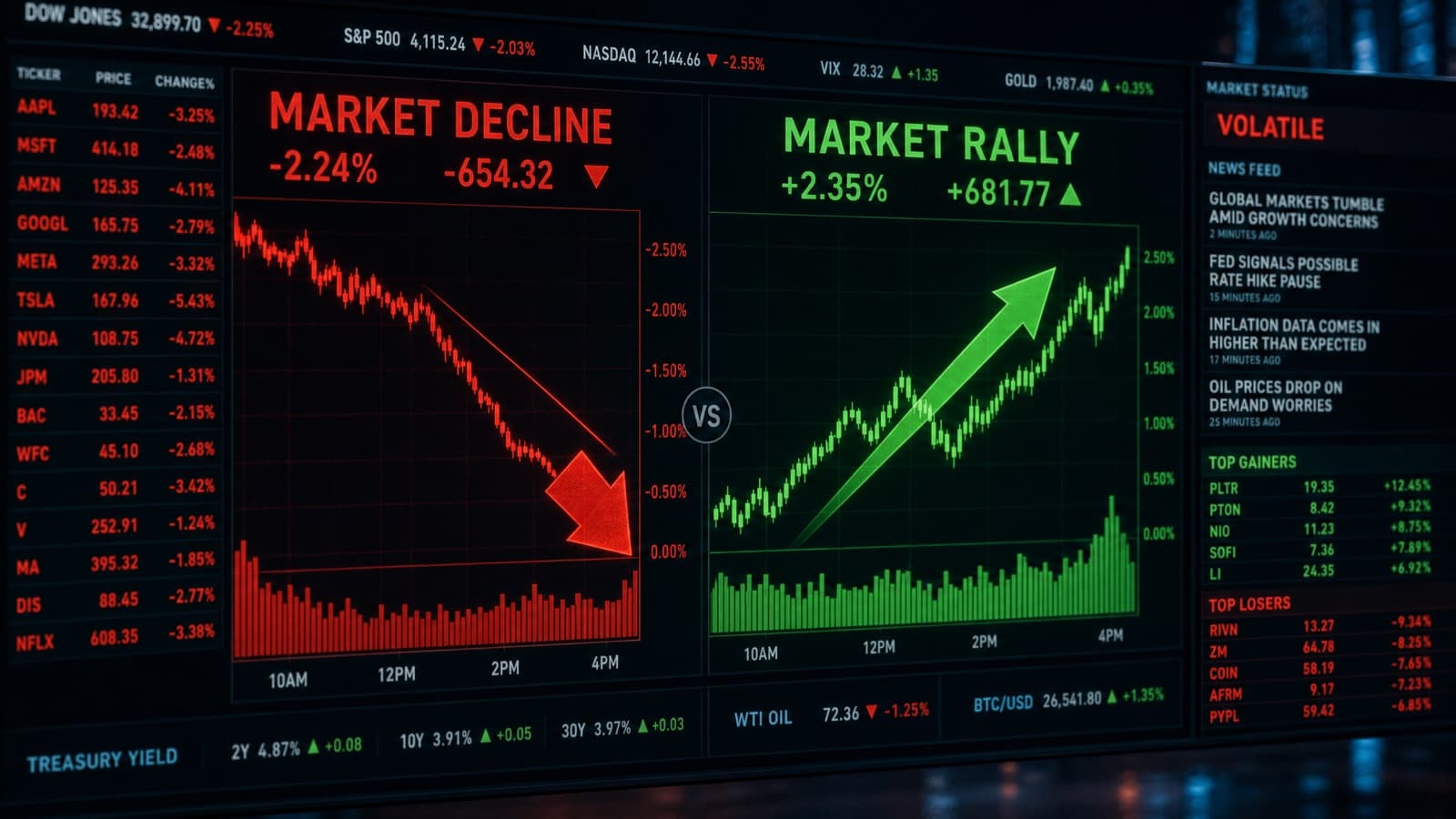
Wall Street has been keeping score in the prediction market wars — and the results are unambiguous. DraftKings (NASDAQ: DKNG) touched a new 52-week low of $20.43 on September 25, 2026, a stock that was trading above $44 just twelve months ago. At the same moment, Robinhood Markets (NASDAQ: HOOD), which also offers prediction-market contracts, is holding firm. Both companies are in the same category. The market is treating them like they’re in different businesses.
The divergence crystallized on September 23, when DraftKings CEO Jason Robins disclosed plans to pull forward marketing spending on the company’s prediction-markets product. DraftKings shares fell 4% to $20.92. Flutter Entertainment (NYSE: FLUT), parent of FanDuel, slipped 1% on the same concern. Robinhood ticked up 0.8% on the identical catalyst. The trading signal was instant and clear: investors reward platforms that already own the prediction-market customer, and punish those paying top dollar to acquire one.
The Math Behind the Split
Why would the same news read so differently across tickers? The answer is customer acquisition cost.
DraftKings built its empire by spending aggressively to attract sportsbook customers — a model that works at scale but generates thin margins and requires constant reinvestment. Now the company is applying that same playbook to prediction markets, signaling it will spend “meaningfully more” in the second half of 2026. CEO Robins cited approximately 1 million prediction-market customers and annualized volume that grew from $2.3 billion to $11 billion in three months as early proof points.
The problem is that investors heard “margin compression.” In prediction markets, DraftKings is fighting Kalshi, Polymarket, and Robinhood — all of which either have lower acquisition costs or a structurally different competitive position. Robinhood’s edge is structural: its existing brokerage users can activate prediction-market features inside an app they already use, at near-zero marginal acquisition cost. That is a fundamentally different unit economics story than marketing a brand-new exchange to fresh customers.
“The Wednesday split separates who pays to acquire the prediction-market customer from who already has that customer arriving through an existing brokerage app,” Yahoo Finance reported on September 23. Robinhood stock trading higher while DraftKings falls on the same catalyst — that is the allocation call in action.
The Needham Data That Spooked Investors
The acquisition-cost story has a competitive backdrop that makes it more urgent. Investment bank Needham released NFL Week One prediction-market volume data that landed hard on DraftKings stock: Kalshi captured 76% of all sports prediction-market volume in the NFL’s opening week. DraftKings’ own exchange, DKeX, claimed approximately 3%.
Even on a consumer-adjusted basis — stripping out professional trading that can inflate exchange-level counts — Needham’s figures put Kalshi at 67%. DKeX held near 3% under either measure.
For context, DKeX launched June 26, 2026. It is, literally, in its first football season. That matters for anyone assessing the long-term trajectory. But for a stock already down 38% year-to-date and trading near 52-week lows, the short-term optics are severe.
Price competition adds another layer. Data from Citizens Financial Group found Kalshi’s implied vig — the platform’s effective profit margin per contract — was 4.32% during NFL Week One. DraftKings came in at 4.51%, FanDuel at 4.44%. Kalshi is undercutting the sportsbook operators on cost, reversing a competitive dynamic from a year ago.
DraftKings shares were down approximately 38% year-to-date through September 25, 2026, and down more than 50% over the trailing twelve months. The 52-week range stretches from $20.35 to $44.22.
The Behavioral Shift Driving the Numbers
The stock market reaction doesn’t exist in a vacuum. It is responding to documented consumer behavior.
A September 2026 survey from behavioral analytics firm Fullstory, conducted with more than 1,000 U.S. consumers, found that 60% of bettors say prediction markets have changed how often they use traditional sportsbooks. More telling: 35% say they are actively using sportsbooks less because of prediction markets, Fortune reported on September 25.
The consumer reasons cited are not primarily about odds or payouts. Trust and reputation (60%) and ease of use (59%) outranked potential payouts or odds (51%) as the top reasons people select a platform, per Fullstory’s survey. Seventy-seven percent of respondents said they had switched gaming platforms entirely based on user experience alone.
“Our research suggests that prediction markets are changing betting behavior, with more types of events to predict, greater transparency around outcomes and pricing, and an easier or more intuitive experience as top reasons why consumers would consider a prediction market over a sportsbook,” said Jason Wolf, president of Fullstory. “That should be a wake-up call for traditional sportsbooks.”
The scale of the shift is significant at the systemic level. Americans legally wagered $166.94 billion on sports in 2025, generating $3.71 billion in state tax revenue, according to the American Gaming Association. The AGA estimates prediction markets have already diverted more than $500 million in potential sports-betting tax revenue away from states — money flowing through CFTC-regulated exchanges rather than state-licensed sportsbooks. Illinois attempted to claw back some of that revenue with a 15% tax on prediction-market sports contracts, but Kalshi sued, arguing the state has no authority over a federally regulated product. Similar legal fights are underway in Nevada, New Jersey, and Maryland.
Prediction market volume itself has been compounding rapidly. Pew Research reported in September 2026 that combined trading volume on leading prediction-market platforms more than doubled between May and July, with sports contracts accounting for much of the growth.
Analysts: Still Mostly Bullish on DraftKings, but Not Unanimously
Despite the price action, Wall Street’s analyst consensus on DraftKings remains constructive, for now.
Citizens JMP cut its price target on DraftKings from $37 to $35 on September 24, maintaining a Market Outperform rating. The firm’s new target implies roughly 65% upside from the stock’s prior close. UBS maintained its Buy rating with a $48 price target. StoneX reiterated a Buy with a $30 target. The average analyst consensus price target sits near $34.29, reflecting a Moderate Buy rating across 41 analyst ratings, according to MarketBeat.
The bull case rests on a few key arguments. DKeX is only months old: a single week of NFL data is not a representative sample of where market share settles once the exchange matures. DraftKings has a licensed sportsbook footprint across 48 states that could prove competitively advantageous if courts ultimately classify prediction markets as gambling — a ruling that would hand licensed operators a structural edge. CEO Robins has said DraftKings is “positioned to do well however the rules land.” Analysts are also forecasting earnings growth of more than 146% in the next 12 months.
The bear case is more immediate: Kalshi took 76% of NFL Week One volume in prediction markets’ highest-profile week. DKeX claims one football season to prove it can close the gap. Front-loaded marketing spend creates near-term EBITDA risk. And the regulatory landscape, which Robins himself acknowledged is “outside the company’s control,” could cut either way.
The Robinhood Model vs. the DraftKings Model
The Robinhood and DraftKings contrast illuminates two fundamentally different approaches to prediction-market distribution.
Robinhood offers event contracts through a partnership with Kalshi. Its prediction-market customers are largely existing Robinhood brokerage users who activated the feature — not externally marketed acquisitions. The company does not need to spend aggressively to build its prediction-market base, because the customer is already inside its ecosystem. That is why HOOD stock moved higher on the same September 23 news that punished DKNG: markets read Robinhood’s model as asset-light expansion and DraftKings’ as margin-dilutive acquisition.
DraftKings is building DKeX as a standalone exchange under GUS III LLC d/b/a DraftKings Predictions, its NFA-registered futures commission merchant. The exchange operates through the Railbird designated contract market, which launched June 26, 2026, giving DKeX access to a full CFTC-regulated infrastructure. The regulatory foundation is legitimate. The question investors are wrestling with is whether DraftKings can close the volume gap against Kalshi’s first-mover position before acquisition spending becomes unsustainable.
The historical parallel Fortune draws is pointed: DraftKings and FanDuel built daily fantasy sports by exploiting a regulatory gray zone — the skill-game exception in the 2006 Unlawful Internet Gambling Enforcement Act — in ways Congress never envisioned. Now they face an industry doing the same thing to them, arguing “commodities futures, not gambling” the same way DraftKings once argued “skill, not chance.”
What to Watch
Three variables will define the next chapter of this trade.
NFL market-share data from later weeks. Needham’s Week One figures established a baseline. If DKeX shows consistent share growth over the season, the acquisition thesis strengthens. If Kalshi’s lead holds or widens, the bearish case becomes harder to dismiss.
Regulatory outcomes. Courts in multiple states are determining whether CFTC-regulated exchanges are exempt from state gambling law. A federal ruling in prediction markets’ favor helps all PM operators including DKeX. A ruling that pushes the category under state gambling law could benefit DraftKings’ licensed footprint. The legal picture remains unsettled.
Margin trajectory. DraftKings maintained its 2026 revenue guidance of $6.5 to $6.9 billion and adjusted EBITDA guidance of $700 million to $900 million as prediction-market spending rises. Any guidance changes in Q3 earnings that reflect whether PM investment is compressing or improving margins will be the next key data point.
Prediction markets have moved from a regulatory footnote to a documented threat to the sportsbook industry — and Wall Street is already pricing the transition. Whether DraftKings leads that transition or gets disrupted by it is the question analysts are still trying to answer.
FAQ
Why is DraftKings stock falling in 2026?
DraftKings stock is down more than 50% over the past year, driven by concerns about prediction-market competition, increased marketing spending to build the DKeX exchange, and margin compression risk. Kalshi captured 76% of NFL Week One prediction-market volume while DKeX claimed roughly 3%, per Needham data, reinforcing investor concerns about the company’s competitive position.
What is DraftKings’ prediction-market exchange?
DraftKings operates the Railbird Exchange (DKeX), launched June 26, 2026. The exchange runs under GUS III LLC d/b/a DraftKings Predictions, an NFA-registered futures commission merchant, and is available in 48 states on a CFTC-regulated designated contract market basis.
Why is Robinhood stock doing better than DraftKings on prediction-market news?
Robinhood offers event contracts through Kalshi’s infrastructure and expands its prediction-market base at near-zero marginal cost from its existing brokerage user base. DraftKings is spending aggressively to acquire new PM customers for DKeX. The market rewards zero-marginal-cost distribution and punishes marketing-intensive acquisition.
How are prediction markets affecting sportsbooks?
A September 2026 survey by Fullstory found 60% of bettors say prediction markets have changed how often they use sportsbooks, and 35% say they use sportsbooks less as a result. The American Gaming Association estimates prediction markets have diverted more than $500 million in potential sports-betting tax revenue from states.
What are analysts’ price targets for DraftKings?
The consensus analyst price target is approximately $34.29 — roughly 62% above DraftKings’ current trading price near its 52-week lows. Most analysts maintain Buy or Outperform ratings, though Citizens JMP cut its target from $37 to $35 in late September 2026. Bulls cite DraftKings’ licensed state footprint and early DKeX growth; bears cite Kalshi’s dominant market-share lead and margin headwinds.
Sources & Verification
- 35% of bettors are leaving sportsbooks for prediction markets — Fortune, September 25, 2026 — verified September 25, 2026
- DraftKings drops 4%, Robinhood ticks up — Yahoo Finance, September 23, 2026 — verified September 25, 2026
- DraftKings falls 7.6% on Kalshi NFL Week 1 data — MarketBeat, September 24, 2026 — verified September 25, 2026
- DraftKings stock hits 52-week low — Investing.com, September 25, 2026 — verified September 25, 2026
- Citizens JMP cuts DraftKings price target — Investing.com, September 24, 2026 — verified September 25, 2026
- Prediction market trading volume doubled May–July — Pew Research, September 23, 2026 — verified September 25, 2026
- AGA commercial gaming revenue and sports-betting tax data — verified September 25, 2026