
How the Prediction Market Industry Is Lobbying to Open California — And What It Means for Traders
The Coalition for Prediction Markets hired AG Bonta's former chief of staff to lobby California. What $150K in new lobbying means for traders.
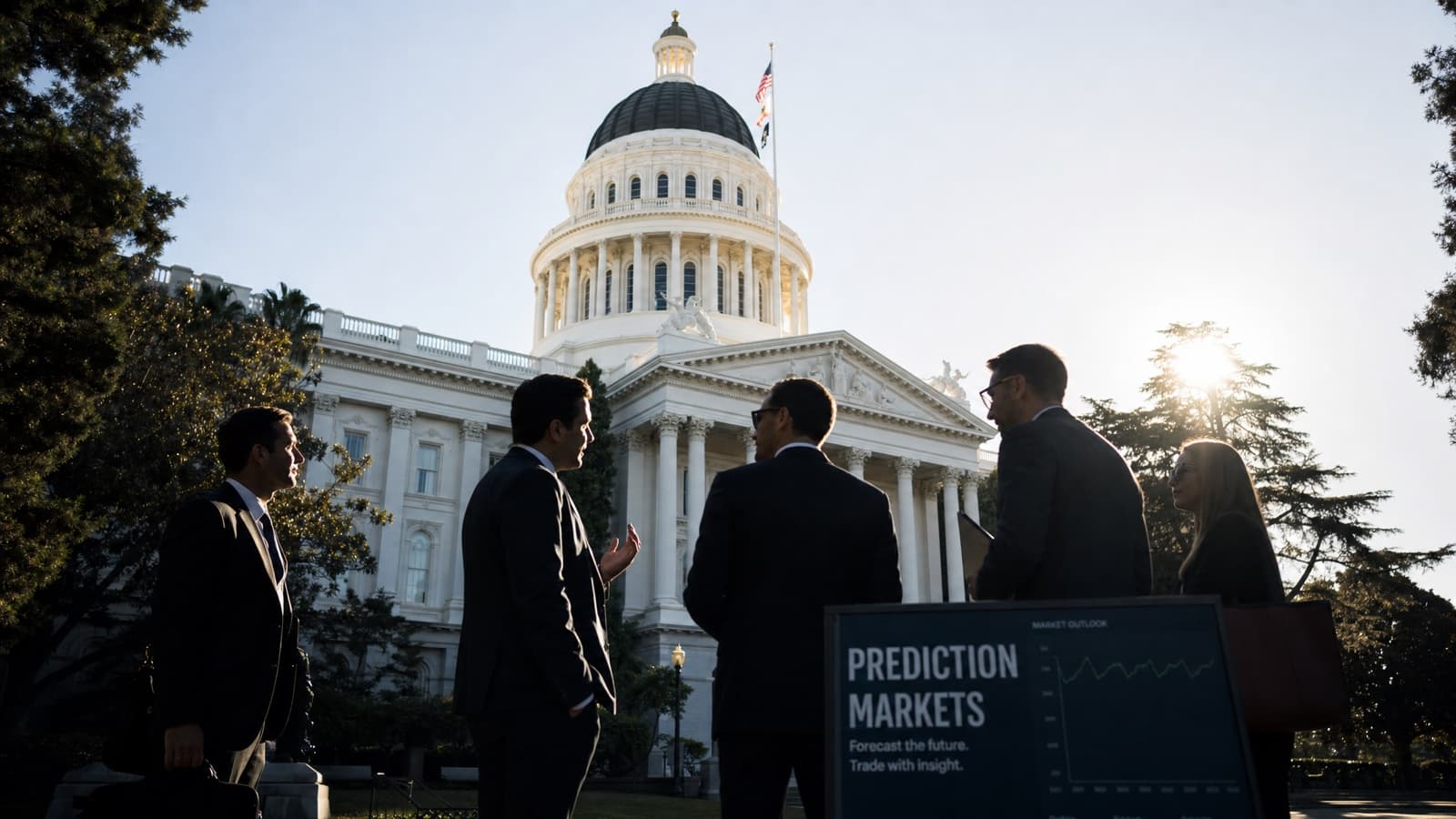
The prediction market industry made its boldest state-level political move yet: hiring Attorney General Rob Bonta's own former chief of staff to lobby the California government simultaneously at both state and federal levels. For the 40 million Californians who already have access to prediction markets — and the policymakers deciding their long-term future — this is the story behind the scenes that matters most.
The Coalition for Prediction Markets (CPM), an industry trade group founded in December 2025, quietly began spending in California earlier this year. According to government lobbying disclosures, the coalition paid $50,000 to Sacramento firm Redwood Public Affairs between April and July 2026 to lobby the offices of Governor Gavin Newsom and Attorney General Rob Bonta directly. Redwood was founded by Evan Corder, Bonta's former legislative director and chief of staff — a hire that signals the industry is playing political hardball in its biggest untapped state.
This is the first time the coalition has deployed lobbyists at the state level anywhere in the country. The move comes as the broader prediction market regulatory battle shifts from individual company lawsuits toward organized, industry-wide political strategy.
Why California Is the Biggest Prize in Prediction Markets
With approximately 40 million residents, California is not just the most populous US state — it's the single largest potential market expansion the prediction market industry could achieve anywhere in the country. To put it in perspective: opening California to unrestricted prediction market access would be worth more than any five other states combined.
The state is already accessible. Unlike Michigan, Nevada, and Washington, California has not moved aggressively to restrict prediction market platforms. Californians can currently use Kalshi, Polymarket's US app, and other CFTC-regulated platforms. But the industry isn't taking California's current quiet for granted — not with tribal interests and the state's attorney general both watching closely.
California banned traditional sports betting through two failed ballot measures (most recently Propositions 26 and 27 in 2022), leaving the state without a legal sportsbook framework. That political context makes prediction markets both an opportunity and a target: platforms operate under federal CFTC oversight rather than state gaming law, making the legal environment favorable — for now.
The state's Digital Financial Assets Law (DFAL), which began enforcement on July 1, 2026, adds another layer. The DFAL governs how crypto businesses operate in California and could intersect with prediction market platforms that settle contracts using stablecoins or blockchain infrastructure. The lobbying effort almost certainly addresses this dimension alongside the more prominent sports betting legal debate.
What the Coalition Is Actually Spending — and Where
The $50,000 California state-level spend is just one piece of CPM's growing political operation. The coalition also paid $100,000 to Washington advisory firm Invariant for federal lobbying in the second quarter of 2026. Invariant's work encompassed educating policymakers on prediction markets and event contracts, and monitoring proposals related to digital commerce, emerging technologies, and regulatory frameworks governing prediction markets. Going forward, the coalition will work with Determinant, an Invariant spin-off, for its federal lobbying services.
CPM members who benefit from these efforts include Kalshi, Crypto.com, Coinbase, Robinhood, and Underdog — a coalition that represents the majority of US-facing CFTC-regulated prediction market volume.
But the coalition's spending is modest compared to what individual member companies are running in parallel. Kalshi alone spent more than $1.7 million on federal lobbying in the first half of 2026, according to government filings — plus an additional roughly $60,000 in California through its own direct lobbying efforts. Kalshi employees have also contributed more than $1 million this election cycle to federal political campaign committees, and the company directed more than $100,000 to state election committees in California specifically.
The CPM's coordinated spend adds a strategic layer: unified messaging that no single company lobbying alone can achieve. Industry observers note that a trade group can frame the conversation around economic policy and market access rather than any single platform's legal troubles.
The Political Hire That Made Headlines
The decision to retain Evan Corder and Redwood Public Affairs is the most politically significant element of the California strategy. Corder served as AG Bonta's legislative director and chief of staff — roles that gave him direct insight into how California's top law enforcement officer approaches emerging regulatory questions.
Hiring the AG's own former top aide to lobby that same AG is an aggressive-but-legal Washington playbook that the prediction market industry has now exported to Sacramento. It signals that CPM isn't hoping California stays passive — it's actively trying to shape how Bonta's office responds if and when a state enforcement decision comes.
Attorney General Bonta has not filed suit against any prediction market platform. But California tribal groups have, arguing that prediction market sports contracts violate both the Indian Gaming Regulatory Act and California's sports betting ban. A federal judge denied the tribes' request for an emergency injunction against Kalshi in 2026, and the case remains active in the Ninth Circuit. California's two neighbors most deeply entrenched in litigation — Arizona and Nevada — both have active court battles with Kalshi that now touch the Ninth Circuit as well.
California has been slower than most states to go after prediction markets. The lobbying effort is designed, in part, to keep it that way.
Platform-by-Platform Odds Analysis: What's at Stake in California
Prediction markets that are currently accessible to California residents include:
Kalshi — CFTC Designated Contract Market (DCM) and Derivatives Clearing Organization (DCO). Offers the broadest category coverage including sports, politics, economics, and entertainment. Sports and all other market types currently available in California.
Polymarket US (QCX LLC) — CFTC-licensed exchange. Sports contracts only for US users. Available in California.
Robinhood — Operates via Kalshi infrastructure. Sports and other event contracts available in California.
Coinbase — Operates via Kalshi infrastructure. Available in California.
OG Predictions — Operates via Crypto.com CDNA infrastructure. Available in all 50 states including California.
None of these platforms currently face California-specific enforcement action. That status quo is what the lobbying campaign is designed to protect — or ideally, to convert into explicit regulatory clarity that opens the door to the full range of category and volume growth that would come with California's active endorsement.
The Opposition Spends Far More — But Not Just on This
The prediction market industry faces a well-funded opposition. Casino and traditional sportsbook trade groups — led by the American Gaming Association — contributed $1.7 million in federal lobbying in the first half of 2026, according to OpenSecrets. Combined, those interest groups are on pace to exceed $50 million in total federal lobbying spending this year.
However, that headline figure requires important context. Unlike prediction market firms, which are almost entirely focused on advancing their single regulatory argument — that the CFTC has exclusive jurisdiction over event contracts — the casino and gaming lobby is spread across dozens of issues: lower tax rates, state iGaming expansion, retail sports betting frameworks, tribal gaming protections, and more.
The prediction market industry is outgunned in raw dollars but potentially more focused in its political messaging. A $150,000 coordinated spend aimed directly at California's governor and AG, delivered by the AG's own former chief of staff, may punch above its weight class.
What Would California Opening Fully Mean?
Short answer: it would be transformative.
California represents approximately 12% of the US population. If the state were to issue explicit regulatory guidance favorable to prediction markets — or if a future state AG chose not to contest federal jurisdiction — the volume implications would be enormous. Kalshi and Polymarket's monthly trading volumes have already grown from approximately $5 billion globally in September 2025 to over $24 billion by April 2026, according to publicly reported data. California's full activation could accelerate that growth significantly.
For traders, a positive California outcome would likely mean better liquidity across the board, as more capital entered markets from the state's large, high-income population. It could also embolden the industry's legal arguments nationally: if the largest state effectively validates federal preemption by not enforcing state gaming laws against CFTC-regulated exchanges, it weakens the legal theory that states have concurrent authority.
For the industry, California is also a political symbol. A win here — even a quiet one — would be cited in every court brief, every Congressional hearing, and every media interview as evidence that prediction markets can coexist with state interests without gambling-law conflict.
FAQ
Are prediction markets currently legal in California? Yes. CFTC-regulated prediction market platforms including Kalshi and Polymarket's US app are currently available to California residents without state-level restrictions. California has not filed enforcement action against any prediction market operator, though California tribal groups have pursued separate federal litigation, which a district court rejected.
What is the Coalition for Prediction Markets? The Coalition for Prediction Markets (CPM) is a trade group founded in December 2025 that advocates for prediction market industry interests before federal and state policymakers. Its members include Kalshi, Crypto.com, Coinbase, Robinhood, and Underdog. The coalition coordinates lobbying, messaging, and policy education efforts across its member companies.
Why is California significant if prediction markets are already available there? Current availability reflects the absence of state enforcement action — not explicit legal protection. If California were to challenge prediction markets the way Nevada, Michigan, or Washington have, platforms could face the same restrictions those states imposed. The lobbying campaign is designed to prevent that outcome and ideally secure positive regulatory signals from the state's political leadership.
Who is Evan Corder and why does it matter? Evan Corder founded Redwood Public Affairs and previously served as Attorney General Rob Bonta's legislative director and chief of staff. His firm was retained by CPM to lobby Bonta's office and Governor Newsom's office directly. In state government, a former chief of staff to the AG has deep institutional knowledge of how the office makes enforcement decisions — making him a strategically significant hire for an industry hoping to avoid California becoming the next legal battleground.
Could California ban prediction markets? California law currently bans traditional sports betting, but CFTC-regulated prediction markets operate under federal law that platforms argue preempts state gaming statutes. Courts in other states have issued conflicting rulings on this preemption question. California has not moved to restrict platforms, but the active litigation in neighboring Arizona and Nevada, plus the California tribal lawsuit in the Ninth Circuit, make the state's long-term posture uncertain. The lobbying campaign reflects the industry's decision not to assume California's current quiet will last indefinitely.
Conclusion
The prediction market industry is making its most sophisticated state-level political play yet in California — and for good reason. With 40 million residents, favorable federal legal ground, and no current enforcement action, California represents the biggest untapped market expansion available anywhere in the country.
By hiring the state's own former top law enforcement official to lobby Governor Newsom and AG Bonta, the Coalition for Prediction Markets is playing a long game. The industry isn't just fighting lawsuits; it's trying to shape the political environment before those lawsuits ever get filed.
For traders already using Kalshi, Polymarket, Robinhood, or other platforms in California, the status quo remains: full access, no restrictions, CFTC oversight. The lobbying campaign is about keeping it that way — and possibly making it even better.
Track California prediction market availability and current odds across platforms at PredictionMarkets.us.
Sources
- Coalition for Prediction Markets lobbies California — Sportico, August 25, 2026
- Redwood Public Affairs — About Evan Corder
- OpenSecrets — Casino & Gambling federal lobbying 2026
- Nevada court extends Kalshi ban — Reuters, April 2026
- Michigan AG secures temporary halt on Kalshi — Michigan AG press release
- Washington state orders Kalshi to halt — Fox 13 Seattle
- California Prediction Markets legal status — CBS Sports, August 24, 2026
- Kalshi lobbying disclosures — Legis1, August 24, 2026
- CFTC Innovation Advisory Committee — Focus GN, August 24, 2026