
Connecticut Sues Kalshi for Unlicensed Sports Betting: Inside the State's Case
Connecticut sued Kalshi on August 26 for unlicensed sports betting, citing underage access, deceptive marketing, and absent consumer safeguards.
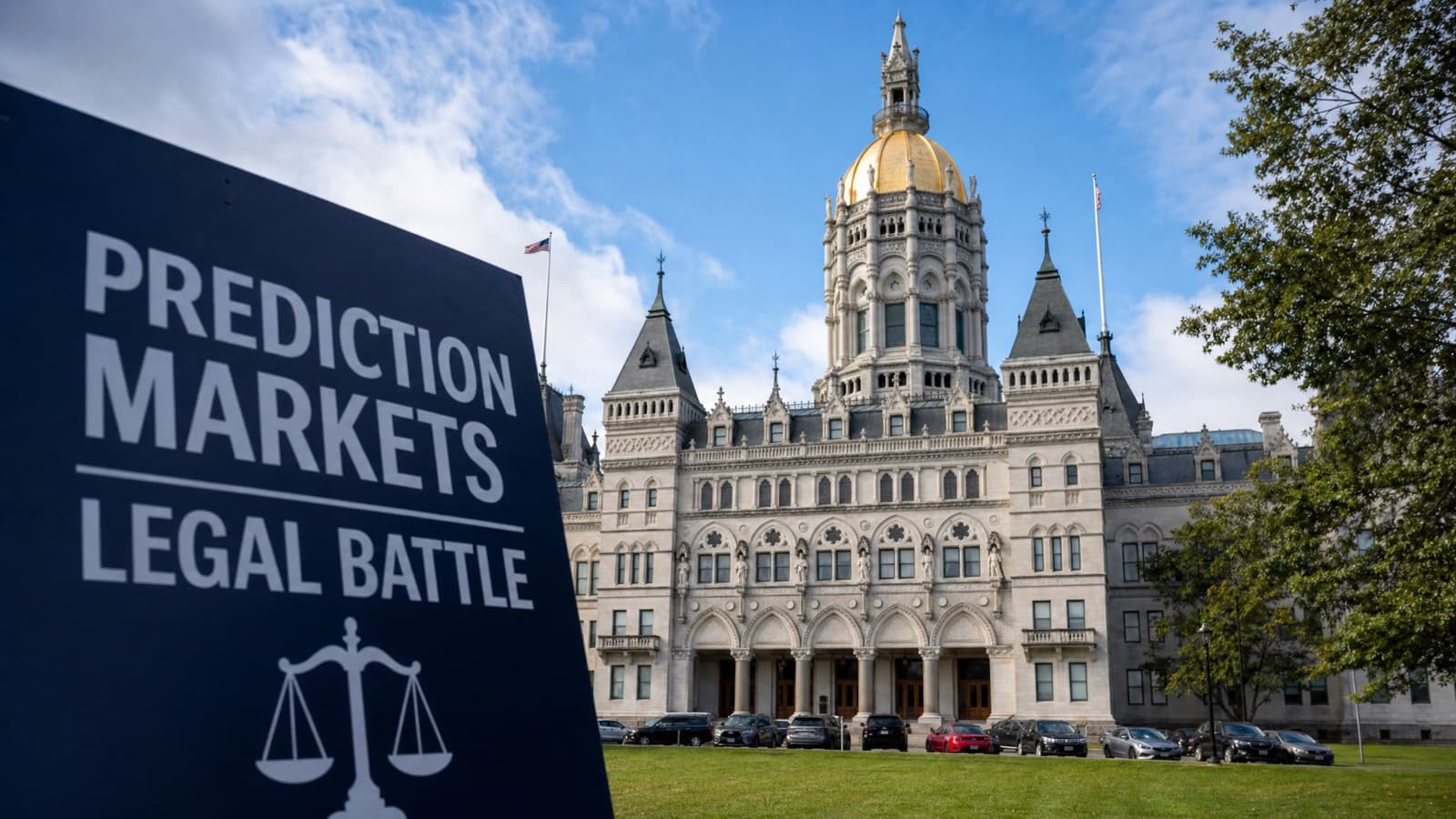
Connecticut has become the latest state to sue prediction market operator Kalshi, alleging the platform has run an unlicensed sports betting operation since early 2025. The complaint, filed August 26 in Hartford Superior Court by Attorney General William Tong, Department of Consumer Protection Commissioner Bryan T. Cafferelli, and Governor Ned Lamont, seeks a permanent court injunction, civil penalties, and the disgorgement of revenues Kalshi is alleged to have earned through unlawful activity in the state.
The lawsuit adds a new front to one of the fastest-moving regulatory battles in American finance. Kalshi, which operates as a CFTC-registered designated contract market and raised $1 billion at a $22 billion valuation in March 2026, has now drawn suits from roughly 20 states and produced a confirmed circuit split at the federal appellate level.
Why Connecticut Believes Kalshi Is Breaking the Law
Connecticut legalized online sports betting in 2021 through a framework deliberately structured to limit who can operate in the state. Only three entities hold sports wagering licenses: the Mashantucket Pequot Tribal Nation, the Mohegan Tribe, and the Connecticut Lottery Corporation. Those partners work through platforms like FanDuel and DraftKings. No prediction market has sought or obtained a license under this framework.
The state's complaint argues that Kalshi's sports event contracts—binary wagers on outcomes like which team will win, point spreads, season win totals, and individual player statistics—fall squarely within Connecticut's definition of sports betting. Federal regulatory status, the state argues, does not override that.
"Sports event contracts are no different than sports betting and are not magically shielded by federal law from Connecticut's commonsense consumer protection laws," said Attorney General Tong. "These laws exist for a reason—to protect minors, to prevent problem gambling, to ensure your money is safe and your personal information is protected. None of that is happening now on Kalshi, and we're suing to put a stop to it."
The lawsuit includes four counts under Connecticut gaming law and three violations of the Connecticut Unfair Trade Practices Act, covering illegal wagering, underage access, and deception.
The Consumer Protection Allegations
Beyond the licensing question, the complaint focuses on specific gaps between Kalshi's operation and the requirements Connecticut imposes on licensed sports betting operators.
Age restrictions. Connecticut requires sports bettors to be at least 21 years old. Kalshi's platform permitted users beginning at 18, the same minimum age required for most other financial products. The complaint alleges Kalshi marketed its products to younger users through paid online promoters and a college ambassador program that included Yale University.
UConn and Yale markets. The state alleges Kalshi offered contracts on games played by Connecticut colleges—including UConn and Yale—without the consumer protections Connecticut's licensed operators must provide.
Problem gambling controls. Licensed operators in Connecticut are required to maintain self-exclusion tools, deposit limits, and responsible gambling safeguards. Kalshi, operating under the theory that it is a federal commodities exchange rather than a gambling platform, did not apply the same controls.
Deceptive marketing. The complaint points to Kalshi's own promotional language. The company had advertised itself as "The First Nationwide Legal Sports Betting Platform" and claimed its platform was "legal in all 50 states." Connecticut argues those statements amount to consumer deception.
Governor Lamont put it plainly: "These prediction markets put Connecticut consumers, young people, our student athletes, and those suffering from gambling addiction at serious risk. They have made it clear their goal is profits over people, and that's why we are holding them accountable."
The Legal History in Connecticut
Wednesday's civil enforcement lawsuit was not Connecticut's first move. The Department of Consumer Protection's Gaming Division issued cease-and-desist orders in December 2025, directing Kalshi, Robinhood Derivatives, and Crypto.com to stop offering what the state called unlicensed online sports wagering.
Kalshi countered by suing Connecticut in federal court, seeking a preliminary injunction to block the state from enforcing its gaming laws. The company's argument follows a template it has used in nearly every state showdown: its contracts are "swaps" regulated exclusively by the federal Commodity Futures Trading Commission under the Commodity Exchange Act, and state gambling law is therefore preempted.
The federal argument failed in Connecticut. U.S. District Judge Vernon Oliver denied Kalshi's motion in early August, finding that the company's contracts are, "at bottom… sports wagers," and that Connecticut's statutes are not preempted by federal commodities law. Kalshi immediately filed an emergency appeal to the Second Circuit Court of Appeals.
Only after Oliver's denial did Connecticut file its August 26 enforcement suit—the complaint explicitly frames the federal court's decision as clearing the way for state action.
The CFTC Enters the Fight—On Both Sides
The federal regulator's role in this litigation has been unusual. While Kalshi holds a CFTC designation as a registered exchange, the CFTC has also filed its own lawsuit against Connecticut, Arizona, and Illinois, arguing that prediction markets listed on designated contract markets fall under the Commodity Exchange Act and cannot be banned by states simply because their outcomes involve sporting events. Connecticut has moved to dismiss the CFTC's case.
That posture places the CFTC in the position of defending Kalshi's business model in state courts even as Kalshi simultaneously loses those court battles. It is also why some legal analysts treat the prediction market fight as a genuine administrative law dispute—not merely a gambling-versus-finance definitional debate.
Kalshi's Response: Inconsistent Enforcement
Kalshi's head of litigation, Jovy Dedaj, posted a pointed response on X the night the lawsuit was filed.
"Connecticut just filed this lawsuit to shut down Kalshi immediately, but they're okay with other prediction markets operating there in the meantime," Dedaj wrote. "This is the latest in a line of arbitrary and inconsistent enforcement by the states, which shows this has nothing to do with consumer protection. If it did, the states would be seeking the same relief across the board. This unequal treatment is exactly why federal oversight is necessary."
The argument tracks a theme Kalshi has raised in multiple state cases: that regulators have selectively targeted Kalshi while allowing other platforms with similar offerings to continue without restriction. Connecticut has not publicly explained the difference in treatment.
A Pattern Across 20 States
Connecticut's lawsuit arrives at a moment when the national legal fight has reached an inflection point.
Senator Richard Blumenthal (D-CT) stated that Connecticut is one of approximately 20 states that have taken legal action against prediction market operators. A DLA Piper analysis from September 2026 found that states filing civil suits include Washington, Massachusetts, Michigan, and Nevada. Arizona has pursued criminal charges. Minnesota has sought to prohibit prediction markets entirely. Kalshi itself has countersued Nevada, New Jersey, Maryland, Ohio, New York, and Utah in efforts to block state enforcement.
At the appellate level, two federal circuit courts have now reached opposite conclusions on the core question:
- Third Circuit (KalshiEx v. Flaherty, April 2026): Sports event contracts are swaps. The Commodity Exchange Act preempts state gambling law. Kalshi wins.
- Ninth Circuit (KalshiEx v. Assad, August 28, 2026): Sports event contracts are not swaps. Federal law does not preempt state gambling law. States win.
The circuit split almost certainly means the Supreme Court will eventually weigh in. New Jersey filed a certiorari petition with the Supreme Court on September 2, asking the justices to decide whether federal law preempts state regulation of sports betting offered on CFTC-registered platforms. Connecticut's appeal is now working through the Second Circuit—the same appellate court Kalshi has separately asked to block New York's enforcement action.
What This Means for Prediction Market Users in Connecticut
As of this writing, sports prediction markets remain accessible in Connecticut. The state filed an ex parte temporary restraining order request alongside the August 26 lawsuit, but the court rejected the immediate ban. Kalshi continues to operate in the state while the litigation moves through the Second Circuit.
For Connecticut residents interested in prediction markets beyond sports, Kalshi's full range of non-sports markets—politics, economics, entertainment, weather—remains available. The lawsuit specifically targets sports event contracts.
Polymarket's global platform is not accessible to U.S. users under QCX LLC's structure, which covers sports markets only for American users through the platform's CFTC-registered U.S. venue.
Frequently Asked Questions
Is Kalshi still available in Connecticut? Yes, as of early September 2026. The court rejected Connecticut's request for an immediate temporary restraining order, so Kalshi remains accessible while the litigation continues. That status could change if the Second Circuit rules in Connecticut's favor on the pending appeal.
What consumer protections does Connecticut require for sports betting? Connecticut's licensed operators must verify users are at least 21, provide self-exclusion tools, offer deposit limits, and meet responsible gambling standards set by the Gaming Division. Kalshi, which operates as a federally regulated exchange, has not applied the same requirements.
Is this the same as the New Jersey Supreme Court petition? Related but separate. New Jersey asked the U.S. Supreme Court to settle the federal preemption question on September 2. Connecticut's case is in state and federal courts within Connecticut, now on appeal at the Second Circuit. Both turn on the same legal question but are distinct proceedings.
Why is the CFTC suing Connecticut? The CFTC argues it has exclusive jurisdiction over prediction markets listed on CFTC-registered exchanges and that states cannot use gambling laws to block federally approved contracts. Connecticut has moved to dismiss that case.
Is Kalshi a gambling company or a financial exchange? Kalshi is registered by the CFTC as a designated contract market—the same federal designation applied to regulated futures exchanges. The dispute across two dozen state courts is over whether that federal designation preempts state gambling laws when the contracts are tied to sports outcomes. Courts have now reached opposite conclusions on that question.
The Road Ahead
Connecticut's lawsuit is one piece of a sprawling multi-court fight that is accelerating faster than most legal battles of its scale. The Second Circuit is expected to rule on both the New York and Connecticut injunction appeals in the coming months. A ruling there—whether for or against Kalshi—will shape the legal landscape for prediction markets during the 2026 midterm election cycle.
Meanwhile, the Supreme Court's decision on whether to take up New Jersey's petition will determine whether this fight reaches a definitive national resolution before or after the November elections.
For now, the legal map looks increasingly fractured: three circuits may reach three different conclusions, and users in different states face materially different access and risk profiles depending on where those courts land.
Prediction markets operate in a space that has never had a clear legal home—too financial for gambling regulators to ignore, too event-driven for traditional commodities frameworks to absorb cleanly. Connecticut's lawsuit is the latest evidence that states are not waiting for Congress or the Supreme Court to resolve that ambiguity.
Sources & Verification
- Connecticut Office of the Attorney General: "Connecticut Sues Kalshi to Stop Illegal, Unlicensed Sports Betting" — August 26, 2026
- ABC News: "Connecticut sues Kalshi to block alleged unlicensed sports gambling" — August 27, 2026
- Hartford Business Journal: "CT sues Kalshi, adding third case to ongoing legal fight" — August 27, 2026
- CT Mirror / WSHU: "CT sues Kalshi over unlicensed sports betting" — August 27, 2026
- Washington Examiner: "Connecticut sues Kalshi over alleged illegal sports gambling" — August 28, 2026
- DLA Piper: "Legal status at odds: Tracking developments in prediction markets and sports betting" — September 2, 2026
- NOTUS: "Kalshi's Clout in Washington Grows as New Regulatory Efforts Languish" — September 3, 2026