
Connecticut Judge Rules CFTC Emergency Order Cannot Override Courts — What It Means for Prediction Markets
A Connecticut judge ruled the CFTC cannot override a court's reading of federal law, dealing Kalshi a setback on the eve of its White House meeting.
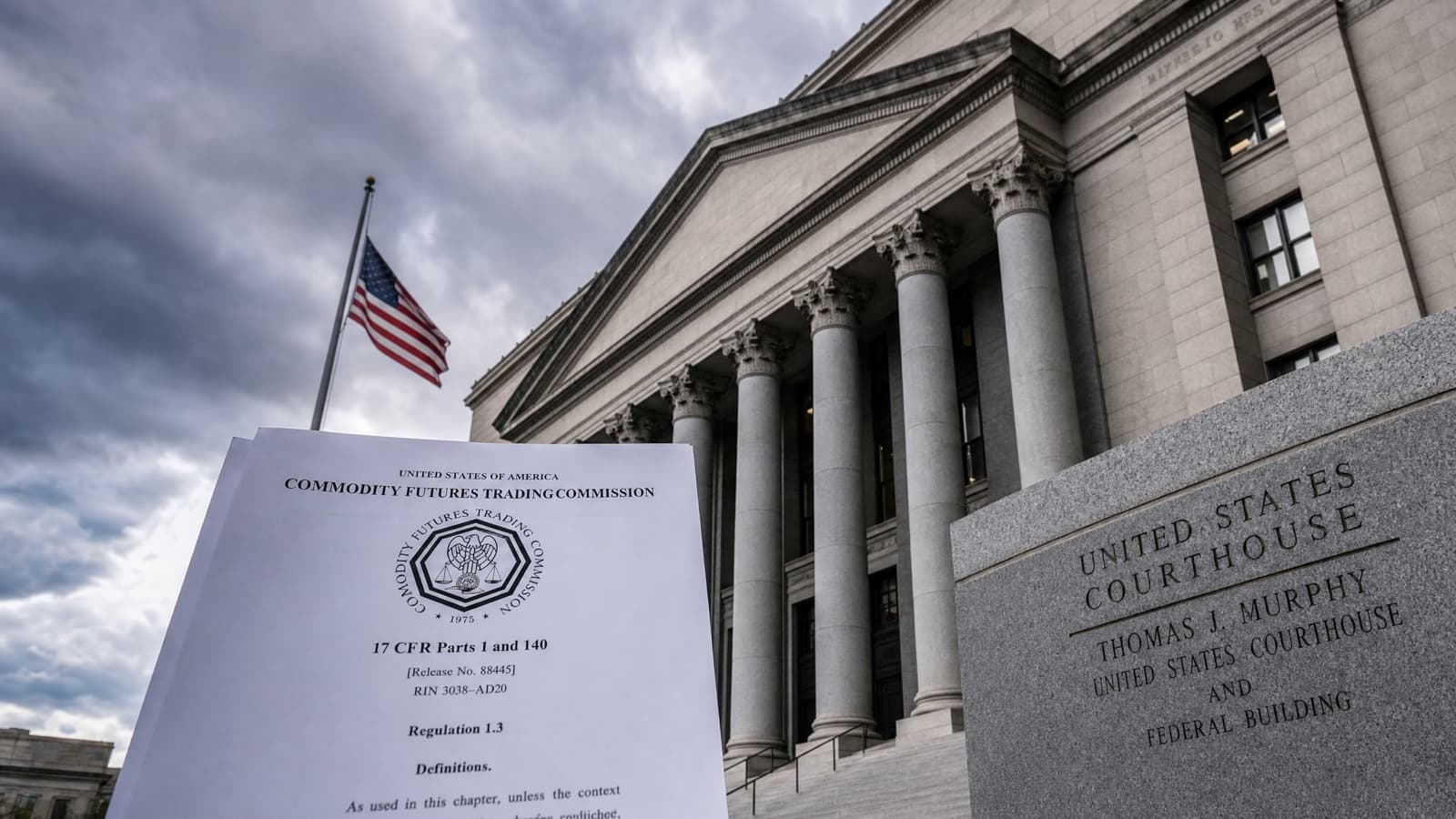
A federal judge in Connecticut has ruled that the Commodity Futures Trading Commission's "market emergency" order cannot override a court's own reading of federal law — delivering Kalshi another legal setback just one day before the company's CEO heads to the White House.
U.S. District Judge Vernon D. Oliver denied Kalshi's emergency injunction bid on August 17, rejecting the platform's argument that the CFTC's intervention obligated the court to change course. His ruling drew a clear line: the executive branch cannot instruct a federal court how to interpret a federal statute.
"The CFTC lacks the authority to dictate an order that conflicts with this Court's decision," the ruling stated, according to multiple legal industry reports.
What Judge Oliver Actually Ruled
To understand Monday's decision, the August 10 ruling comes first. Five days earlier, Judge Oliver denied Kalshi's request for a preliminary injunction after concluding that Kalshi's sports-event contracts do not qualify as "swaps" under the Commodity Exchange Act.
That classification is everything in this litigation. If sports contracts are swaps, the CFTC has exclusive jurisdiction over them under the CEA, and state gambling laws are preempted. If they are not swaps — as Judge Oliver found — states can enforce their own gaming statutes against Kalshi regardless of the company's federal registration.
With that finding in place, Connecticut's enforcement authority over Kalshi's sports markets became live. Kalshi had no federal shield.
The CFTC's Market Emergency Gambit
Five days after Judge Oliver's first ruling, the CFTC escalated. On August 11, the agency invoked Section 8a(9) of the Commodity Exchange Act, issuing a "market emergency" order directing Kalshi to continue operating as a federally regulated exchange in line with its normal practices — explicitly overriding any state court ruling to the contrary.
The Bloomberg report on the order quoted the CFTC asserting it had "exclusive jurisdiction" to regulate its registered entities, and that state interference was unlawful. Kalshi used the order to return to court in Connecticut, arguing that it now faced an impossible bind: comply with state gaming enforcement and violate the federal order, or comply with the federal order and defy the state court.
Judge Oliver rejected that framing. The CFTC order, he wrote, did not change his legal analysis of the underlying swap classification question. The agency's assertion that it has exclusive jurisdiction is not a court ruling — it's the agency's own position. Courts, not regulators, interpret statutes. The CFTC cannot issue an order that effectively tells a federal judge how to read the law.
Kalshi's secondary argument — that complying with state enforcement would cause irreparable harm through civil and criminal liability — was rejected as speculative and unsupported by evidence in the proceedings.
The Growing Circuit Split
Connecticut's courts have now twice ruled against Kalshi on the swap classification question. They are not alone. Federal judges in Nevada and Massachusetts reached similar conclusions, finding that state gambling laws can reach sports prediction contracts. Washington state courts have also sided with state enforcement, resulting in a WA geofencing order that takes effect August 19.
Against those rulings stands the Third Circuit Court of Appeals — the first and only federal appeals court to weigh in directly. In April 2026, the Third Circuit found that Kalshi's sports contracts are swaps and that the CFTC has exclusive jurisdiction, blocking New Jersey from regulating them. That ruling was a sweeping win for the industry.
The divide between the Third Circuit and the courts in Connecticut, Nevada, Massachusetts, and Washington amounts to a deep circuit split on the central legal question governing the entire prediction market industry. When federal appeals circuits reach opposite conclusions on the same statutory question, the Supreme Court typically steps in. An appeal of the Connecticut decision to the Second Circuit — the next stop covering Connecticut and New York — is widely expected.
Prediction Market Odds — What Traders Are Pricing
The market on whether Congress will enact a law banning sports prediction markets in 2026 remains active on PredictionMarkets.US. Track live odds:
Live price — will a law banning sports prediction markets be enacted in 2026?
Live market odds available at PredictionMarkets.us.
Separately, the CLARITY Act — which would create a federal framework explicitly preempting state gambling laws for CFTC-regulated prediction market exchanges — continues to trade at sharply reduced probabilities. Market pricing for CLARITY Act passage in 2026 has fallen to approximately 10 to 19 percent depending on the platform, down from highs earlier in the year.
What Kalshi Users Need to Know
Sports contracts remain live on Kalshi in the majority of states. Connecticut is now one of at least three states — alongside Nevada and Washington — where courts have ruled in favor of state enforcement, putting sports contracts in a legally contested status.
Kalshi is a CFTC-registered Designated Contract Market and Derivatives Clearing Organization, with approval dating to November 2020. The company is headquartered in New York and was valued at $22 billion after a March 2026 capital raise. Sports-event contracts accounted for between 80 and 90 percent of Kalshi's listed contracts and overall revenue as of an earlier Connecticut court hearing, according to court records cited in legal coverage of the case.
The practical advice for users in states with active enforcement actions: check Kalshi's own state availability notices directly, as legal status can change with little advance warning. Kalshi has geofenced certain states as court orders have required.
What Happens Next — 72 Hours That Will Shape the Industry
The Connecticut ruling lands in the middle of the most compressed regulatory calendar the prediction market industry has faced.
August 19 (tomorrow): Kalshi CEO Tarek Mansour meets with Trump administration officials, the CFTC and SEC chairs, and executives from Polymarket, Coinbase, and Ripple at the White House Eisenhower Executive Office Building. Industry sources describe the agenda as focused on the regulatory and legislative path for prediction markets, including CLARITY Act prospects.
August 20: The CFTC's Inaugural Advisory Committee holds its first session from 1 to 4 PM ET, with a 50-minute block dedicated to the federal-versus-state jurisdiction question — the exact issue that Judge Oliver's ruling just sharpened.
Judge Oliver's August 17 ruling delivers a clear message to both rooms: the courts are not waiting on executive branch policy, and a CFTC emergency order is not a substitute for a binding appellate ruling or legislation. Whether that message accelerates momentum for the CLARITY Act or hardens state enforcement positions remains the central unknown.
Frequently Asked Questions
Can Connecticut shut down Kalshi's sports markets? The August 17 ruling denied Kalshi's request to block Connecticut enforcement while the case proceeds — it doesn't automatically halt operations. State officials must still pursue their enforcement action. But Kalshi no longer has a federal court order protecting it from that enforcement in Connecticut.
Does this ruling affect other states? Not directly. Each state case is legally independent, and the Third Circuit's New Jersey ruling still favors Kalshi in that circuit. August 17's significance is that the CFTC's "market emergency" order failed as a state-court bypass — a precedent that may influence how courts in other circuits treat similar CFTC interventions.
What is Section 8a(9) of the Commodity Exchange Act? An emergency power allowing the CFTC to issue orders to address market emergencies and protect market integrity. The CFTC invoked it on August 11 to direct Kalshi to keep operating. Judge Oliver found it didn't change his legal conclusion on whether sports contracts qualify as swaps — the foundational question the emergency order was trying to sidestep.
What is the CLARITY Act? Federal legislation that would explicitly preempt state gambling laws for CFTC-licensed prediction market exchanges, ending the state-by-state legal patchwork. Its passage probability on prediction markets has declined significantly. A Senate cloture vote has approximately 14 legislative session days remaining for the current Congress.
Could the Supreme Court weigh in? That is the most likely long-term resolution. When federal appeals courts reach opposite conclusions on the same statutory question — as the Third Circuit and potentially the Second Circuit are set to do — the Supreme Court typically grants certiorari to resolve the split. A Supreme Court ruling on the core preemption question would be binding on all states and all courts.
The Bottom Line
The CFTC wanted its August 11 emergency order to function as a nationwide override of adverse state court decisions. Connecticut's Judge Oliver just ruled that it doesn't — and that the CFTC cannot instruct a federal court on how to read federal law.
The sports contract fight is heading toward appellate courts at speed. The White House, the CFTC's advisory committee, and the federal judiciary are now all moving simultaneously. For prediction market traders, the legal map remains unsettled through at least the start of the 2026 NFL season.
Sources & Verification
- CFTC market emergency order, August 11, 2026: CFTC Orders Kalshi to Keep Operating Despite New York Suit — Bloomberg
- Third Circuit, NJ preemption ruling: New Jersey cannot regulate Kalshi's prediction market, US appeals court rules — Reuters, April 6, 2026
- CFTC suits against CT, AZ, IL: US sues Arizona, Connecticut, Illinois to stop regulation of prediction markets — Reuters, April 2, 2026
- Washington state ruling: Judge Orders Kalshi to Stop Offering Most Wagers in Washington — Bloomberg, August 13, 2026
- Kalshi CFTC DCM registration: CFTC Designated Contract Market filings — CFTC.gov