
Connecticut Comptroller's Prediction Market Report Exposes an Uncomfortable Truth About Who Really Wins
CT Comptroller: 0.1% of Polymarket accounts capture 67% of profits. What the August 2026 state report reveals about who really wins on prediction markets.
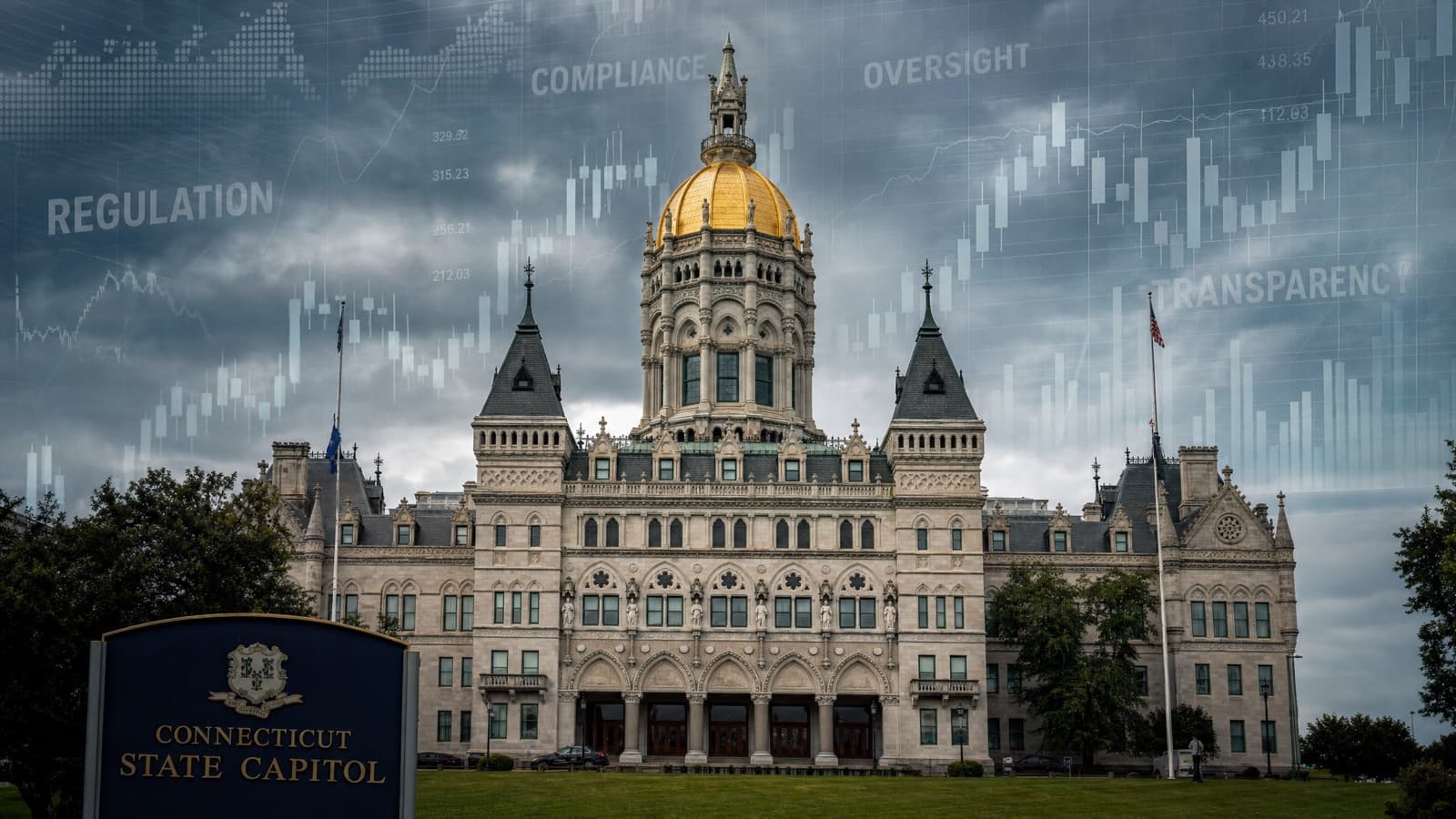
The pitch sounds democratic: anyone can trade on the outcome of elections, sports, and current events, with markets that reward knowledge rather than luck. Connecticut's top financial officer looked at the data and arrived at a sharply different conclusion.
Comptroller Sean Scanlon released the state's August 2026 economic update on August 3 — and tucked inside a section on fiscal projections is a pointed analysis of prediction markets that his office titled "Is it gambling?" The answer, per Scanlon's report, was effectively yes. His staff documented the case with hard numbers sourced from platform trading data and the state's own enforcement record.
What the Comptroller's Report Actually Says
The Connecticut Office of the State Comptroller does not regulate prediction markets. That is precisely the point Scanlon was making. "Prediction markets are literally everywhere and are used to bet on anything which, to me, warrants a lot more attention from government but also all of us in society generally," the comptroller said in a statement accompanying the release.
The report identifies four specific concerns:
Market concentration: The report cites a Wall Street Journal analysis of 1.6 million Polymarket accounts, which found that just 0.1% of accounts — fewer than 2,000 users — captured 67% of all profits generated on the platform since November 2022. The typical Polymarket user is down between $1 and $100. The worst-performing 10% of traders have each lost an average of $4,000.
Gambling addiction: The comptroller's office documented a rise in gambling addiction, particularly among young men. Prediction market platforms, the report notes, "often target their advertising to young people below Connecticut's legal gambling age of 21."
Marketing to minors: Connecticut requires sports betting participants to be at least 21. The report found evidence that prediction market platforms were advertising on college campuses and targeting users on voluntary self-exclusion lists — people who have asked to be kept away from gambling platforms.
Insider trading risk: The report raises concerns about the structural advantage held by institutional traders, including quantitative firms with access to proprietary data feeds, algorithmic execution, and order-placement latency advantages. "The gap in profits highlights how the platforms are designed to benefit sophisticated pros and trading firms, while casual traders are at a large disadvantage," the report states.
The WSJ Numbers Behind the Warning
The 0.1%/67% figure at the center of the comptroller's report comes from a Wall Street Journal investigation published in May 2026, which analyzed platform data across both Polymarket and Kalshi. The findings were striking:
- On Polymarket, fewer than 2,000 accounts collectively netted nearly $500 million in profits since November 2022
- More than 70% of Polymarket users lost money over that period
- Kalshi's own data, shared with the Journal, shows approximately 2.9 unprofitable users for every profitable one
- The Journal analyzed more than 35,000 Kalshi mention markets — wagers on whether public figures will say specific words during public appearances — and found that average "yes" bettors lose 11% of what they wager, returns the Journal characterized as "worse than most Las Vegas slot machines"
The investigation identified Susquehanna International Group, the trading firm co-founded by billionaire Jeff Yass, as believed to trade hundreds of millions of dollars per week through Kalshi, based on traders monitoring the platform's order book.
That structural dynamic mirrors what exists in professional financial markets. The distinction critics draw: stock exchanges and options markets make this asymmetry explicit through regulatory disclosure requirements. Prediction market advertising, by contrast, has tended to highlight exceptional retail wins rather than median retail outcomes.
Connecticut's Legal Standoff
The comptroller's report does not exist in a vacuum. Connecticut is one of several states engaged in an active legal battle with prediction market platforms over who has the authority to regulate them.
In December 2025, Connecticut's Department of Consumer Protection issued cease-and-desist letters to Kalshi, Robinhood Derivatives, and Crypto.com, ordering them to halt what the state called "illegal online gambling and sports betting without a Connecticut license." Commissioner Bryan T. Cafferelli stated: "None of these entities possess a license to offer wagering in our state, and even if they did, their contracts violate numerous other state laws and policies."
Kalshi responded by filing its own lawsuit, arguing that CFTC-regulated designated contract markets have federal protections that preempt state gambling laws. That argument received federal support in April 2026, when the CFTC and the Department of Justice sued Connecticut — along with Illinois and Arizona — in federal court, arguing that the Commodity Exchange Act grants the CFTC exclusive jurisdiction over designated contract markets.
The underlying legal question — whether CEA preemption overrides state gambling laws — remains unresolved. Courts have split on the issue. In August 2025, a Utah federal district court ruled that Utah could enforce its anti-gambling laws against Kalshi, denying the platform a preliminary injunction. The Second Circuit, which covers Connecticut, has not issued a definitive ruling.
Connecticut currently allows online gambling and sports betting under a 2021 law, with exactly three licensed operators: FanDuel (through a partnership with Mohegan Sun), DraftKings (affiliated with Foxwoods Casino), and Fanatics (working with the Connecticut Lottery). Prediction markets, under the state's account, are not among them.
The Platform Pushback
Neither Kalshi nor Polymarket accepted the state comptroller's characterization without objection.
Kalshi's public and legal position is that its products are federally regulated financial instruments under the Commodity Exchange Act, not gambling. The platform has argued that the concentration data cited by the comptroller's office is misleading in isolation: its spokeswoman told the Wall Street Journal that more Kalshi users make money than day traders or sports bettors do on comparable platforms.
Kalshi co-founder Luana Lopes Lara pushed back directly on the WSJ analysis, writing on X: "People win more on prediction markets than sportsbooks and equities."
The platforms also argue that sophisticated traders serve a socially useful function — improving price accuracy — by entering markets that would otherwise be less informationally efficient. That argument mirrors standard defenses of market-making and arbitrage activity in financial markets generally.
What This Means for Prediction Market Regulation
The Connecticut comptroller's report is not a lawsuit, a regulatory action, or a court ruling. It is a monthly economic update from a state official with no direct jurisdiction over the platforms in question. So why does it matter?
Because it represents something that formal enforcement actions cannot easily provide: a documented, sourced argument that the current federal-only regulatory model is producing concrete consumer harms that states are witnessing firsthand.
Connecticut generates more than $600 million annually in regulated gambling tax revenue. Whether prediction market activity is displacing state-sanctioned gambling spending, the report acknowledged, "is not yet visible in the data." But the state's ability to collect that revenue depends on a licensed, taxed industry — one that prediction market platforms are not currently part of.
Live market view — track these prices yourself:
The comptroller's findings land at a moment when prediction markets are under simultaneous scrutiny from Congress, the CFTC, and state attorneys general across the country. More state economic analyses like Connecticut's are likely to follow. Whether they carry regulatory weight depends on courts deciding who actually has the authority to act on them.
Frequently Asked Questions
What did the Connecticut comptroller's report find about prediction markets? The August 3, 2026 economic update from Comptroller Sean Scanlon found that prediction markets have a documented "dark side," including market concentration where 0.1% of Polymarket accounts captured 67% of all profits, rising gambling addiction among young men, marketing to users under 21, and structural insider trading risk.
Are prediction markets legal in Connecticut? Connecticut's Department of Consumer Protection issued cease-and-desist orders to Kalshi, Robinhood Derivatives, and Crypto.com in December 2025, arguing they operate illegally under state gambling law. The platforms dispute this. The CFTC sued Connecticut in April 2026 supporting the platforms' federal preemption argument. The legal question remains unresolved in the Second Circuit.
Who actually profits from prediction markets? According to a Wall Street Journal analysis of 1.6 million Polymarket accounts, fewer than 2,000 accounts — the top 0.1% — captured 67% of all profits since November 2022. More than 70% of users lost money. Kalshi's own data shows approximately 2.9 unprofitable users for every profitable one.
Can I use prediction markets in Connecticut? Platforms including Kalshi and Polymarket US continue to operate in Connecticut despite the state's cease-and-desist orders, citing federal preemption. Whether state enforcement will ultimately succeed depends on pending federal litigation.
The Bottom Line
Connecticut's comptroller did not discover anything the prediction market industry does not already know. The concentration of profits among a small group of sophisticated institutional traders is a structural feature of these markets, not a bug. The distinction critics are drawing — and that state officials are now documenting on the record — is between how these platforms market themselves and what the statistical distribution of outcomes actually looks like for most users.
That documentation, even from officials without direct regulatory authority, is shaping the legal and political environment these platforms will operate in for years. Explore live prediction market odds and contract prices at PredictionMarkets.US.
Sources & Verification
- Connecticut Office of the State Comptroller, August 3, 2026 Economic Update — primary source
- Comptroller Sean Scanlon press release — osc.ct.gov — primary source, August 3, 2026
- Why Almost Everyone Loses—Except a Few Sharks—on Prediction Markets — The Wall Street Journal — May 2026
- Connecticut DCP cease-and-desist orders — portal.ct.gov — primary source, December 2025
- As prediction markets grow, CT comptroller warns of 'dark side' — CT Mirror — August 5, 2026
- Prediction markets at a crossroads: Preemption, enforcement and rulemaking — Norton Rose Fulbright — April 2026
- Since Kalshi's Launch, Ordinary Users Have Lost Half a Billion Dollars — Roosevelt Institute — July 2026