
CLARITY Act Senate Cloture Vote Tuesday: Prediction Markets Price It at 23%
Senate votes CLARITY Act cloture Tuesday at 2:15 PM ET. Markets give it 23-25%. What's at stake for digital asset regulation — and what the bill doesn't do.
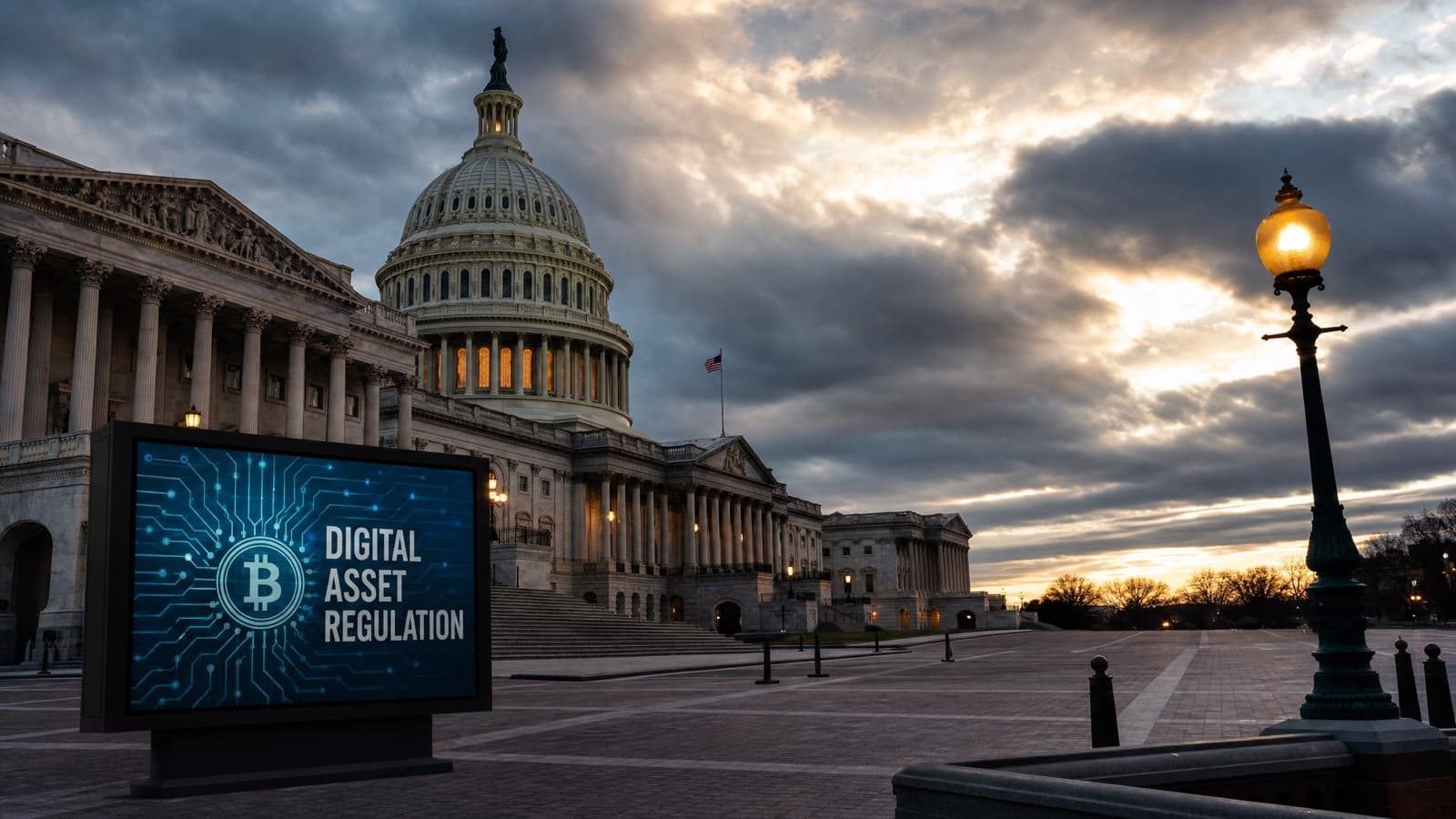
The Senate returns from recess Monday. Tuesday at 2:15 p.m. ET, it votes on whether to formally begin debate on H.R. 3633, the Digital Asset Market Clarity Act — the most sweeping U.S. crypto regulation bill in a decade.
Prediction markets are pricing failure as the more likely outcome. Kalshi's market for CLARITY Act enactment in 2026 stood at 25% on September 13. Polymarket's H.R. 3633 contract sits at 23%, with more than $15.2 million traded on the outcome. Galaxy Digital lowered its own probability estimate to roughly 10%.
None of these numbers reflect only Tuesday's cloture vote in isolation. They price the full legislative chain — cloture, floor passage, House-Senate reconciliation, and a presidential signature — completed before December 31, 2026. The procedural vote Tuesday is the next link in that chain, and the market is saying it is likely to break.
What the CLARITY Act Actually Does
H.R. 3633 answers one foundational question: when a digital asset is involved, does the Securities and Exchange Commission or the Commodity Futures Trading Commission have primary jurisdiction?
Right now, the answer is effectively both — resolved case-by-case through enforcement actions rather than clear statutory rules. The CLARITY Act would replace that uncertainty with a framework: tokens meeting the definition of digital commodities fall primarily under CFTC oversight; those qualifying as securities stay with the SEC. The bill also establishes registration requirements for exchanges, brokers, and other intermediaries dealing in digital assets, and brings them into the Bank Secrecy Act for anti-money laundering compliance.
The bill passed the House on July 17, 2025, by a vote of 294 to 134 — a broad bipartisan majority — and was referred to the Senate Banking Committee that September. After months of negotiation over stablecoin yield, ethics provisions, and DeFi treatment, the Senate Banking Committee advanced the bill 15 to 9 on May 14, 2026, in a vote Chairman Tim Scott called "historic and bipartisan." The committee placed it on the Senate Legislative Calendar as Calendar No. 423 on June 1.
Senate Majority Leader John Thune filed a cloture motion on the motion to proceed on August 8, setting up Tuesday's vote.
The 60-Vote Problem
Tuesday's cloture vote is not a vote on the bill itself. Under Senate Rule XXII, ending debate on whether to even begin debating a bill requires 60 affirmative votes. Republicans hold 53 Senate seats. That means the bill needs at least seven Democratic crossovers to advance.
That math has not changed since the bill left committee. What has changed is the demonstrated alignment of those seven votes. The committee vote was 15 to 9 — bipartisan on paper — but the only two Democrats who voted yes, Senators Gallego and Alsobrooks, subsequently rejected the July 22 updated Republican draft the same day it was released, calling it insufficient on ethics provisions.
Seven votes at fractional individual probabilities, compounded, produces a much lower joint probability than any single senator's odds suggest. The market's 23-25% headline number reflects that compound difficulty.
What Markets Are Saying Right Now
Kalshi and Polymarket are measuring slightly different things. Kalshi's primary CLARITY Act market tracks whether comprehensive crypto market structure legislation becomes law — a contract with a longer horizon that explains why its year-end figure (~25%) differs from its contracts stretching to 2028. Polymarket's H.R. 3633 contract specifically tracks whether that bill is signed into law by December 31, 2026.
The cross-platform picture as of September 13, 2026:
| Contract | Venue | Price |
|---|---|---|
| CLARITY Act enactment by Dec. 31, 2026 | Kalshi | 25% |
| H.R. 3633 signed into law in 2026 | Polymarket | 23% |
| Senate vote on H.R. 3633 before Oct. 1, 2026 | Kalshi | 94% |
| Crypto market structure legislation by Jan. 1, 2028 | Kalshi | 46% |
That last figure is striking. Even stretching the timeline to 2028, the market does not reach a coin flip. More than $8 million has traded on that contract.
Galaxy Digital's research desk lowered its probability estimate to approximately 10% in August, citing unfinished negotiations, the compressed post-recess calendar, and broadening opposition. Ian Katz of Capital Alpha Partners lowered his estimate to 25%. Fidelity, in a September 10 note, said it does not expect the bill to advance through cloture.
How 82% Became 23%: The Collapse
The CLARITY Act's prediction market trajectory illustrates how legislative optimism erodes against procedural reality.
In February 2026, Polymarket odds reached approximately 82%. White House momentum, a bipartisan Senate Banking lineup, and a May markup target made passage before Independence Day look achievable. The Senate Banking Committee advanced the bill 15 to 9 on May 14, and odds briefly pushed into the low 70s.
Then the grind began. A July 22 revised draft — including new ethics provisions — arrived with simultaneous rejection statements from Gallego and Alsobrooks. Odds dropped 11-12 points the same day. Thune signaled doubt about pre-recess passage in late July. When the Senate filed the cloture motion on August 8 and left for recess without a vote, the market read the action correctly: procedurally alive, politically stalled. Odds settled in the mid-teens through late August before recovering modestly to the current 23-25% range following reports that President Trump met with advisers on the CLARITY Act this weekend, and that Treasury Secretary Scott Bessent has been publicly urging the Senate to pass the bill.
Why Supporters Still Believe
The bull case is not negligible. Coinbase CEO Brian Armstrong, speaking to CNBC, said he was "pretty optimistic" the bill would clear 60 votes and characterized the negotiations as having delivered roughly 90% of what both sides wanted. "He would not have scheduled this on September 15 if he didn't think it would pass," Armstrong said of Thune. Senator Lummis, one of the bill's lead architects, noted this week that Democrats received more than 100 changes incorporated into the bill's revised 630-page text. SEC Chair Paul Atkins has publicly expressed expectations of passage.
The structural argument: Senate Majority Leader Thune would not have filed cloture and placed the vote on the calendar if he lacked a credible path to 60. Filing and losing is a worse political outcome than not filing. Scheduling the vote suggests leadership believes a deal is reachable or that the public commitment will pressure holdouts into line before 2:15 p.m. Tuesday.
The Unresolved Sticking Points
Three issues remain the core obstacles between 53 votes and 60.
Ethics provisions. Democrats want stricter restrictions on how elected officials can invest in crypto companies. The ethics fight intensified after Trump reported substantial crypto-related profits. The July 22 Republican draft included DOJ-only enforcement and a 2029 sunset; Democrats immediately rejected it. Senators Tillis and Gallego submitted a bipartisan ethics counterproposal to the White House in late July, but no final agreement was confirmed before this weekend.
Stablecoin yield. Section 404 of the current draft prohibits interest or yield on idle stablecoin balances while permitting activity-based rewards. Banking institutions want clarity that digital stablecoin products cannot compete with insured deposits on yield. Several Democratic senators have sought stronger language than the current compromise.
DeFi treatment and AML requirements. Democratic senators pressed for more stringent anti-money laundering and Know Your Customer requirements on decentralized finance protocols. The current draft brings DeFi trading protocols under CFTC registration requirements in ways some Democratic members still find insufficient.
What a Failed Cloture Vote Means
If the motion fails Tuesday, the CLARITY Act does not simply get rescheduled for a future vote. The Senate calendar faces pressure from government funding deadlines, with appropriations fights consuming floor time through October. The November midterms effectively close the legislative window by late October. A failed cloture vote Tuesday would leave the digital asset industry under regulation by enforcement, with the SEC, CFTC, and OCC each writing pieces of the rulebook on their own terms through at least 2027.
Bernstein analysts projected a 10% to 25% near-term correction in Bitcoin if the bill fails. Altcoins and DeFi governance tokens face potentially steeper drawdowns of 15% to 30%. The institutional capital pipeline for regulated crypto products would face continued uncertainty — a concern for the institutional investors who increasingly cite regulatory clarity as a prerequisite for expanded positions.
Passage, if it happens, would not produce overnight changes. The bill triggers a six-to-eighteen month rulemaking period at the SEC, CFTC, and Treasury before compliance frameworks take effect. But a successful cloture vote Tuesday would represent clear evidence that Congress is moving toward setting the framework — the signal those on the sidelines have been waiting for.
One Key Distinction: CLARITY Does Not Touch Prediction Markets
For readers tracking the prediction market industry, one clarification matters. The CLARITY Act does not address event contracts or prediction markets. It does not amend CFTC Regulation 40.11, which governs the rules Kalshi and other designated contract markets operate under. It does not preempt state gambling laws.
The parallel fight over whether prediction market contracts constitute gambling under state law — active in courts in New York, Utah, Connecticut, Minnesota, and elsewhere — continues on a completely separate legal and regulatory track. Tuesday's vote does not change that fight in either direction.
What the vote will clarify: whether comprehensive digital asset market structure legislation can clear Congress in 2026. What it will not clarify: the legal status of prediction markets under state or federal law.
FAQ
What is the CLARITY Act?
H.R. 3633, the Digital Asset Market Clarity Act, is a bill that would establish a statutory framework for digital assets, assigning primary jurisdiction over digital commodities to the CFTC and keeping securities-category assets under the SEC. It passed the House 294-134 in July 2025 and cleared the Senate Banking Committee 15-9 in May 2026.
What exactly happens on September 15?
The Senate votes on cloture for the motion to proceed to H.R. 3633 at 2:15 p.m. ET. This is a procedural vote on whether to begin floor debate on the bill — not a final passage vote. It requires 60 affirmative votes. Republicans hold 53 seats; at least seven Democrats must vote yes.
What do prediction markets say as of today?
Kalshi prices CLARITY Act enactment in 2026 at approximately 25% as of September 13. Polymarket prices H.R. 3633 becoming law in 2026 at 23%. Galaxy Digital's research estimate is approximately 10%. More than $15 million has traded across these contracts.
Does the CLARITY Act directly affect prediction markets?
No. The bill explicitly does not cover event contracts and does not amend CFTC Reg. 40.11. The legal disputes between prediction market platforms and state regulators continue independently of this legislation.
If cloture fails, is the bill effectively dead for 2026?
Yes, in practical terms. The compressed post-midterm congressional calendar makes 2026 passage extremely unlikely after a failed September cloture vote. The 119th Congress would effectively need to restart the process in 2027.
Sources & Verification
- H.R. 3633 congressional record — all actions, 119th Congress — House vote (294-134, July 17, 2025), Senate Banking markup (15-9, May 14, 2026), cloture motion filed (August 8, 2026)
- Senate Banking Committee press release — May 14, 2026 — Committee advance, Chairman Scott quote
- Paul Hastings Crypto Policy Tracker — August 2026 — Vote timing (2:15 PM ET, September 15)
- Latham & Watkins US Crypto Policy Tracker — 60-vote threshold, cloture requirement
- Galaxy Research — CLARITY Act Senate Banking Analysis — Probability estimates, committee analysis
- crypto.news — "The Treasury Secretary is whipping votes for a bill priced at 10%," September 11, 2026 — Treasury Secretary Bessent, Fidelity position, Galaxy 10% estimate
- crypto.news — "The CLARITY Act vote lands September 15," September 10, 2026 — Polymarket historical odds, $14 million trading volume
- Yahoo Finance — "U.S. Senate Faces a Critical Vote on the Clarity Act," August 21, 2026 — Armstrong quote, Kalshi odds
- Bitcoin News — "Lummis to Democrats: You Helped Build the CLARITY Act, Now Vote for It," September 13, 2026 — Lummis statement, Polymarket 23%, Kalshi enactment markets
- Federal News Network — "When Will the CLARITY Act Become a Law?," August 31, 2026 — Procedural context