
White House Teleprompter Operator Fined $172,000 for Trading on Kalshi's Mention Markets
The CFTC fined a White House teleprompter operator $172,000 for using advance access to Trump speeches to profit from Kalshi's mention markets.
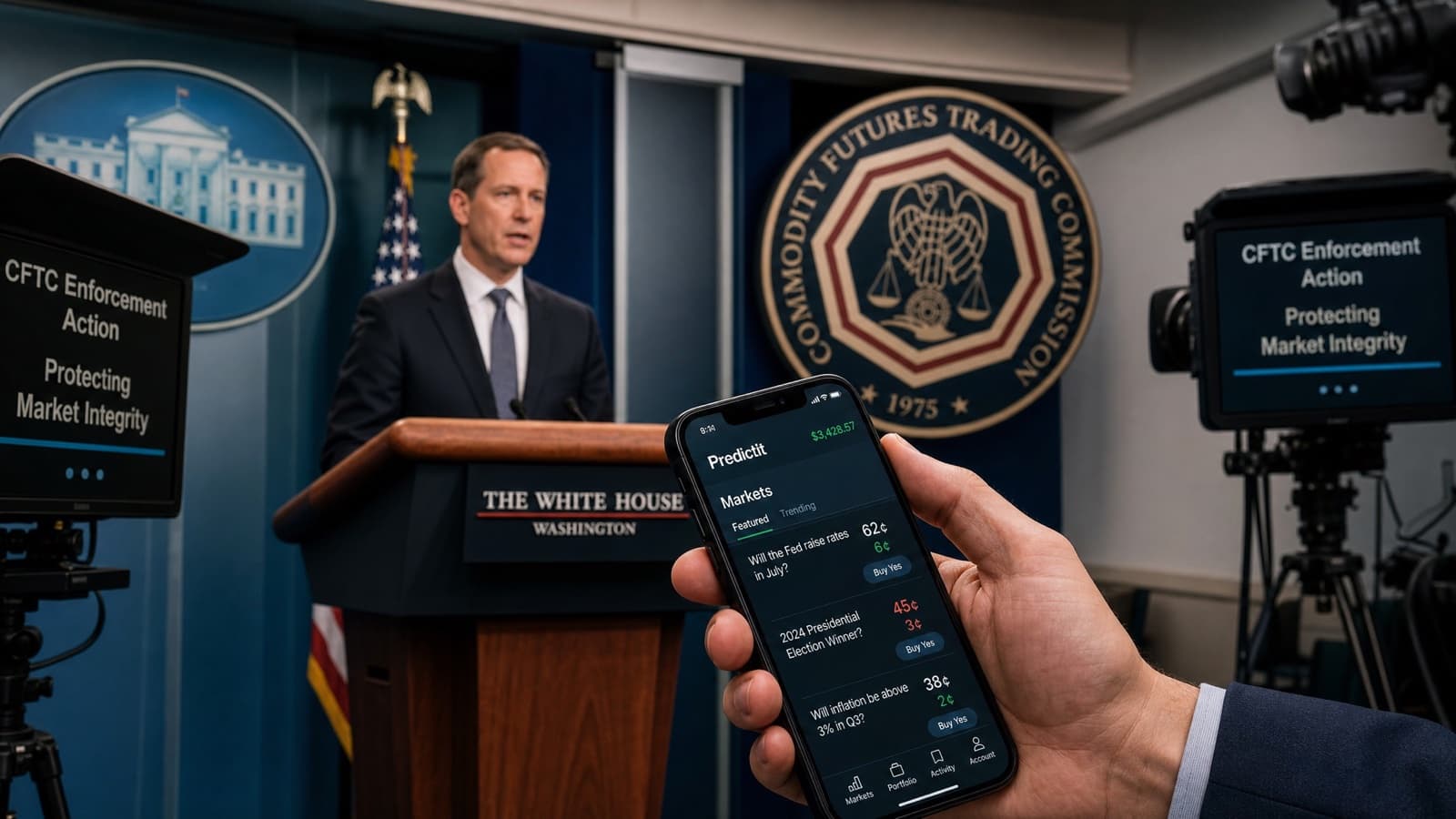
The first federal enforcement action against a sitting White House employee for prediction market insider trading landed Friday, when the Commodity Futures Trading Commission ordered Gabriel Perez—a technical assistant who operated President Trump's teleprompter since 2016—to pay $172,000 for misusing advance access to presidential speeches to profit on Kalshi's mention markets.
The case is the most politically sensitive enforcement action the CFTC has filed in the prediction market space. It also signals that the agency charged with both defending and policing the industry is running its market-integrity function independently of its legal battles with the states.
The Trades That Got Him Caught
Between December 2025 and February 2026, Perez traded presidential mention market contracts on Kalshi on more than a dozen occasions, according to CFTC Order 9289-26. His position gave him a rare edge: he read the speeches before Trump delivered them.
The trading window covered significant public addresses—a December primetime address, a January speech at the World Economic Forum in Davos, Switzerland, the State of the Union address in February, and a March Medal of Honor ceremony. Over that period, Perez generated more than $107,500 in profits.
Under the settlement, Perez must disgorge the full $107,539.02 in profits and pay a $65,000 civil monetary penalty. That penalty represents a 40 percent reduction from the standard amount under the CFTC's cooperation advisory, which the agency described as reflecting Perez's "exemplary cooperation." He also agreed to a three-year ban from trading on CFTC-regulated markets and consented to a cease-and-desist order. He neither admitted nor denied the CFTC's findings.
Sources familiar with the investigation told ABC News that Perez sat for a voluntary interview with regulators and acknowledged some of the trades.
What Are Presidential Mention Markets?
Presidential mention markets are a category of event contracts where traders bet on whether a public figure—most commonly the President—will use a specific word or phrase during a speech or public event. A typical contract might ask: "Will Trump say 'tremendous' during tonight's address?" The contract resolves Yes or No based on the official speech transcript.
Kalshi introduced mention markets as a listed product category during the current presidential term. They attracted significant trading volume and, almost immediately, serious questions from regulators about the structural information advantages they create.
Unlike markets on electoral outcomes—where insider knowledge is diffuse and probabilistic—mention markets resolve on a single, discrete data point: whether a specific word appears in a transcript. For someone who reads the speech before it is delivered, there is no information risk. The trade is, in effect, a guaranteed outcome dressed in the form of a market.
Perez's trades were not a bet on what the president might say. They were trades on what he already knew the president was about to say. The CFTC characterized this as misappropriation: Perez obtained advance speech content "in breach of his duty of trust and confidence" owed to his employer, and used that information to profit personally. This is the same legal theory applied to securities insider trading cases—now deployed against event contracts regulated under the Commodity Exchange Act.
How KalshiEX's Surveillance Unit Caught It
The CFTC's press release credited KalshiEX, the exchange entity that operates Kalshi's platform, for its "assistance" in the matter. Kalshi's head of enforcement, Robert DeNault, confirmed on social media that the exchange's internal surveillance unit identified the trading pattern and assisted federal investigators.
The surveillance model works by cross-referencing trade timestamps with known external events—in this case, the narrow window between when a speech was uploaded to the teleprompter system and when it was publicly delivered. Trades executed in that window, consistently on the profitable side of mention contracts tied to specific speech content, produced a statistically distinctive signature.
That KalshiEX's surveillance unit caught a White House insider carries significance for a platform that has spent much of 2026 defending its market-integrity practices in court. The Perez case provides direct, documented evidence that the exchange's surveillance infrastructure works—and that Kalshi is willing to cooperate with federal enforcement even in politically sensitive cases.
A Broader Enforcement Pattern
The Perez case is part of a larger CFTC enforcement push against prediction market insider trading that has accelerated through 2026.
In July 2026, the CFTC ordered former Congressman George Santos to pay $35,000 for manipulative trading related to contracts in which he was the subject—a different legal theory (market manipulation under CEA Section 6(c)(1)) rather than misappropriation, but part of the same enforcement posture toward prediction market misconduct.
Earlier in the year, federal prosecutors in the Southern District of New York charged a Google engineer with using internal search data to make approximately $1.2 million on Polymarket. That case proceeded as a criminal matter, separate from the CFTC's civil enforcement authority, but coordinated with it.
The CFTC has also opened a broader inquiry into mention markets as a category, NPR reported Friday. That investigation is examining whether the contract type creates structural information asymmetries that require a product-level regulatory response—rather than enforcement action by action.
White House Response
Following ABC News' initial reporting on Perez's trading, which preceded the formal settlement, White House press secretary Karoline Leavitt confirmed that Perez had been placed on unpaid administrative leave.
In March 2026, the White House issued an internal memo warning staff against using nonpublic information to trade prediction markets. The settlement underscores that the warning came too late for Perez—his trading window ran from December 2025 through February 2026, ending weeks before the memo was circulated.
What This Means for Prediction Market Integrity
Two things about the CFTC's approach are worth noting for traders and industry observers.
The enforcement and regulatory-defense functions are running separately. The same agency that has sued nine states to defend prediction markets' federal regulatory status is simultaneously pursuing insider trading cases against individuals who traded on those same platforms. This is standard practice for a financial regulator—the CFTC defends its exclusive jurisdiction while also policing conduct within that jurisdiction—but it is worth restating clearly for an industry that sometimes frames the CFTC as an unconditional champion of the prediction market model.
Mention markets face product-level scrutiny. The Perez case resolves cleanly as a misappropriation fact pattern. But the broader CFTC inquiry into mention markets as a category suggests regulators are asking harder structural questions: Do these contracts create information asymmetries that are qualitatively different from other event markets? Should listing requirements or position limits apply specifically to contracts where the resolution event is controlled by a small number of identifiable individuals with institutional access?
For traders active in mention market contracts, the practical takeaway is that the CFTC's surveillance capabilities are more sophisticated than a surface reading of the enforcement record might suggest. The agency—with Kalshi's cooperation—can connect trade timestamps to speech-delivery schedules and identify specific individuals whose institutional access created a statistical edge.
Frequently Asked Questions
What are mention markets on Kalshi? Mention markets are event contracts that resolve based on whether a public figure uses a specific word or phrase during a speech or event. They are listed on Kalshi as CFTC-regulated event contracts and reflect the outcome of a discrete, verifiable fact.
Is it illegal to use nonpublic information to trade prediction markets? Yes. Under the Commodity Exchange Act, using material nonpublic information obtained in breach of a duty of trust and confidence to trade event contracts constitutes misappropriation—the same legal framework applied to securities law insider trading. The CFTC enforces this standard for all contracts traded on CFTC-registered exchanges, including prediction market platforms.
How did regulators identify the trading? KalshiEX's internal market-surveillance system flagged the pattern and assisted CFTC investigators. The CFTC's order establishes that investigators cross-referenced Perez's trade timing with the window between speech upload and public delivery.
What happened to Gabriel Perez? Perez was placed on unpaid administrative leave from his White House position. Under the CFTC's settlement order (9289-26), he must pay $172,539 in disgorgement and civil penalties, serve a three-year ban from trading on CFTC-regulated markets, and comply with a cease-and-desist order.
Are mention markets still available on prediction platforms? As of this article's publication, mention market contracts continue to be listed on Kalshi. The CFTC's broader inquiry into the contract category is ongoing, and the outcome may affect how these contracts are listed, structured, or limited in the future.
Conclusion
Gabriel Perez's settlement is a landmark in the short history of prediction market regulation: the first insider-trading enforcement action against a White House employee for trading on advance access to the president's own words. It establishes that Kalshi's surveillance infrastructure can identify this class of misconduct, that the CFTC will pursue enforcement even in politically sensitive cases, and that mention markets are drawing regulatory attention that extends beyond individual bad actors.
The legal battles over whether states or the federal government controls the prediction market industry are far from resolved. But the Perez case demonstrates something simpler and more immediate: the rules against insider trading apply on these platforms, and the agency and exchanges are equipped to enforce them.
For traders, the relevant lesson is that prediction markets are functioning financial markets with real surveillance infrastructure—not an unmonitored corner of the internet where institutional information advantages go undetected.
To explore active prediction market contracts and track live odds across platforms, visit PredictionMarkets.US at https://predictionmarkets.us
Sources & Verification
- Gabriel Perez settlement order: CFTC Release 9289-26 — August 28, 2026
- Settlement details and Perez background: ABC News — August 29, 2026
- White House response and KalshiEX enforcement statement: Fox Business — August 29, 2026
- CFTC mention market inquiry and market manipulation context: NPR — August 28, 2026
- George Santos CFTC enforcement background: CFTC Release 9276-26 — July 31, 2026