
CFTC Sues Louisiana After State Court Halts Kalshi, Polymarket and Robinhood: What Traders Need to Know
A Louisiana judge ordered 30+ operators to block event contracts; the CFTC sued the next day. Here is the TRO, the preemption fight and the Nov. 30 hearing.
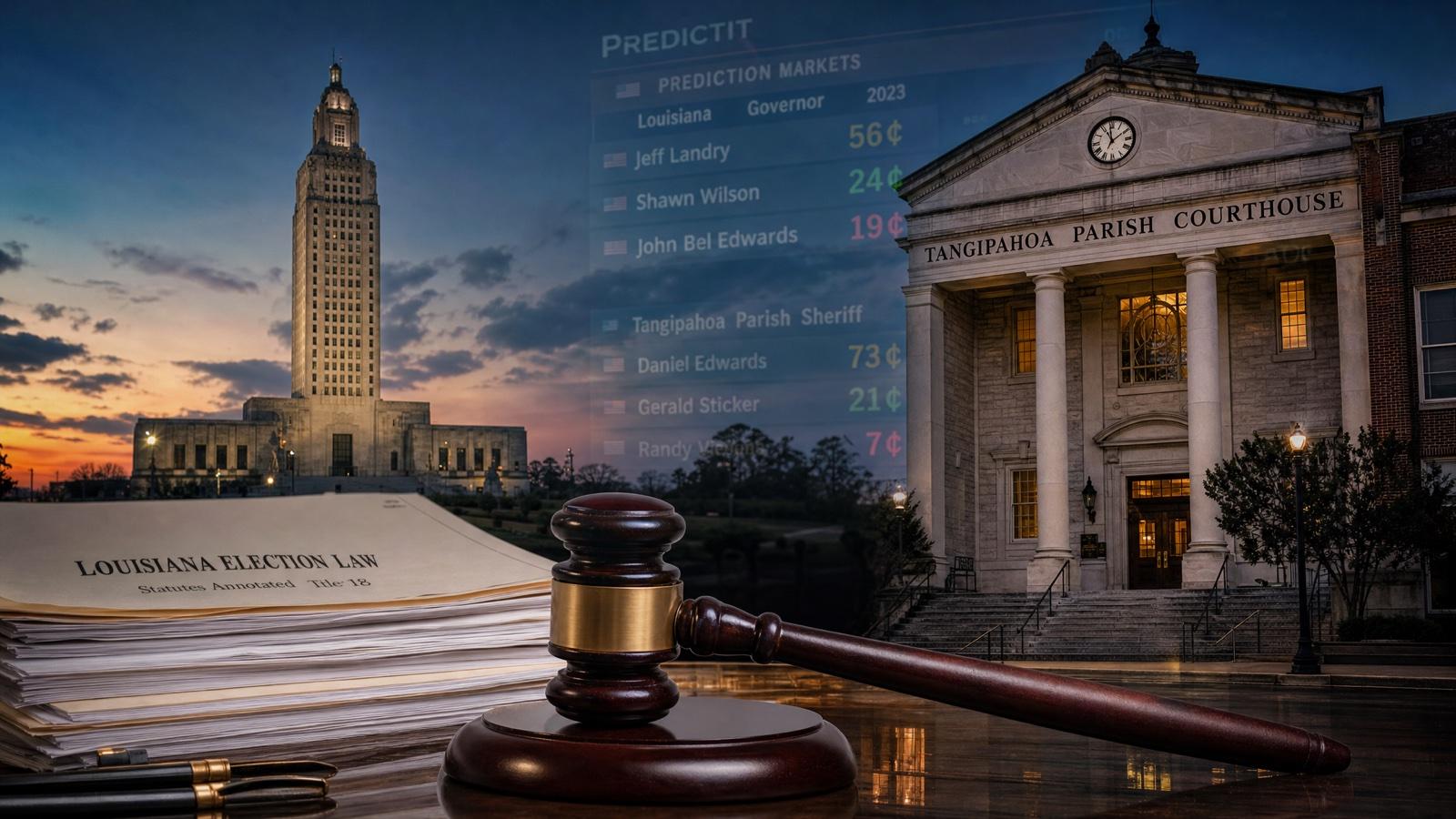
On the evening of Thursday, November 12, 2026, a Louisiana state judge signed an emergency order telling more than 30 companies, including Kalshi, Polymarket US, Robinhood and Coinbase, to stop offering event contracts to anyone physically in the state. The next day, the federal government sued Louisiana to try to undo it.
That makes Louisiana the sharpest collision yet between a state attorney general and the federal regulator over a basic question: are event contracts on CFTC-regulated exchanges financial derivatives under exclusive federal oversight, or gambling that states can license and police? Here is what happened, what each side is claiming, and what to watch before the next hearing on November 30.
This is general information, not legal or financial advice. Court orders change quickly; check each platform's official notices for current availability in your state.
What Louisiana Did
According to reporting from NOLA.com, Louisiana Attorney General Liz Murrill filed suit on Thursday, November 12 against Kalshi, Polymarket, Robinhood and other event-contract providers, accusing them of ignoring Louisiana's gambling laws. Later that afternoon, Judge Jeffrey Johnson of the 21st Judicial District Court in Tangipahoa Parish issued a temporary restraining order (TRO) requiring the companies to halt those markets in Louisiana.
Per the order as described by The Center Square, the restriction covers contracts tied to sports, elections and awards, and requires operators to block access for people physically located in Louisiana. It lasts 10 days unless extended, and a hearing on the state's request for a preliminary injunction is scheduled for 9 a.m. on November 30. A TRO is a short-term emergency measure. It does not decide whether federal law blocks Louisiana from applying its gambling statutes.
WBRZ, citing court documents, reports that the defendants named in the filing include:
- Prediction markets: Kalshi Inc., QCX LLC (doing business as Polymarket US), ForecastEx LLC, Ludlow Exchange LLC (Novig) and ProphetX Opco LLC
- Financial and crypto platforms: Robinhood Markets Inc., Coinbase Global Inc., Foris DAX Inc. (Crypto.com) and Gemini Trust Company LLC
- Sports and derivatives entities: Underdog Sports Holdings Inc., North American Derivatives Exchange Inc. and IG Group Holdings PLC
The CFTC's own release says the order shut down the operation of more than 30 companies connected to the trading of CFTC-regulated derivatives products "without giving the defendants notice or an opportunity to be heard." Murrill's office, for its part, says the platforms are offering unlicensed gambling. In her words: "It's not complicated: if you aren't a licensed gaming operator, you aren't legal."
Why the Order Was So Broad
Most state actions against prediction markets have been filed one company at a time. NOLA.com quotes sports-betting attorney Daniel Wallach saying Murrill is the only attorney general who has convinced a court to effectively order a halt to all prediction market companies in one go. "Naming all the companies in one lawsuit avoided the whack-a-mole problem that has afflicted many other states," he said.
The state also has a newer tool. The Center Square reports that Louisiana's Act 182, effective August 1, expressly authorizes the attorney general to seek restraining orders and injunctions against computer-based gambling, raised the maximum fine for offering gambling games by computer from $20,000 to $100,000, and provides that each wager offered or accepted counts as a separate violation. Earlier, in December 2025, the Louisiana Gaming Control Board warned licensed sports wagering businesses that it considered sporting event contracts and certain other event contracts illegal gambling.
How the Platforms Responded
Robinhood halted its event contracts in Louisiana on Thursday, according to NOLA.com. The outlet also reports that Kalshi posted a notice to Louisiana users on Friday morning saying, "Your government says you can't use Kalshi anymore," and that users could still place trades on event contracts on Friday, leaving it unclear whether the company planned to comply.
Kalshi had already gone to federal court. Per Law Commentary, it filed suit against Murrill and other Louisiana officials on October 23, and Polymarket US filed a similar federal suit on October 27. On Thursday, Kalshi asked the federal court for its own restraining order; at the time of NOLA.com's report, no judge had ruled on it. Kalshi's head of litigation, Jovy Dedaj, wrote on X that "the operation of federally-regulated exchanges is the exclusive province of the federal government. Full stop."
Robinhood has said its event contracts are offered through its registered derivatives subsidiary, and Coinbase has argued that the lawsuit is exactly the fragmented state enforcement that Congress meant to prevent by giving the CFTC exclusive jurisdiction.
The Federal Counterpunch
On Friday, November 13, the CFTC announced it had sued Louisiana to block the state from prohibiting event contracts offered by CFTC-regulated designated contract markets (DCMs), futures commission merchants and derivatives clearing organizations. The agency's complaint seeks injunctive and declaratory relief.
CFTC Chairman Michael Selig said event contracts "have traded openly in Louisiana for years, in compliance with the Commodity Exchange Act and CFTC regulations." He called the state's emergency suit "naked lawfare and a cynical political stunt," and said the CFTC's lawsuit "seeks to maintain the status quo while the federal courts decide this issue in an orderly manner."
The agency says Louisiana is the 12th state it has sued to defend its jurisdiction over derivatives markets, and that it has also filed amicus briefs in four federal courts of appeal and one state supreme court. The Louisiana suit came the same day as the CFTC's Arkansas complaint, and weeks after its complaint against Utah, announced October 27.
Murrill pushed back on X, disputing the CFTC's account. Her message was that gambling "has been regulated by states for 250 years."
Louisiana vs. the CFTC: The Core Arguments
| Louisiana (AG Murrill) | CFTC / federal side | |
|---|---|---|
| What event contracts are | Wagers that require a state gambling license | Derivatives regulated under the Commodity Exchange Act |
| Who has authority | State gambling regulators and courts | CFTC, with exclusive jurisdiction granted by Congress |
| Legal hook | State gambling law, Act 182 enforcement powers | Supremacy Clause and federal preemption |
| What it wants | Halt in Louisiana, civil penalties, preliminary injunction | Injunction and declaration blocking the state's order |
| Next date | Preliminary injunction hearing, Nov. 30, 9 a.m. | Federal complaint filed Nov. 13; no hearing date reported |
What This Means for Traders
If you live in Louisiana, the practical picture is unsettled. A state court has ordered operators to block access. Federal courts have been asked to step in on the opposite side. Platforms have reacted differently, and the order is a temporary one. Do not assume that either "everything is banned" or "nothing changed" is correct for your account; check the official notice from the platform you use.
If you live elsewhere, Louisiana matters for three reasons:
- The all-defendant strategy. One lawsuit naming dozens of operators, paired with a TRO granted without a hearing, is a template other states could copy.
- The venue fight. Louisiana picked state court. Wallach told NOLA.com that states that have filed in state court have succeeded in securing preliminary injunctive relief every time, which is part of why the platforms keep moving to federal court first.
- The scale of the federal response. Twelve state suits is a very different posture from a handful of amicus briefs, and the courts will eventually have to reconcile the outcomes.
Not every platform is exposed in the same way. Contracts differ by product, exchange and category, and a court order covering a list of defendants does not tell you how each exchange will implement it. Treat any single headline with caution until the platforms themselves publish notices.
Live Market View
The market below tracks whether a law banning sports prediction markets will be enacted in 2026. It is a federal-legislation market, not a Louisiana ruling market, but it is a useful read on how traders price the broader political fight.
Live price - will a law banning sports prediction markets be enacted in 2026?
What to Watch Next
- The Kalshi federal TRO request. A ruling in the federal case could change whether the state order can be enforced against Kalshi.
- A judge assigned to the CFTC suit. Press reports on Saturday said none had been assigned yet.
- Expiration or extension of the TRO. The order is described as lasting 10 days unless extended; one outlet reports it expires November 22.
- The November 30 hearing. That is when the state asks for a preliminary injunction.
- Platform notices. Changes to Louisiana access will show up in platform help pages first.
Frequently Asked Questions
Are prediction markets banned in Louisiana right now? A state court has issued a temporary restraining order requiring the named operators to block access for people in Louisiana. The order is temporary, it is being challenged, and reports indicate platforms have responded differently. Check your platform's official notice.
Which companies does the Louisiana order cover? Court documents cited by WBRZ name Kalshi, QCX LLC (Polymarket US), ForecastEx, Novig's Ludlow Exchange, ProphetX, Robinhood, Coinbase, Crypto.com's Foris DAX, Gemini, Underdog, North American Derivatives Exchange and IG Group.
Why is the CFTC suing a state? The agency argues the Commodity Exchange Act gives it exclusive jurisdiction over derivatives markets, and that Louisiana is unlawfully applying state gambling law to contracts on CFTC-regulated exchanges.
What happens on November 30? A Louisiana state court hearing is scheduled for 9 a.m. on the state's request for a preliminary injunction, which would extend restrictions beyond the temporary order.
Does a TRO mean the courts have decided prediction markets are gambling? No. A TRO is an emergency measure issued early in a case. It does not resolve the underlying question of federal preemption.
Bottom Line
Louisiana turned a slow-moving legal debate into a live access problem in a single afternoon, and the CFTC answered with a federal lawsuit within a day. The next few weeks, with the federal TRO request, the state's November 30 hearing and the CFTC's complaint, will show which court gets to answer the preemption question first. Follow live prediction market prices and regulatory developments on PredictionMarkets.US.
Sources & Verification
- CFTC lawsuit against Louisiana, November 13, 2026, including Chairman Selig's statement and the "12th state" count: CFTC Release 9326-26 - verified November 14, 2026
- CFTC lawsuit against Arkansas, November 13, 2026: CFTC Release 9325-26 - verified November 14, 2026
- CFTC suit against Utah, October 27, 2026: CFTC Release 9315-26 - verified November 14, 2026
- TRO issued by Judge Jeffrey Johnson, Murrill statement, Robinhood halt, Kalshi user notice, Wallach comments: NOLA.com, Judge orders Kalshi, Polymarket, others to halt and NOLA.com, what's next - verified November 14, 2026
- Named defendants and complaint allegations: WBRZ - verified November 14, 2026
- TRO scope, 10-day duration, Act 182, Gaming Control Board warning: The Center Square - verified November 14, 2026
- Kalshi and Polymarket US federal suit dates, Nov. 30 hearing, Nov. 22 expiration report: Law Commentary - verified November 14, 2026