
CFTC Opens Prediction Market Access to Any App: What Staff Letter 26-25 Means
CFTC Staff Letter 26-25 frees passive software providers from broker registration, letting qualifying apps embed access to CFTC-regulated prediction markets.
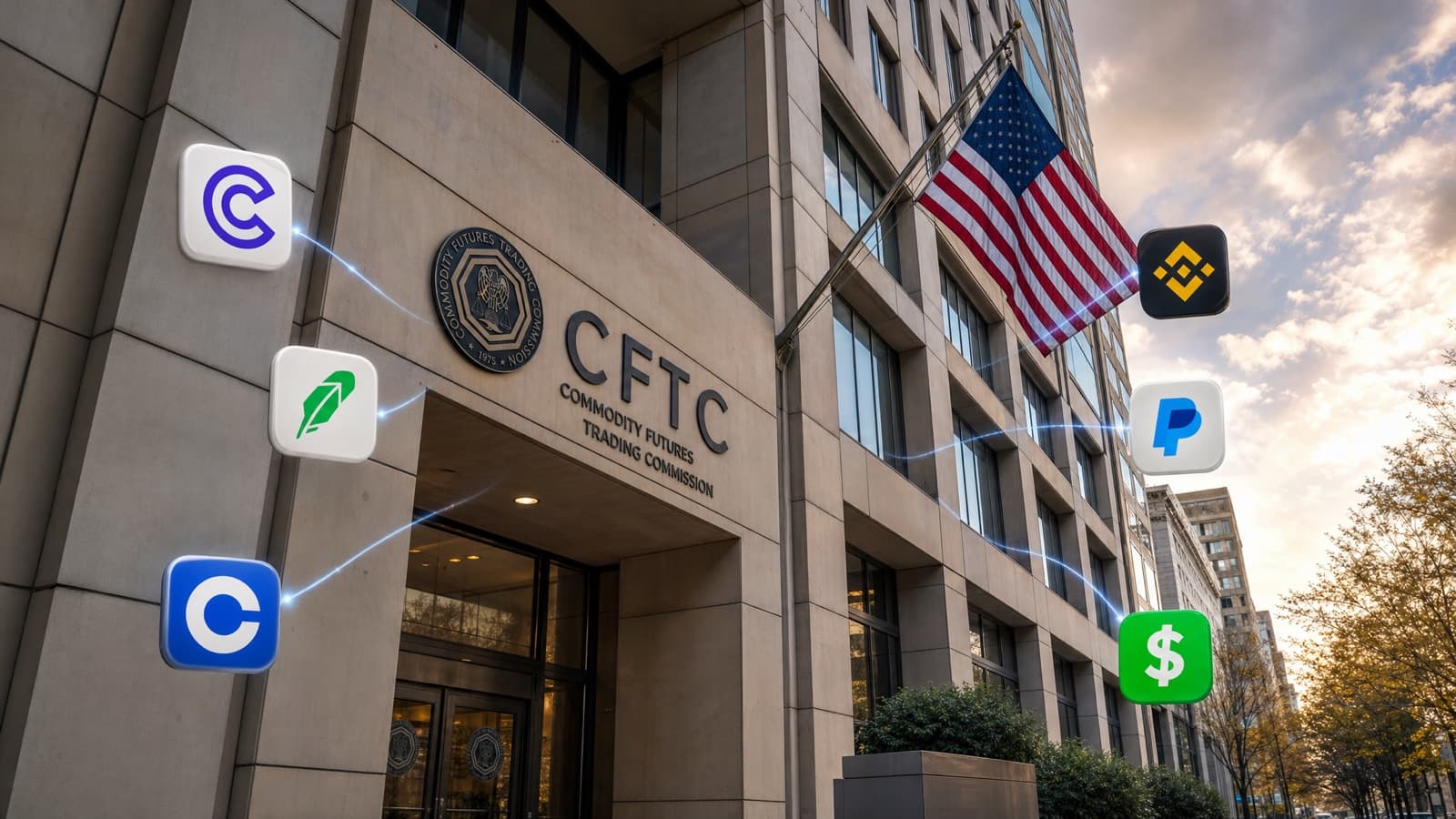
The U.S. Commodity Futures Trading Commission just told developers of crypto wallets, mobile apps, and fintech platforms they no longer need a broker's license to connect users to regulated prediction markets. If you write code that routes traders to a CFTC-registered exchange without ever touching their money, you're exempt from introducing-broker registration.
That's the practical effect of Staff Letter 26-25, the Market Participants Division's September 17 no-action position that extends broker-registration relief from a single company to the entire category of "passive software" providers. A prediction market embedded in any qualifying app is now — legally speaking — much easier to build.
"You could use this to put a prediction market basically anywhere," said Aaron Brogan, founder of Brogan Law, which advises technology companies navigating regulated financial markets. "Anything that can trade on a designated contract market could, in principle, be covered by this."
What the No-Action Position Says
A no-action position is a commitment from the CFTC's Market Participants Division that it will not recommend enforcement against companies or their personnel for a specific activity. It is not a formal rule — it does not create permanent statutory rights and can be withdrawn — but for the companies covered, it functions as a regulatory green light.
Staff Letter 26-25 states that passive software providers connecting users to CFTC-registered futures commission merchants, introducing brokers, and designated contract markets will not face enforcement for operating as unregistered introducing brokers, provided they satisfy the letter's conditions.
The three core requirements are:
- No trade discretion — the software cannot make trading decisions on behalf of users. Every order remains the user's own.
- No custody — the provider never holds user assets. Money flows directly between the user and the registered exchange or broker.
- No volume-based commissions — the provider cannot collect a percentage of trading volume. Fee structures tied to notional trade size are off-limits.
The moment a provider crosses any of these lines — exercising discretion, holding funds, or charging volume-based fees — the relief expires and ordinary introducing-broker registration applies.
The Model That Started It: Phantom Technologies and Kalshi
Staff Letter 26-25 generalizes a framework built first for a single company. In March 2026, the CFTC's Market Participants Division issued Staff Letter 26-09, granting an identical no-action position to Phantom Technologies, Inc., the developer behind the Phantom self-custodial crypto wallet. That letter allowed Phantom to offer its more than 20 million wallet users access to Kalshi's CFTC-regulated event contracts without registering as an introducing broker.
The Phantom-Kalshi integration became the industry's proof of concept: a non-custodial wallet, already used by millions of people for crypto transactions, became a seamless front-end to a regulated prediction market exchange. Users who had never traded a prediction market encountered one natively inside software they already used.
"In March, Phantom became the first passive software provider to receive no-action relief from the CFTC," Phantom CEO and Co-Founder Brandon Millman wrote on X on September 17. "Now the CFTC has opened that same path to other software providers, and that is a win for the whole industry. This is how it should work: software built to protect consumers, paired with regulated partners, giving more people safe access to the financial services they want."
Why This Changes the Distribution Equation for Prediction Markets
Before Staff Letter 26-09, the regulatory picture for software providers adjacent to futures markets was unsettled. Companies that routed trade orders to futures commission merchants and earned fees — even without taking custody of user funds — could be classified as introducing brokers under Commodity Exchange Act rules. Introducing-broker registration requires capital requirements, compliance infrastructure, ongoing reporting duties, and NFA membership. For most startups, that overhead is prohibitive.
Staff Letter 26-25 replaces that case-by-case uncertainty with a published, self-assessable standard. Instead of each new integration requiring its own bespoke no-action request, any developer building to the passive-software criteria can assess their product against the letter and proceed without pre-approval.
The CFTC confirmed the expansion was motivated by "the growing number of providers operating in comparable circumstances" — language signaling that the agency treats the Phantom model as a repeatable template, not a one-time accommodation.
The broader significance registered immediately. Coinbase Vice Chair Ryan VanGrack wrote on X the same day: "After years of regulatory standstill, we just saw meaningful relief in a matter of hours: SEC Innovation Exemption and CFTC No-Action Relief. The tide has officially turned."
Practical Applications for Prediction Market Access
For the prediction market industry, Staff Letter 26-25 is a distribution story. CFTC-registered designated contract markets — including Kalshi — are now legally connectable as back-ends for any qualifying software provider, without that provider needing to become a registered broker.
The practical possibilities are significant:
- A personal finance app adding a prediction market tab for inflation, interest rate, or sports outcome contracts
- A sports analytics platform embedding live event contracts alongside real-time statistics
- A DeFi protocol offering access to CFTC-regulated event contracts through a non-custodial interface
- A news or media platform building a live-market commentary product on top of real-price data
Phantom's 20-million-wallet reach through Kalshi was one version of this model. The September 17 letter formalizes it as the industry template.
The same day the letter was issued, the Tunica-Biloxi Tribe of Louisiana launched the first tribal nation prediction market app built on Kalshi's infrastructure — the first tribal-owned entrant to the space. The tribe's model — connecting sovereign economic interests to a CFTC-registered exchange — illustrates exactly the kind of novel distribution arrangement the passive-software framework enables.
The Coordinated Regulatory Context
The timing of Staff Letter 26-25 was not coincidental. It arrived the same day the Securities and Exchange Commission issued its own "Innovation Exemption" for tokenized U.S. stocks — a parallel move to reduce registration friction for technology-adjacent financial products at a separate agency. The simultaneous dual-agency action suggested coordinated intent rather than independent timing.
The backdrop matters. Two days earlier, the CLARITY Act — which would have provided comprehensive congressional clarity for crypto and prediction market regulation — failed to advance in the Senate, falling short of the 60 votes needed for cloture. With the legislative path stalled, regulators appear to be pressing forward with narrower, agency-level relief.
For prediction markets specifically, the no-action position is meaningful precisely because statutory clarity may be months or years away. The CFTC stated the position "remains in effect until the Commission finalizes formal rulemaking or issues different guidance" — giving developers a functioning framework while Congress works through the broader statutory debate.
What the Letter Does Not Do
Staff Letter 26-25 is important, but its scope has limits that developers should understand.
It is not a formal rule. Staff no-action positions bind only the Market Participants Division's enforcement discretion — they do not bind the Commission itself, and they can be superseded by future rulemaking or guidance. Developers who build under this letter should track CFTC rulemaking actively.
The letter also does not authorize providers to act as investment advisers, portfolio managers, or market makers. Any product that recommends trades, selects strategies for users, or executes orders without user instruction crosses into territory requiring separate regulatory treatment.
Crucially, the relief does not override state-level requirements. The no-action position protects passive software providers from federal introducing-broker registration. It says nothing about state money-transmission laws, state broker-dealer rules, or other jurisdiction-specific compliance obligations. Developers should assess state-by-state exposure independently.
FAQ
What is a passive software provider under CFTC Staff Letter 26-25? A passive software provider is a company that builds technology connecting users to CFTC-registered derivatives markets — including prediction markets — without taking custody of user assets, exercising discretion over trades, or charging volume-based fees. Providers meeting these conditions no longer need to register as introducing brokers to offer this access.
Does this apply to existing prediction market platforms like Kalshi? No. Kalshi operates as a CFTC-registered designated contract market — it is the regulated exchange itself. Staff Letter 26-25 covers software providers that connect users to Kalshi or similar registered platforms. It does not change Kalshi's own regulatory status or requirements.
How long does the no-action position stay in effect? Staff Letter 26-25 remains in effect until the CFTC finalizes formal rulemaking on this topic or issues different guidance. There is no fixed expiration date, but developers should monitor CFTC rulemaking for changes.
Can any app now offer prediction market access? Any qualifying passive software provider can connect users to CFTC-registered exchanges. Whether a specific product qualifies depends on whether it meets the three core conditions: no trade discretion, no custody of user assets, and no volume-based commissions.
What was Staff Letter 26-09? Staff Letter 26-09, issued March 2026, was the original no-action position granted to Phantom Technologies, Inc. for its self-custodial crypto wallet. It allowed Phantom to integrate access to Kalshi's prediction market platform for its 20 million-plus users without registering as an introducing broker. Staff Letter 26-25 extends the same framework to all qualifying providers.
Conclusion
A single CFTC staff letter lowered the regulatory floor for building prediction market access into any software product. The conditions are straightforward: no discretion, no custody, no volume-based fees. What was previously a case-by-case letter process is now a published, self-assessable standard.
For a market that has spent 2026 fighting state regulators in federal courts across the country, this is quiet but meaningful forward motion. The prediction market distribution wall just got significantly shorter.
Explore live event contracts and market data at PredictionMarkets.US.
Sources & Verification
- CFTC Staff Letter 26-25, no-action position for passive software providers: CFTC.gov press release, September 17, 2026 — verified September 18, 2026
- Bloomberg report on CFTC expansion of passive software relief: cited in PYMNTS, September 17, 2026 — verified September 18, 2026
- Brandon Millman (Phantom Technologies CEO) statement: X / Twitter, September 17, 2026 — quoted in PYMNTS and multiple outlets — verified September 18, 2026
- Ryan VanGrack (Coinbase Vice Chair) statement: X / Twitter, September 17, 2026 — quoted in PYMNTS — verified September 18, 2026
- Aaron Brogan (Brogan Law) quote on scope of relief: ReadWrite, September 18, 2026 — verified September 18, 2026
- Seeking Alpha, CFTC prediction market expansion coverage: Seeking Alpha, September 17, 2026 — verified September 18, 2026
- Tunica-Biloxi Tribe Kalshi partnership: Yahoo Finance / NYT DealBook, September 18, 2026 — verified September 18, 2026