
How Prediction Markets Are Upstaging Traditional Election Polls in 2026
Bloomberg called it: prediction markets have upstaged traditional polls. Here's what the evidence shows and what the critics get right.
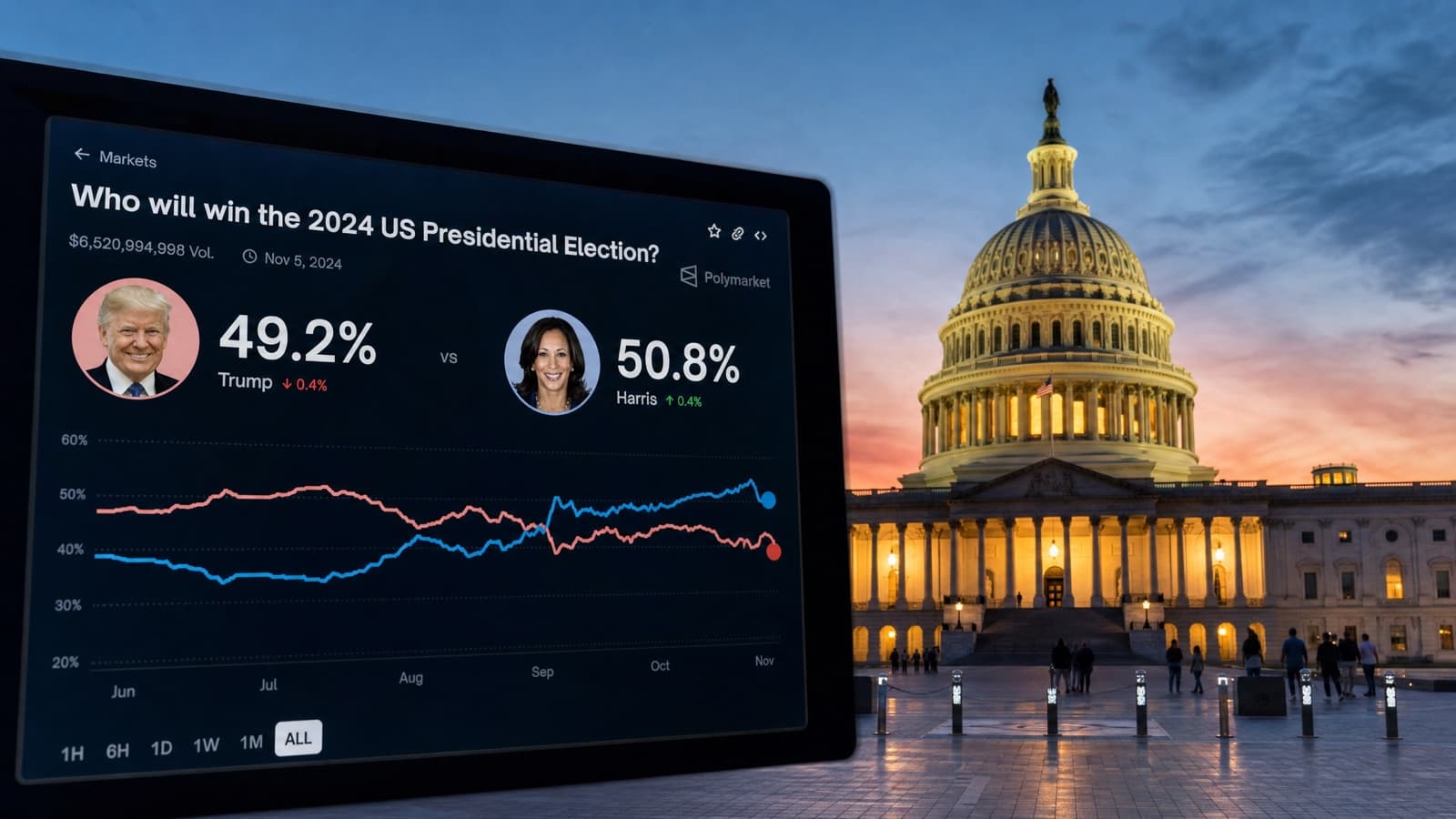
Something significant is happening to the way American voters, donors, campaigns, and newsrooms follow elections. Where they once looked exclusively to polling averages and punditry for a read on a race, a growing number now turn first to prediction market prices from platforms like Kalshi and Polymarket.
Bloomberg named it plainly in a report published Sunday: "How Prediction Markets Upstaged Election Polls." The piece — which landed as the 2026 midterm cycle reaches its most volatile stretch — covers a fundamental shift in how political information flows. Trading volume has surged, media partnerships have multiplied, and the prices set by these markets increasingly shape public conversation about who is winning.
This is not a niche development. It is a structural change in the political information ecosystem. Here is what you need to know about how it happened, what the evidence says, and what the legitimate criticisms are.
The Rise of Federally Regulated Election Markets
Prediction markets are not new. But Kalshi's landmark 2024 federal court victory — which secured its right to list election event contracts under CFTC oversight — fundamentally changed the landscape. Both Kalshi and Polymarket now operate as CFTC Designated Contract Markets, giving their election contracts the same legal standing as other federally regulated financial instruments.
Since that ruling, the volume of money traded on election outcomes has grown to a scale that commands serious attention. NBC News analyzed 1,408 open markets on Kalshi and Polymarket this year and found nearly $200 million in trading volume on midterm election outcomes alone. That figure has grown since July. By any measure, these are no longer toy markets for political junkies — they are liquid, regulated instruments pricing real-money bets on the composition of the next Congress.
Kalshi lists political markets at zero fees, making election trading unusually accessible compared to its other product categories. The platform's dedicated Midterms Hub aggregates House races, Senate races, governor contests, and chamber-control contracts in a single interface designed for political followers, not just financial traders.
What Makes Prediction Market Prices Useful
The core argument for prediction markets as a forecasting tool is the wisdom-of-crowds mechanism. When someone bets real money on an outcome, they have a financial incentive to be accurate. Traders who are wrong lose money. Traders who are right profit.
This differs fundamentally from a poll, which asks voters who they plan to vote for and must grapple with social desirability bias, low response rates, and the challenge of modeling likely voter turnout. Prediction markets sidestep that process: they ask what people with real money on the line believe will actually happen.
Calibration is the technical standard for how well market prices match actual outcomes. A well-calibrated market produces prices where events given a 75% probability occur roughly 75% of the time. Kalshi's head of communications Elisabeth Diana pointed NOTUS to a Washington Post analysis of 2,000 primary election markets that found markets were generally accurate at this distributional level — despite several high-profile individual misses.
A 2025 Vanderbilt University study of Polymarket's 2024 presidential-election pricing found that the platform's implied odds outperformed traditional polls, particularly in swing states. Researchers suggested that the broader demographic reach of prediction market traders — compared to narrowly sampled polling firms — partially accounts for the advantage.
Tufts University researchers, writing in July 2026, framed it precisely: prediction markets "may be more like a political futures market: fast, data-rich and potentially valuable." The markets incorporate new information continuously, adjusting prices within minutes of a new development — a speed no polling firm can match.
Where Markets Have Gotten It Right
The 2026 primary season has produced real-world calibration data. In the South Carolina Senate Republican primary runoff between Sen. Darline Graham and Rep. Ralph Norman, Kalshi saw more than $25.7 million in trading activity. The platform projected Graham's odds at approximately 56% when polls closed — and she won.
This is the pattern markets do best: large-volume, heavily-covered races where significant public information has already been priced into trader positions. When enough informed participants are trading, the market functions as a weighted aggregator of their collective knowledge.
Media organizations have drawn the same conclusion. CNBC, CNN, and The Wall Street Journal have all signed formal partnerships with prediction market platforms to integrate live odds into their election coverage. Individual politicians have followed. Alaska Senate candidate Mary Peltola cited her Kalshi market probability — projecting a 57% chance of winning — directly in a campaign fundraising appeal to donors.
Kalshi has also paid social media influencers to promote its market data. Gunther Eagleman, a conservative poster with 1.7 million followers, is a formal platform partner. The explicit message: market odds are a credible complement — and in some cases a challenger — to traditional poll-based forecasting.
Where Markets Miss
The same primary season has produced notable failures. In Florida's Democratic Senate primary, Kalshi projected that state Rep. Angie Nixon had a single-digit probability of winning. She won by a wide margin — the Associated Press called the race as polls closed.
In Wisconsin's Democratic gubernatorial primary, markets (like traditional polls) projected David Crowley as a long-shot candidate. Crowley won outright.
Charles Franklin, director of the Marquette Law School Poll, identified the structural problem in an interview with NOTUS: prediction markets draw from "a wildly unrepresentative sample of the public." Traders are not voters. The platform user base skews heavily toward educated, politically engaged, financially comfortable individuals — the same people already plugged into public polling, news cycles, and insider chatter. When a race involves a candidate or constituency that those traders know poorly, the market lacks the signal to price correctly.
Democratic strategist Eddie Vale, who worked on Crowley's campaign in Wisconsin, put it more bluntly: "It appears that there really aren't any predictions here, they're just reacting belatedly to public information, like polls and news stories."
University of Iowa researchers comparing Iowa Electronic Markets and Kalshi congressional market forecasts found that both markets largely reflected conventional polling wisdom and produced similar price distributions. The implication: for many races, prediction markets efficiently incorporate polling information rather than independently generate new forecasts.
The Manipulation Question
The fake-polling incident of August 2026 raised the industry's most uncomfortable question: how easily can prediction market prices be moved by bad information?
NPR reported that a polling outlet calling itself Median Strategies published fabricated election polls — a stunt that set off alarm bells precisely because prediction market platforms are known to respond quickly to new data. The fear was that someone might manufacture fake polls to move market prices and profit from the swing.
The actual result was more reassuring than feared. Neither Kalshi nor Polymarket found that the man behind the fake polls — later identified by The Guardian as Rahil Prakash — had placed trades on the affected races. More pointedly, Kalshi argued the non-reaction vindicated the mechanism itself. "Fake polling is a poignant example of why election markets are so important: they're a filter for misinformation," Kalshi spokesman Jack Such told NPR. "Traders lose money if they act on bad information. While news outlets and campaigns touted the poll as real, the markets barely reacted at all."
A harder problem has been insider trading by people with genuine access to private campaign data. NPR reported that campaign staffers have used prediction markets to profit from information they hold about their own candidates. Kalshi says it has already blocked dozens of political staffers from trading on their own races — but the policy relies on self-disclosure, and enforcement has limits.
Amanda Fischer, chief policy officer at Better Markets, summarized the systemic concern: "These markets are very easily manipulated, and the platforms say they invest in surveillance and catch people after the fact, but when it comes to elections, the consequences are really grave."
The Brennan Center for Justice raised a related risk in a June 2026 report: when actual election results diverge from market prices, those prices could be used to amplify false claims of election fraud. In a low-trust political environment, that is not an abstract possibility.
What the 2026 Midterm Markets Show Right Now
As of September 2026, both Kalshi and Polymarket show Democrats as heavy favorites to take the House and clear favorites to take the Senate — a position that has moved sharply over the past three months.
Kalshi's House control market prices Democratic control at approximately 91%, with Republicans at roughly 9%. The Senate control market gives Democrats approximately 60% and Republicans 40%. A Democratic sweep of both chambers is priced near 59% on Kalshi — the highest level recorded for that contract.
These numbers represent a dramatic shift from where markets opened the year. The House contract alone has seen more than 22 million contracts traded. Whether these prices will prove correct in November remains the central question. What is beyond dispute is that they are now part of how campaigns, donors, and newsrooms read the political environment in real time.
FAQ
Are prediction markets more accurate than polls? The evidence is mixed. Studies including a 2025 Vanderbilt University analysis and calibration research cited by Kalshi suggest markets track outcomes well in large, high-volume races. They have notable misses in down-ballot primaries with less trader familiarity. The fairest answer: prediction markets offer a different type of signal — one that is faster and continuously updated — rather than a clean replacement for polling.
Can prediction market prices be manipulated? Platforms maintain manipulation-detection systems. The August 2026 fake-poll incident showed that markets with sufficient volume can resist disinformation. The longer-term concern is insider trading by people with genuine access to private campaign information — a problem Kalshi addresses by barring political staffers from trading on their own races, though enforcement has limits.
Where can I track 2026 midterm prediction market prices? PredictionMarkets.US aggregates live election market data from Kalshi and Polymarket in one place, letting you compare implied probabilities across both platforms in real time for House, Senate, governor, and balance-of-power markets.
Are election prediction markets legal in the United States? Yes. Both Kalshi and Polymarket operate as CFTC Designated Contract Markets, giving their election event contracts full federal authorization for U.S. traders.
Do prediction market platforms charge fees on election markets? Kalshi charges zero fees on political event markets, making election trading unusually accessible compared to its other product categories.
The Bottom Line
Bloomberg's report is a milestone, not a prediction. The fact that a major financial-media organization dedicated a reported feature to how prediction markets have displaced polls as a political-information source confirms something the industry has been arguing for two years: these markets have moved from novelty to infrastructure.
That does not make them infallible. The criticisms — unrepresentative traders, manipulation risk, potential to amplify election-integrity misinformation — are real and deserve ongoing scrutiny. The fake-poll scare showed that concerns about gaming the markets are not paranoid.
But the volume numbers tell a clear story: nearly $200 million in midterm trading, more than 22 million House contracts traded, campaigns using market odds in fundraising appeals, major news networks building live-odds displays into their election coverage. Whether prediction markets ultimately outperform traditional polling models at scale, they have already become a primary source of political information for a significant and growing share of the American electorate.
Sources & Verification
- Bloomberg, How Prediction Markets Upstaged Election Polls — September 20, 2026
- NOTUS, Political Operatives Warn Campaigns: Don't Trust Prediction Markets — August 26, 2026
- NPR, What a fake poll reveals about worries around prediction markets and the midterms — August 28, 2026
- Tufts University, Could Prediction Markets Replace Election Polling? — July 31, 2026
- Votebeat, How prediction market odds could influence the 2026 midterm elections — August 10, 2026
- The Hill, Prediction market users spend nearly $200 million on midterm election bets — July 13, 2026 (citing NBC News analysis)
- Brennan Center for Justice, In Election Betting, Voters Face the Highest Stakes — June 30, 2026
- University of Iowa IEM, Forecasting 2026 Congressional Control: A Comparison of IEM and Kalshi
- Kalshi.com, House elections markets — live market prices, verified September 21, 2026
- GZERO Media, Are prediction markets the new polls? — September 15, 2026