
Baltimore Sues Kalshi, Polymarket, and Their Distribution Partners in Historic Prediction Market Lawsuit
Baltimore sues Kalshi and Polymarket over unlicensed sports betting, making history by naming Coinbase, Robinhood, and Webull as co-defendants.
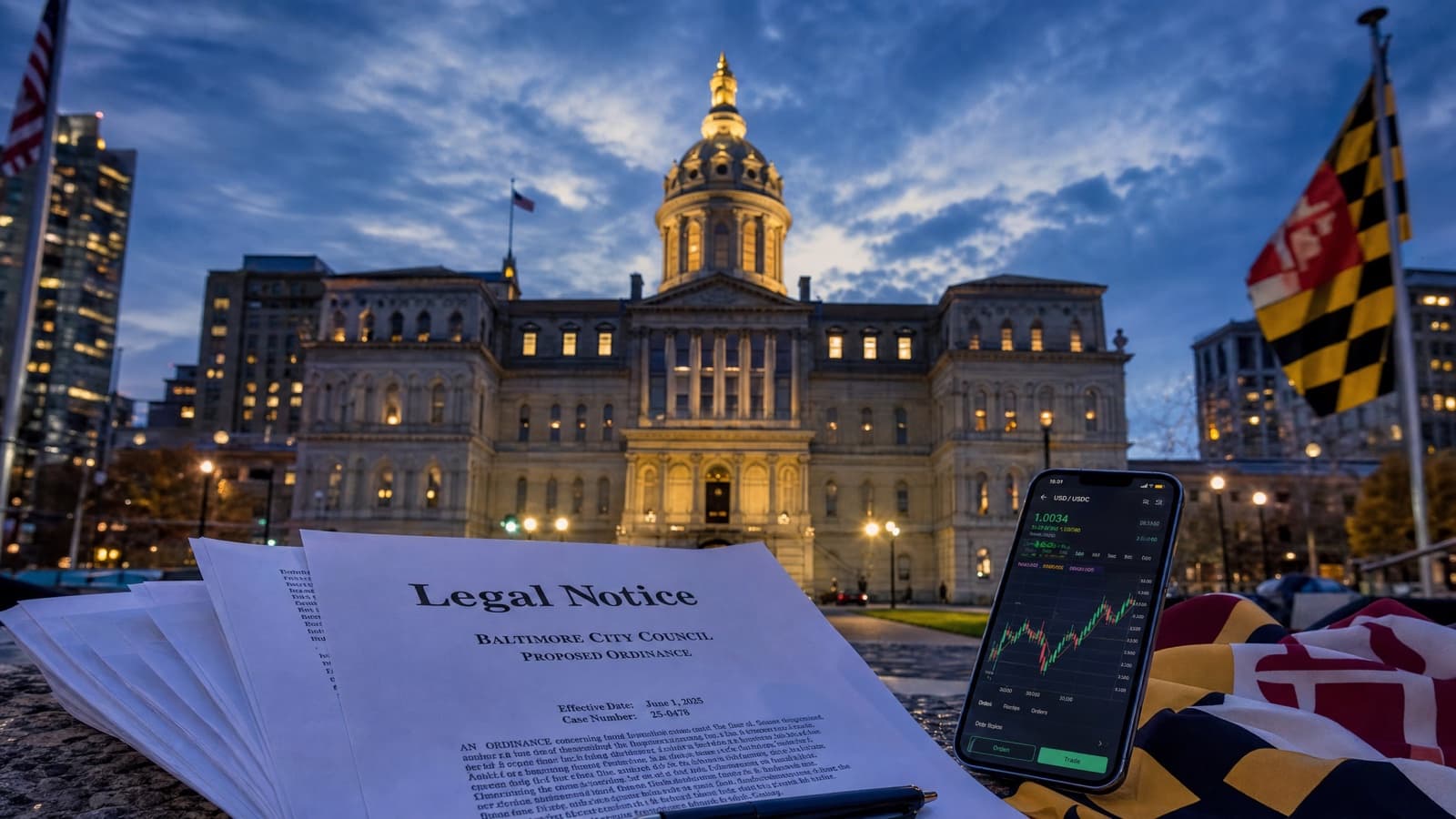
In the space of one week, New York City launched a marketing investigation, New York's attorney general filed civil charges, and now Baltimore has entered the fight — becoming the first city government to name the distribution partners of prediction market operators as co-defendants.
Mayor Brandon M. Scott and the Baltimore City Council filed separate lawsuits on August 13, 2026, in Baltimore City Circuit Court targeting Kalshi and Polymarket for allegedly operating illegal, unlicensed sports-betting platforms. What sets Baltimore's action apart from every prior government lawsuit: the Kalshi complaint also names Robinhood, Webull, and Coinbase — the consumer apps that put Kalshi's sports contracts in front of millions of everyday users.
The prediction market industry's multi-front legal war just opened a new front: the distribution layer.
What Baltimore Filed
Baltimore's two lawsuits rest on the city's Consumer Protection Ordinance (CPO), not state gambling law — a legal theory designed to hold the platforms accountable at the local level even while federal jurisdiction is contested in higher courts.
The complaints allege that both Kalshi and Polymarket:
- Operate unlicensed sports betting platforms without authorization from the Maryland Lottery & Gaming Control Agency, the body that licenses sports wagering operators in the state
- Mislead consumers about the legality and regulatory status of their products
- Expose vulnerable populations — including minors and people with gambling disorders — to financial harm, partly by setting a minimum age of 18, while Maryland requires sports bettors to be 21 or older
"These companies are running sportsbooks without licenses and betting that a new label will put them above the law," Mayor Scott said. "It won't. Baltimore will not let multibillion-dollar companies put profits over people and harm our communities through illegal gambling."
Baltimore City Solicitor Ebony Thompson added a sharp legal frame: "Kalshi and Polymarket cannot circumvent Baltimore's consumer protections by repackaging gambling as something else or claiming federal regulation puts them beyond the reach of our laws."
The city is seeking civil penalties of up to $1,000 per violation per day, full restitution for affected consumers, disgorgement of proceeds obtained through allegedly unlawful activity, and an injunction blocking both platforms from accepting transactions from Baltimore residents.
The Distribution Partner Gambit — First Time Coinbase, Robinhood, and Webull Are Named
The Kalshi complaint goes further than any prior state or local action by pulling Kalshi's consumer distribution partners in as defendants: Robinhood Markets, Robinhood Derivatives, Webull Corporation, Webull Financial, and Coinbase Financial Markets.
The legal theory is direct: those three applications distribute Kalshi's sports event contracts through their own prediction market products, allowing customers to trade sports contracts without ever leaving their Robinhood, Webull, or Coinbase accounts. Baltimore argues that distributing an allegedly unlicensed gambling product makes the distributor liable alongside the operator.
The city brings eight counts of deceptive and unfair trade practices against the combined Kalshi entity defendants. It also takes specific aim at "combo" contracts — bundled multi-leg event contracts offered through Kalshi and Robinhood — arguing they function identically to parlay bets sold by Maryland-licensed sportsbooks.
This is the first time a government action against prediction markets has pierced the layer separating operators from distributors. Prior suits from New York, Massachusetts, New Jersey, and elsewhere targeted the exchange operators themselves. Baltimore's inclusion of Robinhood, Coinbase, and Webull creates a new legal surface area for an industry that has leaned on the consumer brokerage channel as a primary growth engine.
If a court accepts Baltimore's theory, every consumer app offering prediction market contracts could face city- or state-level consumer protection exposure — not just the licensed exchange sitting underneath them.
Polymarket's Separate Problem: Trading Against Its Own Users
Baltimore's Polymarket complaint names QCX LLC, Blockratize Inc., and QC Tech LLC — the corporate entities that collectively operate Polymarket's U.S. business. The city alleges Polymarket violated Baltimore's CPO through the same unlicensed sports betting conduct, but adds a distinct theory of harm unique to Polymarket.
According to the complaint, Polymarket maintains an internal market-making operation capable of taking positions opposite customers. Baltimore argues this means users may, in some situations, be trading against the platform itself rather than exclusively against other participants — structurally closer to a casino house than a peer-to-peer exchange.
"Allowing prediction market companies to evade gambling laws would set a dangerous precedent far beyond Baltimore," said Adam Levitt, founding partner of DiCello Levitt, the firm representing the city. "These companies cannot be permitted to use new terminology and new technology to operate outside the rules designed to protect consumers and communities."
The market-making allegation is the most pointed public accusation of principal trading in the prediction market industry to date. Even if the claim fails in court, it raises questions about Polymarket's market structure that regulators and institutional participants will track closely.
Live market view — will Congress ban sports prediction markets in 2026?
How This Fits Into the National Legal War
Baltimore's lawsuits add to a national wave now exceeding 20 legal actions against prediction market operators. States and local governments are not waiting for Congress or the CFTC to resolve the federal preemption question — they are filing under consumer protection laws and state gambling statutes, forcing platforms to defend on multiple fronts simultaneously.
Baltimore joins: New York Attorney General Letitia James (civil operations lawsuit, July 2026), the New York City Council (marketing investigation, August 12-13, 2026), Massachusetts, New Jersey, Wisconsin, Rhode Island, Minnesota, and Utah — which produced the first federal district court ruling to side with a state against Kalshi on Commodity Exchange Act preemption in August 2026.
The Fourth Circuit Court of Appeals — which covers Maryland, Virginia, West Virginia, North Carolina, and South Carolina — is the appellate court currently weighing the Maryland state case that preceded Baltimore's city action. Kalshi's response explicitly referenced this: the company called Baltimore's suit "an effort to relitigate the same case that's currently under appeal before the Fourth Circuit."
That framing matters. If the Fourth Circuit rules on preemption before Baltimore's case advances, that ruling could significantly shift the landscape — either validating Kalshi's federal-preemption defense across the region or opening the door for the city's CPO theory to proceed.
The preemption question — does the Commodity Exchange Act prevent states and cities from regulating CFTC-registered prediction markets as gambling? — remains unresolved at the appellate level, with different federal circuits producing conflicting signals.
What the Platforms Say
Both companies rejected Baltimore's legal theory in statements issued the same day the suits were filed.
Kalshi: "This is nothing more than an effort to relitigate the same case that's currently under appeal before the Fourth Circuit. It's clearly political theater by Mayor Scott. Kalshi is not violating any consumer protection laws; it's operating lawfully under the exclusive jurisdiction of its federal regulator. We look forward to defending these claims in court."
Polymarket: "City-specific action runs counter to the CFTC's established framework for regulating prediction markets. As courts have recognized, prediction markets on CFTC-registered exchanges are governed by federal law, not a patchwork of state and local rules."
Both arguments rest on the same foundation: CFTC oversight of their respective operations preempts state and local gambling regulation under the Commodity Exchange Act. This preemption argument has produced mixed results across jurisdictions — Kalshi successfully beat preliminary injunctions in several circuits, but courts in New York's Second Circuit have been less favorable, and Utah's ruling in August 2026 marked the first full preemption-denial from a federal district court.
Baltimore's CPO-based theory adds a third legal lane: neither pure gambling regulation nor CEA preemption, but municipal consumer protection law — territory no appellate court has addressed directly in the prediction market context.
What's at Stake for Platforms and Their Partners
Baltimore's lawsuit introduces three risks that prior state actions did not:
1. Distribution partner liability. If a court finds that Robinhood, Coinbase, or Webull face consumer protection liability for offering Kalshi's sports contracts, it creates incentives for those platforms to restrict prediction market features in jurisdictions with elevated legal exposure. Kalshi's growth has relied heavily on these channels — a Robinhood or Coinbase pullback in any major city would be a meaningful distribution loss.
2. Market-making transparency. The Polymarket allegation puts internal trading desk operations into public court filings for the first time. Whether or not it succeeds legally, it surfaces a structural question that regulators and institutional counterparties will not ignore.
3. The municipal template. Baltimore's use of the CPO rather than state gambling law signals a potential playbook for other cities. Municipalities in states without favorable prediction market legislation could pursue similar consumer protection theories — creating a decentralized wave of city-level actions that is harder for platforms to consolidate and defeat at the appellate level than a single state court fight.
The prediction market industry is well-capitalized and has successfully beaten emergency injunctions in multiple circuits. But litigating simultaneously across 20+ state courts, multiple federal appellate courts, and now city circuit courts represents a legal overhead that no CFTC registration eliminates.
Frequently Asked Questions
Can Baltimore actually stop Kalshi and Polymarket from operating there? Baltimore is seeking an injunction, but courts have generally been reluctant to grant emergency relief against prediction markets pending trial. A permanent injunction would require Baltimore to win on the merits, which is a longer litigation path. Kalshi has successfully blocked preliminary injunctions in prior state cases.
Why are Coinbase, Robinhood, and Webull named in the Kalshi suit but not the Polymarket suit? Because Kalshi's distribution partners embed Kalshi's contracts directly inside their consumer apps, making them active participants in the distribution chain. Polymarket's U.S. operations run through QCX LLC on Polymarket's own platform, without the same consumer-brokerage embedding structure.
Does this affect operations outside Baltimore City limits? Baltimore's authority extends to Baltimore City. The Maryland Lottery & Gaming Control Agency holds statewide licensing jurisdiction, but Baltimore is not purporting to create a statewide ban — it is seeking to block transactions from Baltimore City residents specifically.
What happens to prediction market contracts already open for Baltimore residents? The complaint does not seek to void existing contracts. The relief requested is forward-looking: stopping future transactions and imposing penalties for past conduct.
Where does the national legal battle stand? With more than 20 active lawsuits and three federal circuits engaged, the courts are producing conflicting signals on preemption. The CLARITY Act — which would explicitly authorize sports event contracts under federal law — has a September 15 cloture vote in the Senate. Congressional action remains the cleanest resolution path for the industry, but legislative timing is uncertain.
The Bottom Line
Baltimore's lawsuit is the most legally ambitious municipal action against prediction markets to date. It targets the distribution layer that prior government actions left alone, raises a market-making allegation against Polymarket that goes beyond the typical "it's gambling" claim, and deploys municipal consumer protection law rather than state gambling statutes — a legal approach courts have not yet addressed at the appellate level.
For Kalshi's distribution partners specifically, the filing is a warning shot: partnering with a federally regulated prediction market does not automatically insulate a consumer application from city- or state-level enforcement.
Track the full regulatory landscape for prediction markets — including live odds on the sports prediction market ban, the CLARITY Act, and state-level enforcement actions — at PredictionMarkets.US.
Sources & Verification
- Baltimore Consumer Protection Ordinance lawsuit against Kalshi and affiliates; Mayor Scott and City Solicitor Thompson statements: CBS Baltimore, August 13, 2026 — verified August 14, 2026
- Robinhood, Webull, Coinbase named as co-defendants; eight counts of deceptive trade; "combo" parlay argument; penalties and injunctive relief sought: Maryland Daily Record, August 13, 2026 — verified August 14, 2026
- Mayor Scott quote and city council filing; minimum age disparity (18 vs 21); DiCello Levitt attorney statement: WBAL-TV 11 News, August 13, 2026 — verified August 14, 2026
- QCX LLC, Blockratize Inc., QC Tech LLC named in Polymarket complaint; Polymarket internal market-making allegation; Kalshi and Polymarket responses: Baltimore Sun, August 13, 2026 — verified August 14, 2026
- 20+ lawsuits nationally; context of NYC AG, NYC Council, Maryland Fourth Circuit appeal: CBS Baltimore, August 13, 2026 — verified August 14, 2026