
The 2028 Democratic Primary Has a New Front-Runner. Traders Keep Changing Their Minds.
AOC and Ossoff are trading places at the top of Kalshi and Polymarket's 2028 Democratic primary markets. Neither has declared. One says he won't run.
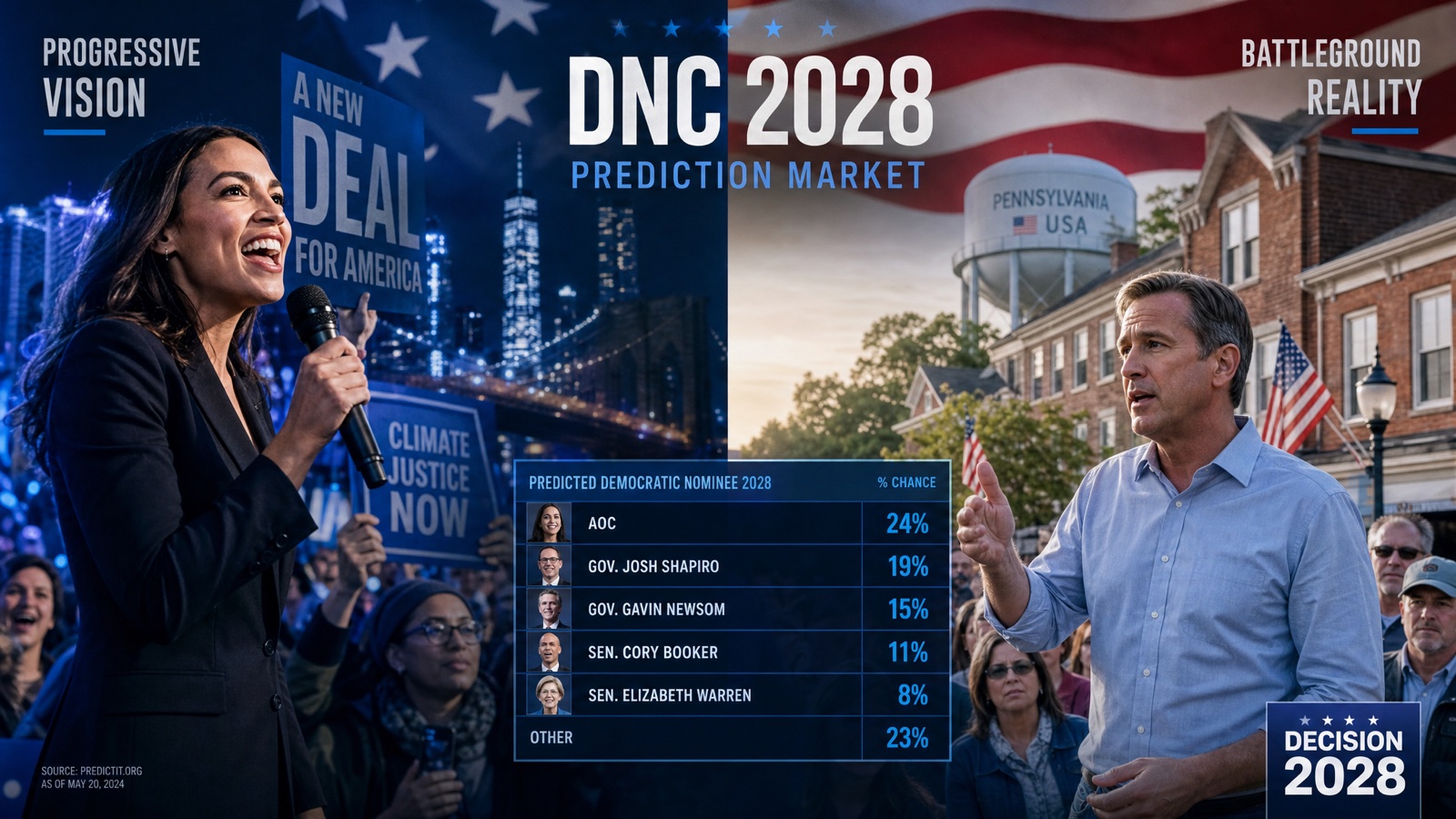
Alexandria Ocasio-Cortez and Jon Ossoff are trading places at the top of the 2028 Democratic presidential primary market. Neither has announced a run. One has explicitly said he won't. And yet traders on the two largest CFTC-regulated prediction market platforms have moved nearly $1.5 billion into contracts on who will be the next Democratic nominee — more than any non-election market in history.
The crowd no longer sees Gavin Newsom as the inevitable heir to the Democratic Party. That decision was made months ago. The open question now is who has replaced him — and what, if anything, the markets actually know this far out.
What the Markets Are Saying Right Now
As of September 2, 2026, the Polymarket Democratic presidential nominee contract shows:
- Alexandria Ocasio-Cortez: 20%
- Jon Ossoff: 16%
- Gavin Newsom: 15%
- Kamala Harris: 8%
- Pete Buttigieg: 5%
The contract has drawn more than $1.27 billion in total volume on Polymarket alone.
On Kalshi, the largest CFTC-designated contract market for prediction trading in the United States, the 2028 Democratic nominee contract — which has 48 individual candidate markets — shows Ocasio-Cortez at roughly 17%, with Ossoff trading close behind. Kalshi's volume on this contract has approached $200 million.
Neither of those figures would have seemed plausible six months ago. In December 2025, Newsom held a market-leading position north of 30% on Polymarket. Ossoff was in the low single digits. Ocasio-Cortez had not yet crossed 15%.
The reversal has been one of the more dramatic market repricings of the current cycle.
AOC — The Progressive Lane
Ocasio-Cortez has not declared a presidential candidacy. She has also not ruled one out.
In late August, the Democratic Socialists of America confirmed that her membership in the national organization — which had lapsed since 2019 — had been renewed. The DSA issued a statement acknowledging the renewal, noting that "ongoing discussions about the 2028 presidential campaign" had prompted their disclosure. Political observers interpreted the timing as deliberate.
"The timing of her renewal, right as various DSA chapters float her for 2028 and the national organization gears up its endorsement process, isn't a coincidence," Matt Klink, a Republican campaign consultant, told Newsweek. "It's a rebrand."
Her market trajectory tracks her public profile. When former Vice President JD Vance publicly predicted in July that AOC would be the Democratic nominee, her Polymarket price jumped from 9% to 14% within days. When former Transportation Secretary Pete Buttigieg and Kamala Harris surged in polling, her price dipped. The market is sensitive to every signal.
What traders are pricing is a candidate who has a clear ideological lane, a national fundraising network built over years of congressional prominence, and a primary electorate that, in recent cycles, has trended younger and more progressive. The 2026 midterm primaries have reinforced that trend, with several DSA-backed candidates winning congressional primaries in New York and beyond.
Ossoff — The Candidate Who Says He Isn't Running
Ossoff's market trajectory is harder to explain on its face. He has been explicit about his intentions.
"I have zero interest in running for president in 2028, and frankly zero interest in the 2028 fantasy football right now," he told MS Now in August.
That has not moved the market much. Traders pushed his Kalshi price from roughly 4.5% in February 2026 to a peak above 18% in late August, before settling back to the mid-teens. The Daily Beast noted in late August that Ossoff had officially passed both Newsom and Ocasio-Cortez on Kalshi at that point, an occurrence that surprised most political observers.
What traders appear to be pricing is not the candidate Ossoff says he is — a Georgia senator focused on reelection in a competitive state — but rather the candidate he could become if political circumstances align.
The argument for Ossoff is structural. He won election and reelection in Georgia, a genuine battleground state. He is young. He has a record of winning the kinds of voters that Democrats need in November. His viral campaign speeches against the Trump administration in mid-2026 drove an initial wave of market interest that polling lagged by several weeks.
There is also a conditional logic built into his price. Prediction markets on Kalshi show Ossoff at 92% to win reelection to the Senate — a number that traders are treating as a prerequisite. A successful 2026 defense in a difficult state would strengthen the case for 2028 considerably. Markets are pricing the option, not the certainty.
Newsom's Fall — What Happened
At its peak in late 2025, Newsom commanded the 2028 Democratic primary market the way most frontrunners do: by simple name recognition and a lack of organized alternatives.
His Polymarket price has fallen from above 30% to roughly 15%. The decline has no single cause. A reported DOJ investigation into Newsom's conduct, reported by several outlets in mid-2026, dented his price in June. California's continued association with policy difficulties that swing voters cite — housing costs, public safety, fiscal pressure — has weighed on perceptions of his electability.
More broadly, the market may be pricing something polls have not yet fully captured: Democratic voters who are skeptical that a two-term California governor is the answer to a party that lost to Donald Trump and is trying to rebuild a coalition.
Why the Markets Diverge So Sharply From the Polls
The disagreement between prediction markets and polling is striking and worth understanding clearly.
The polling average compiled by PollsMax from surveys conducted in the past 50 days shows Harris at 27%, Newsom at 14%, Buttigieg at 11%, Ocasio-Cortez at 9%, and Ossoff at 9%. In most national polls, Harris leads, followed by Newsom. Ossoff is not listed in several surveys.
The Emerson College poll conducted July 19-20 found Ocasio-Cortez and Ossoff tied at 13%, behind Newsom at 17% and Buttigieg at 19%. Among likely Democratic primary voters, neither is a clear frontrunner in polling.
Prediction markets price differently from polls for several structural reasons:
Polling measures name recognition as much as preference. Harris leads many polls partly because she is the most recently prominent Democrat — she ran for president in 2019 and was the party's 2024 vice-presidential nominee. Prediction market traders are pricing long-run probability of nomination, which includes the possibility that currently low-name-recognition candidates build networks and coalitions over two years.
Markets price conditional paths. If a candidate wins their 2026 Senate race (Ossoff), or builds a donor network (AOC), or avoids a legal complication (Newsom), the conditional probability of nomination shifts. Traders try to price those contingencies. Polls do not.
Markets are sensitive to narrative momentum. When CNN's Harry Enten highlighted Ossoff's rising profile and the data around his polling surge, Ossoff's market price moved immediately. When Vance name-checked AOC, her price moved. These are not necessarily rational long-term signals — but they reflect what traders believe other traders will do, which is its own kind of information.
The divergence is not evidence that one source is right and the other is wrong. It is evidence that they are measuring different things.
What Could Move These Numbers
The next two years of political developments will compress or expand each candidate's options considerably. Several near-term catalysts stand out:
The 2026 midterms. If progressive DSA-backed candidates outperform in swing districts, it strengthens AOC's argument that her lane extends beyond safe seats. If they underperform, market traders will recalibrate. Ossoff's own reelection in Georgia is the single most-watched individual race for what it signals about 2028.
Candidate declarations. No major candidate has declared for 2028. The field remains open. When the first major Democrat formally announces, the distribution of prices will likely shift sharply as traders recalibrate toward declared versus undeclared candidates.
Harris's positioning. Polling consistently shows Harris with more Democratic support than the markets imply. If Harris builds an early-state campaign infrastructure — something she has not yet done publicly — her Polymarket price of 8% is likely mispriced relative to polls showing her at 27%.
Newsom's legal picture. The DOJ investigation, if it results in significant developments, could effectively remove him from consideration. If it resolves without consequence, his price may recover toward prior levels.
How Accurate Are These Markets at This Stage?
Early presidential primary markets have a mixed track record. There is no precedent for markets this deep, this early, for a cycle this far out. Polymarket's $1.27 billion in volume on the Democratic primary contract is not comparable to any prior market — the infrastructure for this kind of retail political trading simply did not exist before 2025.
What that volume tells us is not the answer — it tells us how many people are thinking about the question. More liquidity means prices are harder to manipulate and more reflective of aggregate trader sentiment. It does not mean traders have access to information that pollsters, donors, and party insiders don't.
The most honest interpretation of the current market prices: Traders believe AOC and Ossoff represent viable pathways to the 2028 nomination. They are less certain about Newsom than they were six months ago. And they are collectively uncertain enough that three candidates trade within 5 percentage points of each other.
That is a genuinely open race — by any measure.
Frequently Asked Questions
Who is leading the 2028 Democratic primary prediction markets? As of September 2, 2026, Alexandria Ocasio-Cortez leads on Polymarket at approximately 20%, followed by Jon Ossoff at 16% and Gavin Newsom at 15%. On Kalshi, Ocasio-Cortez and Ossoff are trading closely in the 17-18% range, with Newsom behind.
Has Jon Ossoff said he's running for president in 2028? No. Ossoff has explicitly said he has "zero interest" in running for president in 2028. Prediction market prices reflect what traders think he might do under future conditions — particularly if he wins reelection in Georgia in 2026 — rather than a declaration of candidacy.
Why do prediction markets show different results than polls? Polls measure current name recognition and stated preference among likely Democratic primary voters. Prediction markets try to price the long-run probability of winning the nomination, which incorporates conditional paths, future events, and trader assessments of who can build a winning coalition over two years. The two measures are not directly comparable.
Is Polymarket available to U.S. users for these markets? The 2028 Democratic primary market described in this article is on Polymarket's global platform, which is not accessible to U.S. users. U.S. users can access political prediction markets through Kalshi, which is a CFTC-designated contract market that includes election and political contracts.
Where can I track these odds in one place? PredictionMarkets.US aggregates live prediction market data across platforms, including Kalshi and other CFTC-regulated venues.
The Bottom Line
Two years before the 2028 Democratic primary begins in earnest, prediction market traders have collectively placed nearly $1.5 billion on the outcome. The market's current verdict is that the race is genuinely open — and that the old hierarchy, with Newsom as the presumptive heir, no longer holds.
Whether that verdict is prescient or premature will depend on events that haven't happened yet: elections, endorsements, investigations, and decisions that candidates themselves haven't made. What prediction markets provide at this stage is not a forecast. It is a real-time measure of what a large, distributed group of traders believes is possible.
Right now, they believe the 2028 Democratic primary is anyone's race.
Sources & Verification
- Polymarket Democratic Presidential Nominee 2028 current prices and volume: Polymarket.com — verified September 2, 2026
- Kalshi 2028 Democratic nominee contract, 48 markets, AOC at 17%: Kalshi.com — verified September 2, 2026
- Ossoff "zero interest" quote, Newsweek Aug 30 context: Newsweek, August 30, 2026
- AOC DSA renewal and 2028 speculation: Newsweek, August 27, 2026
- Kalshi volume approaching $200M, Ossoff as new Kalshi favorite: Federal News Network, August 26, 2026
- Ossoff market trajectory, rose from 4.5% in February to lead Kalshi in August: The Daily Beast, August 27, 2026
- Emerson College poll July 19-20 (AOC 13%, Ossoff 13%, Newsom 17%, Buttigieg 19%): cited in Newsweek, August 27, 2026