
Markets Called Alaska. Florida Had Other Plans.
Markets nailed Alaska's open primary but handed an 8-cent underdog a 12-point win in Florida. What August 18 revealed about market size and accuracy.
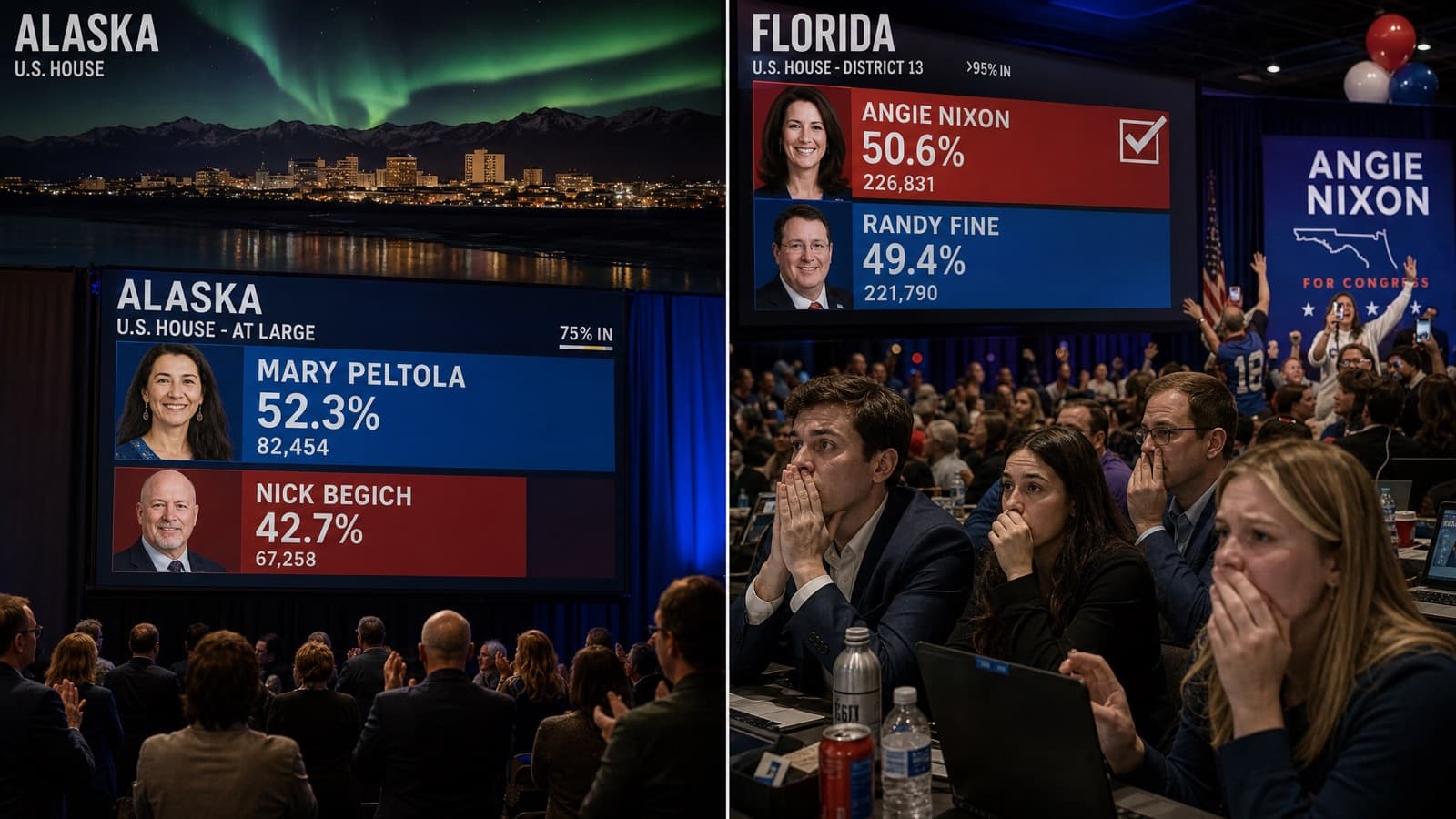
August 18, 2026 handed prediction markets two very different tests in one night. In Alaska, a layered open-primary featuring two candidates named Dan Sullivan resolved almost exactly as traders had priced it — clean, well-calibrated, and informative for November. In Florida, a low-volume Democratic Senate market with $91 cents sitting on the established candidate watched that candidate lose decisively to an 8-cent underdog.
The contrast is more than just dramatic. It is a readable case study in when prediction markets work and when they break down.
Alaska: A Correctly Priced Primary
Alaska's August 18 top-four open primary posed a genuine methodological challenge. The field included Democratic Rep. Mary Peltola, incumbent Republican Sen. Dan S. Sullivan, and — adding real confusion — a second candidate, Daniel J. Sullivan Jr., sharing nearly the same name.
Kalshi's pre-primary market assessed the situation clearly. According to Kalshi's official market data published on election morning, Peltola had a 99% implied probability of advancing from the primary, Dan S. Sullivan stood at 94%, and Daniel J. Sullivan Jr. was assigned a roughly 55% chance to advance.
Final results from the Alaska Division of Elections, with 99% of precincts reported by August 20: Peltola led the field with 48.1% of the vote. Dan S. Sullivan followed at 42.7%, Daniel J. Sullivan Jr. at 2.4%, and independent Scott Kohlhaas at approximately 3.8% — all four advancing to November's ranked-choice general election.
Markets got the primary shape right. Under Alaska's ranked-choice open-primary system, finishing first is largely ceremonial. All four top candidates advance regardless. The market understood this: Kalshi priced Peltola at 93 cents to finish first, which was less meaningful than the more important question of who wins in November. Traders weren't confusing a seeding-round lead with a victory.
Alaska in November: A Coin Flip the Markets Are Not Hiding
After the primary results landed, the Alaska Senate general election market updated modestly. Newsweek reported that on Wednesday morning, Kalshi showed Peltola at 54% and Sullivan at 48%, while Polymarket had Peltola at 52% and Sullivan at 47%. Polymarket's current Alaska Senate Election Winner market has Peltola at 56% and Sullivan at 44%.
This is calibration working. The primary provided new information — Peltola outperformed Sullivan's first-choice vote share by about five percentage points — and the markets absorbed it with a slight lean toward the Democrat while keeping the race squarely in toss-up territory. The RealClearPolitics polling average of available surveys shows Peltola leading by roughly two points.
Alaska's governor race told a similar story. The top-four open primary advanced the candidates markets expected: Democrat Jonathan Kreiss-Tomkins led with 21.6%, followed by fellow Democrat Tom Begich at 20.1%, Republican Bernadette Wilson at 10.4%, and Republican Dave Bronson at 8.4%. The New York Times confirmed all four advances. Polymarket's Alaska Governor Election Winner market now prices Wilson at 35%, Kreiss-Tomkins at 33%, and Begich at 19% — a contested three-way general election correctly foreshadowed by the primary's fragmented result.
Florida: The Miss That Will Define This Week's Postmortem
Florida's Democratic Senate special primary pitted retired Army Lt. Col. Alexander Vindman against state Rep. Angie Nixon, a Jacksonville-based democratic socialist and member of the Florida House.
On election morning, August 18, Kalshi's Democratic nominee market (event KXSENATEFLD-26) priced Vindman at 91.4 cents — roughly a 91% implied probability — and Nixon at approximately 8 cents. Polymarket had comparable pricing: Vindman near 91 cents, Nixon near 8 to 10 cents. Total volume on Polymarket was $262,019; Kalshi's market carried roughly $111,000. For a Senate primary in a major state, those are thin figures.
Results confirmed by the New York Times, NBC News, and CNN on election night: Nixon won the Democratic nomination with 56.1% of the vote to Vindman's 43.9%.
Anyone who bet $100 on Nixon at 8 cents that morning collected roughly $1,150 the next day. The 91-cent holder lost essentially the entire position.
Why the Market Missed
This is the calibration lesson worth understanding. The miss was not random noise; it followed a recognizable pattern with three compounding factors.
Thin volume anchors prices to observable signals. With approximately $110,000 to $262,000 across two platforms, relatively few traders determined the market price. National observers who track fundraising and name recognition dominated the price discovery. Vindman had raised $14.5 million through June. Nixon had raised under $1 million. In a thin market, money raised is the signal most available — and that signal pointed overwhelmingly to Vindman.
Florida Democratic primaries are chronically under-polled. Newsweek noted before the primary that no live polling had captured the race's trajectory with precision. Nixon had briefly surged to roughly 19% on prediction markets following a Miami Herald endorsement in late July before drifting back to 8% by election day — a move that suggests markets were tracking national attention cycles, not ground-level voter intent.
Grassroots organization does not file with the FEC. Nixon's campaign was built on union support and local organizing in Jacksonville, the Tampa Bay corridor, and South Florida communities. These organizing advantages do not appear in campaign finance disclosures or national endorsement tallies. Vindman's $14.5 million told one story. Democratic primary voters in Florida told a different one, 56 to 44.
What Did Not Change: The November Math
Nixon's nomination did not materially shift the general election outlook. Forbes reported after the primary that Polymarket priced Republicans at 89.6% to win the Florida Senate seat in November; Kalshi had Republicans at 92%. The current Polymarket Florida Senate Election Winner market has Ashley Moody at 92% and Nixon at 9%. Kalshi shows a comparable spread.
Moody won the Republican primary with 79.6% of the vote — effectively unchallenged. A University of North Florida poll conducted before the primary showed Moody leading 50% to 42% over Nixon in a hypothetical general matchup. Florida voted for Trump by 13 points in 2024. The math does not swing because the Democratic nominee shifted left; it was already heavily Republican-leaning regardless of who emerged from the August primary.
The primary was a genuine democratic socialist upset. It was not, according to market pricing or polling, a signal that Florida's Senate seat is now competitive.
Volume Is the Signal Inside the Signal
The Florida primary miss points to something prediction market users should track consistently: market size as a proxy for information quality.
Compare the Florida Democratic Senate primary to the Florida Republican governor market. Donalds was priced at approximately 99% on Kalshi with tens of millions of dollars in trading volume — and won with 47.8% in a crowded Republican primary, easily clearing the field. The Republican Senate market, where Moody faced nominal opposition, priced her near 99.9 cents and that is exactly what happened.
In both high-volume Florida races, markets captured outcomes cleanly. In the thin Democratic primary market, they anchored to fundraising ratios and missed the grassroots reality entirely.
Markets aggregate information. When the pool of traders is large and varied — including people with ground-level knowledge of the race — aggregation works remarkably well. When it is small and dominated by national observers reading FEC reports, the aggregate mirrors what those FEC reports say.
The lesson is not to distrust prediction markets. It is to check the volume before you trust the price.
Senate Control: What Comes Next
Both primary nights' results feed into the broader Senate control picture, which remains the most liquid and closely watched midterm market. Current Kalshi and Polymarket pricing has Democrats controlling the Senate at 46.5% (both platforms, per the Polymarket midterms predictions page) and Republicans at 38.5% — a tighter gap than the high-volume individual state markets might suggest.
Alaska is one of several Democratic pickup opportunities on the board. Peltola at 56% in a toss-up state represents one of the cleaner paths to a Democratic Senate seat gain. If the November ranked-choice tabulation breaks her way, it adds meaningfully to the Democratic math.
Florida, by contrast, is effectively off the Senate board. Nixon's historic upset changes the Democratic brand argument in the state; it does not change the Senate probability calculus.
Frequently Asked Questions
What were Kalshi's odds on Angie Nixon before the Florida primary? On election morning, August 18, 2026, Kalshi priced Nixon at approximately 8 cents — roughly an 8% implied probability — while Alexander Vindman sat near 91 cents. Polymarket had comparable pricing. Nixon won with 56.1% of the vote.
Did prediction markets correctly predict the Alaska primary results? Yes, in the ways that mattered. Kalshi gave Mary Peltola a 99% chance of advancing from the August 18 primary and Dan S. Sullivan a 94% chance. Both advanced. The November general election remains priced as a near-coin-flip, with Peltola at roughly 56% and Sullivan at 44% on Polymarket.
Why did prediction markets miss the Nixon upset in Florida? Three factors compounded: thin trading volume (approximately $110,000 to $262,000 across two platforms), chronically under-polled Florida Democratic primaries, and grassroots organizing that does not appear in fundraising disclosures. Markets anchored to Vindman's $14.5 million fundraising advantage and missed Nixon's ground-level support.
Did Nixon's primary win change the November Florida Senate odds? Minimally. Republican Ashley Moody remains the heavy favorite, priced near 90 to 92% on both Kalshi and Polymarket. University of North Florida polling showed Moody ahead of Nixon by 8 points before the primary. Florida's Republican lean in statewide elections makes the general election a stable Republican advantage regardless of the Democratic nominee.
Where can I track the Alaska Senate and Senate control markets? Live Alaska Senate and 2026 Senate control markets are available on PredictionMarkets.US, aggregating data from Kalshi and Polymarket in real time.
Conclusion
One night, two tests. Alaska's multi-candidate open primary came through prediction markets with accuracy — prices moved appropriately on new information, candidates advanced as expected, and the November coin-flip remains clearly priced. Florida's thin Democratic primary market handed an 8-cent underdog a decisive win while its 91-cent favorite lost by 12 points.
The distinction matters more than the headline. Prediction markets are information aggregation tools, and their accuracy is a function of how much information is actually flowing in. Deep-volume markets on well-covered races tend to calibrate well. Thin markets on under-polled primaries can miss badly. Checking the volume before trusting the price is not skepticism about the tool — it is how the tool is meant to be used.
Sources & Verification
- Alaska primary results: Alaska Division of Elections — 2026 Primary Election Results — verified August 22, 2026
- Alaska primary results detail: New York Times — 2026 Alaska Primary Election Results — verified August 22, 2026
- Florida primary results: New York Times — 2026 Florida Primary Election Results — verified August 22, 2026
- Nixon upset confirmed: CNN — Florida primary election 2026 live coverage — verified August 22, 2026
- Nixon upset detail: Forbes — Democratic socialist Angie Nixon scores major upset in Florida Senate primary — verified August 22, 2026
- NBC News primary coverage: NBC News — Florida Primary 2026 — verified August 22, 2026
- Kalshi Alaska Senate primary odds: Kalshi official blog — Alaska Senate primary odds: Peltola and Sullivan heavily favored — verified August 22, 2026
- Polymarket Florida Democratic Senate primary: Polymarket — Florida Democratic Senate Primary Winner — verified August 22, 2026
- Polymarket Alaska Senate general: Polymarket — Alaska Senate Election Winner — verified August 22, 2026
- Polymarket 2026 midterms overview: Polymarket — 2026 Midterm Elections predictions and odds — verified August 22, 2026
- Peltola general election odds post-primary: Newsweek — Mary Peltola vs. Dan Sullivan: Alaska Senate Primary Final Polls — verified August 22, 2026
- Post-primary Alaska market movement: Newsweek — Mary Peltola's chances of beating Dan Sullivan to flip Alaska Senate seat — verified August 22, 2026