
The 2026 Midterms Are 95 Days Out. Here's What Prediction Markets Say Will Happen.
Real-money prediction markets give Democrats an 84% chance of winning the House and Republicans a 55% shot at keeping the Senate. Here's what Kalshi's Midterms Hub is showing 95 days out.
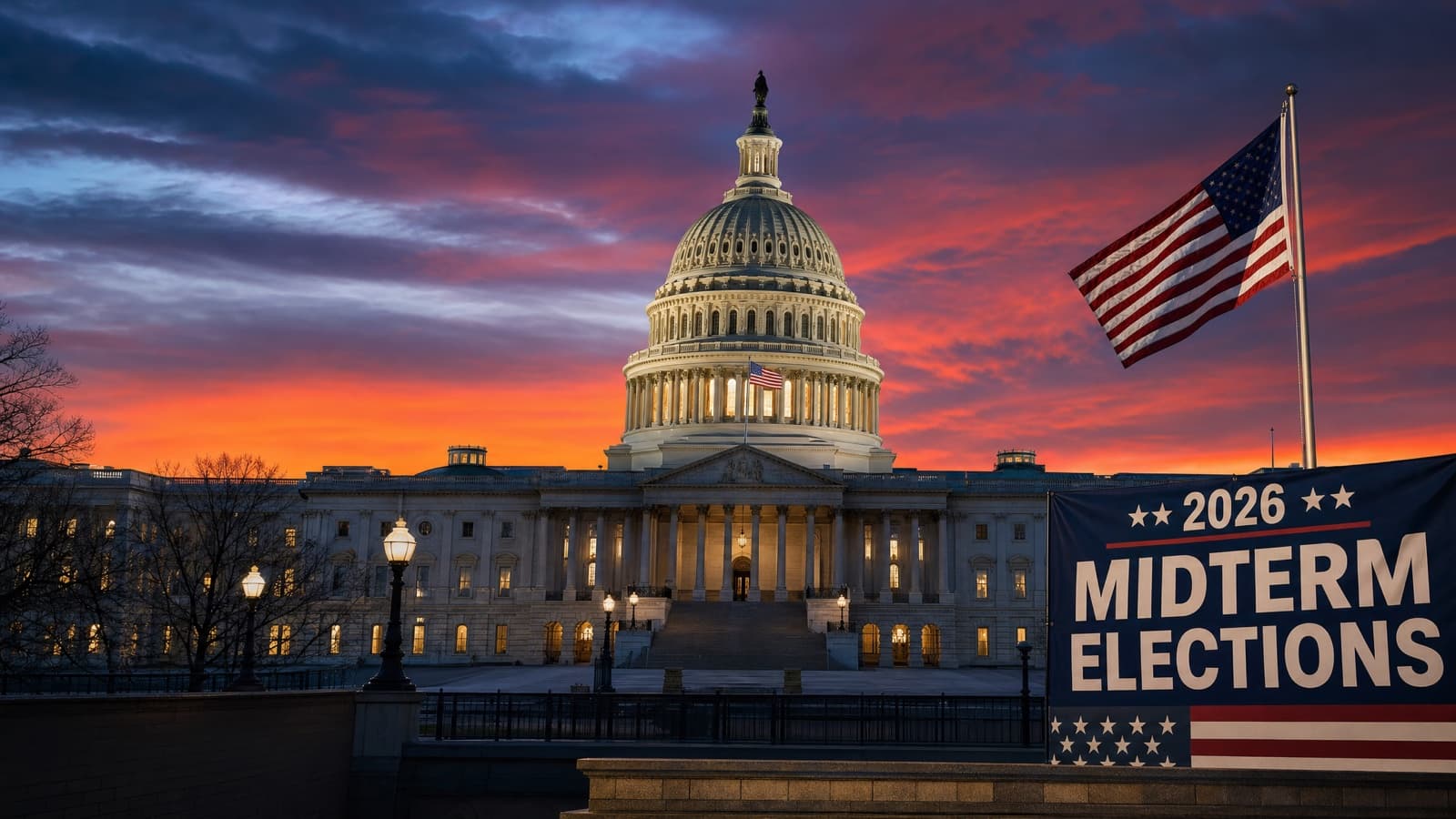
With 95 days until the 2026 midterm elections, prediction markets are generating something traditional pollsters can't: a continuously updated, real-money forecast of which party will control Congress.
Kalshi, the federally regulated prediction market platform, launched its "Midterms Hub" in late July—an interactive tool that combines election market odds with polling averages and Federal Election Commission fundraising data in one place. The platform bills it as "the first election hub of its kind, powered by Kalshi markets."
The headline number, as of August 1: traders give Democrats an 84% chance to control the House and Republicans a 55% chance to retain the Senate—pointing strongly toward divided government.
How Kalshi's Midterms Hub Works
The Midterms Hub isn't just a dashboard for placing bets. Kalshi's own data shows that 75% of site visitors are simply checking odds, while only 25% are actively trading, according to spokesperson Jacki McGavick speaking to The Boston Globe.
The hub provides:
- Live market odds for every competitive House and Senate race across an interactive map
- Polling averages side-by-side with market prices, letting visitors compare the two
- FEC fundraising data for individual candidates
- Curated election news and analysis
"Kalshi was always built to be an information source for people," McGavick told the Globe. "Polling just drops, you know, weekly or every few weeks, depending on the race. [Kalshi] updates instantaneously when someone makes a trade on our platform."
Kalshi first received permission to list contracts on political outcomes in fall 2024, according to Boston Globe reporting. Since then, it has opened a Washington, D.C. office and spent $990,000 on lobbying during the first half of 2026. The total volume of 2026 election trades has already surpassed the entire 2024 election cycle, according to Kalshi's internal data shared with the Globe.
CEO Tarek Mansour framed the distinction in the hub's launch announcement: "Prediction markets don't care about spin or partisanship. They cut through polarization and show you what the wisdom of the crowds actually believes, backed by real money, not rhetoric."
What the Markets Say About Congressional Control
At the big-picture level, Kalshi's markets as of August 1 are projecting one clear outcome: a split Congress.
House of Representatives: Democrats are the strong favorites. Kalshi gives Democrats an 84% chance of winning the House majority in November—a forecast aligned with historical midterm patterns. In 18 of the last 20 midterm elections, the president's party has lost seats in the House. With Republicans currently holding both chambers under a Republican president, the structural headwinds favor Democrats substantially.
Senate: The picture is reversed. Republicans are favored at 55% to retain Senate control. Democrats need a net gain of four seats to reach 51—the threshold for a majority given that Vice President JD Vance would break a 50-50 tie in Republicans' favor. Republicans currently hold a 53-45 majority with two independents, meaning Democrats must run the table on a difficult map.
The most likely single outcome in prediction markets: a split Congress, with Democrats controlling the House and Republicans holding the Senate.
The Four Senate Seats That Could Flip the Chamber
If Democrats want to take the Senate, the path runs through four competitive Republican-held states—and one vulnerable Democratic seat that could complicate the math.
Alaska — Democrats lead at 55%, with former Rep. Mary Peltola challenging incumbent Republican Sen. Dan Sullivan, according to Kalshi market data cited in Newsweek. Polling has been split, with some surveys showing Sullivan ahead and others showing Peltola leading. Markets have priced Peltola as the slight favorite.
Maine — Democrats hold a stronger 64% edge, with Democrat Troy Jackson challenging four-term incumbent Sen. Susan Collins. As of August 1, Kalshi listed Jackson's "Yes" contract at 62 cents, reflecting 62% market probability, per Boston Globe reporting. A University of New Hampshire poll from July showed Jackson leading Collins 49% to 46%.
North Carolina — The clearest Democratic opportunity in the markets. Former Gov. Roy Cooper holds a striking advantage: Kalshi prices Cooper at approximately 90% against Republican Michael Whatley. North Carolina is rated "Lean Democrat" by the Cook Political Report, and polling has consistently shown Cooper ahead by margins of four to seven points.
Ohio — The tightest race. Kalshi gives Democrat Sherrod Brown an essentially even 50% chance against Republican Sen. Jon Husted—a genuine toss-up. Ohio has drifted Republican in recent presidential cycles, but Brown has a long track record of winning statewide, which keeps the market balanced.
The Michigan Wildcard: Democrats cannot simply flip four Republican seats. They must also defend Michigan, where the market on Kalshi's platform as of August 2 shows a nearly deadlocked race: Republican Mike Rogers at 44% against Democrat Abdul El-Sayed at 43%. El-Sayed has not yet secured the Democratic nomination—the Michigan Democratic primary is scheduled for August 4—but prediction markets already give him a 97% chance of winning the primary over challenger Haley Stevens, according to Newsweek reporting from August 1.
If Democrats flip Alaska, Maine, North Carolina, and Ohio but lose Michigan, they net only three seats—still short of the majority threshold.
Cross-Platform View on House and Senate Markets
Live market view — track these prices yourself:
Who Can Trade Midterm Markets in the U.S.?
Kalshi is the primary U.S.-regulated venue for election prediction markets. As a Designated Contract Market (DCM) regulated by the Commodity Futures Trading Commission, Kalshi is the only exchange where U.S. users can currently trade federal election contracts under full regulatory oversight.
The global prediction market platform Polymarket, which operates at polymarket.com, also tracks the 2026 midterms and shows similar signals—approximately 86% for Democratic House control and 56% for Republican Senate retention, per late-July market data. However, Polymarket's U.S. venue (operated by QCX LLC d/b/a Polymarket US) covers sports contracts only and does not offer U.S.-accessible election markets.
For American traders and election watchers seeking live, regulated election market data, Kalshi's Midterms Hub is the primary tool of its kind.
Prediction Markets vs. Polling: What's Different?
Markets and polls measure different things, which is part of why they're useful together.
Polls ask a sample of voters how they plan to vote or who they prefer. They reflect current stated intention and are subject to sampling error, response bias, and the timing of the survey. Most national polls update weekly or less frequently.
Markets ask traders to put real money behind their expectations of the outcome—not their preference, but their best guess about what will actually happen. Because money is at stake, traders have a financial incentive to be accurate. Markets also update in real time: a surprise debate performance, a fundraising surge, or breaking news can reprice a contract within minutes.
Senator Thom Tillis (R-NC) noted a complication during the Midterms Hub launch, telling the Globe: "We are also talking about markets that are setting lines on things that any one person can influence the outcome." The implicit concern—that a politician could move market odds through their own actions—reflects ongoing debate in Congress about prediction markets as election tools.
Kalshi's own data underscores the information function: 75% of Midterms Hub visitors are watching the markets rather than trading them, treating election odds as a complement to traditional polling and forecast models.
What to Watch in the Coming Weeks
The market signals are clear today, but three months in prediction markets is a long time. Key events to monitor:
- August 4: Michigan Democratic primary resolves. A 97% El-Sayed market implies the race sharpens quickly once the nominee is confirmed.
- Fall candidate debates: Individual Senate race markets are highly sensitive to major performance events.
- October FEC filings: The fundraising data Kalshi incorporates into its hub will update, potentially shifting market prices in tightly contested races.
- Economic data releases: Midterm elections frequently hinge on economic sentiment. A significant jobs report or inflation print can move congressional control markets.
For live market prices on every Senate and House race, PredictionMarkets.US aggregates real-time data from regulated exchanges.
Frequently Asked Questions
Can U.S. users trade midterm election markets? Yes. Kalshi is the primary federally regulated venue offering election contracts in the United States. U.S. users can trade Senate, House, and governor race markets directly on Kalshi's platform at kalshi.com.
How accurate are election prediction markets? Track records are mixed. Markets have produced well-calibrated aggregate forecasts in several recent cycles, but have also been surprised by primary upsets and unexpected general election results. They are best understood as a probability estimate—not a guarantee—reflecting current trader consensus.
What's the difference between Kalshi and Polymarket for elections? Kalshi is CFTC-regulated and available to U.S. users for all market types, including elections. Polymarket's global platform covers elections but is not accessible to U.S. users. Polymarket's U.S. entity (QCX LLC) offers sports markets only.
Why do Kalshi and Polymarket sometimes show different odds? Different platforms can price the same event differently due to variations in their trader base, resolution criteria, and market liquidity. Small discrepancies are normal. Large and persistent gaps can sometimes indicate arbitrage opportunities or reflect structural differences in how each platform resolves contracts.
Sources & Verification
- Kalshi Midterms Hub: kalshi.com/category/elections/midterms — hub features and live market data, accessed August 2, 2026
- Kalshi Michigan Senate market: kalshi.com/markets/senatemi/michigan-senate-race/senatemi-26 — Michigan race odds, accessed August 2, 2026
- The Boston Globe, Sophie Endrud: bostonglobe.com/2026/08/01/nation/kalshi-markets-polling-elections/ — hub details, visitor stats, lobbying figure, Senate/House odds — August 1, 2026
- CNBC Prediction Markets: cnbc.com/markets/prediction-markets/ — hub launch coverage, July 24, 2026
- Newsweek, Daniel Orton and Tony Phillips: newsweek.com/can-democrats-flip-senate-chances-100-days-midterms-12245883 — race-by-race Senate market odds — July 29, 2026
- Newsweek: newsweek.com/el-sayed-lead-stevens-michigan-primary-poll-12273776 — Michigan primary market odds — August 1, 2026